Action at Mainpuri
Having dispatched the guns under Major Eld as planned, Seaton now took up his road to Etah. It should have been a quiet march if there hadn’t been a singular disturbance at Mainpuri. The raja, Tej Singh, who Malleson quite unkindly calls a “debauchee” and Seaton calls a drunk, had suddenly decided he would stand against the EICo after all, and he was determined to fight.
The whole district had passed for a time into the hands of the Raja of Mainpuri. In Shikohabad, the influence of Prag Datt, the tahsildar, held his charge to the last and kept his court loyal, though the rebellion was at its height in all the surrounding districts, and the Ahirs of Bharaul actually defeated the Raja’s troops. In Kuraoli too Lachman Singh, the taluqdar, long held the police station and harassed the mutineers on their way through the district By keeping the roadside villages deserted so that no supplies could be obtained, Rao Bhawani Singh, though unable any longer to control his clansmen, managed to preserve intact the treasure placed in his charge by Mr Powers well back in May, and when, on October the 10th, the rebels evacuated Mainpuri before Sir Hope Grant’s column, he handed it over to the last penny. Grant, however, merely halted for the night at Mainpuri on his way to Cawnpore, and the district remained in the power of Raja Tej Singh. Although a “thoroughly dissipated and incapable youth”, he wielded influence as chief of the Chauhan clan. His claim to the Mainpuri Raj had been disputed by his uncle Bhawani Singh and had even been decided in his favour by the High Court. An appeal against this decision was pending before the Privy Council when the Mutiny broke out. The official decision should have kept him loyal and driven Bhawani Singh to revolt, but the Raja had lost three-fourths of his estates by the settlement of 1840, and though a monetary compensation had been presented, he was wounded in his honour by the curtailment of its hereditary dignities, and so irritated by the interests of his dubious counsellors the Raja was finally provoked into taking arms against the Government. Bhawani Singh, on the other hand, once his nephew had cast in his lot with the rebels, had nothing to lose and everything to gain by siding with the British. His loyalty would eventually win him not only the title but the estates!
At the beginning of the mutiny, an old feud between the Mainpuri Raj and the Farrukhabad Nawab had nearly culminated in war between the two rebel leaders, but after their forces had spent part of July facing each other off in Bewar, the quarrelling was put aside, and both parties decided to unitedly display their defiance of the British. The Raja did not oppose Sir Hope Grant’s column in October, but in December, upon hearing that Brigadier Seaton was coming, he advanced to Kuraoli and decided to bar the road. He had been, for some months, casting cannons again and had declared not only his independence but also decided the road which passed through his dominion was irrefutably his.
On Christmas Day, Seaton reached Kuraoli, fourteen miles from Mainpuri. The Raja had drawn up his army in position across the road from Kuraoli, just beyond the junction which led to Agra and had occupied the walled gardens on both sides of the road. An informant said he had erected “some kind of field works to command.” Hodson pushed on ahead and fairly quickly found out everything there was to know, not just about the road but all the approaches to Mainpuri.
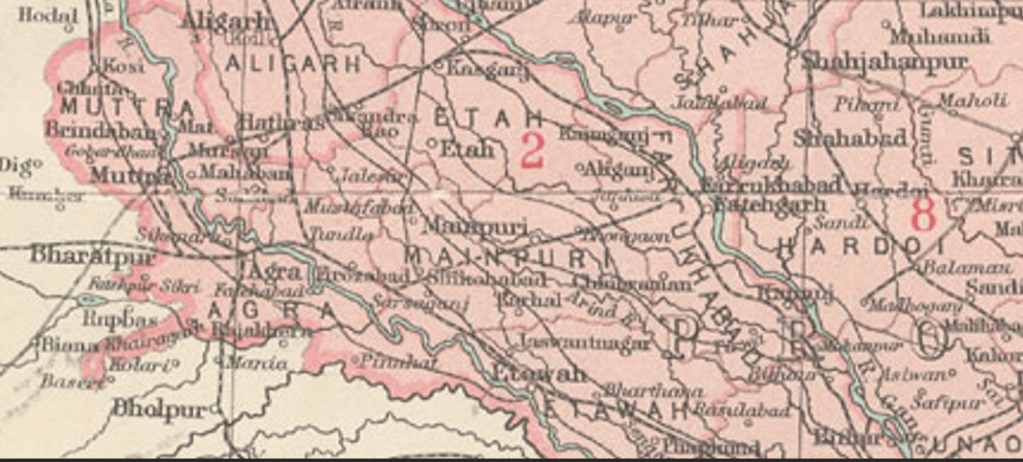
Following Hodson’s advice, four miles from Mainpuri, Seaton turned into a side road which went straight to the fort, leaving the main road a mile to the left.
“Taking this road, I should have to cross the Eesun river, which swept past the left of the rebels; but at this season of the year, the stream was not more than ankle deep, with a firm bottom. On approaching Mynpooree, we caught a distant, glimpse of the enemy’s position away to our left; so, getting the Cavalry to make a demonstration, as if we were going to form across and march by the road and to make as much dust as possible, I quietly moved on with the artillery and infantry, our march being concealed by some mounds, a small village and the nature of the ground.”
As they approached the stream, the column came in full view of the rebels who, until now, had been firing at the dust kicked up by the cavalry. As soon as they saw Seaton well on their left, there was a “tremendous hubbub and confusion”, made even louder when the artillery dashed through the stream, opened fire and raked the raja’s front. Within minutes, the gunners had limbered up, crossed the river again a quarter mile lower and got into the rebels’ rear, as the stream, after a sharp turn, now ran at angles to their flank.
“The enemy were so thoroughly cowed by our prompt and determined onset that they fled at once, followed by the whole of the cavalry and artillery. Without paying further attention to them, I marched with the infantry and heavy guns directly to the fort, which we found evacuated. The Rajah’s brave army had not had time to throw themselves into it had they been inclined to do so; we were much nearer to it, and had completely cut them off.”
Mainpuri was his with hardly any effort – and now Seaton was at leisure to capture eight of the Raja’s guns on the field. One happened to be an English 8-inch howitzer, and the rest appeared to be from the Raja’s own foundry in the fort; six in all were still serviceable. The next day, Seaton looked over the Raja’s position, the one he had so hastily abandoned.
“I had reason to congratulate myself on having turned off the high road and taken them in flank. The walls of the gardens they had taken possession of were all loopholed, or, where they were low and of earth, they had cut small embrasures for their long matchlocks. The eight-inch howitzer, with the other guns and every matchlock, was pointed towards a slight turn in the road, by which they expected we should advance. Of course, had we done so, their preparations for our reception were so effective that our loss would have been considerable, whereas by disappointing their expectations as to the direction we intended to take, we had only two men slightly wounded.”
With the convoy safe, all Seaton had to do now was open up communications with Sir Colin Campbell, who was supposedly at Goorsahaiganj, marching for Fatehgarh. The only man for the task was Hodson.
Sources:
Behan, T. L., ed. Bulletins and Other State Intelligence for the Year 1858. Part 2. London: Harrison and Sons, 1859.
Hodson, W. S. R. Twelve Years of a Soldier’s Life in India: Being Extracts from the Letters of the Late Major W. S. R. Hodson. Edited by George H. Hodson. London: John W. Parker and Son, 1859.
Malleson, G. B. History of the Indian Mutiny, 1857–1858: Commencing from the Close of the Second Volume of Sir John Kaye’s History of the Sepoy War. Vol. 2. London: William H. Allen and Co., 1879.
Neave, E. R. Mainpuri: A Gazetteer. Vol. X of the District Gazetteers of the United Provinces of Agra and Oudh. Allahabad: Government Press, 1910.
Seaton, Thomas. From Cadet to Colonel: The Record of a Life of Active Service. 2 vols. London: Hurst and Blackett, 1866.
Tavender, I. T., comp. Casualty Roll for the Indian Mutiny 1857-59. Suffolk: J.B. Hayward & Son, 1983.
Trotter, Lionel J. A Leader of Light Horse: Life of Hodson of Hodson’s Horse. Edinburgh: William Blackwood and Sons, 1901.
Vibart, Edward. The Sepoy Mutiny as Seen by a Subaltern: From Delhi to Lucknow. London: Smith, Elder and Co., 1898.
Links:
https://oldshirburnian.org.uk/the-indian-rebellion-1857-1859/
The dead of Gangiri have not been forgotten, however, their commemoration is hardly what they would have expected.
https://timesofindia.indiatimes.com/city/agra/at-aligarh-village-shrine-to-british-soldiers-killed-in-1857/articleshow/48415086.cms
 Mutiny Reflections