Action at Pattiali
Artillery. —two 18-pounder guns. one 8-pounder howitzer, six 9-pounder H. A. guns, two 6-pounder H. A. guns.
Cavalry.—1st Troop 6th Carabineers. Detachment 9th Lancers. Hodson’s Horse.
Infantry.—1st Bengal Fusiliers. 100 3rd Europeans. 7th Punjaub Infantry. 2 Cos. Sappers
Hodson preceded the force with 100 men and 2 engineering officers, while the advance guard consisted of 50 Hodson’s Horse, 30 Carabineers, 100 infantry and 2 guns who followed Hodson at no great distance, in case he needed support.
About halfway, Hodson’s party fell in with the rebels’ videttes, who retreated rapidly on their approach. As Hodson recalls, they “had the boldness to await our arrival in great force.” He continued his advance, coming next upon their main body of cavalry, who quickly fired on Hodson and his men. Hodson formed up the 100 infantry and went on steadily, expecting any moment to be charged. Instead, the cavalry retired to a thick belt of trees when, quite unexpectedly, seven guns opened up on Hodson. Halting the men and sending for the advance guard, the officers quickly rode forward to reconnoitre the position. They found the rebels strongly posted across the road with eleven guns, who lost no time in opening fire.
After passing through Sahawar, some two miles down the road, Seaton heard a few shots. Within minutes, he received Hodson’s message – the rebels at the outpost had fired on him. Seaton brought his force through the village, then halted to allow for the heavy guns to come up. As the men were served out bread and grog, he ordered the battery elephants be exchanged for bullocks.
Twenty minutes later, Hodson himself returned. The entrance to Pattiali was barred; the right and centre rested on large ravines, on the right face and front, they had half entrenched themselves, the left centre and left were covered by gardens and enclosures and on the extreme left, stood their cavalry. Hodson surmised correctly that they were expecting Seaton to advance on through the front centre of their position, from which, at half a mile, was a small village. Accordingly, they were waiting.
The heavy guns, in the meantime, “came trotting merrily along, ” under Lieutenant Gillespie – eighteen pairs of bullocks to each gun with a man for each pair and Seaton, upon hearing Hodson’s report, made his plans.
“But as I had no idea of adapting my attack to suit their plans, or of risking even a single soldier’s life more than was absolutely necessary. I moved off the road considerably, to come down on their unprotected left, and to have open ground before me, instead of ravines and fieldworks.”
He formed up the infantry to line columns at “deploying distance” with artillery on both flanks and then moved to the spot where Hodson had left some men to watch the rebels. As the ground rose a little in his front and then descended from the village to the enemy’s position for some time, Seaton remained out of their sights. As soon as the columns were moving, Seaton rode to the front and, taking a good look at his enemy, he massed his cavalry on the right -Hodson’s Horse, the Carabineers and Lancers with some light guns -in the centre, he placed the Europeans, and on the left the native infantry and the heavy guns. His plan was simply to turn their left flank. A few men were sent into a little village on his left, as soon as they approached, Seaton sent forward the artillery to engage the rebels. Four guns were straight to the front, and four made a detour to the right. Driving the rebel cavalry back, they then wheeled up and took their guns in the flank.
“The moment our artillery galloped to the front, the rebels showed their strength and opened fire on us from twelve guns. For some time, there was a sharp cannonade on both sides, then the fire of the rebel guns began to slacken|, while our artillery gained ground at every shot. As the infantry, formed into line, showed clear of the village and were descending the slight decline toward the enemy’s position, the sun shining full on, their ranks made the bayonets glitter, and the rapidly advancing line looked so formidable that, several of their guns being disabled, the rebels lost courage, slackened fire, and hesitated. Our artillery, seeing this hesitation, limbered up to advance to closer quarters, and, in the excitement of the moment, commander, staff, artillery, and cavalry all rushed at the guns with a loud cheer. The enemy broke and fled, and in a moment there, guns were fairly captured.”
On seeing the rebels waver, Hodson gave the order to charge, “and on we went, slap into their camp, our horse artillery limbering up and leaping into their saddles, leading the way. They turned and ran, and we galloping through their encampment, came upon a fortified village; nothing could stop us; through it we went, and on emerging from it, found the whole plain in front of us covered with them, cavalry, artillery, and all, running away. We pursued them for eight miles.”
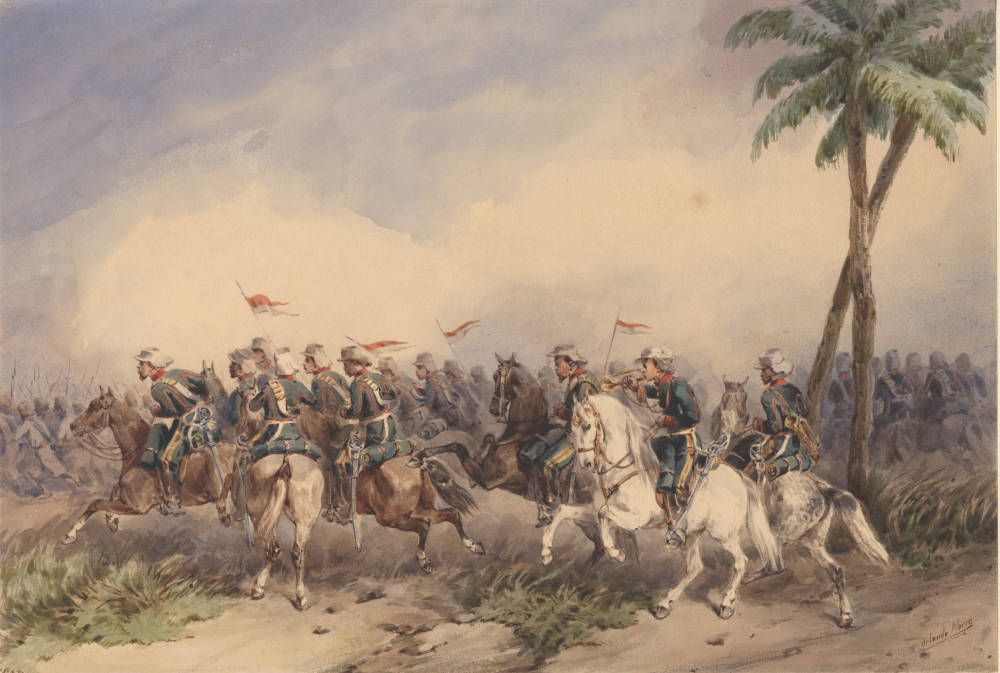
The infantry came up in the rear turning everyone who was left out of the village, bayonetting and shooting as they went – many of the rebels were driven into the deep pools that formed along the old river bed and drowned. The slaughter the cavalry and artillery wrought was devasting, leaving upwards of 500 dead in their wake.
With Pattiali cleared, Seaton drew up his camp on the other side of the town not far from where the cavalry had fallen on the rebels. Just as the tents were being pitched a small party returned sent by Hodson to bring Seaton the spoils of war – the elephant with its silver howdah still on its back and the sword of the Hakim of Farrukhabad. Hodson had killed him with his own hand, who after an obstinate defence, had tried to flee the field. Malleson grimly points out, “In the choice of an open position in front of one very defensible, he had clearly demonstrated that the qualities which go to form an efficient commander-in-chief are not hereditary.”
Seaton’s force captured 13 guns, the Hakim’s baggage, the baggage of his entire force, and all their ammunition and stores. As for losses, Seaton had one man killed and five wounded.
“Nothing of any particular value was found in the Hukeem’s baggage, but amongst the papers it contained, there was one of considerable, importance, namely, a very handsomely illuminated letter from the Nawab of Furruckabad to the King of Delhi, stating that his ancestors had been in possession of fifty-two pergunnahs (counties), and praying that, when his majesty should have driven the English out of India, he would be pleased to restore to him his ancestral possessions. A copy of this document was taken by the civil authorities and was produced at the trial of the Nuwab. The original, framed and glazed, is hanging in my house.”
For the next three days, Seaton remained at Pattiali to give the civil authorities time to reorganise their establishments and, once again, “settle” the country. He also wanted to see what the effect of his action had on some large body of rebels, safely on the other side of the Ganges. One of these, obviously less impressed than the others, decided to recross the river and make for a place called Kaderganj, thirteen miles distant. Seaton immediately struck camp and moved to the other side of the town, where he had left the captured guns, and sent a party of Hodson’s Horse out to reconnoitre.
They returned towards evening, the officer reporting the rebels had indeed crossed the Ganges the night before, but on hearing from the terrified villagers they passed that Seaton had killed the Hakim at Pattiali and razed Gangiri, “they were in such a state of alarm, that on the appearance in the distance of the reconnoitring party had fled precipitately. The officer went over the ground on which they had been encamped and found their food still cooking on the fire, their pots and pans and all their baggage standing apart.” Fear was a severe master.
By all appearances, the district up to this point at least had been cleared of rebels. Seaton now felt confident he could move his convoy out of Aligarh. He returned to Khasganj to cross over the river at the suspension bridge, as, for miles around, not a single ferry was to be had. From Khasganj, he sent the captured guns to Aligarh under the escort of Major Eld and his detachment of 3rd Europeans, and he was now determined to make for Etah on the Grand Trunk Road in one march to establish if it was safe enough for the convoy to follow him. That was the plan, at any rate.
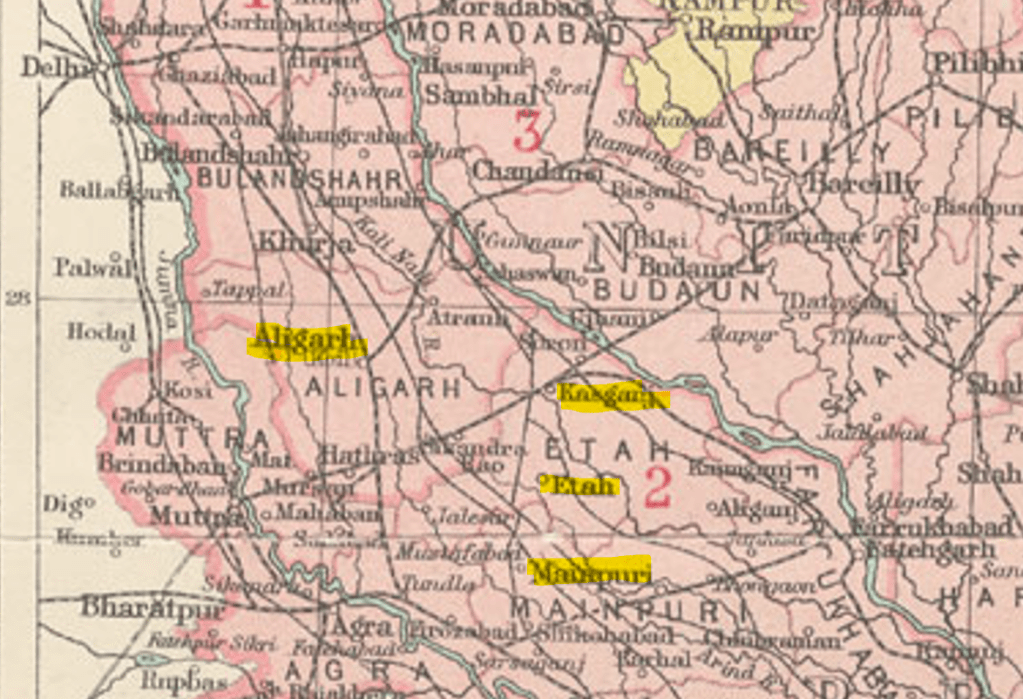
On the 21st, he marched back to Sahawar and on the next day to Khasganj. When they were within a few miles of the place, the “able and energetic” civil officer, Mr Arthur Cocks rode up. The “notorious traitor” named Jowahir Khan – a pensioned risaldar – and his two sons, all of whom had fought against Seaton at Pattiali, had returned to Khasganj. Only one son was with him, and he was wounded. It was an opportunity, Cocks felt, that should not be missed. Calling up Hodson, Seaton sent him off with a troop of his horse to apprehend him. Hodson was off in a flash.
As the column neared Khasganj, Hodson came out to meet them.
“His salutation was, “I’ve got him, Colonel; we rode in at a gallop and surrounded his house, burst open the door, found the son and killed him; and the traitor himself, trying to escape, jumped over a wall into the arms of one of my men.”
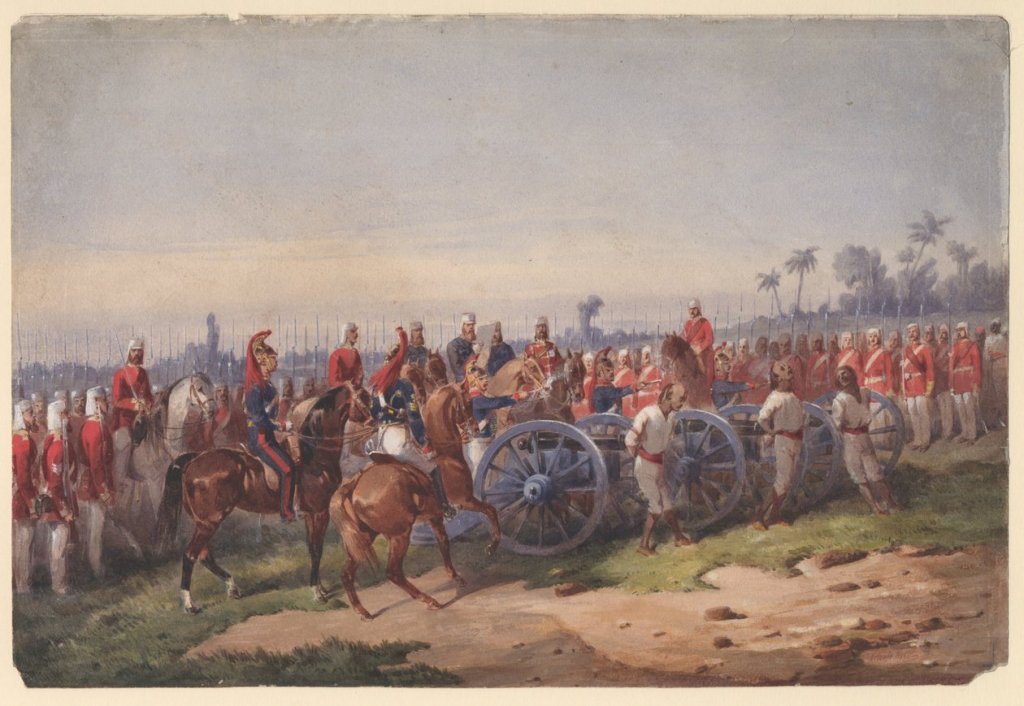
Jowahir Khan was, in the eyes of Seaton and the others, no ordinary traitor. He had for 40 long years served the EICo’s army, and had retired on a full pension allocated to a risaldar, to which was added, most generously, the emoluments from his Order of British India of which he was a recipient. That he had turned on them was one thing, but to have openly fought against his former paymasters at Pattiali was unforgivable. Seaton, however, did not give him up to the ministrations of Mr Cocks. Instead, Khan stood in front of a military commission. He was condemned to die the same evening, and his punishment was to be blown from a gun,
“…in the presence of all the troops, who were paraded for the purpose; and certainly no more awful looking spectacle than this mode of execution can well be imagined – though death itself must be practically painless – or one more calculated to impress awe in the eyes of the beholder. It was the first, and I am glad to think the last, execution of the kind I have ever witnessed.” (Vibart) Even Seaton admitted this was an “awful looking death”, but it was intended to make an impression and serve as a warning.
Watercolour by Orlando Norie
Action at Patialli
3rd Troop, 3rd Brigade Horse Artillery
Farrier John Boyd – wounded
1st European Bengal Fusiliers
1 private severely wounded
1 private slightly wounded
Hodson’s Horse
Killed in action—1 duffadar.
Slightly wounded—1 sowar.
 Mutiny Reflections