“Within the last month, under Colonel T. Seaton’s command, we have fought three actions, and captured twenty-five guns, and marched I can’t say how many miles. I can only say that on one day—that before yesterday—I rode ninety-four miles between ‘ morn and dewy eve,’ to carry a despatch to the Commander -in-Chief, and bring back his orders to Seaton….”
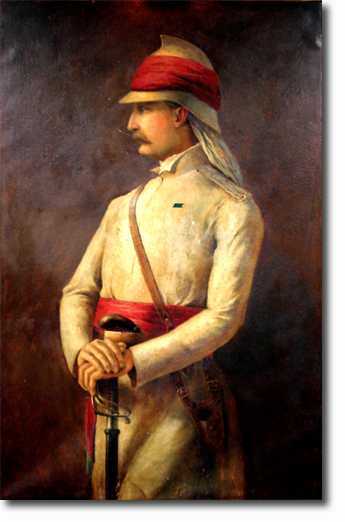
Seaton had received news from that energetic young civilian, Arthur Cocks, that Sir Colin Campbell was camped at Goorsahaiganj on the Grand Trunk Road, marching for Fatehgarh. Someone now had to open up communication with the Commander-in-Chief. Seaton called for volunteers, but he knew in his heart there was only one man who would be daring enough for the task. Hodson, that most irregular captain of irregular horse, volunteered. Seaton prepared the despatches and duly sent him off on the 30th of December with his second in command Lieutenant McDowell and an escort of 75 men chosen by Hodson from his own regiment. They would have to cover the distance through disturbed countryside, with as much speed as possible and no change of horse, relying on nothing more than a good portion of luck. Hodson himself hardly wrote a word about the ride, but fortunately, young McDowell had plenty to say. We will, however, spare a moment on the life of this intrepid lieutenant. He has appeared in the narrative of Hodson’s life in the mutiny on the periphery but now, he can take a more prominent place.
Lieutenant Charles Theophilus Metcalfe McDowell was a young man, just 28 years old. The 2nd son of the late James McDowell, Esq., of Bengal Medical Service, he was born on 29th October 1829, and appointed to Honourable East India Company’s Service, in 1846. Served in the Punjab campaign of 1848-9, including the passage of Chenab at Ramnuggur, and battles of Chillianwallah and Goojerat, in which he carried the Colours of his regiment, the 2nd Bengal European Fusiliers (medal and clasp). Served in Burma, marched with his regiment to Delhi, and served with it in various engagements until in August he was appointed second in command of Hodson’s Horse. Described by Hodson as “game to the backbone, invaluable as a brilliant soldier, a true friend and thorough gentleman,” he was one of the few officers to witness, first-hand, the killing of the princes at Delhi. This narrative would be one of the last exploits of his all-too-short life for in less than a month, Lieutenant McDowell would be dead.
Since the tale is best told in his own words, it is transcribed here. McDowell described it in a letter to Hodson’s wife and passages in italics have been entered to clarify a few points in the text.
Between morn and dewy eve
You know we took Mynpooree on the 27th. We halted that day and the two following. On the night of the 29th, Hodson came into my tent, about nine o’clock, and told me a report had come in that the Commander-in-Chief had arrived with his forces at Goorsahaigunge, about thirty-eight miles from Mynpooree and that he had volunteered to ride over to him with despatches, asking me at the same time if I would accompany him. Of course, I consented at once and was very much gratified by his selecting me as his companion.
At 6 a.m. the next morning, we started; with seventy-five sowars of our own regiment. I do not wish to enhance the danger of the undertaking, but shall merely tell you that since Brigadier Grant’s column moved down this road towards Lucknow, it had been closed against all Europeans; that we were not certain if the Commander-in-Chief’s camp was at Goorsahaigunge (which uncertainty was verified, as you will see); and that, to say the least of it, there was a chance of our falling in with roving bands of the enemy.
We reached Bewar all safe, fourteen miles from our camp. Here we halted, and ate sandwiches, and then leaving fifty men to stay till our return, pushed on to Chibberamow, fourteen miles farther on. Here we made another halt, and then, leaving the remaining twenty-five men behind, we pushed on by ourselves, unaccompanied, for Goorsahaigunge, where we hoped to find the Commander-in-Chief.
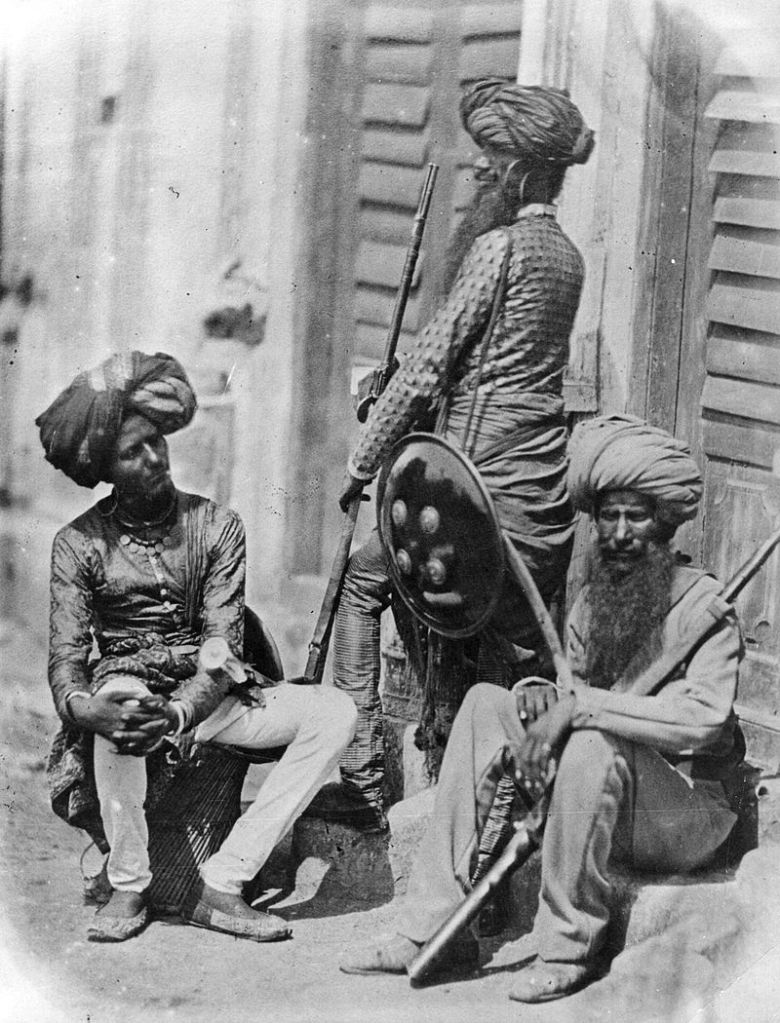
Hodson and McDowell were unaware of the danger they had narrowly evaded:
A sowar rode in to Seaton’s camp to say that Captain Hodson and Lieutenant McDowell had left part of their escort at Bewar and another at Chbberamow. As soon as they left, a body of rebel cavalry had entered the town, surprised the escort and cut them up. Since then, no one had heard from either Hodson or McDowell. Although still convinced these were two of the most “wide awake” men in the army, Seaton was feeling decidedly uneasy. He sent off 100 sowars under an officer, and an hour before daybreak was himself in the saddle. Seaton wrote – “At first this seemed most alarming, yet I had the ‘ greatest faith in his consummate prudence and kill.”
We return now to McDowell.
On arriving there (a fourteen-mile stage), we found the Commander-in-Chief was at Mermuka-Serai, fifteen miles further on. This was very annoying: but there was no help for it, so we struck out for it as fast as we could, the more so as we heard that the enemy, 700 strong, with four guns, was within two miles of us.
We arrived at Mermuka-Serai at 4 a.m. and found the camp there all right. We were received most
cordially by all, and not a little surprised were they to hear where we had come from. Hodson was
most warmly received by Sir Colin Campbell, and was closeted with him till dinner time.
One of the first to see Hodson that day was Lieutenant Hugh Gough who was leading a detachment of Hodson’s Horse: “…when he reached the chief’s camp he was so cool and calm as if he had only ridden from one brigade to another. This cool insouciance was one of Hodson’s characteristics; where in the heat of action or sitting mess; he always seemed the same – nothing appeared to put him out.”
McDowell, in the meantime, enjoyed the sights of the camp:
Meanwhile, I sought out some old friends and amused myself with looking at the novel sight of English sailors employed with heavy guns. I also went to see the Highlanders, and magnificent fellows they are, with their bonnets and kilts, looking as if they could eat up all the Pandies in India. A summons to the Commander-in-Chief’s table called me away, and off I went to dinner when I found Hodson seated by Sir Colin and carrying on a most animated conversation with him. We had a very pleasant dinner, and at 8 p.m. started on our long ride (fifty-four miles) back.
While in camp, McDowell neglects to mention that Sir Colin showed Hodson around the camp, much to the delight of the 93rd Highlanders who had never seen Hodson before but had heard of his exploits:
“During the afternoon a man of my company rushed into the tent, calling, ‘Come, boys, and see Hodson! He and Sir Colin are in front of the camp; Sir Colin is showing him round, and the smile on the old chief’s face shows how he appreciates his companion.’ I hastened to the front of the camp, and was rewarded with a good look at Hodson; and, as the man who had called us had said, I could see that he had made a favourable impression on Sir Colin.” We now resume McDowell’s narrative:
We arrived at Goorsahaigunge all safe and pushed on at once for the next stage. Chiberamow. When we had got halfway, we were stopped by a native, who had been waiting in expectation of our return. God bless him! I say, and I am sure you will say so too when you have read all. He told us that a party of the enemy had attacked our twenty-five sowars at Chibberamow, cut up some, and beaten back the rest, and that there was a great probability some of them (the enemy) were lurking about the road to our front.
This was pleasant news, was it not? – twenty miles from the Commander-in-Chief’s camp thirty from
our own; time, midnight; scene, an open road; dramatis persona, two officers armed with swords
and revolvers, and a howling enemy supposed to be close at hand. We deliberated what we should do, and Hodson decided we should ride on at all risks.
“At the worst,” he said, “we can gallop back; but we’ll try and push through.”
The native came with us, and we started. I have seen a few adventures in my time, but must confess this was the most trying one I had ever engaged in. It was a piercingly cold night, with a bright moon and a
wintry sky, and a cold wind every now and then sweeping by and chilling us to the very marrow. Taking our horses off the hard road on to the side where it was soft so that the noise of their footfalls
could be less distinctly heard, we silently went on our way, anxiously listening for every sound that
fell upon our ears, and straining our sight to see if, behind the dark trees dotted along the road, we
could discern the forms of the enemy waiting in ambush to seize us. It was indeed an anxious time.
We proceeded till close to Chibberamow.
They are there,” said our guide in a whisper, pointing to a garden in a clump of trees to our right front. Distinctly we heard a faint hum in the distance — whether it was the enemy, or whether our imagination conjured up the sound, I know not. We slowly and silently passed through the village, in
the main street of which we saw the dead body of one of our men lying stark and stiff and ghastly in
the moonlight and on emerging from the other side, dismissed our faithful guide, with directions to come to our camp—and then putting spurs to our horses, we galloped for the dear life to Bewar,
breathing more freely as every stride bore us away from the danger now happily past. We reached
Bewar at about two o’clock a.m., and found a party of our men sent out to look for us. Our troopers
had ridden in to say they had been attacked and driven back, and that we had gone on alone, and all concluded we must fall into the hands of the enemy.
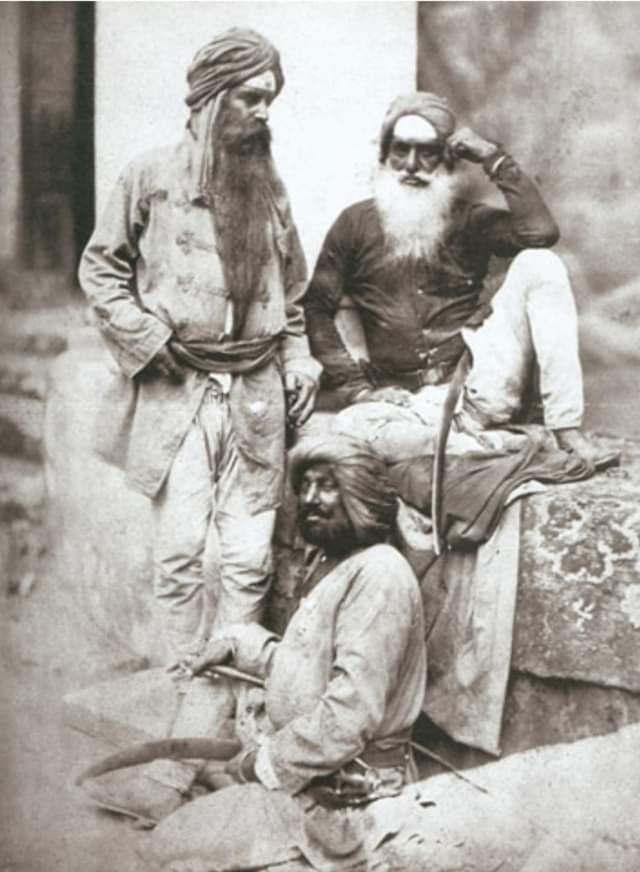
For Seaton the worrying finally had an end – At daybreak, shortly after he had decided he would lead a search for the missing officers, a sowar rode up with a note from Hodson to say they were safe at Bewar. All this time, Seaton who had not slept all night, had been fretting and thinking, “ Oh! dear, what should I say to his poor wife.”
McDowell now concludes his narrative:
We flung ourselves down on charpoys and slept till daylight when our column marched in, and we received the hearty congratulations of all on our escape. What do you think of it? The man whose information gave us such timely warning, and thereby prevented our galloping on, by which we should certainly have excited the attention of the enemy, has been very handsomely rewarded and obtained employment.
Walpole’s actions at Etawah had grievous consequences for the men Hodson had left behind on the road. However neither Hodson nor McDowell were aware at the time that Walpole had marched; if he had, his whole ride might have played out differently.
Now we conclude McDowell’s narrative:
It appears from the reports afterwards received, that the party that cut up our men were fugitives from Etawah, where a column of ours, under General Walpole, had arrived. They consisted of about 1500 men, with seven guns, and were proceeding to Futtypore. We rode in at one end of Chibberamow in the morning—they rode in at the other. They saw us, but we did not see them, as we were on unfavourable ground. Thinking we were the advanced guard of our column, they retired hastily to a village some two koss off. Meanwhile, Hodson and I, unconscious of their vicinity, rode on. They sent out scouts and ascertained only twenty-five of our sowars were in the village, upon which they resumed their march, sending a party to cut up our men, and I suppose, to wait for our return. All Hodson said when we were at Bewar, and safe, was “By George! Mac, I’d give a good deal for a cup of tea,” and immediately went to sleep. He is the coolest hand I have ever yet met. We rode ninety-four miles. Hodson rode seventy-two on one horse, the little dun, and I rode Alma seventy-two miles also.”
If a soldier,
Choose brave employments with a naked sword,
Throughout the world.
– George Herbert
Thus we conclude 1857 – it is the 31st of December. The next year is about to begin and the war, so long in the making, shall take a new turn.
Sources:
Hodson, W. S. R. Twelve Years of a Soldier’s Life in India, Being Extracts from the Letters of the Late Major W.S.R. Hodson. Edited by George H. Hodson. N.p., 1859.
Trotter, L. J. A Leader of Light Horse: Hodson of Hodson’s Horse. N.p., 1901.
 Mutiny Reflections
Good post on Hudson horse 🐴 I didn’t know the story before your blog well shared 💐
LikeLiked by 1 person
Thank you, I am so happy you enjoyed reading it! Hodson’s Horse still exists today, albeit in a very different form, as part of the Indian Army’s Armoured Corps. They also served in both world wars. Hodson was one of the first true intelligence gatherers before it was really a thing. He was also a gifted linguist who spoke not just the language of every province he served in, but picked up the dialects and local idioms. Apparently, he spoke accent-free, which was quite an achievement. Kipling is said to have based his character, Strickland, on Hodson. The first buildings at the Lawrence School in Sanawar were designed by Hodson and built under his supervision, it was on his advice, that Sir Henry Lawrence approved the site! There was much more to the man that is forgotten today.
LikeLiked by 1 person
🙏
LikeLiked by 1 person