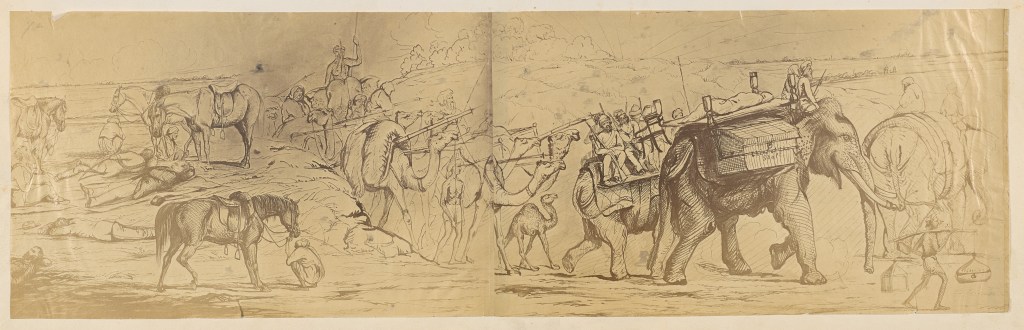
By the middle of June, the huts that Rowcroft had ordered built were finally completed and on 13 June, the Naval Brigade “shifted billet”, a welcome change from tents. Williams marvelled at how light and airy the quarters were, with good straw thatched roofs, thick enough to keep out not only the sun but the rain. Punkhas were quickly rigged up and soon punkha wallahs could be seen outside the walls, pulling the ropes.
The monsoon too had set in and the “occasional thunderstorm was quite a variety, not an agreeable one to those who had the misfortune to be in tents and were obliged to paddle in water…” And yet with the change in season, the temperatures now dropped and Rowcroft was relieved that his hospital was slowly but surely emptying out.
Camp routine, however, went on with its usual dullness. As the season was no longer amiable for drill, this was now relaxed the Naval Brigade suddenly found themselves with nothing to do. They wiled the hours away with “reading or sleeping…” Captain Sotheby, anxious for his men to have at least some occupation in their free hours, sent out for books to organise a reading room, and when the rain abated, he organised athletics – “jumping, racing, throwing shot for prizes, hurdle-racing, leaping and hopping.” Variations included an ekka race, a pony race or a dhoolie race in which the sailors, much to the amusement of the dhoolie bearers, attempted to heft the palanquins off the ground and run with them. At one point, even the mahouts encouraged their elephants to hold a race. However, the jocularity of the races paled in comparison the antics of three men of the Pearl, who “dressed up in the costume of ladies of the last century, riding on donkeys with their feet touching the ground; and sometimes the grand finale would be a scamper, with loud shouts and vociferous cheering, after an unfortunate pig with his tail shaved.” Some men of a more theatrical bend, organised plays for an evening’s entertainment. But the war was continuing on the margins and there would be “an occasional alarm in the night to keep up the excitement.” If having rebels skulking about was not enough, even the local wildlife joined in on night raids.
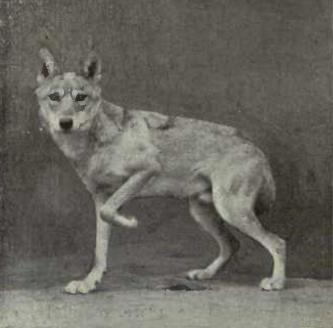
“At this time tawny wolves from the adjacent jungles paid periodical visits to the camp, and one fine night, when some of the camp followers were up later than usual, cooking their supper, some of these hungry visitors considered they had a better right to the meal than the cooks, and coming unpleasantly close, the strangers scared the servants, who ran screaming, and causing such an alarm throughout the camp, that the sentries turned out the guard, and in less than ten minutes the brigade was under arms, and the guns were manned ready for action.”
Although the rains were now in full force, it did not stop the rebels, nor the actions of the Sarun Field Force and on 18 June, the next fight was at hand.
Harriah – 18 June
The Nazim was proving, if nothing else, a very persistent foe. His dismissal from Amorha had done nothing to soothe his warring breast. On 13 June, Wingfield once again asked Rowcroft to send a detachment to Captainganj to protect the work ongoing to rebuild and fortify the tehsil, a task assigned to Lieutenant Garnault of the Engineers. Although Rowcroft had sent already left men in Captainganj for the purpose of defending the place, the Nazim, on his retreat from Amorha, had taken up his abode at nearby Sirsaie, where on the 14 June, it was reported he had set up camp. The next day, Wingfield’s spies reported that to make things more interesting, he had commenced building huts and throwing earthworks, looking for every intention, as if he intended to stay put until after the rains. That very night, Rowcroft ordered a strong detachment under Colonel Byng (6th Madras Cavalry) to proceed to Captainganj. Byng was under no circumstances to “harass the European troops” by sending them out on lengthy pursuits and “if the Nazim moved forward, leaving the river and bridge in his rear, then to advance and attack him, when there would be little doubt of the result; and should any difficulty arise, or the Nazim get reinforced from Belwa, I would be ready immediately to join him with the Head Quarters of the Field Force.”
On 16 June, the Nazim was still at Sirsaie and have begun collecting revenue from the villagers who now complained loudly to Mr Wingfield. Rowcroft sent orders to Byng to attack the Nizam without any further delay and drive the man out of Sirsaie. To help matters, he sent him a reinforcement of another troop of the BYC, 50 seamen and 20 marines of the Naval Brigade, and a 24-pounder rocket tube, all under the command of Captain Sotheby. The expediate their march, he sent the men out on the baggage elephants and in ekkas to ensure they were fresh for work when they arrived. However, things did not quite work out that way.
The party reached the vicinity of Captainganj some three hours after leaving Basti. The night had proved to tremendously hot, very dark and ominously still and around midnight, Mother Nature decided to throw them a party.
“The hot winds had lulled themselves to rest with the sun, the country still panted with glowing heat, and the sky, though cloudless, was dimmed by a brassy film that obscured the stars. Suddenly from the far-off distance a dull rumbling sound resembling thunder was heard, followed by vivid flashes of lightning on the horizon. Presently we were unexpectedly kissed with cool puffs of wind, which instantly turned into strong gusts, and developed a howling hurricane. Soon flashes of lightning followed each other with amazing rapidity, and peals of thunder absolutely deafening, rolled onwards, louder, louder still as they approached, and yet louder than the roar of all our artillery fired off simultaneously. Then there seemed a momentary lull in the furious rush of the hurricane as if to allow the forlorn creatures below to prepare for what was coming while from the electrical discharge above descended a terrific crash, accompanied with oceans of rain seldom seen out of India, and which drenched us in a moment.”
There was no point in moving onwards – Sotheby ordered the men to find shelter as best as they could of which, he soon found there was none. The men stood about in miserable groups, drenched to the bone as the ground around them turned into a vast sheet of water. As soon as the rains subsided enough, a dram of rum was issued to all the men and the march proceeded, now with squelching slowness to Captainganj which they reached by noon. A camp was set up under some overly large peepul trees which would provide at least some relief from the now blazing sun. As it was, Byng had attacked no one. The storm had turned the roads into a quagmire of sticky unrelenting mud and he could not have moved his guns even if had wanted to. So the Nazim would not receive Byng’s attentions until the world had dried out a little. On 18 June with no rain having fallen in the past day, Byng was ready to proceed.
The Field Detachment
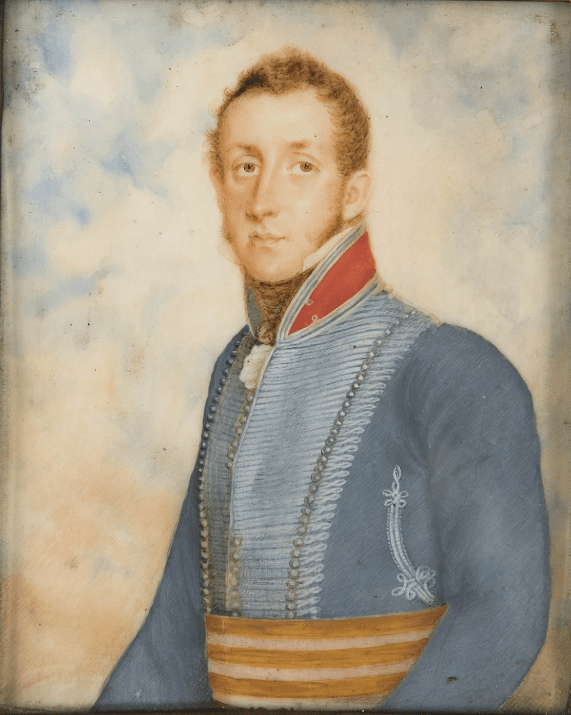
https://www.indarpasricha.co.uk/collection/pages/P101_John_Byng.html
Lt-Col J Byng, Commanding
Lt Fairlie, Staff Officer
Lt Rowley, Orderly Officer
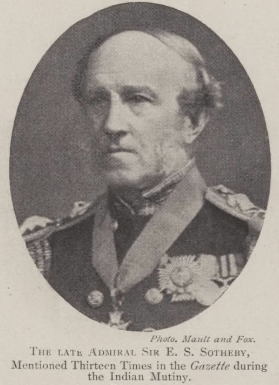
Pearl’s Naval Brigade under Captain Sotheby RN
5 officers incl. Lt Turnour RN, Mr Mate Inglis RN
105 seamen & marines
Two 12-pounder howitzers
One 24-pounder rocket
Bengal Artillery under Lieutenant Welsh
1 officer
17 European rank & file
7 gun Lascars
19 bullock drivers
2 guns
HM 13th Light Infantry under Captain Frederick van Straubenzee
6 officers incl. Lt Everett, Lt Wroughton, Lt Rowley
160 rank & file
Dr Gee
Sikh Detachment under Lieutenant Maddock, 3rd Bengal European Regt
2 native officers
81 rank & file
Bengal Yeomanry Cavalry under Captain Chapman
7 officers
140 rank & file
1 surgeon Dr Garden
1 veterinary surgeon
6th Madras Light Cavalry under Captain Mulcaster
4 European officers incl Lt Fairlie
3 native officers
2 European warrant & non-commissioned officers
84 rank & file
6 trumpeters & farriers
Lt Garnault, Bengal Engineers
Mr Wilson, Deputy Magistrate Bengal Civil Service
As for the Nazim, he was well aware that Rowcroft had moved out a considerable force but since none of them had appeared in his vicinity on the 17th, he continued his building works. Around his flag were now 5000 men of whom at least 900 were well-trained sepoys from mutinied regiments, and he had 5 guns to bring into play. He had also requestioned the village of Harriah for his purposes. On the 18th, however, he was more than ready to meet them in the field.
On the night of the 17th, Byng had sent out an advanced party of cavalry under the whole command of Captain Mulcaster (6th MLC), consisting of a squadron each of the BYC and the 6th Madras Light Cavalry. Their orders were to cross the country “by a circuitous route of 16 miles and cross the river Munowah at a ford about three miles north of Hurriah” which would bring them two miles to the rear of the Nazim’s force. When Byng began his attack at daybreak, they were to rush in and capture not just the guns but the Nazim himself. It was a tall order, but the being the Shaitan-ka-Pultan, the BYC thought this really was not the worst thing they had heard as yet.
They cavalry took up their position within a tope of trees which sat between the rods from Harriah to Gonda and Amorha, with the idea that if anyone was going to retreat, they would have to do it in by any of these roads. As it was, they saw the rebels had themselves thought this was a good idea, for the Nazim had liberally placed his men not only in the villages and groves along the roads. They were very aware of the cavalry in their midst and before day break, opened fire, “long and continuous” on the one tope of trees they themselves had failed to occupy.
“Captain Mulcaster with his squadron of the 6th Madras Cavalry, continued to watch the enemy’s movements to the north-east, but neither Nazim, guns, or elephants retreated in his direction. Some of the enemy’s cavalry, who had taken up a position in front of a village covered by a large body of infantry, were shot by the carabiniers of the Madras Cavalry, whom Captain Mulcaster had thrown out in skirmishing order.”
Mulcaster now tried to send a message to Byng but quickly realised he was well and truly surrounded, with fire now rolling in from all sides; Captain Chapman seeing this situation would eventually be the death of them, after discussing with Mulcaster, withdrew the BYC through the tope of trees and took “a wide sweep to the south-west and up the road from Amorha to Harriah” but he soon found the Nazim’s baggage and his three elephants were blocking his way, as they were now safely ensconce in a grove of trees, around which a thick ring of infantry stood guard. “During Captain Chapman’s advance, his men and horses were under a heavy and continued fire, from men in charge of the baggage, who, from behind walls and trees kept up a steady fire, from which the squadron escaped with one man and four horses wounded.” Chapman swiftly returned to Mulcaster and they now had to wait for Byng.
Colonel Byng left the Captainganj at three in the morning and proceeded towards Harriah, eight miles distant. Half a mile from the village, he was surprised to find himself under fire, when the rebels, who had been hiding in dry ditch on the left side of the road, commenced firing. Byng quickly ordered a portion of HM’s 13th and the Sikhs to advance in skirmishing order and ordered the artillery to open fire.
“The skirmishers under Lieutenant Wroughton, Her Majesty’s 13th Light Infantry, advanced in the most spirited and gallant manner. Captain Sotheby, R.N., and two horsed guns, and the Naval Brigade and Marines, 65 of whom acted as skirmishers, and 50 of the Yeomanry Cavalry followed in support. The enemy retreated across the river, and took refuge in a village...”
Captain Sotheby now galloped up with his guns to join Lieutenant Welsh of the Bengal Artillery, who had taken up a position on the road. Finding the “right in close collision” with the rebels’ left who were vehemently holding a patch of jungle, he opened up a dreadful fire of shot and shell. Byng now sent up Captain Van Straubenzee and company of the HM’s 13th on the road to prevent the rebels from attacking his rear, and he proceeded with the Naval Brigade and their two guns, and 50 men of the BYC towards Harriah. Sotheby now opened fire on the village, causing the rebels to scatter. Byng rode through the village and passed over an unguarded bridge – from here he could see the rebel in their strong positions within the topes of trees, wholly unaware of his presence. “On the right, at a distance of 300 yards, a small mud battery was thrown up, with well-made embrasures, in order to command the bridge, and another in a tope about double the distance off. From the former they were soon cleared out by the howitzers ; and as they were retreating from the latter, where they appeared to be a strong column of 1500 men, their movements were accelerated by the same agency. The naval guns here coming up with the skirmishers and the Bengal Yeomanry Cavalry at the same time…” The guns now took aim at the groves, causing much consternation among the rebels, who now, in “good order” began to retreat, moving rapidly through the numerous topes and villages. Byng tried to effect a pursuit, but with Rowcroft’s directions to spare the Europeans any undue fatigue, he recalled the men to Harriah and ordered a rest.
As for Captain Mulcaster and Captain Chapman, the day ended with little success. Chapman’s ride had caused enough worry for the rebels that as soon as he was gone, they had started moving their baggage and their elephants in an attempt to bring them safely across the river. However, Byng’s assault now caused the force to retreat wholesale and in the ensuing rush, much of the baggage was abandoned. However, as luck would have it, the Nazim used the moment to effect his escape into Oudh, directly under the noses of the waiting cavalry. They had missed the Nazim, but he had the annoyance of knowing the baggage he had left behind was thoroughly plundered.
As the British went over the positions held by the Nazim, they would find had he managed to hold his force together, the resistance could have been even more formidable. For several miles around, topes and villages had been reinforced, rifle pits had been dug and every dry nullah prepared for defence. As it was, he left behind 200 dead – of the wounded, they could get no news, as the rebels had taken them off the field. The only gun captured was a small brass one. They had not used any artillery during the battle, for as Byng found out, they had removed their guns to safe tope, eight miles further away from the action, to facilitate their removal over the river. The only things they left behind, besides their dead, were two boxes of ammunition, some weapons and a few cannonballs. A small quantity of powder, and some cartridges, not enough to make it worth carting along, was blown up in the field.
 Mutiny Reflections