“I beg, in conclusion, to place on record how much I have been indebted to Captain Keatinge, Bombay Artillery, and Assistant to the Agent of the Governor-General for Central India, throughout these operations. This officer joined me at Ragooghur, and proved of the very greatest assistance to me in gaining information as to the enemy’s movements, and also in making me acquainted with all particulars as to the defences of the fort of Chaudairee; so anxious was he to verify his information that, on two occasions, immediately before the assault, he examined the intermediate ground, which is of a very difficult nature, from the breaching battery to the very foot of the breach. The knowledge thus gained led him to volunteer to assist in guiding the storming-party, and I deeply grieve to add that he fell dangerously wounded at the head of the breach, foremost amongst the foremost of the stormers.” (Brigadier Stuart, Commanding 1st Brigade Central India Field Force, to the Assistant Adjutant-General Central India Field Force.
Camp Musjed Ghat, en route to Jhansi, March 21, 1858)
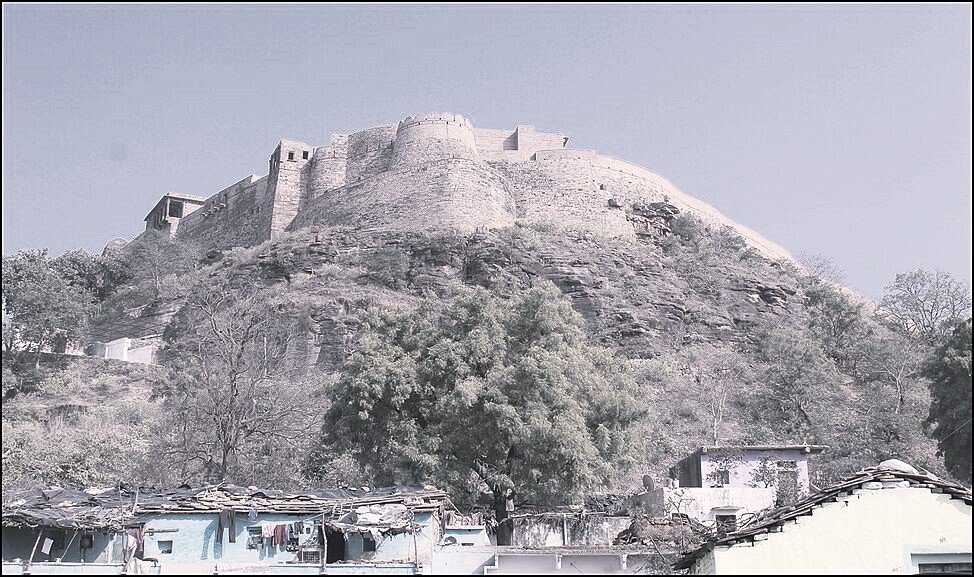
The Gazette citation adds a little more excitement to Keatinge’s deed at Chanderi, on 17 March 1858, by adding a small path and a reluctant servant:
“For having rendered most efficient aid at the assault of Chundairee, in voluntarily leading the Column through the breach, which was protected by a heavy cross fire. He was one of the foremost to enter and was severely wounded in the breach. The Column was saved from a serious loss that would probably have resulted, but for Major Keatinge’s knowledge of the small path leading across the ditch, which had been examined during the night by himself and a servant, who declined, when required, to lead the Column, without his master. Having cleared the breach, he led into the Fort, where he was struck down by another dangerous wound. The Commander-in-Chief in India states that the success at Chundairee was mainly owing to this Officer, whose gallantry, really brilliant, he considers was equalled by his ability and devotion. Major Keatinge was at the time a Political Officer with the 2nd Brigade of the Central India Field Force.” (The London Gazette, 25 February 1862, 22601, p. 956)
The story becomes far more exciting with the next retelling, but misses the servant altogether and adds a guide and an interpreter:
“The troops were assembled in the trenches betimes, and at the first streak of dawn a salvo was fired from all the guns of the besiegers, the band struck up ‘ St. Patrick’s Day,’ the Irishmen were let loose, and there was the devil to pay in the fort. Gosset of the R.E.’s was told off to lead the assaulting column; Jerome of the 86th was his interpreter; these two and the guide started for the breach. Captain Keatinge of the artillery, employed in the Political Department, had been refused permission to lead on account of his civil duties, although he knew the ground thoroughly; but pointing out to the brigadier that there was hesitation, that probably Jerome, though a passed interpreter of Hindustani, did not understand the patois of the village guide, obtained leave to go as far as the foot of the breach. The assault was splendidly carried out. Gosset had two bullets in the turban round his forage cap. Keatinge was cut down on the top of the breach, though the slope was so steep that a man could with difficulty surmount it. Under the excitement of action, the column dashed up it, and killed all the garrison except those who, in their terror, threw themselves over its walls down the precipices.” (Prendergast)
This thrilling account finds itself in the biography of Harry Prendergast, VC. Although he was not at Chanderi, as he was with the 2nd Brigade at the time, he had the opportunity to talk to Major Stuart of the 86th during their stay at Jhansi.
In his version of events, Assistant Surgeon Sylvester joins in with, “Captain Keatinge, barefooted and noiseless, proceeded during the darkness to inspect the breach” on the night before the assault. As the ground around Chanderi is mostly composed of loose stones, rocks, dust, thorny scrub and jungle, Keatinge must have been a brave man to attempt this without shoes. We can only hope he had the sense to replace his footwear before the actual assault. Then things truly ramped up: “Scaling ladders were thrown across the cutting at the base of the breach, which in itself was as difficult to mount as could be well conceived; but in went the gallant party, fighting hand to hand in the breach, and Keatinge fell severely wounded.”
Captain Keatinge was certainly a man for adventures. As Political Agent for Western Malwa, he had seen to the disarming of a detachment of the Gwalior Contingent infantry, had joined the Malwa Field Force, and fought his way with them up to Mandsaur and Goraria, which cost the life of his horse. Following the battle, he remained at Mandsaur, albeit temporarily, in political charge of the city. However, Brigadier Stuart certainly needed a man of Keatinge’s talents in the 1st Brigade, so it is not surprising we find him at Chanderi, barefoot or not.
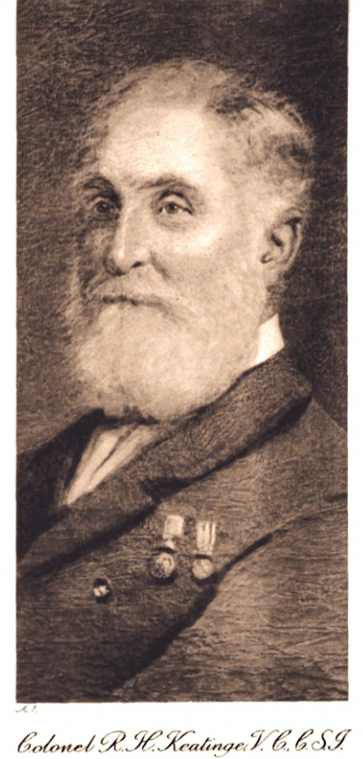
Born on 17 June 1825, he was baptised at St. Andrews, Co. Dublin, Ireland, the son of the Right Hon. Richard Keatinge, Judge of the Prerogative Court (Ireland) and his wife, Harriet Augusta, née Joseph. Keatinge was privately educated. He entered the Bombay Artillery in 1842 and arrived in India a year later. However, it would appear political work was in his interest, and in 1847, he was Assistant Superintendent at Nimar in the Saugor-Narbadda Territories. Promoted to captain in 1857, the same year he took up the post of Political Agent in Western Malwa. With the mutiny squarely at his doorstep, he served as the Political Officer for the Malwa Field Force, where he saw fighting at Dhar and at the taking of Mandsaur. He then joined the Central India Field Force for the Mhow Brigade, once again as Political Officer.
Although injured at Chanderi, he was back up and fighting fit when he commanded a body of irregular troops in the Satpura Hills from 1858 to 1859 in the pursuit of Tantya Tope. Raised to brevet-major in 1858, Keatinge returned to political work in Nimar in 1860 before transferring to the Bombay Staff Corps in 1861. His VC citation was published in 1862 and on 1 January 1863, he was invested with his Victoria Cross in Bombay by Lieutenant General Sir William Mansfield. His was one of the last VCs awarded for the Indian Mutiny.
Keatinge was also a married man — his wife Harriet née Pottinger, whom he married in 1846, was the daughter of Thomas Pottinger, whose son (by his first marriage), Major Eldred Pottinger, would make a name for himself as the “Hero of Herat.” She would bear Keatinge 10 children — two of whom died in infancy — before she died in Assam in 1874. Harriet left a legacy of her own, not as a Keatinge’s wife or the half-sister of a celebrated major, but as an author. She published two books in her lifetime — the first, “English Homes in India,” was published in two parts and anonymously; however, the second, “Honor Blake: The Story of a Plain Woman” also in two volumes, appeared under the name Mrs. R.H. Keatinge and is often falsely attributed to her husband. Both books found success during her lifetime but have fallen into obscurity in ours. The inscription on her tomb at Shillong Cemetery reads thus: “Here lies Harriett Keatinge, who died on 19th November 1874, aged 48 years.”
Richard Harte Keatinge continued his rise through the political department. In 1862, he was Political Agent at Gwalior until 1863, from whence he took over as Political Agent to Kathiawar, a position he kept until 1867. Here, he was back in the saddle, chasing Wagheer rebels through the district with a field detachment, for which he was commended in General Orders in 1866.
However, he had other pursuits while in Kathiawar, and that was education: not of the rural population, but of the nobility. It was not the first time the government had shown itself so inclined – a Court of Wards Institute was set up in Calcutta in 1856, but as it proved, “not a single Minor under the Court of Wards turned out really well.” Although many chiefs had received an excellent education from private tutors, much of the nobility itself was uneducated. The idea, hence, was to offer education to the minor sons of native rulers, a wholesome education under the tutelage of Indian tutors, but these complained the wards came to them at “an advanced age of ignorance, that they were arrogant and lazy, and imbued with a purse-proud contempt for knowledge.” Besides this, they frequently went home on duties that did not involve studies, and since many were betrothed at an early age, this form of education was impractical. A similar institution existed in Benares, with a similar rate of success and complaints. So it was left to the political agent of the erstwhile princely state to ensure the young princes became what could be called gentlemen with an English education and an appreciation of English customs. This certainly was the case with the Nawab of Banda, but all the appreciation still did not make him a strong leader.
In 1864, the Bombay Government issued a circular in the Political Department, asking the political officers in the field to give their suggestions regarding the best means of education of young chiefs and nobles to prepare them for public duty. Keatinge was quick to reply. Stating education of the nobility was “defective” all over India, he was particularly concerned with Kathiawar, where he felt, though the “lads” were of considerable promise and quite capable of doing everything boys of their age should, they were “surrounded by evil influences,” making successful education in their own homes, impossible.
“No person acquainted only with our own Province, or with the educated Natives of our Presidency cities, can conceive the degraded atmosphere in which lads are brought up, who are destined to rule over several hundred villages, to enjoy incomes amounting to lacs of rupees, and to possess powers of life and death over their own subjects.” He believed the lads should be divided into two classes – those whose fathers were still alive and those who were wards of the government. With the former, Keatinge stated the government was not in the position to do more than use political influence to induce the fathers to educate their children, but in the latter, there certainly was a need for markedly energetic action. In Kathiawar alone there were several boys for whom Keatinge had procured tutors but their education was proceeding under desolutory conditions, exposed as they were to “opium eaters, slaves and drunkards,” surrounded by relatives desperate to ingratiate themselves with the ruler to be; Keatinge wanted above all to protect the boys from “the danger arising from personal contact with the followers of their houses,” while giving them an education that would prepare them not as mere rulers over vast tracts of land but as social leaders able to bring advancement to their provinces. He recommended an institution exclusively for young nobles, which would be overseen by a European gentleman and “for many reasons, a military officer.”
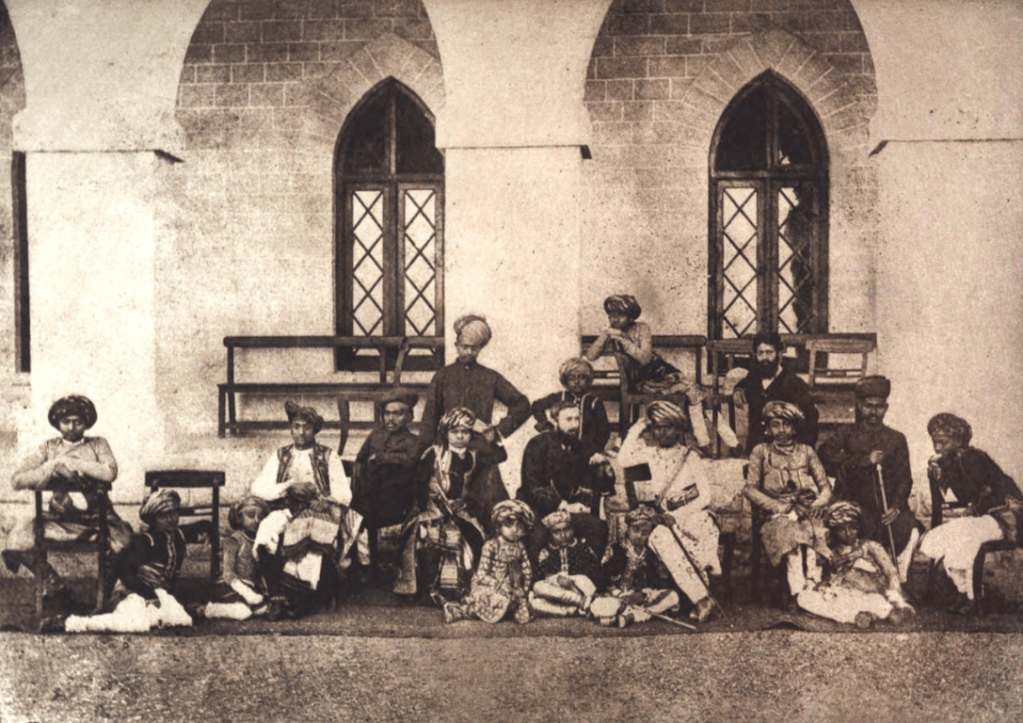
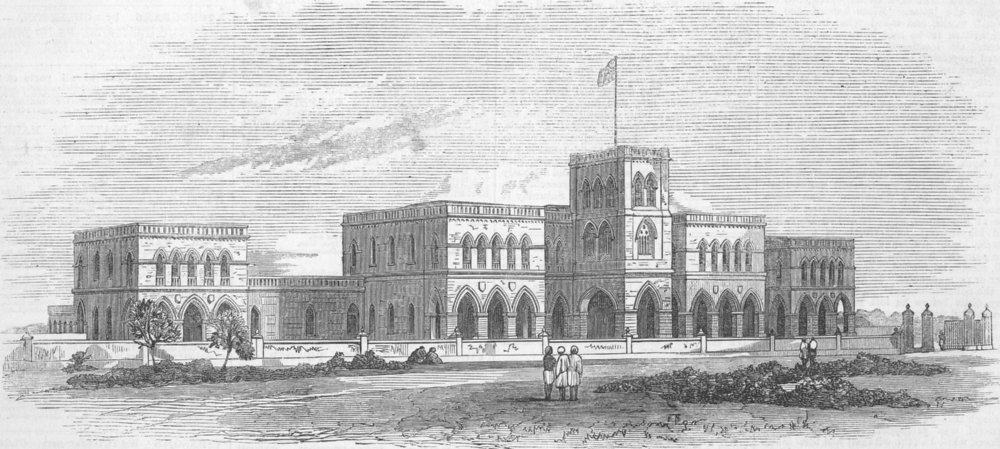
Surprisingly, the idea was considered a sensible one and with the enthusiastic support of the various noble houses of Gujerat and Kathiawar, the foundation stone for institution was laid in 1868, in Rajkot, Gujerat. Rajkumar College opened in 1870 with 12 students. It still exists today, still noted for its excellence.
Contrary to popular opinion, Keatinge did not build Rajkumar College; he designed the educational principles of the school and laid the path for its inception. Keatinge left India in June 1867 on furlough. When he returned 6 months later, it was to a new posting in Rajputana as the Governor-General’s Agent, where he remained until 1870. He took over as Acting Chief Commissionerof the Central Provinces that same year; in 1874 he became the first Chief Commissioner of Assam, where he remained until 1878. Keatinge’s legacy survives in another structure – the Northbrook Gate at Ghuwati, built to welcome Lord Thomas George Baring (Lord Northbrook) the Viceroy of India on his first visit to Assam. Keatinge ordered the construction of what was called a “Gate of Honour” at Sukreshwar Ghat, where Northbrook arrived by steamer from Calcutta.
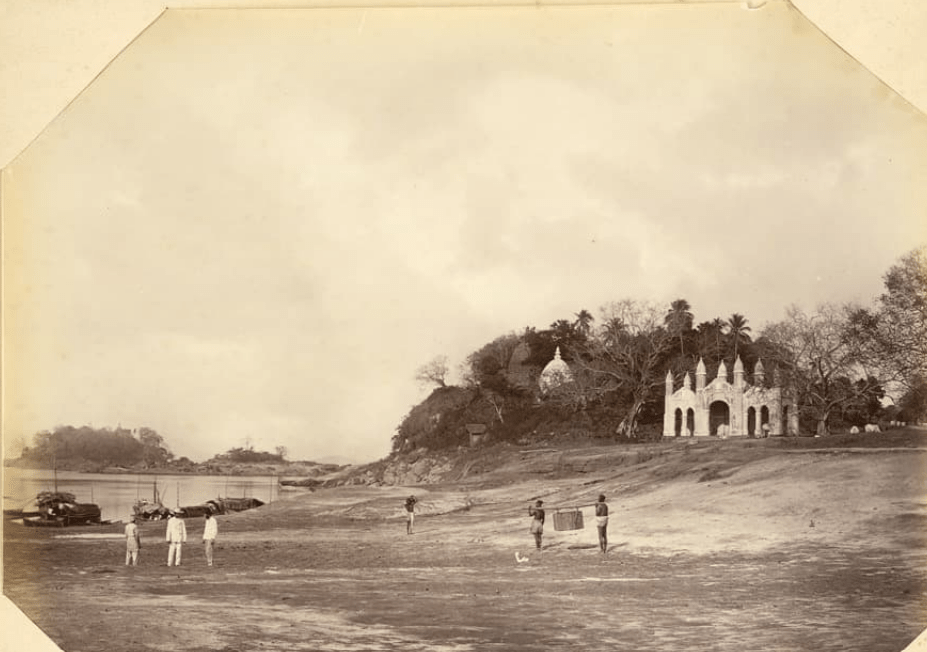
It was more than just a servant pleasing his paymaster – Northbrook announced the creation of Assam during his visit, as a Chief Commissioner’s Province, nominating Shillong as its capital, thus ensuring Assam as a seperate province. Today it is still known as “Gateway of Assam.” Curiously, it was the only British built structure to survive the devasting 1897 earthquake, that even flattened Keatinge’s former home, Government House, in Shillong.
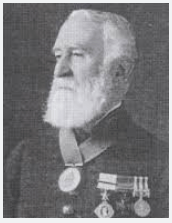
Keatinge retired in 1881 and returned to England. He remarried a year later, Julia Anna, the rather young widow of E.C. Fox Esq. While they would have no children, their house would not be empty for long – Keatinge’s daughter was widowed in India in 1886 (according to FIBIS) when her engineer husband met with an unfortunate accident in Shillong – as such, the children, and presumably their mother, sailed for home. One of the grandchildren would gain some noteriety in later life, as the prospector, Dan Willians who disappeared in Canada in 1936. In 2020 the following article appeared in the BACSA newsletter, Chowkidar:
Daniel Willans was the son of Major Thomas James Willans (who died in Shillong in 1886 or 1888). The Major’s children were sent home to Ireland to live with relatives at ‘Fort William’ in County Fermanagh, and Daniel probably accompanied his siblings. He is said to have been a ‘scapegrace brother…turned out of the house by his grandfather, General Sir Richard Harte Keatinge who was the first Governor of Assam. Daniel emigrated to Canada and appeared in the northern Ontario mining area early this century. He never spoke about his past, but appeared as an educated man, probably with a military background. He made a substantial amount of money, which has remained unclaimed since his sudden disappearance in 1936. One of his sisters used to send him cigarettes from England, and that is all that is known! His great niece, Mrs EA Forestier-Walker would like to obtain a birth certificate for him and indeed to have any information about Major Thomas ‘s descendants.
https://www.bacsa.org.uk/wp-content/uploads/2020/01/chowkidar_07_01.pdf
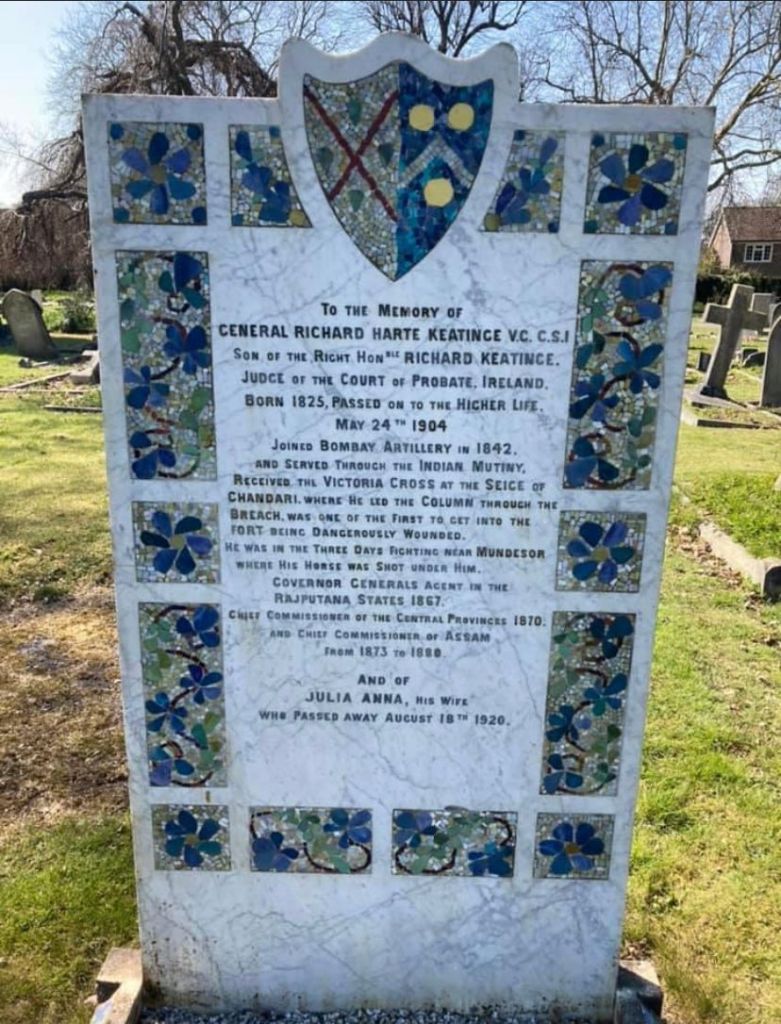
General Sir Richard Harte Keatinge died at his home, “Lynwood House” in Horsham in 1904. His medals are not publicly held:
Victoria Cross
Companion, Order of the Star of India ( CSI )
Indian Mutiny Medal ( 1857-58 ) – 1 clasp: “Central India”
Empress of India Medal ( 1877 )
He lies buried at Hills Street Cemetery, Horsham, together with his wife.
Sources:
Behan, T. L. Bulletins and Other State Intelligence for the Year 1858. London: Harrison & Sons, London Gazette Office, 1860.
Bhavsinhji Takhtsinhji, Maharaja of Bhavnagar. Forty Years of the Rajkumar College; An Account of the Origin and Progress of the Rajkumar College, Rajkot. Compiled and abridged from the papers of Chester MacNaghten. London: Hazell, Watson and Viney, 1910.
Francis, C. List of Inscriptions on Tombs or Monuments in Assam. Shillong: Press Superintendent at the Secretariat Printing Office, 1902.
Lowe, Thomas. Central India during the Rebellion of 1857-1858. London: Longman, Green, Longman & Roberts, 1860.
Raza, Rosemary. In Their Own Words: British Women Writers and India 1740-1857. New Delhi: Oxford University Press, 2006.
Spring, F. W. M., comp. The Bombay Artillery: List of Officers Who Have Served in the Regiment of Bombay Artillery. London: William Clowes & Son, Ltd., 1902.
Sylvester, John Henry. Recollections of the Campaign in Malwa and Central India under Major General Sir Hugh Rose. Bombay: Smith, Taylor & Co., 1860.
Vibart, Henry M. The Life of General Sir H.N.D. Prendergast, R.E., V.C., G.C.B. (The Happy Warrior). London: Eveleigh Nash, 1914.
Links:
https://www.bacsa.org.uk/wp-content/uploads/2020/01/chowkidar_07_01.pdf
FIBIS
https://vcgca.org/our-people/profile/1120/Richard-Harte-KEATINGE
https://www.victoriacross.org.uk/vcross.htm
https://www.victoriacross.org.uk/ccindmut.htm
https://horshammuseum.org/__data/assets/pdf_file/0016/91015/horsham-park-heritage-trail.pdf
 Mutiny Reflections