“Here’s to Hew and Sam and Kirkby,
And may they make Tippoo’s Army to fly;
Here’s to Kirkby, Hew and Sam,
And may they take Seringapatam!
Here’s to Kirkby, Sam and Hew,
We’ll drink their health till we are fou!”
(A poem composed by the uncle of the three Dalrymple brothers who fought against Tipu Sultan – it was recited every night, over the punch bowl.)
The three brothers, Kirkby, Samuel, and Hew Dalrymple all served before Seringapatam — the eldest, Kirkby was a giant of a man, standing 6’7” and is said to be the man who cut down Tipu himself before the fortress gates. Their sister Elizabeth was married to one Jeffrey Prendergast, who spent 40 years in India, in the service of the Madras Army and, like his Dalrymple brothers-in-law, served before Seringapatam. When his career ended, in 1835, General Sir Jeffrey Prendergast was the Military Auditor General of Madras. Of his four sons, Thomas pursued a career, not in the army, but in the EICo’s Madras Presidency civil service.
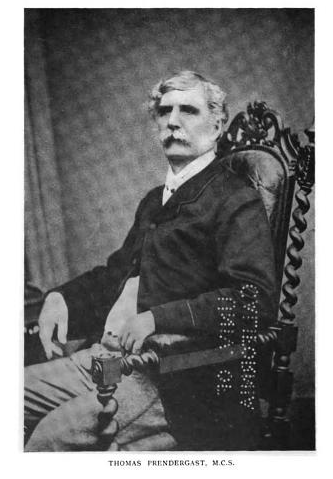
His wife died in 1839, leaving Thomas with little choice but to send the boys, Hew Lindsay and Harry Dalrymple, then aged 8 and 5 respectively, back to England to live with their grandfather, Sir Jeffrey and his wife, in Brighton. It is then little wonder, then, that the boys joined the Madras army. Hew, after a successful career at Addiscombe, was commissioned to the Madras Engineers in 1850. Harry arrived at Addiscombe in 1852 and quickly distinguished himself as not only an athlete but as a very likeable companion.
“My impression of him at Addiscombe and Chatham is that of a brave dashing fellow, ready to risk his life in any good cause, and without a moment’s hesitation,” wrote a friend. Another noted him as a “manly man, first class in all sports, and one who was ever ready to give advice and help under all circumstances…”
After the usual regime of drill, engineering and survey at Chatham, Harry left for Madras and arrived in October 1856, just 22 years old.
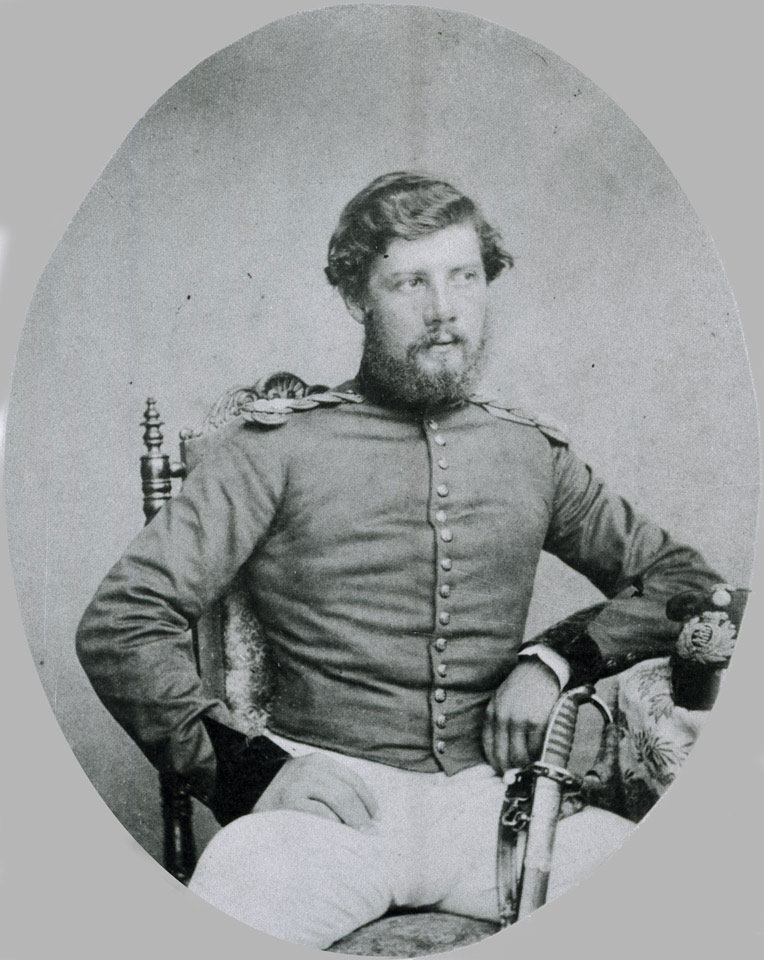
A month after his arrival, Prendergast became Acting Adjutant to Colonel Sir Arthur Cotton, Commandant of the Madras Engineers.
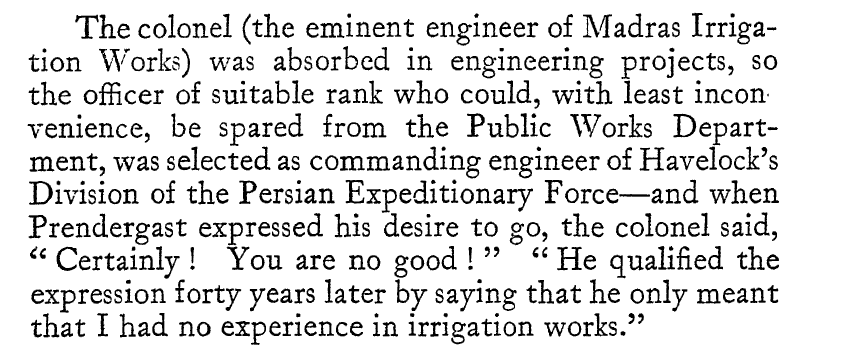
Prendergast was transferred to the Godavari Division of the Public Works Department. With the outbreak of the Persian war, he was transferred to B-Company Sappers and Miners, who would shortly after be sent from Dowlaishwaram on active service to Persia. The campaign was short, but Sir James Outram made a special note of the sappers – they had impressed him with their conspicuous zeal and incessant activity. He further commended them for the “alacrity with which they volunteered for foreign service, though they had only very lately rejoined their families, after a separation of nearly five years of successive absences on field service.”
On the 1st of June 1857, B-Company, Madras Sappers arrived at Bombay. Then, a few days later, following a letter from Major Boileau to the Adjutant-General, Bombay Army, requesting a company of sappers to join Windburn’s Column, with equal alacrity, and “utmost cheerfulness”, B-Company volunteered. Two weeks later, on the 16th of June, they left Bombay and joined the field force on the 5th of July. With the rest of the troops, they would make it as far as Mhow before the monsoons made further passage to Central India impossible. Still, as soon as the rains cleared, they marched towards Dhar, with Harry Prendergast acting as Brigade Major. The Sappers had already proved their worth in Outram’s eyes in Persia, and now, at Dhar, they continued their sterling work,
“The weather was delightful, the scenery charming, the excitement invigorating to the young engineer, who at the age of 23, was second in seniority of the Engineers during the siege, but the work was very hard, one tour of duty lasting 42 hours. Where the attack was made, the walls were 34 feet (ca. 10 m) high. We erected four sandbag batteries on the ridge west of the fort, the breaching battery being 263 yards (0.24 km) from the wall.
The sappers behaved splendidly in mending the embrasures in broad daylight when the enemy’s fire was so hot that the artillerymen could not service the guns and by their pluck, good humour, and unceasing labour in the trenches, gained golden opinions in the force.” (H.D. Prendergast, commenting on Dhar)
The capture of the fort was “sweetened” for Prendergast by the receipt of £300 in prize money.
Following Dhar, Prendergast found himself as assistant to Sir Henry Durand, copying despatches, when no other writer could be found. Durand had a profound distrust of Indians, feeling they were, under the current circumstances, singularly unsuitable for the job, as much of his correspondence dealt directly with the campaign. The work was “strictly confidential; an officer who had dominion over me asked what I was doing all day, to which I replied that I only copied correspondence and tried to save the colonel trouble.“As how?” said my interrogator. “Just ordering his boots and writing to his tailor, etc…”
“I cannot have an engineering officer wasting his time in private correspondence!” and away he went to the great political official with his complaint, at which Colonel Durand was much amused when it occurred to him that an attempt had been made to pump me!”
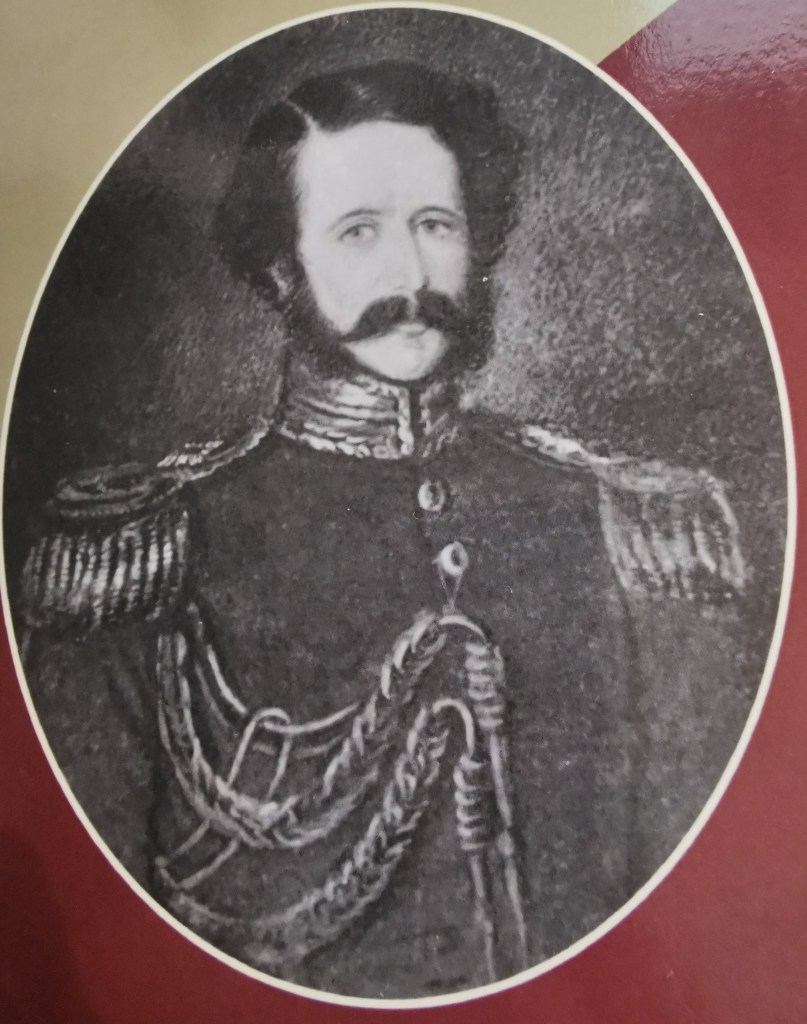
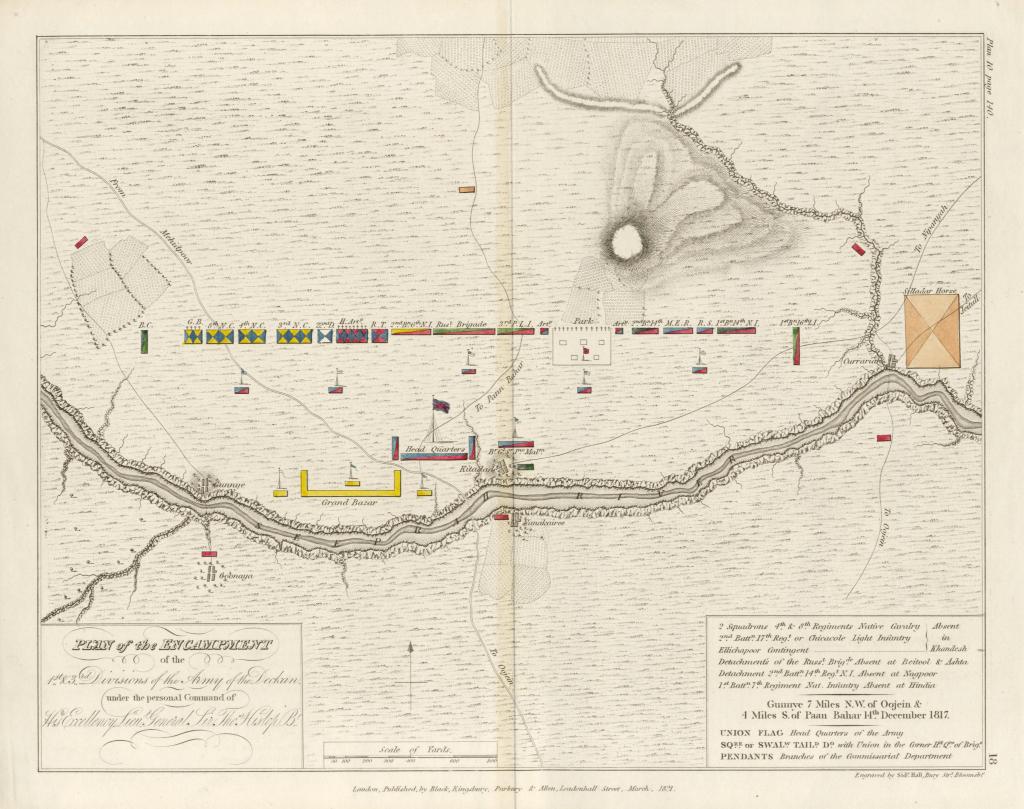
Durand and even Stuart, however, had another reason to be delighted with Prendergast — the young man was the only one in the entire force who possessed a map of the country around Mandswar. The intelligence officer of the force, Captain Henty Otway Mayne (who later raised the Central India Horse), with whom Prendergast was riding on the 20th of November on reconnaissance, assured Prendergast the information regarding the town was excellent. When thy returned to camp, Mayne showed him his map which Prendergast found was “sheet of paper with a round ‘O’ in the middle marked ‘Mundisore 12 guns’ and there were smaller o’s nearer it, marked with the names of the villages and the supposed number of men and guns in each.”
What Prendergast had to offer was a map he had copied from Blacker’s “Mahratta War”, which he had been reading at Mhow. Though 40 years old, the map showed the exact position of General Hyslop’s camp in 1817 where the treaty was signed, and as such, despite its age, proved to be “wonderfully accurate.” It certainly served better than O’s on a sheet of paper.
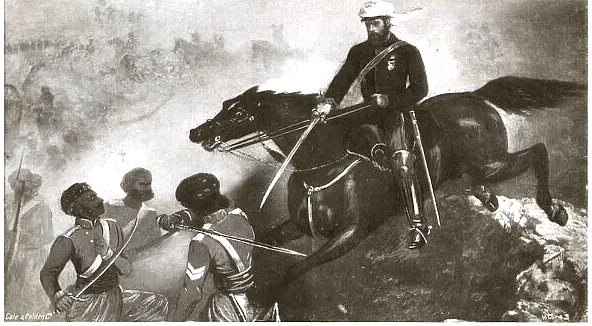
Lieutenant Harry Prendergast, VC
The next day, the 21st of November, the Malwa Field Force arrived within 5 miles (ca. 8 km) of Mandswar. The question now was whether to attack the Shahzada and then march on Neemuch or to make a flank march around Mandswar to Neemuch, either passing Mandswar on the right or on the left. Durand, during his discussions with Stewart, invited Prendergast to attend and, above all, to bring his map.
The advice offered by Durand was to march on Neemuch and fight the Shahzada should he be inclined to attack, but there was still discussion regarding the route to take. Prendergast’s map showed the river in detail, but as no one could say for certain whether it was passable or not, the camp was pitched, and a reconnaissance was agreed upon. Mayne would go, and Prendergast volunteered, only to have the senior engineer object, saying it was too dangerous. The meeting ended, and Mayne went to organise his men while Durand invited Prendergast for breakfast.
During the meal, Durand mentioned he wished Prendergast to accompany Mayne, disregarding the worries of the senior engineer and Prendergast, quickly saddled up and joined Mayne and the 3rd Hyderabad Contingent. The order was “to report on the places for crossing the streams, and especially regarding two hills… and no account to bring on action.” The camp was positioned in the valley of the stream, outposts had been placed on the higher ground to the north, while the nearby villages served as cavalry pickets further ahead.
However, as they rode on, they saw one of the two hills had been occupied by the insurgent cavalry — the position was a strong one, but Mayne wanted to charge them. Prendergast reminded him of their orders, but he “consented to go if he would give me the distinct order in presence of the cavalry officer commanding the picquet, and when we reached him it was no longer a question whether the enemy should be attacked…”
The insurgents, seeing but few of the British and not realising the remainder of the force was hidden behind the rise in the ground, decided to attack the picket. In their charge, they drove back the outlying pickets, forcing Henry Clerk and George Dew to abandon their position and rush back towards Mayne’s position.
“My memory is not clear about the early part of the battle. I remember charging right in among the enemy’s standard-bearers, and I recollect hearing a tremendous noise behind me and seeing artillery clattering down a hill covered with loose stones at a gallop; this was Hungerford’s battery. When he crested the hill and wished to fire into the enemy’s infantry columns, the dragoons began to charge. He couldn’t stand that, so he charged his guns right into the thick of the rebels.”
Riding for a long time onwards with the 3rd Hyderabad Cavalry with Dew and Clerk, they met but little opposition from the rebel cavalry, who refused to charge. In their midst, as they turned, Prendergast saw a “big dun horse” that he found so admirable he determined to have it. The rider, however, knew the ground and was very aware that Prendergast was following him. At a small village, the rider pulled up and dismounted, and Prendergast, thinking he had not been seen, was suddenly surprised when the man, resting his musket on his saddle, shot at him. Further shots from the man’s companions convinced Prendergast that the horse “was not worth having,” and he quickly retreated.
The chase continued.
“In one place, we found a party of the enemy had occupied a rocky hillock, round the base of which a stream ran. I happened to be leading, and I was conscious that my horse generally refused water, and I crammed him at the brook and round he swerved, throwing the leading sowars out of their stride; then came the commandant full of compliments to me for spoiling everything.” The stream was crossed, and the insurgent infantry on the other side was destroyed – it was not the end of Prendergast’s adventures. Riding close on the heels of Major Sutherland Orr, he watched as the major speared his opponents, “so accomplished was the commandant that he considered it clumsy to touch a man with his hog-spear except in the neck” that when he missed a man, he was determined to remedy his mistake. He turned his horse for the second try so swiftly that Prendergast, unable to move out of the way, nearly upset Orr, spear, horse and all. By now, the regiment was no longer riding in formation, broken up as they were by the irregular ground, the streams that lay in its path, and the trees, rocks and hedges.
At one of these hedges, Lieutenant George Dew did not see the man who was covering him with his matchlock, but Prendergast did. He shouted to Dew, but it was the man with the matchlock who heard him and prepared to receive Prendergast, who was riding straight at him. He waiting until
“I was so close to him that the superfluous powder and flask from the discharge burnt by bridle hand fired into my ribs. close to the heart.” It was Orr and his spear who killed the attacker who, “scorning to retire behind the high hedge…preferred to remain where he was and fight the regiment.”
Being badly wounded, Prendergast was ordered back to camp, with two Dragoons whose horses were lame, to escort him. They kept up his spirits with tales of their day’s adventure, one of them describing, while in the thick of things, “a blooming fool of an officer not only let off a man who might have cut him down but called to him that he was a bheestie. I damned soon cut off half the beggar’s head!” The story, as Prendergast recalled, was true – he was the officer, and the water-carrier’s sword was in its scabbard, so he “could not strike him.”
As they walked their horses towards the camp, they stumbled across the field of battle, now strewn with corpses – the dragoons asked for permission to see if there was any plunder or arms worth having. As the dragoons had “done their share of the destruction,” Prendergast allowed it. One of the dragoons was carrying Prendergast’s sword, for he was feeling ” a little weak” – as soon as the two men had commenced their search, bullets came flying at them from a thicket, leaving Prendergast little choice but to ride at his assailants, armed only with his revolver. Only three barrels would go off, but luckily for Prendergast, having fired his shots, he was saved by some dragoons who “happened to come up.” One of these would lose a toe by sword cut – the only casualty of this little skirmish.
Arriving in camp, Prendergast was met with “lamentations and severe chidings” from his horse keeper, who felt most keenly that the injury suffered by his officer was somehow his fault. Prendergast had ridden off without telling him and had been wounded without him in attendance. The wound was certainly worrying and considered as both severe and dangerous.
“Colonel Robertson of the 25th Bombay NI commanded the outposts and he was good enough to attribute the success of the day in a great measure to a charge of a handful of cavalry headed by Lieutenants Clerk, Hyderabad Cavalry, George Dew of the 14th Light Dragoons; and H. Prendergast of the Engineers, on the enemy’s infantry, which delayed the enemy while the British troops were getting under arms, and the colonel considered all three of them deserved the Victoria Cross.”
By December, Prendergast’s wound had healed sufficiently to allow him to join Sir Hugh Rose’s force for the remainder of the Central India Campaign, although Durand had offered him the lucrative position of executive engineer at Mhow, the best posting he had to give. Prendergast politely refused – he was young and strong, and the fight was still very much on him.
The Central India Campaign
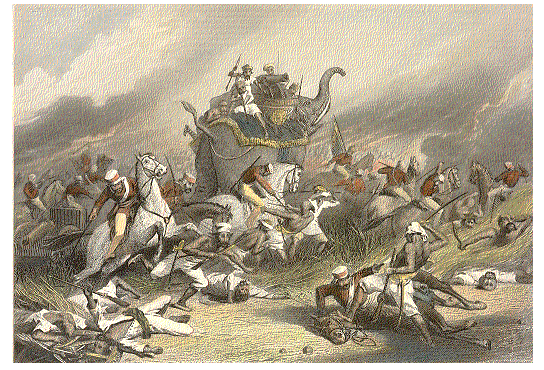
“The enemy tried to stop our pursuit by setting the jungle on fire, but nothing could check the ardour of the Artillery and Cavalry, who galloped in pursuit across the country in flames.”
Prendergast distinguished himself by his gallantry in the actions at Rahatgarh and Betwa, but he was severely wounded at the latter. Major-General Sir Hugh Rose, in forwarding his recommendation, stated,
“Lieutenant Prendergast, Madras Engineers, was specially mentioned by Brigadier, now Sir Charles Stuart, for the gallant act at Mundisore, when he was severely wounded; secondly, he was specially mentioned by me when acting voluntarily as my Aide-de-Camp in the Action before besieging Ratgurh on the Beena river, for gallant conduct. His horse was killed on that occasion. Thirdly, at the action of ‘the Betwa, he again voluntarily acted as my Aide-de-Camp, and distinguished himself by his bravery in the charge, which I made with Captain Need’s Troop, Her Majesty’s 14th Light Dragoons, against the left of the so-called Peishwa’s Army, under Tantia Topee. He was severely wounded on that occasion.”
The Central India Campaign deserves far more consideration than can be put into the scope of this post – unfortunately for Prendergast, his involvement was short and ended on the 1st of April at the Battle of Betwa River. Although Tantia Tope would be routed by Sir Hugh Rose, the engagement was fierce. Tope had chosen his position carefully – his first line was placed behind the ridge of a rock that rose out of the plain, he positioned his 24-pounder to the left of their line and was escorted by a regiment from Gwalior Contingent Infantry.
Prendergast was ordered away from the regiment of the 25th Bombay Infantry and rode off to find General Hugh Rose. He found him preparing to charge the battery, but things had until then gone badly for the Hyderabad Contingent.
The 3rd Hyderabad Contingent, under Clerk, charged the rebels twice from the left, and the commanding officer, the only British officer with them, was severely wounded. Sir Hugh Rose put himself “at the head of a squadron of the 14th…the word was given for dragoons and irregulars to advance, but the Sowars, having no British leaders, and having been twice repulsed, did not answer the call.” The General, unaware the sowars were not following, headed towards the battery but reined up, arriving before it. Prendergast “chose a spot where it was possible to jump the ridge and went at it; in riding up to it, only the heads of men and puffs of smoke could be seen. There was infantry in front, infantry to the right, the battery in front, and bullets pouring down like hail so that I was inclined to put my head down to prevent their hurting my face. As I came down from the jump I found native artillerymen on my right, and the Gwalior Contingent on my left; several cut at me, but my horse and I kept our heads and went off, but it was weird work going forward with our wounds open and apparently no Britishers near, and when I reached the ground over which round shot from the batteries on the British left were bounding, I thought it was time to consider my position.”
Prendergast turned his horse in time to see a solitary Dragoon fall off his horse, shot through the heart. His horse turned, and Prendergast, unable to see far in front of him, decided to “trust the instinct and discipline of the riderless horse” until he fell in with a group of Sappers. Lieutenant Fox of the Sappers helped Prendergast to find a surgeon and advised him against the inclination Prendergast felt to bite off his own thumb, which was “hanging on by a shred of skin on the back of my hand” to have done with it. According to Rose, Prendergast’s charge was “equal in point of danger to charging a battery.” It was also surprising that he was still alive.
His left arm had suffered the most – the deltoid and biceps had been severed, his thumb was practically cut off, and he had a wound on the index finger. While in the field, all he received in the way of care was port wine from a tin pot that “was flavoured with camphor.” Then, weak from blood loss, he was carried three miles back to his tent. A surgeon finally came to see to him, but Prendergast considered him nervous, as he “puffed a pipe of course tobacco in my face while looking me over, and then strapped the big wound with a diaculum plaister.” Prendergast had to point out to him that the wound was still bleeding, for which he swiftly applied a tourniquet that pulled on the edges of the bandage.
The type of plaster Prendergast is referring to is most likely an adhesive bandage – it was made by spreading a mixture of resin, oil and lead monoxide onto muslin. These bandages, when dried, could then be rolled up for future use. When needed, the bandage could be cut to size and after heating, (in the worst-case scenario when even a spirit lamp was not available, such bandages could be rubbed between the fingers to warm the resin enough to render it reasonably adhesive) which enabled the resin to revert to its sticky origins, could be stuck on the skin to hold the wound together. However, the surgeon had no time to treat Prendergast’s other wounds, and it would be some hours before another doctor, this time Dr. Lowe of the Madras Engineers, could look in on the patient. The tourniquet was removed and the plaster torn off, opening the wound again. Lowe “fitted the sides together and sewed up the wound.” He then stitched his thumb back into place and lashed it to a splint before turning his attention to his injured index finger. While Lowe “made beautiful cures of all of them”, Prendergast had endured a day of horrific pain until his doctor came in to perform every single procedure without any anaesthetic, something which Prendergast describes as “torture…till he had completed his operations.” Prendergast was quite sure matters would have been much worse. “It was the first hand-to-hand conflict in which I had been engaged since I possessed metal reins, and my leather reins were cut through in the charge so that I would have been helpless if I had not used iron chains.” Having found a survey chain in a fort in March, Prendergast had taken his idea to the company smith, who fashioned the iron into chain reins.
Prendergast was invalided back to England, where he remained for two years. In October 1859, he was invested with the Victoria Cross at Windsor Castle by the Queen herself. Joining him on that day was Sir Charles Gough, Major Mark Walker, W.F. McDonnell, R.L. Mangles and “half a dozen privates.”
By 1860, he was looking for employment. He applied for the China Expedition under Sir Hope Grant, but his request was denied as his wounds had not sufficiently healed.
When he finally returned to India towards the end of 1860, it was to work in the Public Works Department, initially under his brother Hew, whom he served as assistant. He transferred to Madras, where he was put in charge of the military buildings in three cantonments, besides irrigation works and roads. It was, he remarked, “A remarkably pleasant billet.” There was work, but not too much of it, the society was good, and the Madras Artillery provided a “fine mess and an excellent band.” Prendergast noted that there “are not many monuments of my skill as an engineer” while serving at Saint Thomas Mount. Over the next few years, until his marriage in 1864, Prendergast travelled around India in his engineering capacity – it would appear war for him was an event well set in the past. With his wife Emilie (née Simpson, the daughter of Frederick Simpson Esq. and niece to General George W.G. Simpson of the Madras Artillery, superintendent, gunpowder factory Madras) he settled down for a time at Saint Thomas Mount.
In 1867, Captain Prendergast was given command of three companies of Madras Sappers for the Abyssinia Expedition. He returned to India in 1868 and reverted to his duty as deputy consulting engineer of Madras railways, but a short six months later found himself appointed commander of the Madras Sappers and Bangalore. He had served with them now in 4 campaigns – Persia, Malwa, Central India and Abyssinia- and had gained brevets of Major and Lieutenant-Colonel. As such, there was not a better man for the post. He knew the men, had always been most concerned for their welfare and, above all, wanted to make the Sappers even better. For the next 12 years, Prendergast “took considerable pains to improve them…” Regular drills and manoeuvres and the establishment of a Rifle Club for the shooting corps. His sappers had their own gymnasium long before other units had one, believing his men should not only be able to perform all the duties of a sapper but be fit in mind and body. However, if the men needed inspiration, they could look to their commander.
Prendergast did not believe men were unteachable – his sappers used Morse code “to disprove the accepted theory that the British soldier could not be taught to use it. Though in England the British soldier was held not to be intelligent enough to use the Morse alphabet the soldiers and sappers acquitted themselves admirably.” He also refused to discriminate when it came to recruits from the Indian population. For him, a man needed to prove his skills – no questions were asked about caste or religion; the only one asked was “What can you do?” If a man said carpenter or bricklayer or whatever he proposed, he was marched off and tested, and a report was made on his work; if it was satisfactory and his measurements and eyesight good, and the medical officer passed him, he was admitted. ” Not once in his long service with the sappers did Prendergast ever have a man refuse service overseas – they were asked, as regulation dictated, but none wished to be excused. As he saw it, the conditions were good, the men were fit, the esprit de corps was strong, and above all, they were “sensibly treated and well fed.” Prendergast believed a busy man had no time to “indulge in opiates” and, in the same vein, after an 8-hour day, “he has little leisure for fooling about the bazaar and spending his money.” He was gratified when on one occasion someone did ask a sapper his caste, the man replied he was “Sapper Caste” – in other words, a sapper first and his religion second. They were respected, and their positions held in high regard – it was a lesson the Bengal Army should have learned before the dark days of 1857.
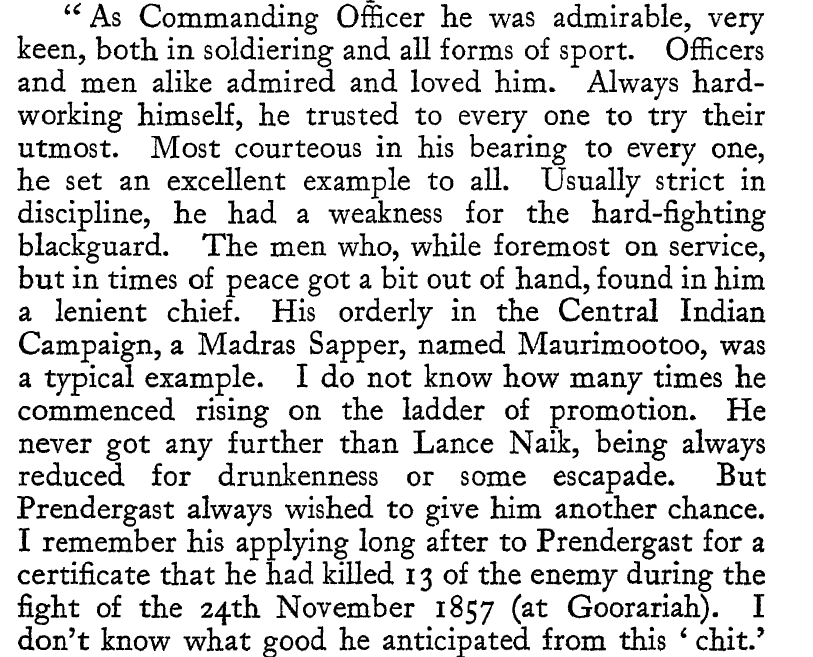
Prendergast, even though his left arm never regained its full strength and his hand was nearly useless, did not lose his love of sport. He played polo in Bangalore and was a strong rider, a good boxer and a fine cricketer. It was not uncommon to find Prendergast on “Thursdays…at Bangalore” to ride with the hounds in the morning, play cricket through the afternoon and end the day with football.
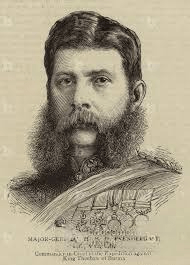
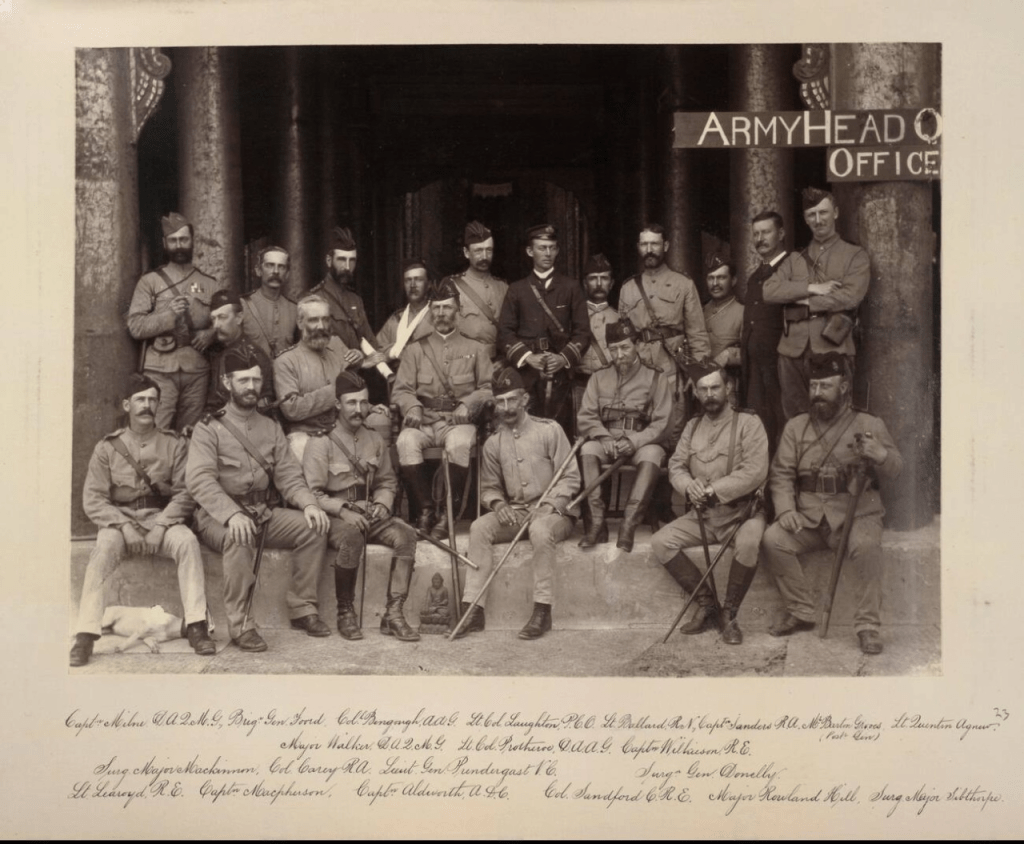
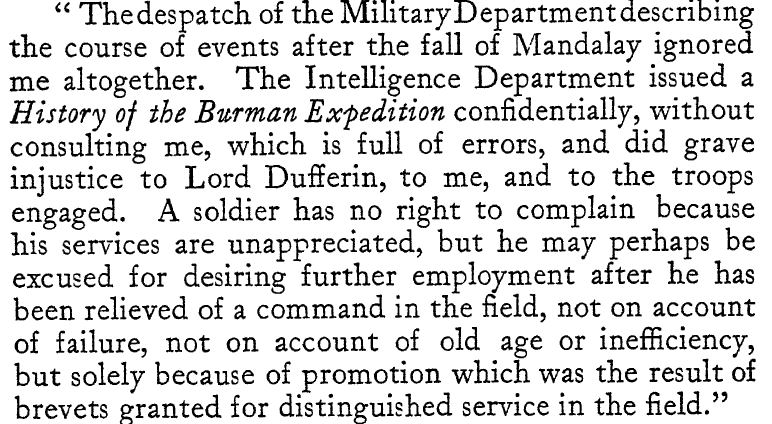
During his next furlough, from 1874 to 1876, he was nominated for a Companion of the Bath and in his absence from the corps, the Queen had nominated the Prince of Wales (after his India visit) to honorary colonel of the corps of Sappers and Miners. She awarded them the distinction of “Queen’s Own.” Expeditions to Malta and Cyprus followed in 1878, with further staff appointments for now Colonel Prendergast until finally, in 1885, he was selected to lead the Burma Field Force in the 3rd Burmese War. Initially, things went well, and the occupation of Mandalay in November 1885 led to his receiving the KCB in recognition of his services. Lord Dufferin approved Prendergast for executive duties to command the newly formed British Burma Division in addition to his command of the expeditionary force. A few months later, he found he was promoted to Lieutenant General and in the same breath, lost his command – the Secretary of State went one step further and revoked Dufferin’s sanction of his executive position. The move was considered “a serious blunder”, but there was nothing for it. Harry Prendergast left Burma and would never return to active service. Subsequently, his service in Burma would not receive the recognition his well-wishers believed he deserved.
Although the Third Burma War would require a longer post, needless to say, he was blamed for
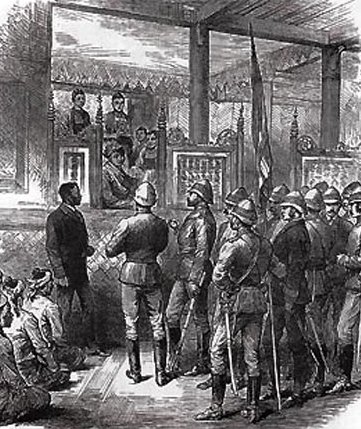
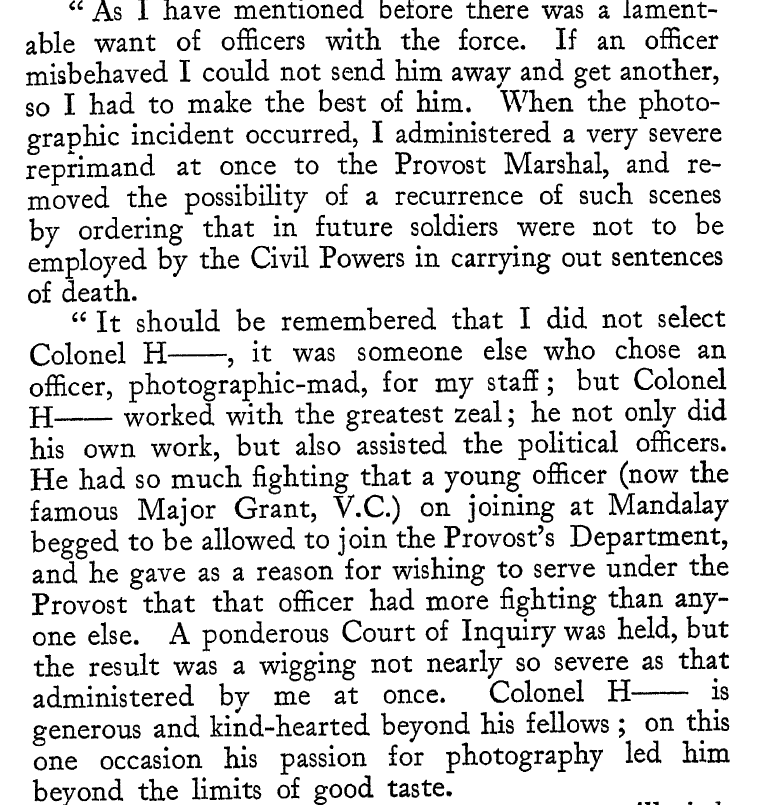
“the continuance of fighting…” among other things. Of those, it included deporting the Times correspondent for stirring up mischief with dishonest and exaggerated statements. As such, the Times correspondent had very little good to say about Harry Prendergast, and the government, eager to have a positive position in the Times, did not support their general. Prendergast decision was subsequently overruled and the same correspondent, now freed from his blacklisting, could return to Burma and report unfavourably on anything Prendergast did. One of these incidents was his altercation with the Provost Marshall at Mandalay. In infamous bad taste, the Provost Marshall took photographs of prisoners when they were being executed, something Prendergast found horrifyingly dishonourable. Speaking of the incident, which the Times correspondent, in his reinstated position, blew out of proportion, Prendergast noted,
As such, when the History of the Third Burmese War was issued, despite Harry Prendergast’s numerous corrections sent to the author, who had sent him a draft of the book, the letters that followed and finally protests, the text was never changed; his official account of the war, the addendum proposed was never added and no attempt was made to correct any errors. It remained “erroneous and highly injurious” not just to Prendergast but, to his horror, the very army he commanded. After 1886, Harry Prendergast’s military career was as good as done. He never received any further commands and, at the age of 51, would spend his remaining years in India in political office.
He left India for the last time in 1892 and for the last 20 years of his life he was ignored by the government he had served – he was passed up for an appointment back in England at the Indian Civil Engineering College; his friends, including Lord Dufferin, tried to secure him a position – any position at all, but the government remained adamant. Prendergast’s life became a long list of speeches, appearances and banquets. He worked diligently at the furtherance of good causes, but he never stopped being a soldier. At the age of 65, he once again tried his hand at joining the South Africa War, even offering to waive his rank if he could secure a command. He was once more denied.
In 1902 he was created a GCB but the opinion was unanimous, this honour had been long deferred, coming 16 years after his KCB; this was followed by his appointment as Colonel to the Queen’s Own Madras Sappers and Miners and although he never saw the corps in India again, he presented an album of photographs of the regiment on their behalf, to the King. In 1908, he was appointed Colonel-Commandant of the Royal Engineers.
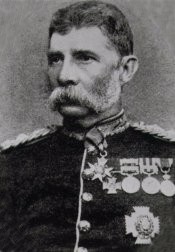
On the 24th of July, 1913 Sir Harry Prendergast died at home. He had caught a chill while attending yet another ceremony – a “rehearsal in connection with the Most Honourable Order of the Bath” in Westminster Abbey. He had spent the last year of his life, not where he should have been, but overseeing various committees and attended no less than six public dinners in six weeks. A man who had never put himself forward or complained and “never had an unkind thought of anyone, and it is quite certain that, if he had, he never expressed it,” or as one old school friend wrote, on his death, “He was absolutely innocent of pushing in any form, and, perhaps in consequence of this, I always felt his merits were not adequately recognised by the powers that be; otherwise he certainly would not have died without the baton of a Field Marshal,” but to the very end as Vibart writes, “the beau-ideal of a Happy Warrior.”
He was buried on the 28th of July at Richmond Cemetery with full military honours.
Sources:
History of the Indian Mutiny, commencing from the close of the 2nd Volume of Sir John Kaye’s History of the Sepoy War, Vol. III – Col. G.B. Malleson (1888)
A History of the Hyderabad Contingent – Major Reginald George Burton (1905)
The Revolt in Central India 1857-59, Compiled in the Intelligence Branch (1908)
The Life of Sir H.N.D. Prendergast, R.E., V.C.,G.C.B. (The Happy Warrior) – Col. Henry M. Vibart R.E. (1914)
King George’s Own Central India Horse, the Story of a Local Corps – Major-General W.A. Watson (reprinted by the Naval and Military Press, 2005)
History of the Third Burmese War 1885, 1886 and 1887. Period II. History of the War from the Annexation of the Country to the Commencement of the Winter Campaign 1886-87 – Lt Henry E. Stanton (1888)
Queen Victoria’s Wars: British Military Campaigns, 1857–1902. Edited by Stephen M. Miller (Cambridge University Press (August 5, 2021)
 Mutiny Reflections