For the Battle of Betwa on 1 April 1858, although plenty of men were mentioned in despatches, only three would receive a Victoria Cross. The first belongs to Lieutenant Harry Prendergast, Madras Sappers, the second to Lieutenant James Leith, 14th Light Dragoons, and the third to Lieutenant Hugh Cochrane, 86th Regiment of Foot.
In this post, we shall look at the very short life of Lieutenant James Leith.
A Soldier’s Sons
James Leith was the son of a soldier; his father was none other than General Sir Alexander Leith of Freefield and Glenkindie, KCB, who would live just long enough to read of his son’s VC in the London Gazette. The general had had something of an adventurous career himself from the time he joined the army as an ensign in 1792. With the 42nd Regiment of Foot, he served at the defence of Nieuwpoort in Flanders, and then two years later at the capture of St Lucia. In 1799, at the Battle of Alkmaar, he lost an eye. Not that this seemed to be a cause for concern, for Major Leith served in Egypt in 1807. Raised to lieutenant-colonel in 1811, a year later, he was off to the Peninsular War to command the 31st Foot at the battles of Vittoria, Pyrenees and Nive. The latter nearly proved his undoing, for he was severely wounded at St Pierre, but Leith was proving to be rather a stubborn soldier, and his nickname “Cauld Steel” might say something of the man. In 1814, he was involved not only in the Battle of Orthez but also added Toulouse to his books. Knighted KCB in 1815, his war-faring days were finally over.
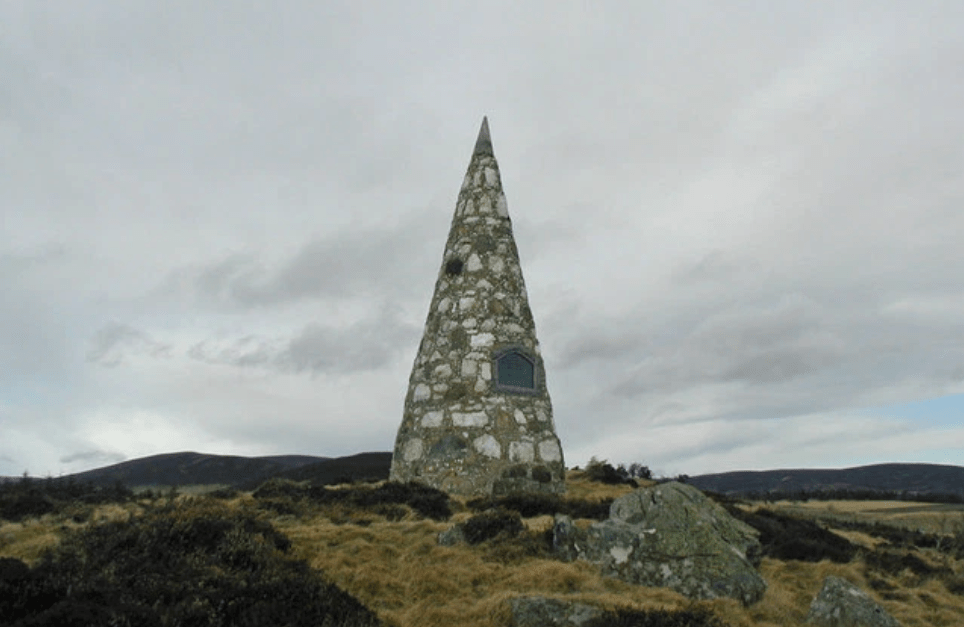
Promoted to major general in 1830 and eleven years later to lieutenant general, he was given, in the same year, a colonelcy in the 90th Regiment of Foot, but in 1853, he was offered the same position in his old regiment – the 31st Foot. Made a full general in 1854, he remained with the 31st Foot until his death in 1859. Although he lies buried in Towie churchyard, an impressive memorial cairn was erected in 1908 by his “family, old servants and an attached tenantry” on top of Dalrossach Hill.
The general, in his long life, married twice, but it appears his six children were all from his first wife, Maria Thorp, who died in 1834. While his eldest son, also named Alexander, decided, after graduating from Trinity College with an MA, he became an advocate and later Justice of the Peace. His most warlike adventure was being admitted to the Royal Company of Archers. However, Alexander’s three brothers all joined the army, Robert and Thomas destined for Bombay and James for the 14th Light Dragoons.
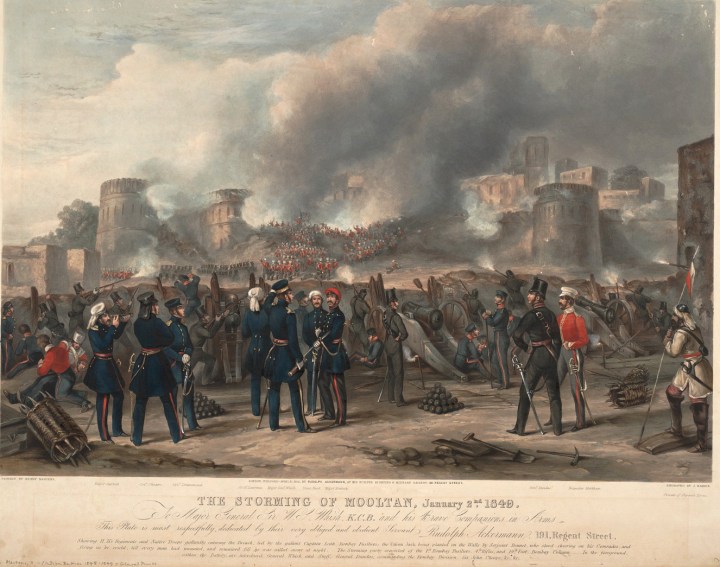
Robert William Disney Leith (born 1819), joined the Bombay Fusiliers in 1837 as an ensign, but his early years were indeed lonesome, as for three long years he served on a small island in the Persian Gulf. India must have been something of a relief – promoted to captain in 1846, he would see service in the Punjab Campaign. On 2 January 1849, Captain Leith was at the Siege of Multan. He led the Fusiliers through one of the breaches through a devilish storm of musket fire and gained for his pains a wound so severe it cost him his left arm. His right arm was also slashed, and the bullet in his shoulder stayed where it had buried itself until his death. For heroism under fire, he was brevetted as a major. His younger brother, Thomas, born in 1830, too, served at the Siege of Multan and later fought in the 1857 Persia Campaign.
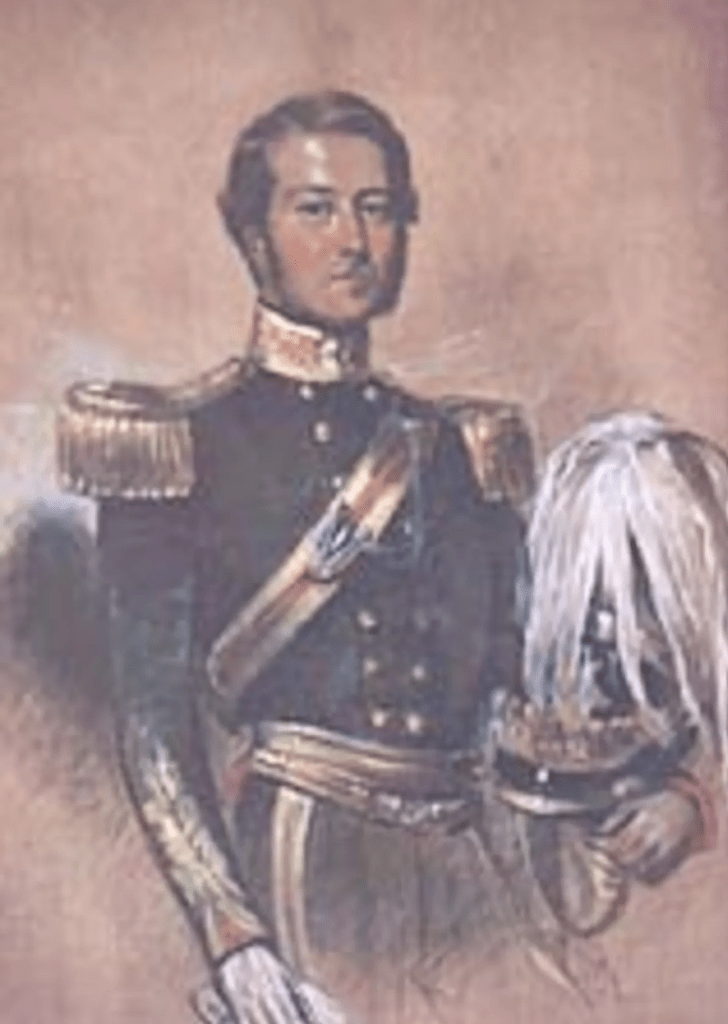
While his brothers were both in India, where was James? Born in 1826, he was educated at the Blackheath Proprietary School and then followed Alexander’s footsteps to Trinity College, Cambridge. Cricket obviously held some attraction for James, as he played for the Cambridge side between 1846 and 1849, and won his Blue in 1848. His last match was
Cambridge U vs M.C.C. at Lord’s on June 14–15, 1849. A month earlier, on 4 May, he had joined the 14th Light Dragoons, but first appeared in the Army List as a cornet in 1850. The 14th Light Dragoons had been on service in India since 1841, and James sailed out to join his regiment. In 1854, he attained his lieutenancy and, three years later, joined the Persia Campaign. All three Leith brothers would serve in the Indian Mutiny; however, Robert appears to have remained in Bombay in a staff position, and Thomas saw active service in 1857 and 1858 with the 14th Bombay Native Infantry.
For James, the mutiny campaign was a long one — it started as part of Woodburn’s Column in June 1857 and finally joined the Malwa Field Force. Leith would be one of the many men wounded at Mandsaur in November, but would be up and ready to fight again with Sir Hugh Rose set off for the Central India Campaign.
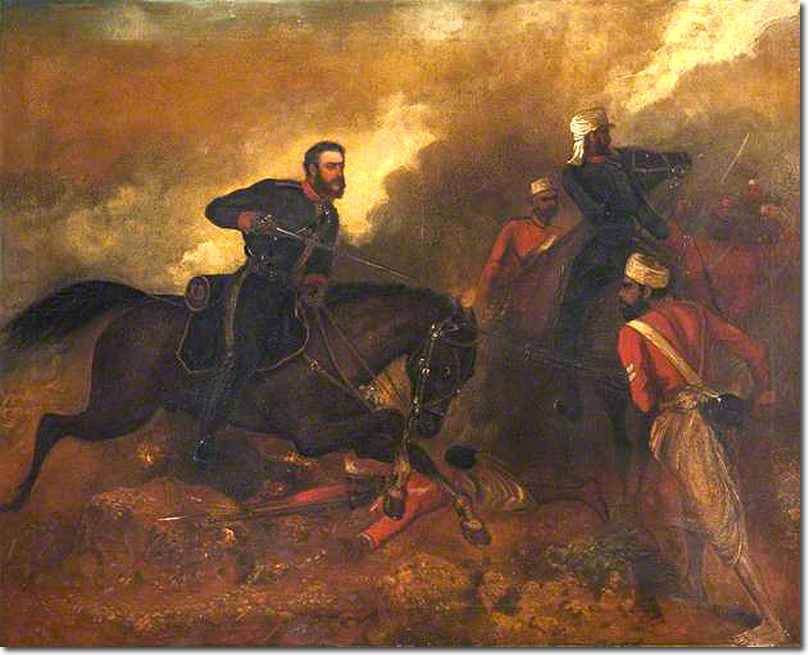
The Dragoons had been quite busy throughout the campaign, and as we have seen at Betwa, they had had to take on some of their hardest fighting as yet. Captain Arthur Need, who had proved himself to be a fine cavalryman and a sterling rider, did, however, manage to get himself into a tight spot. In the charge, led by Sir Hugh Rose himself, Need found himself separated from the main body, woefully surrounded and desperately fighting for his life. His horse was not taking kindly to the treatment it was receiving from the rebels’ tulwars: they slashed at the saddle, at the reins and at Need, cutting his clothes to ribbons but not managing to injure the captain, who continued fending off their blows. Leith, seeing Need, who was fighting what was rapidly becoming a losing battle, spurred on his horse, alone and with sword drawn, dashed to save his captain. The timely interference saved Captain Need’s life and gained, for Lieutenant Leith, a Victoria Cross.
“Captain Need, who commanded the squadron, was most discreet in leading his men to the left of the line I adopted, and the wheeling to the right; by this of course he got better ground for charging and took the enemy in the flank. It was a splendid feat, sent the Gwalior Infantry flying, and enabled the 86th to capture the guns. In the melee, Need was surrounded, his horse, a low-bred one, reared up and was so frightened that he would not move until Lieutenant Leith came to the rescue and gave him a lead.” (Prendergast)
Sir Hugh was most impressed.
“I beg to do justice to Captain Need’s troop: they charged with steady gallantry on the enemy’s left, which was composed of the best rebel troops, the Velaitees and sepoys, who, throwing themselves back on the right and resting the flanks of their new line four or five deep on the rocky knolls, received the charge with a heavy fire of musketry. We broke through the dense line, which flung itself amongst the rocks, and bringing our right shoulders forward, took the front line in reverse and routed it. I believe I may say that what Captain Need’s troop did on this occasion was equal to breaking a square of infantry, and the result was most successful, because the charge turned the enemy’s position and decided in a great measure the fate of the day.
I have the honour to recommend to His Excellency’s favourable consideration Captain Need and his devoted troop, and Lieutenant Leith, who saved Captain Need’s life, for which I have ventured to recommend him for the Victoria Cross.”
Lieutenant Leith was gazetted on 24 December 1858 and received his VC on 8 June 1859 from Queen Victoria, and it does not appear that he returned to India. The 14th Light Dragoons left India in 1860; Leith, retired a brevet major in 1861 on half-pay, his health quite ruined. In 1863, he was appointed a Member of the Honorary Corps of Gentlemen-in-Arms, but died only aged 43 in London in 1869 and was buried in Towie, Aberdeenshire. The last of three brothers to serve in India, he would be the first to shake off the mortal coils.
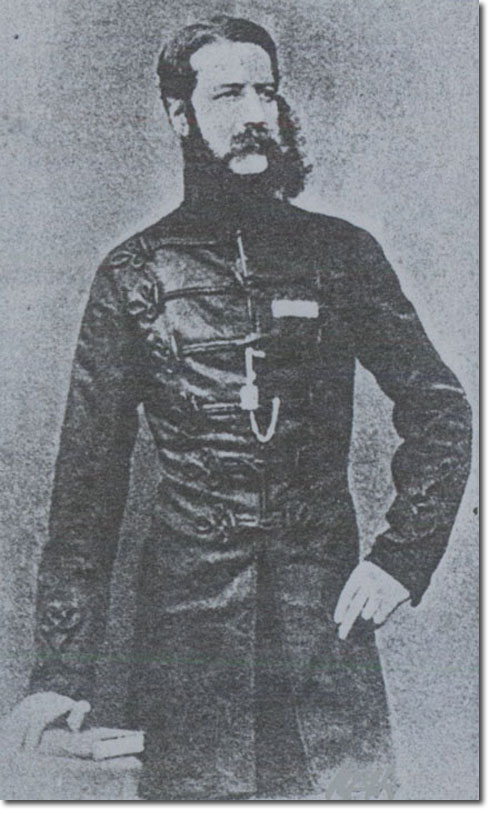
His brothers fared better – Colonel Robert Leith would be the first officer to command the 106th Regiment of Foot (Bombay Light Infantry). Promoted to Major General on the 6th March 1868, to Lieut.-General on the 1st October 1877 and to General on the 1st July 1881, he died on the Isle of Wight in 1892, aged 73.
Thomas ended his career as a major in the Bombay Staff Corps, returned home and held the office of Justice of the Peace and Deputy Lieutenant, in Aberdeenshire, Scotland. He had a remarkably long life, dying in 1920.
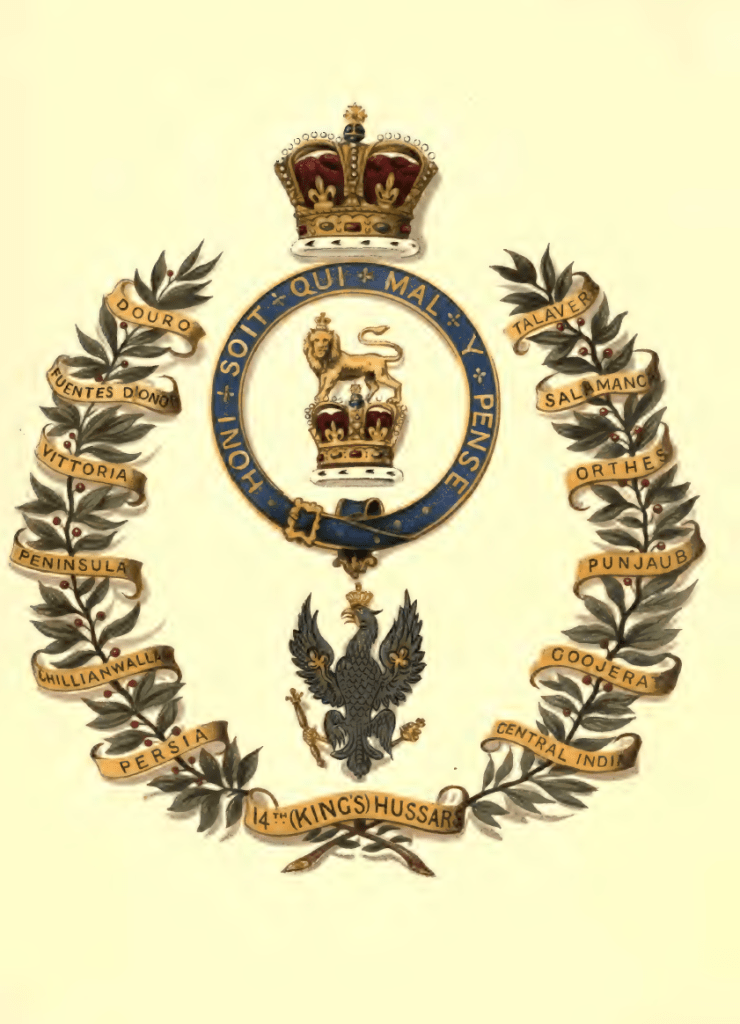
Lieutenant James Leith’s VC would be the only one awarded to a man of the 14th Light Dragoons for the mutiny. The regiment would not have another recipient for the next 42 years, when Major Edward Douglas Brown was gazetted during the Second Boer War on 13 October.
Sources:
Hamilton, Henry Blackburne. Historical Record of the 14th (King’s) Hussars from 1715 to 1900. London: Longmans, Green & Co., 1901.
Vibart, Henry M. The Life of General Sir H.N.D. Prendergast, R.E., V.C., G.C.B. (The Happy Warrior). London: Eveleigh Nash, 1914.
Links:
https://www.espncricinfo.com/cricketers/james-leith-16788
https://vcgca.org/our-people/profile/1125/James-LEITH
https://victoriacross.org.uk/bbleithj.htm
http://lewishamwarmemorials.wikidot.com/person:leith-james-vc
https://military-history.fandom.com/wiki/Alexander_Leith_(British_Army_officer)
FIBIS
https://lenathehyena.wordpress.com/tag/james-leith/
 Mutiny Reflections