“At this time, a new era dawned on our force. A general who shed the brightest lustre on our arms joined us—a man who went from victory to victory. Though he knew nothing of India and its customs, and less of its languages, he took and kept his own counsel, set at nought routine and red-tapism, while inculcating the most rigid discipline.”
This man was Major General Sir Hugh Rose, K.C.B. At fifty-six, he was by far not the youngest man for the work at hand, but he certainly was experienced in warfare. Rose, the third son of Sir George Rose of Sandhills, was born in Berlin in 1801, where his father was the British Minister to the Prussian Court. He received his early education in the art of war from Prussian officers of the court. Following a stint at St. John’s College, Cambridge, in 1819, Rose was commissioned as an ensign in the 93rd Sutherland Highlanders in 1820.
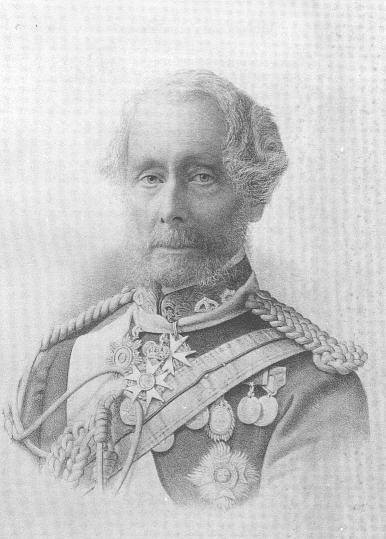
Although the first 20 years of his career cannot be said to be spectacular, consisting of an exchange, first to the 19th Regiment of Foot and then to the 92nd Highlanders, with duty in Ireland, Gibraltar and Malta, by 1839, Rose was a lieutenant-colonel.
Things certainly picked up in 1840 when Rose was chosen as part of a group of military advisers, whose objective was to “check the progress of the rebellious Pasha of Egypt,” and they were deputed to serve with Omar Pasha’s Brigade in Syria. The objective was to chase the forces of Mehmet Ali from Syria; Rose distinguished himself at the Battle of El Mesden in 1841, when, during a hand-to-hand encounter with the Egyptian cavalry, Rose, who was wounded, managed to capture their leader. The exploit gained him a sabre of honour from the Sultan and the Order of the Nishan Iftar, which was set in diamonds. Frederick William of Prussia had not forgotten his “young friend” and bestowed on him the Cross of St. John of Jerusalem. The British gave him a CB. As such, his career in Syria was just beginning — Rose would be appointed the British Consul-General and would continue keeping the various factions from flying at each other’s throats for the next ten years. In 1851, he was appointed Secretary to the Embassy of Constantinople, and eventually found himself as Colonel Rose and Queen’s Commissioner with the French Army in Crimea with the rank of brigadier general. He would distinguish himself at both the Alma and Inkerman, and Marshall Canrobet would even recommend him for a Victoria Cross. “He received the thanks of the French general and of Lord Clarendon for his tactful address and helpful advice tendered to the French commanders, and on his return home was made a Knight of the Bath,” and a step-up in rank for his distinguished conduct in the field. He also received the Turkish order of the Medjidie. As a leader, Rose never spared himself and, as such, did not spare his subordinates. While he could be impatient with the failings of others, everyone could agree that, on the whole, just and generous to his officers and men alike.
When the mutiny broke out in 1857, Rose did not hesitate to offer his services, but he did not land in Bombay until September of that year, having been given a division in the Bombay Presidency. He would not spend his time in a staff appointment — instead, he was given the command of the Central India Field Force. Sir Hugh Rose took command on 17 December 1857 at Mhow.
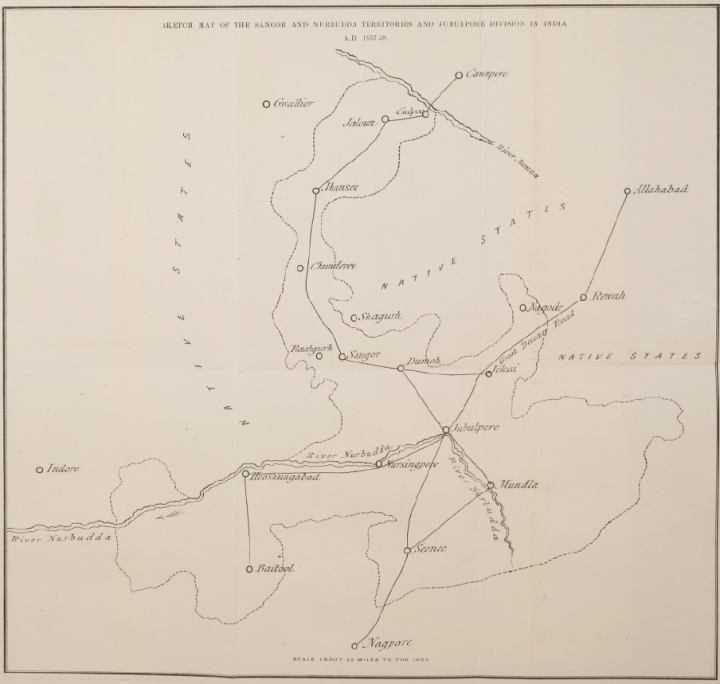
At the time, the field force consisted of two brigades — one at Mhow and the other at Sehore. The Malwa Field Force, which had done such sterling work, was now the First Brigade.
First Brigade at Mhow, Brigadier C.S. Stuart, Bombay Army, commanding:
One squadron, 14th Light Dragoons
One troop, 3rd Bombay Light Cavalry
HM’s 86th Regiment of Foot, two companies
25th Regiment, Bombay Native Infantry — the remainder of the companies would join the force at a later date.
Three light field batteries, one belonging to the Royal Artillery, one to Bombay, and the third to Hyderabad.
Sappers
Major W.A. Orr would form the advanced guard with a portion of the Hyderabad Contingent Field Force, consisting of two regiments of cavalry and one of infantry.
Second Brigade at Sehore, Brigadier Steuart, 14th Light Dragoons, commanding:
14th Light Dragoons, headquarters
3rd Bombay Light Cavalry, headquarters
3rd Bombay European Fusiliers – the remainder of the companies would join the force at a later date
24th Regiment, Bombay Native Infantry
One battery, Bombay Horse Artillery
One Light Field Battery
One Battery, Bhopal Artillery
One Company, Madras Sappers
A detachment of the Hyderabad Contingent Field Force, consisting of one regiment of cavalry, one regiment of infantry, and one artillery field battery. The Siege Train would be organised in Mhow and join the force in Sehore.
Sir Hugh Rose, now in Mhow, would remain there until 30 December 1857 while the siege-train was fitted up and to organise improved carriages for the troops. Although the task of relieving the garrison at Saugor had been given to Brigadier Whitlock, Sir Hugh Rose knew that the Madras Column would not reach its vicinity for another two months and he took it on himself to diverge from the original plan, determining with only a portion of his force to march to Sagar’s relief. However, to do so, he would have to take Rahatgarh Fort first.
Malwa and Rajputana supplied thousands of camels for the effort, but it was still not enough, although it would be the first campaign which utilised camel ambulances. To dispense with a trailing line of hackeries, officers were ordered to leave their heavy baggage behind in Mhow — Sir Hugh Rose wanted to move swiftly, and the fewer impedimenta he had from the start, the better. On 6 January 1858, Sir Hugh Rose, accompanied by Sir Robert Hamilton, started from Mhow to join the Sehore Brigade, taking a troop of Dragoons under Captain Leith, and part of the Hyderabad under Captain G. Hare with him to join the Sehore Brigade; the siege train would leave on the 8th of January and the remaining Mhow Brigade were to march north, one month later, towards Chanderi to form a junction with the Sehore Brigade before attacking Jhansi.
The March Begins
For the siege train, the start of the march could not have been worse. Leaving Indore around five in the morning, they had scarcely proceeded four miles when a violent explosion rent the air. Believing themselves fired on in ambush to their rear, the officers turned around to see a black column of smoke rising in the air from the artillery of the Hyderabad Contingent; men were rushing about wildly, others frantically ran back to the wagons. The halt was sounded, and the officers galloped to the spot to find a limber of a 9-pounder, filled with loaded shell, had exploded, apparently due to faulty packing.
“There lay a human foot in one spot, pieces of flesh in another, burning cloth in a third; a wounded man here, another dying there, a third with the hair of his face and head singed, off, his jaw broken. Two men were blown to atoms – the head with the right arm attached being all that was found. The limber had disappeared, and the gun, with its trail broken, was driven some yards back, covered with blood. The oxen stood still as death, also wounded. The driver who sat upon the box was only blown off while the second ahead of him was killed.”
The dead, what could be found of them, were buried by the wayside, the injured sent back to Indore, and the force continued its now somewhat melancholy march to Sehore. They arrived on the 15th. On the following morning, Sir Hugh Rose left Sehore with the Second Brigade and proceeded to Bhopal, opening the Central India Campaign. The same day, Rose moved onwards towards Rahatgarh.
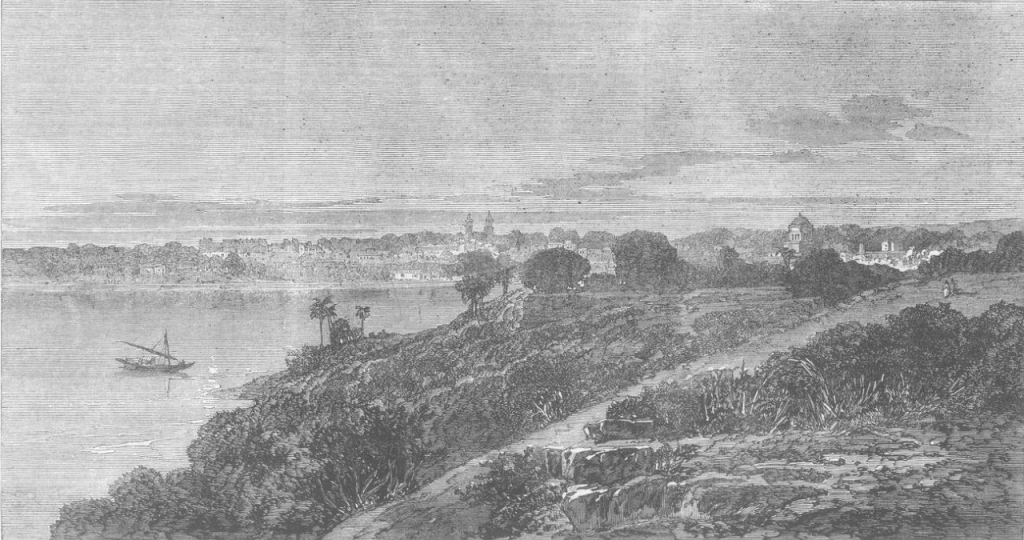
The Begum of Bhopal, who had been playing a game as difficult as that of Scindia at Gwalior, had been putting off the mutinous solicitations of her people for months now, assuring them that the time to expel the British had not yet come. She resorted to bribing her mutinous soldiers to switch their loyalty back to her. She had had little sway over the Bhopal Contingent or several of her male relatives who joined the rebellion.
While the Bhopal Contingent headquarters were at Sehore, detachments were in Indore, where they refused to assist Colonel Durand back in July; of the 270 men, only twelve followed orders, the rest refused to fight and resorted to threatening their officers. Durand retreated to Sehore with a few sowars of the Bhopal Cavalry, but these refused to accompany him further. The bulk of the Bhopal Contingent joined the Indore Brigade to share its fortunes and misfortunes, right up to their annihilation at the Kala Nadi. Others remained in Sehore: it must be noted that their grievance was less with the British but more with the Begum – they were disgruntled over low wages, half of what the soldiers of Indore and Gwalior were being paid. Shortly after Durand was forced to flee Indore, William Rickards, commissioner at Sehore, and his family did the same and ended up in Hoshangabad. The Bhopal Contingent, which by now had effectively ceased to exist, became part of a parallel, albeit temporary, government set up in Sehore by Risaldar Wali Shah and Kotha-Havaldar Mahavir. To fund their new enterprise, they extorted money from the coffers of the Mahajans of Sehore and looted what they could from the state treasury of the Sehore Tehsil. Then, with all that done, they allowed not just the sepoys but the badmashes to destroy every single British bungalow and plunder the arms and ammunition from the Magazine. With the support of what was once the Bhopal Contingent, other rebel leaders proceeded to plunder and ransack other towns in Bhopal – Sikandar Begum managed to oust some of them on her own, punishing rebels and forcing others to flee. Those being held in Sehore when Sir Hugh Rose arrived had been captured by the Begum’s force. While she had a hand in some of their punishments, much was left up to Rose.
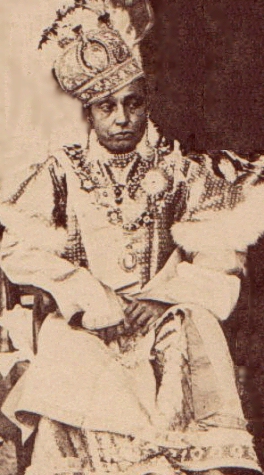
“One hundred and fifty mutineers of the Bhopal Contingent, which had in great part proved faithless, were put to a merciful death. Anticipating what was in store for them, they made a futile attempt to escape, and, consequently, many brought their career to a close a few hours sooner. They were killed by the sentries and guards placed over them.” While this sounds barbaric, 274 of them were dismissed, and 228 were retained. All of them were tried by court martial, and 195 were found guilty of mutiny. The Sikhs of the Contingent who had not mutinied were placed at the disposal of Captain H.O. Mayne and formed the nucleus of the Central India Horse. As for the Begum, she remained, despite continued pressure from her concillors, her relations and swathes of people in Bhopal, staunchly committed to the British. Sadly, the modern world has chosen to deride this remarkable ruler as a woman of “passive fibre.” When Sir Hugh Rose arrived in Bhopal, the Begum furnished him with fresh supplies for his force and placed 800 men of her personal levies at his disposal. The siege train followed on the next day.
One hundred miles from Sehore and twenty-five miles southwest of Sagar was the Fortress of Rahatgarh. Here, the first shots of the Central India Campaign would fall, but it would not be without a few surprises for Sir Hugh Rose.
Sources:
Burton, Reginald George. A History of the Hyderabad Contingent. Calcutta: Government of India Central Printing Office, 1905.
Forrest, George W., ed. Selections of Letters, Despatches and other State Papers Preserved in the Military Department of the Government of India 1857-58. Vol. IV. Calcutta: Superintendent Government Printing India, 1912.
Intelligence Branch, comp. The Revolt in Central India 1857-59. Simla: Government Monotype Press, 1908.
Lowe, Thomas. Central India during the Rebellion of 1857-1858. London: Longman, Green, Longman & Roberts, 1860.
Malleson, G.B. History of the Indian Mutiny, commencing from the close of the 2nd Volume of Sir John Kaye’s History of the Sepoy War. Vol. III. London: W.H. Allen & Co., 1888.
Stotherd, E.A.W. History of the Thirtieth Lancers, Gordon’s Horse, formerly 4th Nizam’s Cavalry, 4th Cavalry, Hyderabad Contingent, 4th Lancers, Hyderabad Contingent. Aldershot: Gale & Polden, Ltd., 1911.
Sylvester, John Henry. Recollections of the Campaign in Malwa and Central India under Major General Sir Hugh Rose. Bombay: Smith, Taylor & Co., 1860.
 Mutiny Reflections