The 93rd Set Sail for China
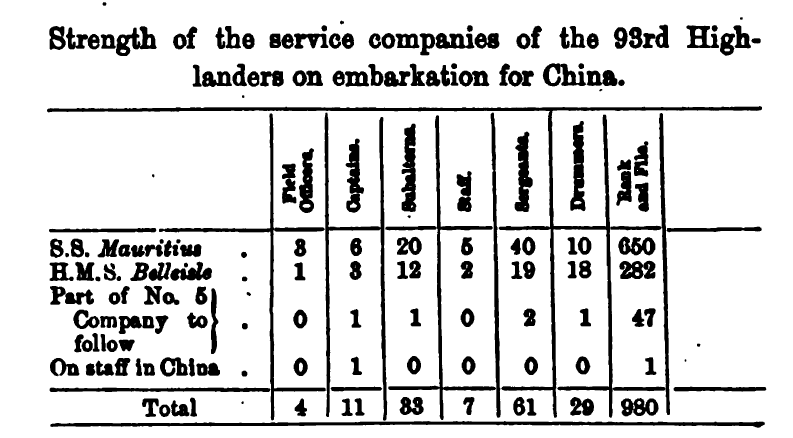
The regiment had barely been in England a year when orders came for them to leave their comfortable quarters at Dover and move to Portsmouth; here, three companies of the 93rd (No. 3, 7 and 8) under Lieutenant-Colonel Adrian Hope were to board the “Belleisle” and set sail for China on 3 June. When their ship left England behind, no one on board knew as yet that India was in the grips of a mutiny.
Nearly two weeks later, on 16 June, the Grenadiers, No. 1,2,4,6, with the light companies, boarded the screw steamer the “Mauritius”. Only part of the 5th company would be making this voyage – Captain Sprot, Ensign Mackenzie, two sergeants, one piper and 47 rank and file would be left behind as the ship was already full to the brim. They would sail on a different day. On the 17th of June 1857, the “Mauritius” set sail, expecting, in three months, to reach Singapore. Brevet Lieutenant-Colonel John Ewart amused himself by occasionally taking observations and taking the latitude and longitude, using a sextant lent him by the captain, who found Ewart knew how to handle the instrument. For reading, he had taken with him A Parliamentary Blue Book sent to him by his cousin William Ewart, M.P., amongst others, one being the life of Sir Charles Napier. He had his own cabin and found himself “tolerably well off.”
“As regards our life on board, I may mention that we breakfasted at nine, lunched at twelve, dined at four, and had tea at half past seven. On one occasion, we had all the pipers into the saloon to play during dinner; the wind was aft at the time, and the vessel was rolling a great deal. The scene, therefore, as they marched, or rather tried to march round the table, was laughable in the extreme, and the nature of the music must be imagined.”
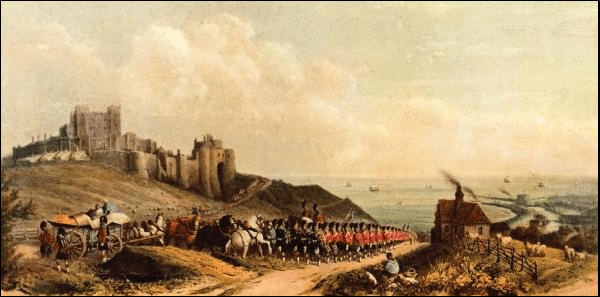
It was a voyage like any other. By the 30th of June, they had reached St Vincent in the Cape Verde Islands and remained there for coaling until 4 July. On the evening of the 11th August, they were finally anchored at Simon’s Bay, at the Cape of Good Hope.
Onwards to India
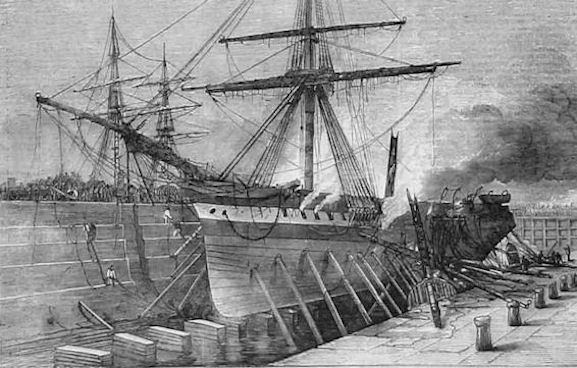
Built by:
C. J. Mare & Co. of Blackwall
Auxiliary Screw.Three masts.Two masts in 1869.
1889. Sold to Norway.
8th November 1892. Wrecked off of Cardiff, under the Norwegian flag.
Thinking the Belleisle might be nearby, the 93rd sounded their regimental call and out of the dark came the reply, confirming she was certainly there. With night rapidly falling, Lieutenant-Colonel Hope and some other officers quickly set off to visit the Mauritius – they had some news to tell, and it could not wait until morning. As it was, the 93rd would not see Singapore – Hope informed Ewart and the others of the mutiny, and Lord Canning had requested the Governor of the Cape to stop every regiment proceeding to China and send them, with all haste, to India. Rumours abounded – the only information they had on any certainty was that General Anson was dead and Sir Henry Bernard was besieged at Delhi. For Burroughs of the 93rd, he had the first news that his father might well have been murdered.
The Belleisle set sail on the 12th, with the Mauritius following on the 16th. By the morning of the 29th, they were in Port Louis Harbour in Mauritius. Ewart went on shore to meet with some old friends, but the news from India was hardly heartening. Reading through the newspapers, Ewart found the mutineers were still at Delhi, Sir Henry Lawrence was dead, the 78th had fought their way to Cawnpore and his old regiment, the 35th, was moving up. As he looked through the pages, he was horrified to find that 2 companies of the 84th had been cut to pieces at Cawnpore.
After three days, the Mauritius pulled out of Port Louis. On the 12th of September, they passed Ceylon without touching down. Two days later, they fell in with a vessel from Calcutta – the only intelligence they received was that the 93rd were anxiously expected. On the 18th, they arrived at Diamond Harbour on the Hooghly, having made the passage from England in 93 days. On the 20th – the anniversary of the Battle of Alma- the 93rd Highlanders disembarked in Calcutta. For John Ewart, the first news he received threw a cloud over his day – his cousin, his wife and their daughter had been murdered at Cawnpore.
The 93rd March
On the 22nd of September, Lieutenant-Colonel Alexander Sebastian Leith-Hay received orders to send off 350 men to Chinsura under a field officer, and Ewart was selected to command the detachment.
“We started at ten a.m. in a large river-boat attached to a steam tug, and reached our destination at half-past four in the afternoon, the distance by water being about forty miles, though, I believe, only about twenty-five by land. My men were all in their kilts, and as I had three pipers with me, who discoursed sweet music, we astonished the natives not a little as we steamed up the Hoogly, numbers of people coming out to look at us as we passed Barrackpore, and the French settlement of Chandernagore.”
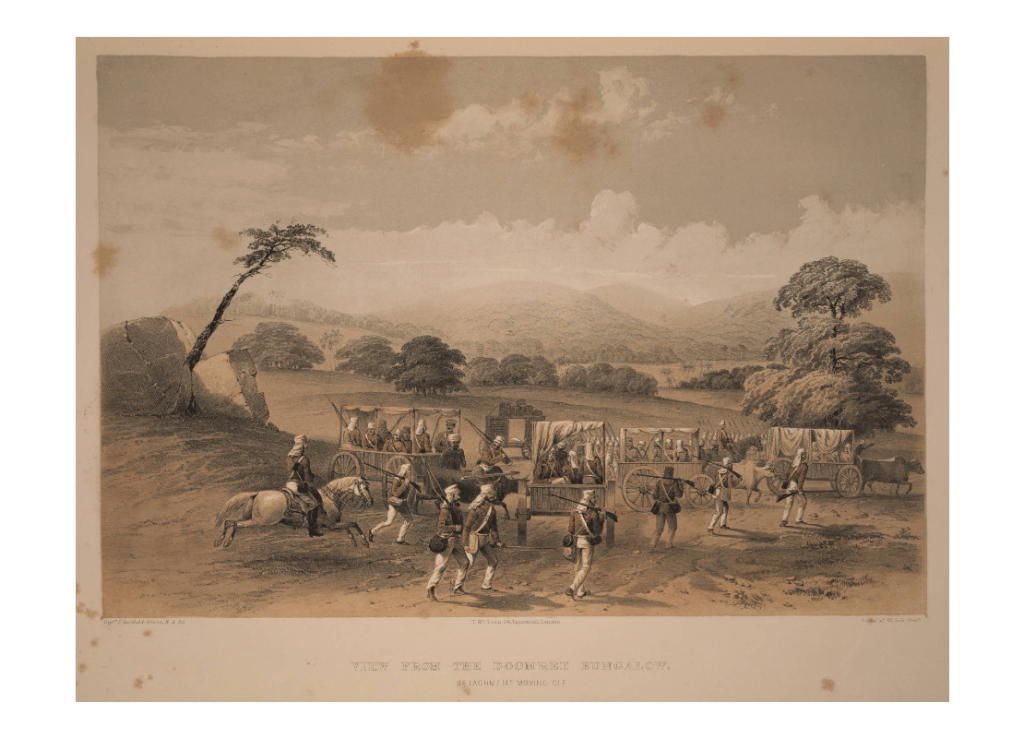
On the 28th, they proceeded to Allahabad, first by rail from Raniganj and then by bullock train from the 6th of October, traversing the 421 miles to Benares in 11 days. Ewart’s detachment occupied 24 carts, with four men travelling in a cart, drawn by 2 bullocks, travelling mostly at night. It was long and tiresome, but the weather was fine, and Ewart concluded, “The life of a gypsy must on the whole be a rather jovial one.” For his part, Ewart walked most of the distance at night and slept during the day when the column ground to a halt. One cart carried provisions, and rum for the men, as rations were not issued to the officers “as in the Crimea,” so Ewart had ensured he purchased a stock of tea, sugar and other articles before leaving Calcutta. According to orders, Ewart telegraphed Calcutta every day to inform them of the state of the country they were passing through- until now, everything was curiously peaceful. Determined to give his men at least one night’s rest, he decided to push onto Shergotty instead of halting at Barra as other detachments in front had done – they covered the distance of 33 miles in one march, and as a result, his men could rest for a full two days before pushing on.
“Our march up the country was a very amusing one, though, of course, I had to keep a good lookout, especially as we had charge of the Colours. The Dunwa, or Dhunwah Pass, was the most gloomy part of our journey, wood and jungle extending on each side for miles, which was no doubt full of tigers. We did not, however, see one, nor did the rebels take the opportunity of forming an ambush. A day or two after, I was walking along one morning some little distance in front of the carts, when just as it was beginning to get light, I suddenly saw a wild beast close to my right, taking a look at me. I was quite alone, but having my revolver fastened round my waist, I did not much care. Presently, the brute disappeared into the jungle, no doubt hearing the noise of the carts in the distance. It looked something like a leopard. On another occasion, I saw a wolf seated in a field. The native drivers told me to look out for snakes, but I fortunately never trod upon one. We passed and met a number of elephants employed by the Commissariat Department, and I was greatly entertained one day by a huge fellow engaged in washing himself in a pond.”
During the march, they crossed paths with some of the 53rd Regiment, some of the Madras Native Artillery and 200 men of the Military Train. There was little time for pleasantries – Ewart pushed on to Benares. Here, he found Captain C.W. McDonald, who had been instructed to wait for Ewart as a body of 800 mutineers was suspected in the vicinity of Allahabad. With his detachment thus increased to 168 men and Dr. Munro, who had accompanied McDonald, Ewart set off on the 17th towards Allahabad. They marched 35 miles to Gopiganj and halted for the men to eat – Ewart planned to start again as soon as they were ready, but intelligence arrived that the rebels were only 10 miles off. He would have to proceed with some caution – with night approaching, the last thing he wanted was a battle in the dark.
“We had only gone a few miles when, suddenly, bang went a gun, apparently a 6- 6-pounder, about a mile to my left, followed almost immediately by a second. It was now quite dark, so I could see nothing, but at once halted and formed up my carts, thirty-seven in number, as close together as I could – a difficult proceeding with bullocks and drivers. A third gun was now fired, and voices could be heard; a light or two was also seen approaching. I therefore ordered my detachment to load and prepared for a little fight of my own, quite determined to defend the Colours to the last. Luckily, I had with me a very intelligent young officer belonging to the Company’s Service who could speak Hindostanee; so before opening fire, I decided to send him quietly forward with one or two of my men, for the purpose of reconnoitring. In a short time, he returned and reported that he had met a large procession engaged in celebrating a wedding but that they had dispersed in all directions on catching sight of his Highlanders.”
Everyone had a laugh, but Ewart was glad he had not favoured the supposed enemy with a volley.
During the march, the passed some Sikh cavalry who informed him there were no less than 1500 rebels on the road ahead, but instead, Ewart found three artillery sepoys – all with furlough papers – who said they were returning to Allahabad after leave. Ewart let them go.
They reached Allahabad on the 19th of October – Brigadier Adrian Hope had already marched onwards with three companies towards Fatehpur; other companies of the 93rd began to arrive in the next days, but Ewart was ordered to proceed to Cawnpore with four officers and 100 men on the 22nd. Loaded up again in carts, by the 24th they had arrived within 14 miles of Fatehpur to the news that the rebels had crossed the Jumna and were supposed to be planning an attack on the fort. Ewart pushed his men on as rapidly as possible only to find Captain Cornwall’s company of the 93rd in the fort. Adrian Hope had marched on with 3 companies towards Cawnpore. Besides the Highlanders, the fort contained twenty artillerymen and thirty sick belonging to the 5th Fusiliers and 90th Light Infantry, the regiments had gone on with Outram. Armed with only two guns, Captain Cornwall begged Ewart to stay as he expected to be attacked at any moment, but his orders were to march to Cawnpore. With some hesitation, Ewart remained for a day to ascertain where the now nearly fabled mutineers could possibly be. It turned out they had not crossed the river but were still only considering it, eighteen miles away. With Peel’s Brigade following on behind and other companies of the 93rd moving up, Ewart bid goodbye to Cornwall and pushed on.
Exactly 18 miles from Fatehpur, a fire of musketry suddenly commenced off to his left – the rebels were on the move and had crossed the river at Chilla Tara Ghat; he could only presume some were most likely on the Grand Trunk Road ahead of him. After a short halt and with rifles loaded, the 93rd moved on, Ewart anxious to avoid the rebels at all costs; his force was small, and support was too far off to be of any use. The firing continued for another 45 minutes, but they saw no one.
“What the mutineers could be doing, I could not imagine, as there were no Europeans in the neighbourhood for them to kill, and they could hardly have been celebrating another wedding. It is just possible that they were firing off their muskets preparatory to cleaning them; if not, they must have been firing at some imaginary enemy, as I remember the Russians once doing.”
After 36 miles of marching, Ewart succeeded in making a juncture with Adrian Hope at Maharajpur. Here, he found he and his men had slipped past the Banda rebels, some 800 strong with 16 guns, but he never found out who had been shooting at what. As Ewart’s orders were to push onto Cawnpore with all speed, it was decided he should push on, and Hope would follow on. Ewart started the march on the evening of the 26th and, around midnight, arrived in Cawnpore. Having left the main road, Ewart and his men suddenly found themselves on an open plain. He ordered a halt – without a guide and no knowledge of the place, he could not say for sure which way to go. Ewart set off to reconnoitre the grounds in what he hoped was the right direction.
At Cawnpore
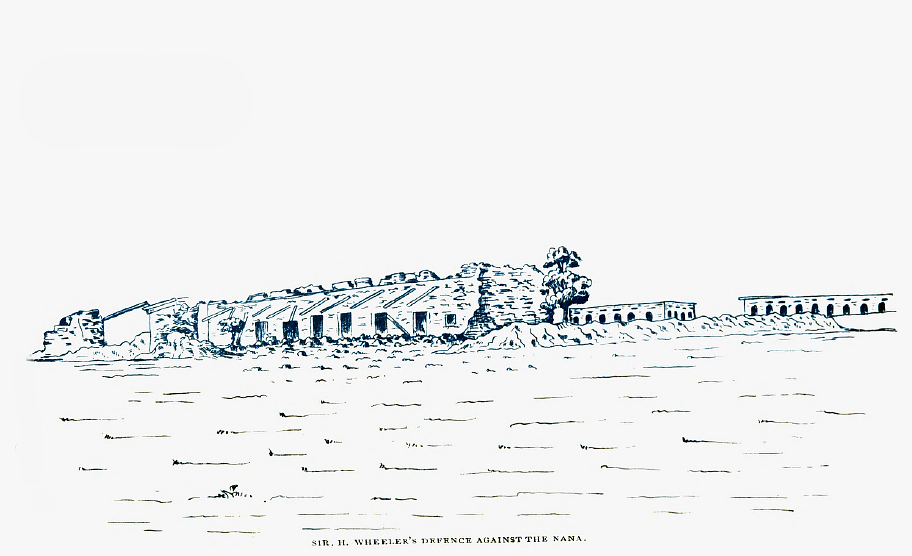
A short distance from his men, he heard English voices – after hailing them, a soldier came running up. He pointed out the ruined artillery barracks off to the left, “which, he stated, was the place in which General Wheeler had been besieged; there was light enough for me to notice that close by were several large houses arranged in a sort of echelon, built of brick, and in an unfinished state.” From here, Havelock’s entrenchment was only a mile distant; leaving his detachment on the plain, Ewart proceeded with a guide. To his surprise, no one was expecting them. Captain McCrea of the 64th was rustled out of bed, and he quickly sent for Colonel Wilson (64th and in charge of Cawnpore). Astonished to find a detachment of the 93rd on his doorstep and infinitely happier to know another three companies were on their way under Adrian Hope, Wilson suggested the men remain the night on the plain, and the next morning, he would settle what to do with them. Shortly after daybreak, the men were settled in a large empty barrack – two long buildings a mile from the entrenchment and near the river.
Cawnpore was gradually filling up with troops – the day before Ewart’s arrival Brigadier Hope Grant and the Delhi Column had arrived with two troops of Horse Artillery and a field battery, HM’s 9th Lancers, the 1st, 2nd and 4th Punjab Cavalry and Hodson’s Horse; HM’s 8th and 75th Regiments and the 2nd and 4th Punjab Infantry. In all, there were 600 cavalry and 16 guns but the infantry regiments were weak – the arrival of the 93rd was more welcome than Ewart could imagine. On the 27th, Adrian Hope arrived with his three companies and joined Ewart at the barracks. The carts were sent back to Allahabad and Ewart lamented his gypsy life was, at least for a moment, over.
For Ewart, the stop at Cawnpore would at least give him a chance to ascertain the fate of his namesake, Colonel John Ewart of the 1st BNI. Sending his servant off to the bazaar to question the shopkeepers, Ewart proceeded alone to Wheeler’s Entrenchment.
“On reaching the intrenchment, I found it a complete ruin, and it was pretty evident that Sir Hugh Wheeler had held out almost as long as it was possible. The rooms were full of books, some religious and some which must have belonged to children, and I also found a quantity of music, several ladies’ shoes, and numerous locks of hair. A note in pencil on one of the walls informed me that Captain Halliday, of the 56th Native Infantry, was killed by a round shot on the 9th June; but I could find no letters or papers with the name of Ewart. Whilst continuing my search I came, on entering one of the rooms, upon an officer in a Light Cavalry uniform, who was gazing sadly upon the desolate scene. We had some conversation together, and he showed me a beautiful lock of hair he had just picked up. Presently he said, “I think you do not know me;” and on my replying that such was the case, he informed me that he was Hope Grant. This was my first introduction to an officer who afterwards so greatly distinguished himself.”
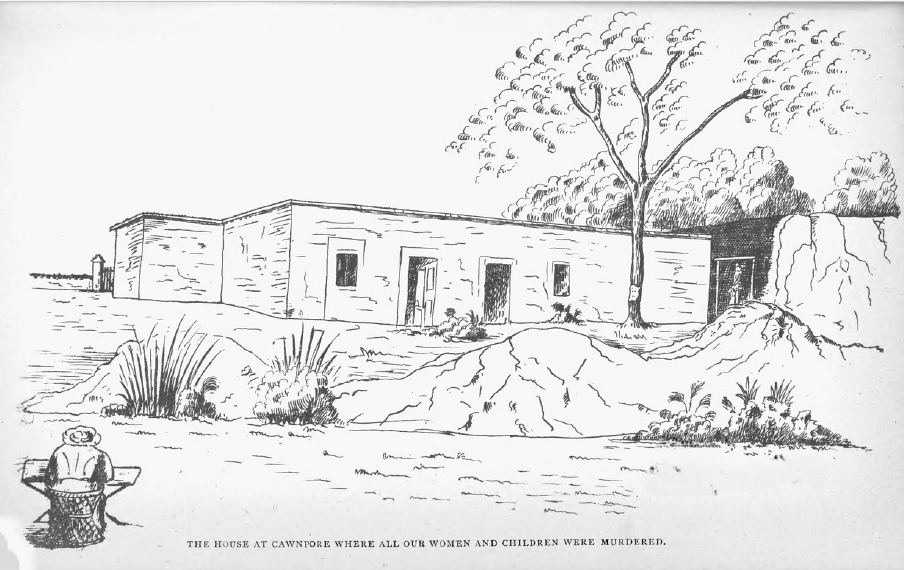
His next stop on the melancholy tour was the Bibighar. He found it to be an insignificant-looking house from the outside; inside, however, the rooms were still full of shreds of ladies’ dresses and numbers of shoes were strewn about in all directions, along with locks of hair. The mats were stained with blood as were the sides of the rooms, and the sabre cuts told their own story. On approaching the well, which had by now been mercifully covered, Ewart found a skull with “beautiful teeth” under some bushes.
“As I looked around, I could almost have cried with rage; and when I left the house where this fearful crime of unsurpassed brutality had been committed, I felt that I had become a changed man. All feelings of mercy or consideration for the mutineers had left me; I was no longer a Christian, and all I wanted was revenge. In the Crimea, I had never wished to kill a Russian, or ever tried to, but now my one idea was to kill every rebel I could come across.”
On returning to the barracks, Ewart sent for his servant – the man told him he had asked around the bazaar, but he had not found out anything positive about Lieutenant-Colonel Ewart’s fate – everyone, he said, was too afraid to speak of the massacre, and no one would even direct him to the Ewarts’ house. He would eventually find out that his cousin and his wife had survived the entrenchment, but the lieutenant colonel had been badly wounded. He was being carried on a charpoy by some bearers, followed by his wife: they had fallen behind the column proceeding to the river when some sepoys from his regiment stopped them. After asking Ewart in a mocking tone if he was pleased with their parade and were well turned out, they cut him down with their swords. Mrs Ewart was promised her life; as she sat on the ground next to her dead husband, they suddenly killed her with their swords. As for their daughter, she had died during the siege. Curiously enough, Ewart was left believing the bodies of his kinsman and his family had been thrown into the well at the Bibighar – but when truth be told, they were most likely cast into the river or simply left where they lay, pickings for the carrion birds and dogs.
The 2nd of November
At the end of October, news arrived in Cawnpore that the Gwalior Contingent had finally marched and were on the move, presumably towards Cawnpore, with 30 guns. The Banda and Dinapore mutineers, too, were still threatening to cut communications with Allahabad, and on the very day Hope Grant pushed onwards to the Alambagh – the 30th of October – they crossed the Jumna. Captain Cornwall was still at Fatehpur, reinforced for a moment by Captain Peel and his guns. Lieutenant-Colonel Powell, with some of the 53rd and two more companies of the 93rd under brevet Lieutenant-Colonel Gordon, had arrived there with a company of sappers. On the 1st of November, they met the mutineers at Kudjwa. As for the company of 93rd under Captain Clarke, when moving up from Chinsura were ordered to proceed to the assistance of Colonel English and the left wing of the 53rd who expected a fight with the Ramghar mutineers – Clarke promptly set off and after a long and harassing march, was met by a messenger that English had thrashed the rebels at Chatra – the 93rd would no longer be needed; they were to march to Cawnpore instead.
Hope Grant crossed the Ganges on the 30th of October and encamped three miles from Cawnpore, on the Lucknow road. His force consisted of the 9th Lancers, some Sikh cavalry, and 20 guns, H.M. 8th and 75th Regiments, each 300 strong, 380 of the 93rd Highlanders, 150 of H.M. 53rd Regiment, 70 of the 5th Fusiliers, and two battalions of Punjab infantry, some 400 men, making a total strength
of about 3000 men of all arms. The cavalry was commanded by Colonel Little, of the 9th Lancers,
and the infantry by Colonel Guy, of the 5th Fusiliers, the latter being divided into two brigades, under Adrian Hope and Greathed. Three officers of the 78th Highlanders, Brevet Lieut. -Colonel Henry Hamilton, Captain A. Mackenzie, and Lieutenant F. H. Walsh marched with them en route to join their regiment at Lucknow.
Ewart had two camels- one for his tent and another for his baggage, but there were no horses to be had at Cawnpore – only the kindness of Captain Bannatyne (of the 8th and previously of the 93rd) solved Ewart’s problem; he had two and lent him one along with a syce. Feeling himself a proper, mounted officer once again, Ewart was ready for any duty that would come his way. It would be sooner than he expected.
On the 2nd of November came the first fight. The rebels had taken up a position in a village a short distance from the road, and Ewart was ordered to attack it, with 2 companies of the 93rd on one side, while Lieutenant Colonel Hamilton of the 78th, with some of the 53rd and 5th, from the other. Ewart advanced with Captain Clarke’s company in skirmishing order, the grenadiers under Captain Middleton as support. The rebels greeted their approach with ineffectual matchlock fire, but they had a surprise for Ewart. On getting close to the village, Ewart saw it was surrounded by a high wall, and it was “regularly fortified.” They had no ladders, but Ewart was ordered to storm it, regardless. He rode up right up to the wall while the rebels, “who must have been shocking bad shots”, hit neither him nor his horse. Instructing his men to get under any cover they could find, they were to open fire on any head they saw peeping over the wall – “We could see the drawn swords, or tulwars as they are called, and the muzzles of the firelocks, but the rebels kept their persons well concealed.” While the rebels were thus occupied, Ewart rode around the wall and found, by chance, a door. Calling some of the Highlanders to follow him, Ewart drew his sword and entered. To his disgust, the door led him into a small room, at the end of which was another door that, when he tried to open it, was found to be barred. Without an iron bar or hammer to hand, there was no way to break through it and worse, the sepoys had heard the racket Ewart and his men were making; they swiftly broke a hole in the mud roof and commenced firing on the party below, “…shooting one man in the groin, and also wounding a second. They contrived to kill one of
the grenadiers, and to put a ball through the nose of another.”
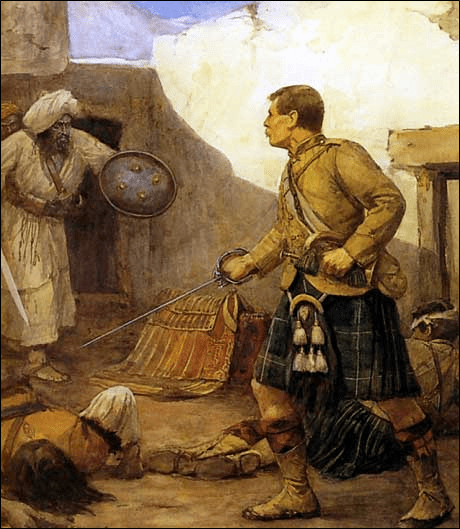
Realising there was no point staying in the room, the men quickly ran out the way they came, but Ewart was still determined to take the village. If he could not get through the door, then he would climb over the wall. The Punjabi infantry came up in support, and soon, they too were trying hard to get in. One of the rebels tried to cover Ewart more than once with his musket and most likely would have ended Ewart’s day had not his men had their eyes on him. Still puzzling over how to get at the rebels in their stronghold, a message came from Hope Grant -Ewart was to come immediately to the front as the rebels were on him in force. Accordingly, Ewart left the 150 Punjabis to watch the village with Hamilton on the other side, still trying to get in. What Ewart couldn’t do, Hamilton succeeded but only after some guns, coming up with the rear-guard, had smashed down the wall. The rebels inside were shown no mercy and proved to be sepoys from various mutinied regiments. The assault cost the force Captain Mackenzie, of the 78th, wounded in the leg, and 17 men of various corps, killed or wounded.
Ewart, in the meantime, was marching quickly to the front and caught up with Hope Grant. The rebels, however, had by this time had quite enough after two rounds from the guns; they left off their attack, leaving one of their guns behind. The force then fell back and took up a position just short of the captured village to wait for Sir Colin Campbell.
Sources:
The Story of a Soldier’s Life or Peace, War and Mutiny, Vol I & II – Lt.Gen. John Alexander Ewart (1881)
Reminiscences of Military Service with the 93rd Sutherland Highlanders – Surgeon General William Munro (1883)
Forty-One Years in India, Vol I- Field Marshal Lord Roberts (1897)
Recollections of a Highland Subaltern -Lt.Col. W. Gordon Alexander (1898)
 Mutiny Reflections