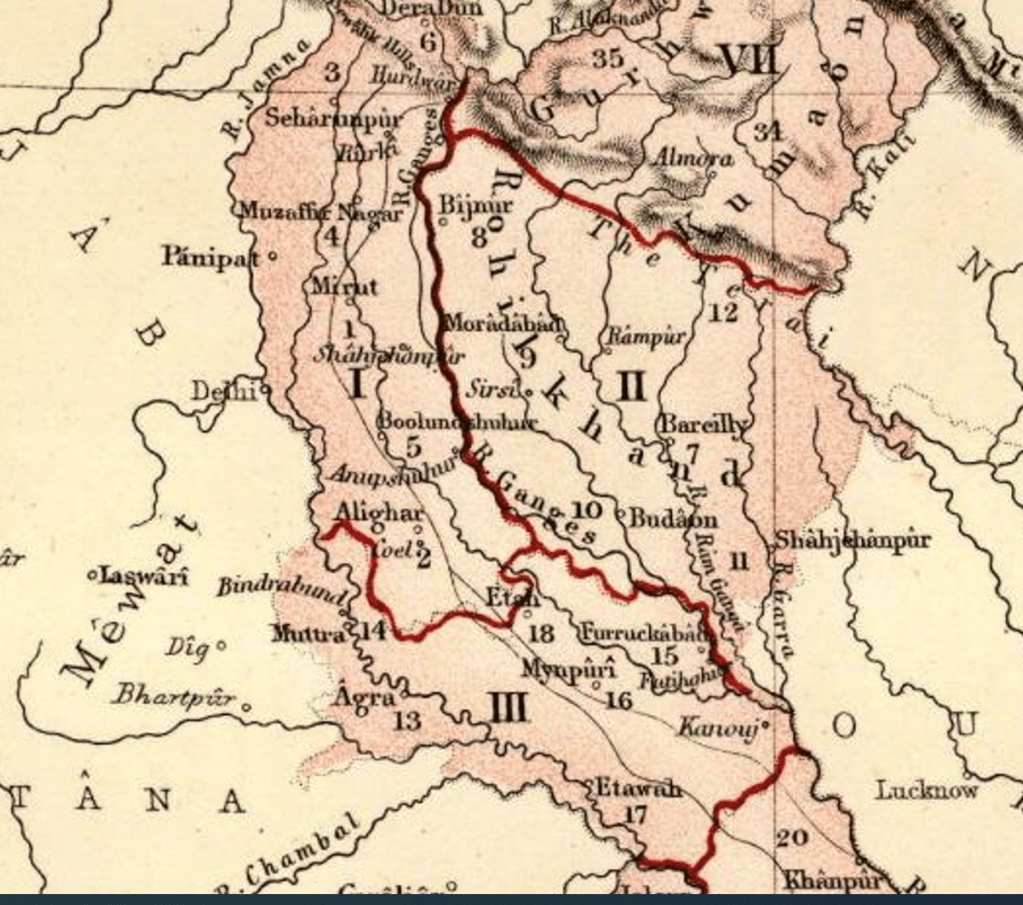
The force that had left Delhi on the 24th of September had consisted of
European Infantry (450 men)
HM 8th Regiment of Foot – Major Hinde
HM 75th Regiment of Foot – Captain Gordon
Punjab Infantry (1,200 men)
2nd Punjab Infantry – Captain Green
4th Punjab Infantry – Captain Wilde
British Cavalry (300 men)
HM 9th Lancers – Colonel Ouvry
Indian Cavalry (320 men)
1st Punjab Cavalry
2nd Punjab Cavalry
5th Punjab Cavalry
Wing of Hodson’s Horse – Lieutenant Hugh Gough commanding (180 men)
Capt Blunt’s Troop of Horse Artillery (60 men, 5 guns)
Capt Remmington’s Troop of Horse Artillery (60 men, 6 guns)
Bourchier’s Light Field Battery (120 men, 5 guns)
Pearson’s 9-pounder Battery
Sappers and Miners (200), with whom were Lieutenants Home and Lang.
The force had been diminished following the battles of Bulandshahr, Akbarbad and Agra, sustaining losses in all ranks and regiments; Lieutenant Home was killed by the ill-fated explosion at the Malagarh Fort on the 1st of October and Wilde had been forced by illness to return to Delhi. There would token reinforcements – a small party of artillerymen with two 18-pounder guns and some convalescents who had been left behind in Delhi – in all some 300 men – would join the column shortly after they left Agra. Colonel James Hope Grant of the 9th Lancers was proceeding with some haste from Delhi to take over command from Colonel Edward Greathed and as the force pushed on from Agra, they would have in tow the civilians of Mainpuri who took advantage of this impromptu escort to return to their district and get away from the hand-wringers in Agra Fort. Two more civilians, one bound for Cawnpore – Mr. Harrington, who could barely be dissuaded from bringing his wife along- and Mr. George Campbell joined the column, assigned the arduous task of organising the intelligence department for the force on his own. A rag-tag band of volunteers, chiefly officers who had been left unemployed after their regiments mutinied, quickly packed their kit and joined the column. They were assigned to the Punjab regiments, whose number of European officers had considerably diminished by the “constantly recurring casualties.” One of these was Captain Carey, a fortunate survivor of Cawnpore who had somehow ended up in Agra Fort.
In May, Carey had, with the rest of the garrison entered Wheeler’s Entrenchment to await whatever Fate intended to throw at them; however, Carey was destined for other duties. A few days before the first shots were fired at Cawnpore, Sir Henry Lawrence sent his Military Secretary, Captain Fletcher Hayes, to Cawnpore to confer with Wheeler and if possible, open up communication with Delhi. He arrived with an escort of the 2nd Oudh Irregular Cavalry. Hayes and Carey were friends of some standing and it was no surprise when he asked Carey to accompany him to Delhi. Carey leapt at the chance – it was certainly a better option than waiting for the thunder to unleash over Cawnpore. Together they set off on the road to Mainpuri.
As they approached Bewar, where the road to Mainpuri turned off, Hayes and Carey decided to take the opportunity to speak to the civilians at that station regarding the state of the road to Delhi and Hayes instructed the Irregulars to proceed towards Delhi with their three British officers. They would catch up with them on the road the next day.
The following day as Hayes and Carey proceeded to the place where they expected to find the troop encamped, they were surprised by the regiment marching towards them in “regular formation” and at a distance, they could not discern if their officers, whose uniforms resembled those of the sowars, were with them. As it turned out, they were not.
Suddenly, when Hayes and Carey got within 200 yards of the sowars, the troopers, “with one accord broke into shouts and yells and brandishing their swords” galloped towards the officers. Without a moment to lose Hayes and Carey turned their horses towards Mainpuri. Unfortunately, Hayes who was an “indifferent rider” was quickly overtaken and cut to pieces while Carey “one of the best horsemen in the army and beautifully mounted” rode pell-mell towards Mainpuri, the sowars hard on his heels. A wide irrigation ditch was all that stood between Carey and his would-be murderers; he took the chance and jumped his horse – the sowars pulled back in wild confusion, unable to clear the distance leaving Carey to ride back to Mainpuri, warn the civilians and then make his way, with them, to Agra Fort.
Here he was, 5 months later, riding on the same road that had brought him to safety, back to ill-fated Cawnpore from whence he had been so fortunate to escape, on to Mainpuri which he had last left with his sterling friend, Hayes who could not ride, past the well where the sowars had barbarously murdered their officers, one of whom had been young Richard Fayrer, the 23-year-old brother of the Residency doctor, a volunteer with the escort. Fayrer, (according to the few sowars that had hightailed it back to Lucknow when their brethren had started murdering), had dismounted his horse and was taking a drink from a well when a sowar had come up behind him and all but severed his head from his neck. Carey was horrified to learn that when he and Hayes had come upon the murderers, Fayrer and the other officers had only been dead less than an hour.
This time Carey was riding in a much different company – young Lieutenant Roberts jogged along on his horse by his side, while weaving along the route like spectres were the wild Punjabis under Probyn and Younghusband, and the scarlet turbanned men of Hodson’s Horse under Gough (Hodson will re-emerge in this tale but for now he is past Delhi on a mission of a different sort). The battle-hardened men of Delhi were on their way to Cawnpore. It would appear that speed was not necessarily the order of the day – 2000 camels laden with supplies for Havelock’s Force were placed under the charge of the column, this, along with their own baggage did not make for quick travelling.
The March Commences
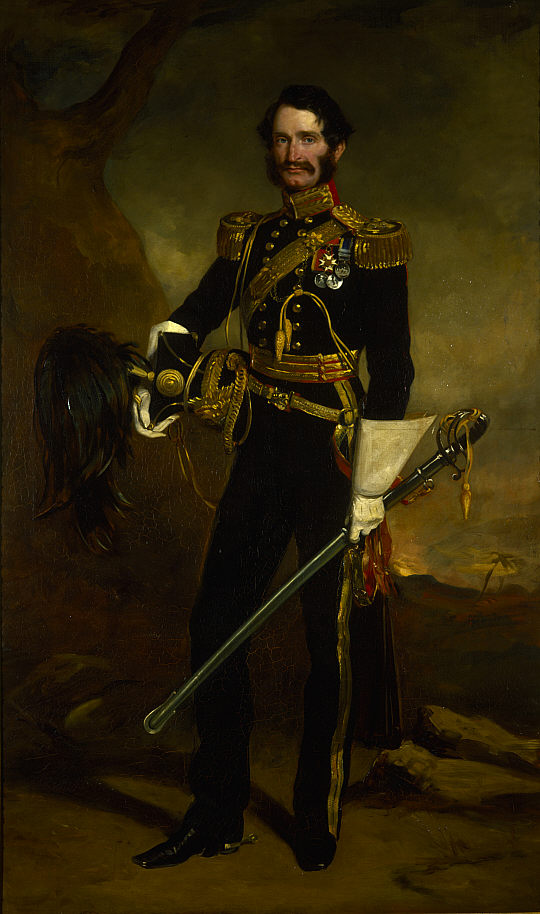
We now take up the scene that ended in Fleeting Intelligence II
“Early on the morning of the 14th October, the column crept stealthily out of Agra; doubtful, indeed, how far we should get away, ere, local timidity being excited, we should be recalled from the more urgent duty—the relief of the Lucknow Garrison. Havelock, it was true, had forced his entrance into the Residency; but he was himself there besieged, and all were clamorous to get on as fast as possible.” (Bourchier)
The first day was less of a march and more of a change of camp and took the column to Rambagh barely out of shouting distance from Agra Fort, on the left bank of the Jamuna. In the pretty gardens, they set up their tents. It was an odd setting for a picnic, but a picnic it was as they entertained the ladies and gentlemen from the Fort who had dared to venture out this far, and waited for the detachments of HM’s 8th and 75th along with the 2 siege guns to catch them up. The next day they were back on the road leaving Agra further behind with each step, away from the politicking and bickering of the ignorant civilians who had nearly brought the column to ruin. The 15th brought them of Boorya-ka-Talao, and on the 16th they reached Ferozabad where Hope Grant joined the column and took over command from Greathed. Two days later, they were encamped outside Mainpuri, expecting the raja, who had had complete control of the district for the past 5 months, would now put up a fight.
As Grant approached the town, Rao Bhawani Singh, a relative of the errant raja and a friend of the British, arrived with a small escort of unarmed men – he informed Grant he believed the Raja was still in his fort and if he made haste he might still catch him. Accordingly, Grant moved onto Mainpuri and arrived on the 19th of October around noon but to his surprise, the Raja and his followers had bolted in his wake. A party was sent to take possession of the fort while Mr. Power, the commissioner of Mainpuri fretted about the governmental treasure he had left behind in June. Raja Tej Singh’s haste must have been supreme as he left the treasure where Power had put it months ago, amounting to some two lacs, in full tally, in the fort. Bourchier could hardly mask his astonishment.
“It is difficult to conceive under what circumstances so large a sum had been saved. The Rao himself may have been able to resist the temptation with a view to future benefits; but how its existence was kept a secret from the Rajah (who, as an acknowledged traitor, could expect no favour from the British Government under any circumstances) is indeed a mystery: or if its existence was known to the Rajah, why was it not appropriated or carried off, when he left the previous night? That might easily have been done, he having a number of elephants and carriages with him. The bags of coin were deposited in a little room with a slight door of open railings. However, there it was, and proved a most acceptable addition to the Commissariat treasure chest.”
The fort itself had not been completely deserted but its occupants were hardly those of a war-like footing. As soon as the gates were opened out marched a “snow white army, headed by a commander in black with a red helmet formed the garrison or, to drop allegory, a flock of geese, headed by a magnificent turkey in all the pride of fantail and scarlet top-knot, cackled forth a hearty welcome. Traitors all, like their masters, a summary sentence of death was passed, and immediately carried out; every man carried off his prize, and a glorious feast was the result.”
Private property found in the rooms of the fort was quickly plundered while under the fort a sizeable quantity of powder was found along with several well-cast guns in different stages of manufacture; one but lately finished was found dropped down a well and a large quantity of ammunition added to the bounty.
As for the fort, it was ordered destroyed but not before Commissioner Power had argued for its reprieve. This argument he lost but when it came to the property of Rao Bhawani Singh, Power was determined the prize agents would have none of it.
“By way of compromise, it was agreed that the doors should be opened, and we should cursorily inspect the interior. The first object that came to view was a huge Government drum; the second (Power’s face of delight was worth coming the distance to see) was a box: not, as will be supposed, containing the gorgeous turban and velvet chupkin,f of the Rao, or the skeleton petticoat and dainty slippers of his daughter, but a most unexceptionable array of coats and inexpressibles, Power’s lost property. This, to a man who on the whole liked a neat turn-out and had been condemned for months to one single shooting coat, was a glorious find.”
As for the town, it had been remarkably spared the ravages visited on others like Meerut or Cawnpore; while the civil station where Power had lived and worked was burned to the ground, including the church, gaol and cutcherry, the rest of Mainpuri was untouched. Anson took a little time to send a letter to his wife, remarking how Mainpuri “seems to have been in perfect order before the mutineers broke upon its shady and serene tranquillity…The trees along the road have been so well cared for, so have the public buildings and town…”
Meanwhile, the rebels were still a step ahead of Grant and had begun entrenching themselves at Bewar, the next stop on the column’s march to Cawnpore. However, it would appear they did not have a stomach for a fight just yet.
After a brief halt, Grant pushed his column towards Bewar – a junction of the roads from Meerut, Agra, Fatehgarh and Cawnpore. Fatehgarh was in the hands of the Nawab, but Grant had received instructions to “make the best of my way to Lucknow, I did not consider myself at liberty to devote any time to its capture.” The fugitives from the ill-fated boats were all dead, and while the Nawab was a nuisance, he was, for the moment at least, not interfering with Grant. Fatehgarh would be dealt with, but not right now. He pushed to Bewar, where instead of finding the rebels, he only found their cooking fires still smouldering and not a rebel in sight. To be certain he would not be caught off guard, Grant ordered his column would henceforth march in regular battle array.
At Bewar, as Hope Grant availed himself of his breakfast by the roadside, a coolie approached him. He swiftly opened up a hole in the cudgel he carried and extracted from it a quill. Inside the quill was a small roll of paper on which a despatch was written, to Hope Grant’s chagrin, in Greek.
“I had almost forgotten my Greek, and I employed several young gentlemen lately from school to decipher the missive…” As it turned out, it had been written by Sir James Outram from his position at the Residency; he was imploring Grant for aid; provisions were running low and they would not be able to hold out much longer. This decided matters for Grant – he would push on towards Cawnpore and give Fatehgarh a pass.
Leaving Bewar, the force marched 29 miles in one day to Gussenganj – on the way Ouvry notes “we have been marching without anything happening, except the burning of a village or two..” while Anson grumbled about not taking Fatehgarh conceded it would “fall just as easily three weeks hence.” He then makes an allusion to the following:
“We thought we were going to have a fight this morning on arriving at our ground, for Ouvry came galloping in for Watson’s Horse, in order to cut up some two or three hundred men that he had seen running away, and who were supposed to be the advance guard of the enemy retreating from Futtyghur, fancying that we were in their rear instead of parallel to them. They made sure that we would go to Futtyghur, but as this did not suit our convenience, we came here instead and sorely puzzled them. We caught an Irregular Cavalry sowar yesterday, and he was shot. Two have been caught today, and are sure to meet the same fate. We are twenty-five miles from Futtyghur.”
Everywhere Grant stepped, the rebels were now headlong in retreat.
On the 23rd of October, they reached Miran-ki-Serai close to the ruined Hindu city of Kannauj.
Action on the Kala Naddi
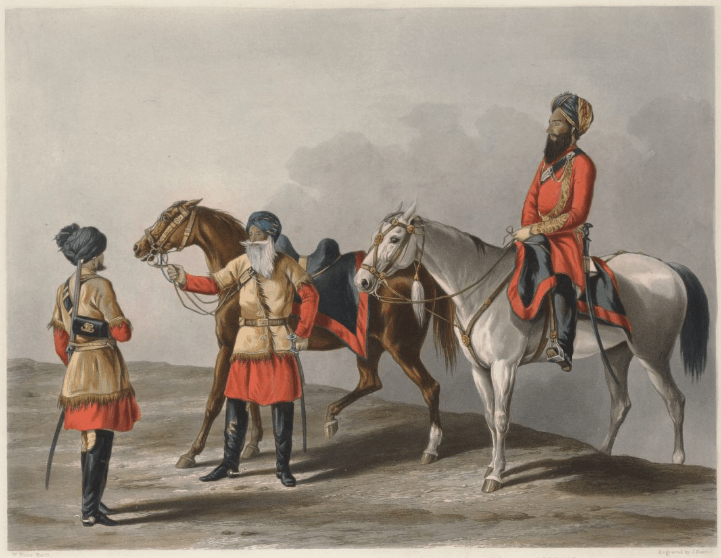
“The same day I went on as usual with a small escort to reconnoitre and had passed through the town when I was fired upon by a party of the rebels, consisting of some 300 cavalry, 500 infantry and 4 guns, who have heard of the approach of the column were trying to get away before it arrived.” The cavalry and infantry were on the opposite side of a wide stream called the Kala Naddi and as Roberts observed, were in the process of dragging some heavy pieces of cannon through it. Roberts pulled back a short way and sent word to the advanced guard and Ouvry thus informed Grant.
Grant immediately gave Ouvry permission to “look them up” so he took a squadron of the 9th Lancers and two regiments of the Punjab cavalry under Watson and Probyn to see what he could do. With two 6-pounder field pieces, Ouvry proceeded to the river. As soon they saw the British, the rebels opened fire from the three guns they had brought across the stream. At four hundred yards, Ouvry returned fire and “with such effect, that at about the fourth round, they began deserting their guns.” Ouvry ordered the artillery to cease firing and advanced the whole of the cavalry into the river, which was only 4 feet deep and hardly 100 yards wide. He then ordered the charge.
Listening to the sharp firing in the distance and thinking his men might be hard-pressed, Grant proceeded forward with another squadron and four more guns, to the scene of the battle, “threading
my way through tortuous lanes outside the town, which would have been nasty places wherein to have encountered a determined enemy.” After a trot of some two miles, Grant reached the stream and found a small party of his men in charge of 4 guns which had but recently belonged to the rebels and the cavalry in pursuit. Roberts was a part of the charge.
“A few rounds from our artillery caused the enemy to abandon their guns, the infantry dispersed and disappeared, the cavalry fled and we, crossing the stream, had a smart gallop after them for about four miles over a fine grassy plain. On we flew, Probyn’s and Watson’s squadrons leading in parallel lines, about a mile apart. I was with the latter, and we had a running fight till we reached the Ganges, into which plunged those of the sowars we had not been able to overtake; we reined up and saw the unlucky fugitives struggling in the water, men and horses rolling over each other; they were gradually carried down by the swiftly running stream, and but very few reached the opposite bank.”
It was hardly a fight. From his position Grant watched.
“A few horsemen plunged into the Ganges; and one of them, pursued by a man of the 9th Lancers, dismounted and took to the water. The lancer called out to him to stop; and for some unaccountable reason— I suppose because he considered himself in the hands of fate— he came out of the river and calmly walked up to the English soldier, who presented a pistol at the sepoy’s breast and fired. The bullet must have dropped out during the pursuit, for the man remained unscathed. No sooner did he perceive this than he once more plunged into the river, dived down, rose some distance from the shore, and amidst showers of bullets fired by the great portion of the cavalry, which had by this time come up to the bank, succeeded in crossing and in effecting his escape. Major Ouvry told me that at least 1000 shots were fired at the man.”
Ouvry estimated some 200 rebels were either killed or drowned while the casualties to the column were trifling with only 6 men wounded. Roberts lamented his injured horse which had received a sabre cut on its quarter, but took a little time to chaff Watson who had had the forefinger of his right hand badly cut during a fight with a young sowar. He had nearly allowed himself, said Roberts, to be cut down by a mere boy, at which Watson laughed and replied, “Well boy or not, he was bigger than you.”
On the 24th of October after another forced march, Anson found a little time to write to his wife,
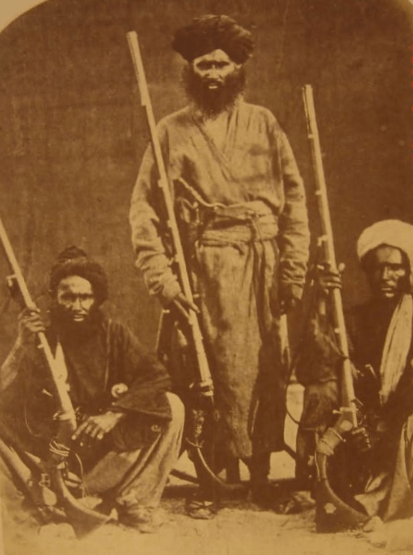
“It is unsatisfactory work writing now, because I feel sure that my letters never go beyond that awful
savage, the Nawaub of Futtyghur. However, one line a day, on the mere venture, you shall have. We made another forced march this morning, twenty-three miles to this, and are now within two easy marches of Cawnpore, into which we propose walking on Monday morning; and how changed the
scene will be from 1850! There was no skirmish or affair this morning, barring Ouvry’s dour (raid) with thirty of poor Probyn’s tired Irregulars (three of his horses died from fatigue yesterday), after a budmash six miles off, said to have money and arms concealed in his place. We got here this morning at 8.30, having started at 12 so that we are improving in our marching. This column will soon be able to conquer all India. Our men are longing for a charge against the ” Neemuk arams,” and how they would delight in serving Nana Sahib out if they could but catch him.”
In a letter to his wife, Ouvry makes a quick note of the same incident:
“We have received very bad news from Lucknow; Outram and Havelock are in a mess, but I think I can clear the road with my cavalry, helped by a little artillery, at any rate we going to try.
Since I last wrote, I have destroyed the town of a rascally fellow who annoyed the district, I forget his name. His fort was blown up and his village destroyed. He had 800 matchlock men who all bolted, except a dozen who I took in the fort…”
On the 26th of October, the column reached Cawnpore.
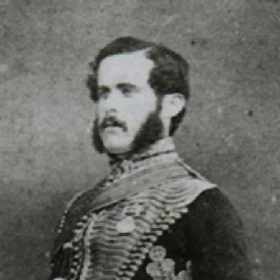
Only 1500 troops had been holding Cawnpore for the month since Havelock had crossed the Ganges to take Lucknow; this included the headquarters of the 64th Regiment of Foot under Colonel Wilson and some recovered invalids belonging to regiments that had pushed onto Lucknow. Shortly before Grant arrived, four companies of 93rd Highlanders had arrived and in their wake, an “avant courier” of Peel’s Naval Brigade who had been instructed by his commander to ensure everything was in order when the rest of the blue-jackets came in. Other troops were being pushed up and officers who had been on leave in England when the mutiny broke were descending on Cawnpore, many on their way to join their regiments. To Roberts’ delight, his good friend Lieutenant Augustus Otway Mayne (of the Bengal Horse Artillery) was amongst them and Grant had appointed him D.A.Q.M.G. to assist Roberts who believed there would now be “more work to be done that I could well get through.” The officers and men of the column acquainted themselves with Cawnpore – some had been there before and were horrified to see the destruction of the cantonment that had once been considered the finest in India. They roamed over Wheeler’s Entrenchment, astonished that anyone could have held out in such a pitiful excuse for a defence for a day much less 21.
Bourchier, like the others walked over the ruins.
“…but the shattered walls told their tale of woe. Wandering about the intrenchment, British soldiers of every rank might be seen searching for little mementoes of their fallen countrymen so foully murdered. Revenge deep and bitter was vowed against the perpetrators of such atrocities. I confess to have been no stranger to the influence exercised on the mind by these scenes: the very worst feelings rose to the surface. Here might be seen a dragoon with a child’s frock on the end of his lance, on which he had vowed never to spare a sepoy; there a soldier with a fair tress attached to his bayonet, determined on future revenge.
“Could it be wondered at? Twice I passed the ruins, and the same feelings on both occasions seemed to rise involuntarily. I resolved never again to enter its precincts, and although on a subsequent occasion, my tent abutted for six days on a corner of the intrenchment, I religiously kept my word.
The fatal well, the grave of so many of that band of heroes, was carefully covered in. Who could pass it unmoved? If the intrenchment was horrible, the massacre house was infinitely more so: in the inner courtyard was a tree on which were traces of the murder of the poor little innocents, whose hair, sticking to the bark, told of the dreadful death they had met.“
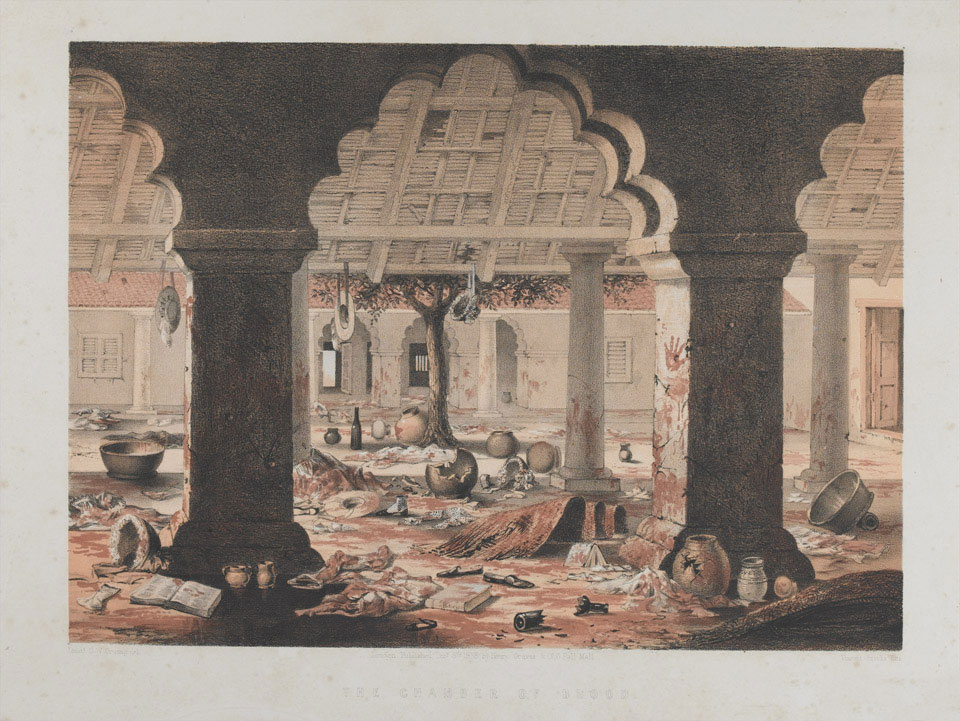
Ouvry was one of those who picked up a morbid souvenir, in the form of a baby’s dress, which Anson estimated could not have fit a child more than a month old and “laid his hands on a page of what must have been a Church Bible, from the large size of the page and print. It contained part of the Sermon on the Mount.” As for Anson, he walked to places he had known in the past, writing furiously to his wife that from where he stood he could see the church in which he had been twice married had been desecrated; as he went around the Bibighar, he found a skull unburied and long tresses of hair clung tenaciously to bushes surrounding the house and well; the floor of the house was still strewn with clothes “dyed in blood,” and if this was not enough for one day, he discovered Wheeler’s famous entrenchment was nothing more than “our old hospital surrounded by a trench.”
He visited the house of his old friends, the Spiers, and writing to his wife, he sadly notes,
“The trees all round scorched and killed by the tremendous blaze of the bungalow, which, with its fine verandah, pillars still standing, looked noble in its very desolation. From there I went to your old house, to the gate of it, for I did not- venture in, being all alone, walking with only a stick in my hand. It was in an admirable state of preservation, and lots of people were cutting the grass in the compound. Further than this I did not go, much as I wished to see the Wemyss’s house; it was hardly safe for a lone European, unarmed, to go so far.”
For Anson, Cawnpore had not just been his home but that of both his wives – of Katherine Wemyss who he married in 1845 in Cawnpore and sadly buried in Ambala in 1849; and to Frances Manson, his second wife; married since 1850, she now waited for his letters at her exile home in Kasauli while Anson roamed around Cawnpore alone.
For Lieutenant Roberts it must have been a strange homecoming. He had, after all, been born in Cawnpore in 1832 and had probably spent a portion of his childhood in this now-ruined cantonment. However, except for a brief sojourn to Satichaura Ghat, he leaves well alone; instead, he marvelled at the first Highland regiment he had ever seen – the 93rd – and was “duly impressed by their fine physique, and not a little also by their fine dress. They certainly look splendid in their bonnets and kilts – a striking contrast to my war-worn, travel-stained comrades on the Moveable Column…“
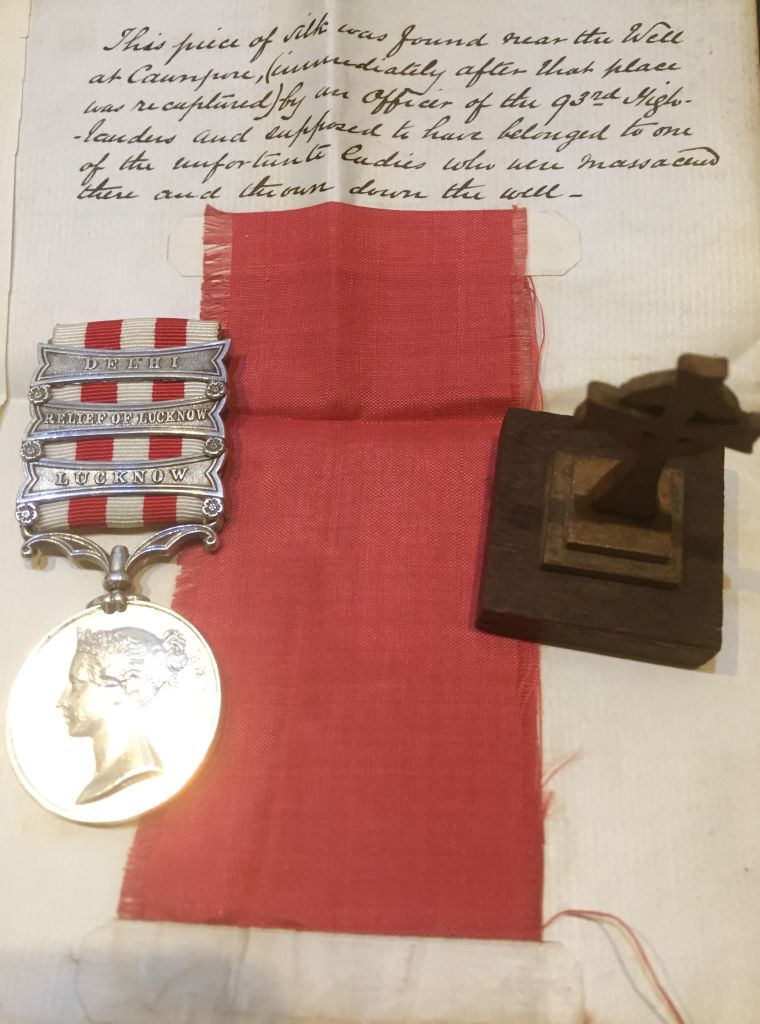
On the 27th of October, news came to Cawnpore that Sir Colin Campbell was starting that evening from Calcutta to take command of the force and with this news, an order was sent to Hope Grant from Campbell to open up communication with the Alambagh. On the 30th of October Grant crossed the Ganges at Cawnpore and a veritable harvest of death would soon be unleashed over Oudh.
“The soldiers needed no hounding on to excite them to revenge: the difficulty was to prevent them from considering everyone with a black face as an enemy.”
Sources:
Eight Months Campaign Against the Bengal Sepoy Army during the Mutiny of 1857 – Col. George Bourchier (1858)
Incidents in the Sepoy War, from the Private Journals of General Sir Hope Grant – Henry Knollys (1873)
Cavalry Experiences and Leaves from my Journal – Henry Aimé Ouvry (1892)
With H.M. 9th Lancers during the Indian Mutiny – Brev.-Major O.H.St.G. Anson (1896)
Forty-One Years in India – Field Marshal Lord Roberts of Kandahar (1897)
Old Memories – General Sir Hugh Gough (1898)
A History of the Indian Mutiny, Vol II – G.W. Forrest (1904)
Memoirs of Field Marshal Sir Henry Wylie Norman – Sir William Lee-Warner (1908)
 Mutiny Reflections