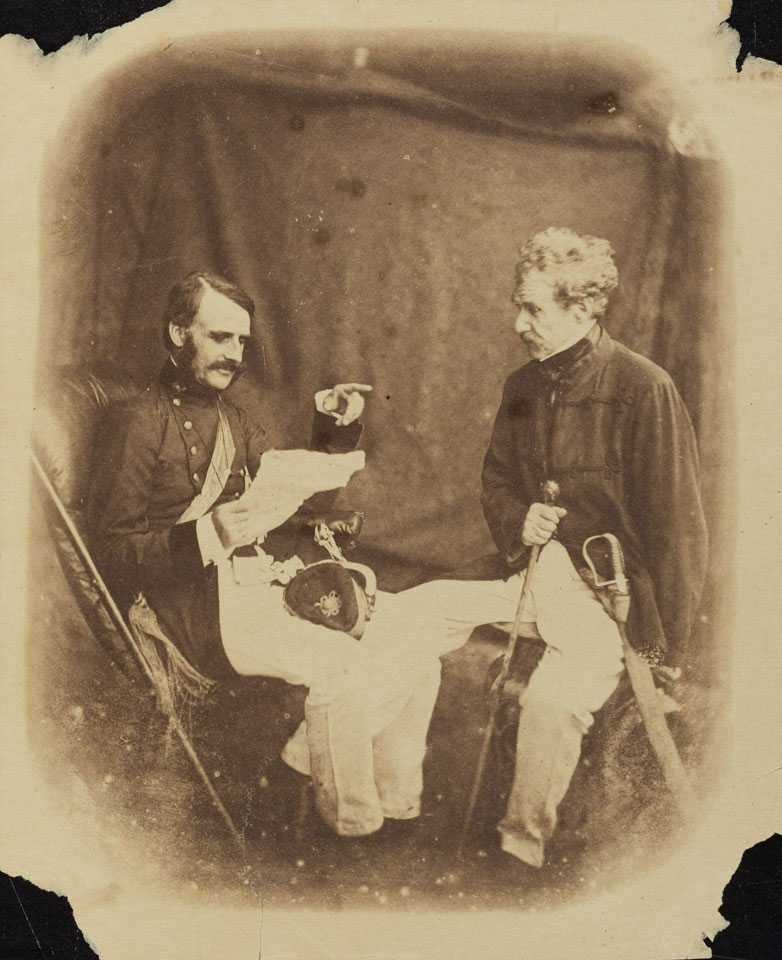
Everywhere Sir Colin Campbell looked it appeared the British were holding on by the skin of their teeth and that only by luck, a little chance and the personal strength of a few officers in the field, both military and civilian. As for Calcutta, with Sir Cecil Beadon’s precious line of 600 miles becoming precariously shorter every day, the city wavered daily on the brink of absolute panic. News of fresh outbreaks, such as that in Dinapore, caused yet another wave of terrified civilians to pile their families into boats moored along the banks of the Hoogley. No one seemed quite sure what to do about the revolts in Bihar besides pestering William Tytler out of his position, and the entire management of Calcutta itself had devolved onto the shoulders of one single man, the town major, Major Orfeur Cavanagh, the man who nearly single-handedly saved Calcutta from mutiny. Slowly but with all steadiness, Sir Colin Campbell moved men and machinery towards Allahabad, each day more left Calcutta until his work was done. On the 27th of October, he finally left Calcutta. The final pieces were falling into place, and a new phase of the rebellion was about to begin. One of the largest forces assembled in the history of the mutiny was now weaving its way towards Lucknow.
Mercilessly surrounded by Canning’s bickering brood of almost useless advisors, Cavanagh had had to navigate a veritable quagmire of politics that so undermined his efforts that he finally resorted to simply presenting his ideas and then expecting them to be negatived as they always were. He then continued with his plans regardless of what the powers that should have been said, using their half-given permissions to mean yes. It was the wisest plan Cavanagh could follow; the government at least learned quickly not to interfere with Major Cavanagh, something Sir Colin would learn when he arrived in August. While the government at Calcutta continued to pray and beg for reinforcements from every quarter it was left to Cavanagh to deal with the details of what to do with the troops when they arrived.
Hindered as he was by his efforts, Cavanagh still managed to ensure the troops left Calcutta almost as quickly as they arrived, albeit in drips and drabs pushed on towards Allahabad in any means of conveyance available; but the influx of troops was soon more than even Cavanagh could manage and he did not have the authority to do what was necessary to ensure they continued to move down country; it would take the final word of Sir Colin to effect everything Sir Patrick Grant should have been doing. He had used the organisation of the reinforcements as his chief excuse for remaining in Calcutta but in the two and half months he had spent at Government House, he had done as little as the rest of the politicos. Canning could despair as much as he liked; his civilians wanted to ensure their own safety first and they were still doing so when Sir Colin arrived. Very likely to Cavanagh’s delight, things were about to change.
In August, the means of transporting the troops was still woeful at best, horses for both cavalry and artillery were wanting, Enfield rifle ammunition was deficient and nothing was being to provide for its manufacture. Even flour was running short, while guns, gun carriages and harnesses for the field batteries were either “unfit for service” or simply did not exist as the superintendent at the gun-foundry at nearby Kasipur had not received any orders to supply the deficiencies. If Sir Colin was to run a war for the government of Calcutta then this state of affairs had to change; thus instead of taking to the field as he had originally intended to, he would spend nearly three months in Calcutta moving the government into action; no expense was to be spared on buying horses, England would be goaded into producing and supplying Enfield rifle ammunition until it could be sufficiently manufactured on the spot, flour was ordered from the Cape and the Kasipur foundry would fire up its forges and manufacture the weaponry they had not been making due to that lack of orders, the same for tents and harnesses. By the end of August, Sir Colin had effectively quintupled the activity of nearly every department in the city be it governmental, civilian or mercantile.
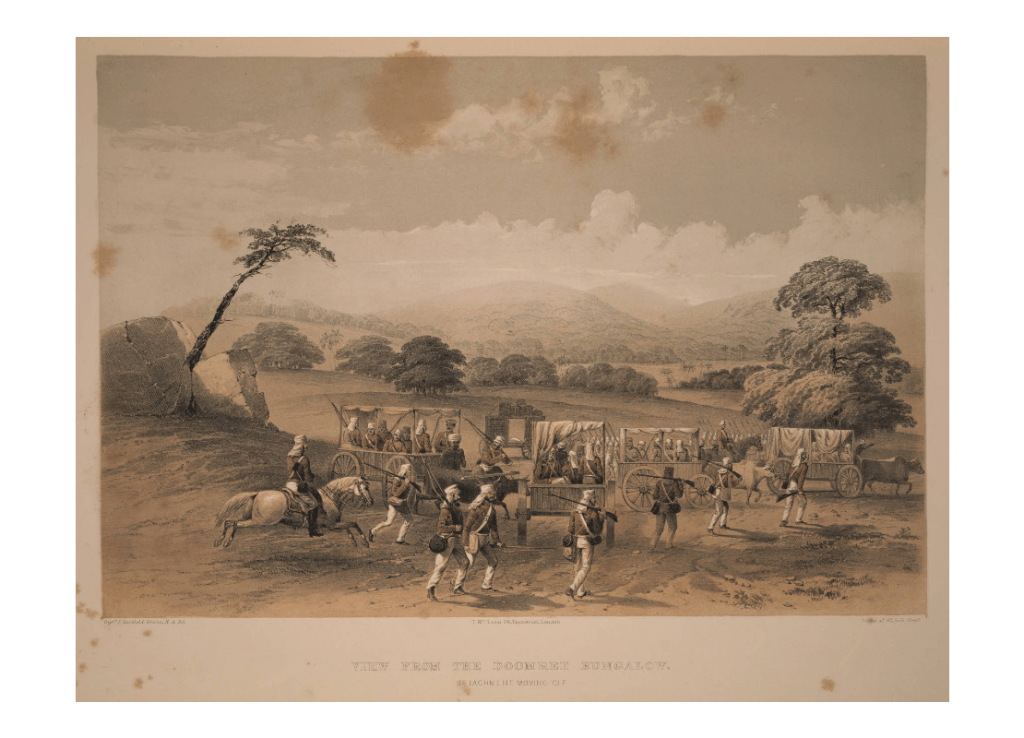
As for the troops, they were to move forward, as swiftly as possible with as little delay necessary. There were two routes open to Sir Colin – the cumbersome yet tolerably safe river ways that were guarded by men who should have been sent to reinforce Havelock and the more precarious one by road which was continuously being traversed by rebel forces. With the end of the rains and the river levels rapidly falling, the river route was no longer the best option and Sir Colin now concentrated his energies on securing the land route. Exhorting supreme pressure on the government he was able to organise efficient bullock trains. Composed of several covered waggons in which a set number of troops could sit in relative ease, the waggons were drawn by bullocks from post to post, with fresh animals limbered up at each stop. The starting point of this train was at the railway terminus of Raniganj, 120 miles from Calcutta. In theory, the troops should have disembarked the train and immediately taken their places in the bullock waggons, and then travel through the night into the early hours of the next day while resting during the hottest hours at the set camps. Although the plan initially ran into hitches, it would eventually be able to land up to 200 men a day in Allahabad, “fresh and fit for work”, within 2 weeks of their arrival in Calcutta.
This was the plan, at any rate.
The land route in August was far from safe and Sir Colin needed from the first, to ensure its complete security before he could endeavour to send troops onwards by it. The problem lay with the Ramgarh Battalion stationed in Ranchi had broken ranks and gone rogue, menacing anyone who ventured to traverse any point close to the station, along the left side of the road. On the right, the remains of the Dinapur garrison, the 5th Irregular Cavalry and the mutinous portion of the 32nd NI had thrown in their lot with Kanwar Singh and spread “consternation” through the central part of the route. Had he had a sufficient force, Sir Colin could have dealt with them piecemeal but he had nothing of the sort at his disposal. The mutinous regiments managed to harass a vast tract of land, swiftly traversing from station to station leaving Campbell with no choice but to counter their movements with a moveable column of his own. Consisting of 600 men each of infantry and cavalry, their only objective was to patrol the road. As successful as this operation was it opened a floodgate in a different direction and some of the civil authorities in the outlying districts to give into temptation and divert some of the troops to small and “comparatively unimportant local operations on the flanks,” resulting in 1800 men out 2400 who were in the process of travelling by different routes to Allahabad, being laid hold of by these civilians who had remained in their stations, and one pretence or another, diverted them to “operations extraneous to the general plan of the campaign.”
The Gwalior Contingent too had been on the move since the 15th of October. They had risen in one body, no longer willing to listen to either Scindia or Dinkar Rao and had marched out of Gwalior, burned Morar to the ground and taken possession of Jalaun and Keubwahagar in the name of the Nana Sahib. After leaving detachments in Jalaun and Kalpi, they crossed the Jamuna on the 15th of November on their final move to Cawnpore. While it had been in their power to cut off communication between Cawnpore and Calcutta and sever the land route at any time between October and December they had neglected to do so. So while they still remained a threat, this mistake on their part allowed Sir Colin to continue moving his troops towards Oudh. It was essentially the beginning of a very long end for the mutiny. What was their undoing at this juncture proved to be a boon for Sir Colin Campbell.
The plan of using the land route began to show some fruition by the time most of the troops who had been diverted from the now-postponed China Expedition started arriving in Calcutta. The first of these consisted of the 93rd Highlanders, the 23rd Fusiliers, three companies of the 82nd Foot, two companies of the Royal Artillery and one company of Sappers. On their heels, at the end of September and the first week of October, a company of Royal Artillery arrived from the Cape of Good Hope with 58 horses and 500 men of the 13th Light Infantry. By the time they arrived, Delhi had fallen and it became imperative to push them on with all haste towards Cawnpore and Lucknow.
Travelling the route in October, Brevet Lieutenant-Colonel John Ewart of the 93rd Highlanders described just such a journey. Arriving in Raniganj, his detachment embarked, four men to each bullock cart and taking up 24 carts in all, each drawn by 2 bullocks. They travelled from 4pm all through the night at the staggeringly slow pace of 2 1/4 miles an hour with halts to change bullocks and drivers every 8 miles.
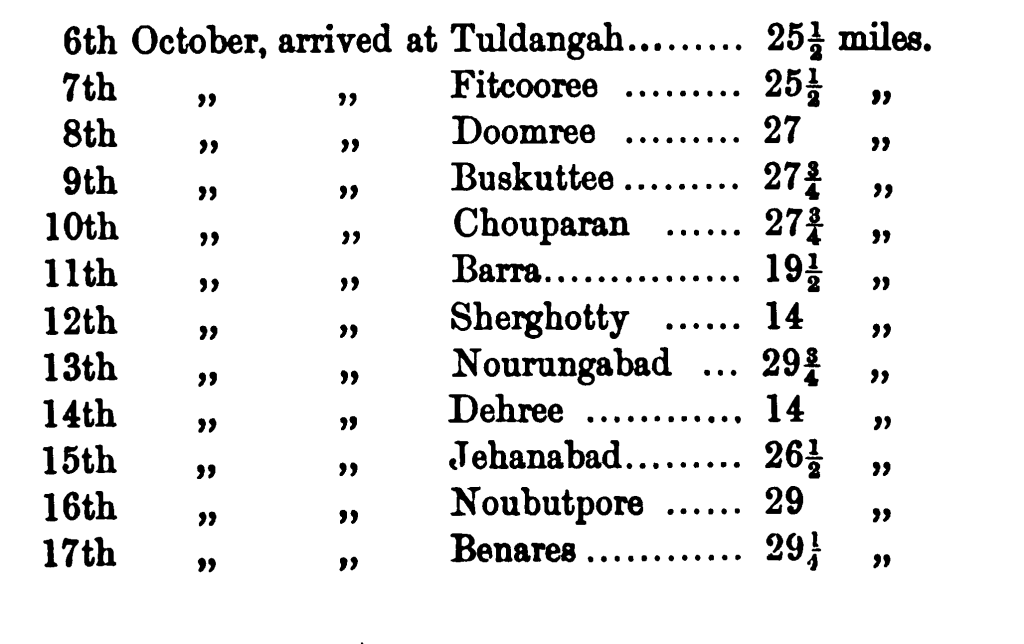
“Occasionally a bullock declined to proceed…sometimes a wheel would come off and whilst endeavouring to put matters to rights, away would go the bullocks, causing a grand smash…” Ewart opted to walk some of the distance at night as the jolting of the waggons was terrible and he also relinquished any thought of sleeping, reserving that for the longer halts during the day. One waggon alone carried provisions and rum for the men.
Between Barra and Shergotty there were three unbridged rivers to cross, and between Noroungabad and Dehree the bullock train had to cross the Soane an operation which took a further three hours. Shortly before Benares, the road stopped altogether as there was no bridge across the Ganges and the remaining part of the journey was accomplished by boats. After a brief halt in Benares, they pushed on towards Allahabad, arriving two days later. From Allahabad, there was yet another partial railway but only as far as Lohunga – a paltry 48 miles – on the arduous 118 miles remaining to Cawnpore.
While diverting troops from the China Expedition to serve in India would become a matter of course as the narrative of 1857 unfolded, it had not been seen initially as a viable option. Far back in June as Lord Canning had finally come to the realisation his advisors were woefully wrong and the British position in India was in far greater peril than his council believed, he had been attempting to secure reinforcements from any channel open in his power. One of those he approached was Lord Elgin, the British Plenipotentiary in China.
Initially, Elgin was little inclined to send any assistance, writing to Canning in a private letter on the 3rd of June that he greatly regretted that there was little he could do for him, “but we are doing our best. It is not quite impossible that the troubles in India may re-act upon China and add to our difficulties in that quarter. I hope, there, that it will not be necessary to remove any troops from Hong Kong. Indeed, the European force there is so small that it could not, I apprehend, be reduced without positive danger…Meanwhile, I can only express my earnest hope that you may get out of your difficulties.” Only when Elgin received Canning’s letter addressed to the Governor of the Strait Settlements in which Canning desired that all ships proceeding to China through the Straits of Sunda be diverted to India, that he had an inkling of the trouble Canning was facing. Blundell, the Governor of the Strait Settlements was from the onset more accommodating than Elgin and with resolution, halted the aforementioned ships as Canning had requested sending on with haste, the 5th Fusiliers from Mauritius and the 90th from England. Blundell then hired a steamer, at his own expense, to carry a despatch to the Governor-General of Netherlandish India at Batavia, requesting him to send on board the transport orders of both Elgin and General Ashburnham to stop them on their way through the Straits. While the general continued on his way to China, Elgin remained in Singapore, waiting for the arrival of that celebrated ship, the Shannon.
Captain William Peel of the Shannon had been apprised of the uprising while anchored off Singapore on the 11th of June. Another ship, the Simoon, arriving with troops for China had already been ordered to return to Calcutta. As she steamed the military band onboard, rather sarcastically played “You May Go to Hong Kong for Me” as they left the harbour. On the 23rd, Lord Elgin and his staff embarked the Shannon and sailed for Hong Kong where the ship arrived on the 2nd of July. News from Calcutta was never far behind and it would be on the 14th of July when Elgin would finally understand that the affairs in India were infinitely worse than he had imagined a month ago. Consequentially, Elgin decided China would have to wait and on the 16th of July, he re-embarked the Shannon. With him, he took on board a detachment of the Royal Marines – 300 men – and 100 men of the 90th Regiment. With only one stop in Singapore, Elgin arrived in Calcutta to take council with Canning on the 8th of August. Three days later the Pearl under Captain Sotheby brought, besides her crew, a further 100 men of the 90th to the mouth of the Ganges. The backbone of the navy had arrived in India and in their wake, came Sir Colin Campbell. Before his arrival, Elgin had already consigned the two crews into the hands of Lord Canning, writing on the 10th of August,
“I have further to state that I have learned from your Lordship and Lieutenant-General Sir Patrick Grant that a body of seamen and marines, though roughly trained as artillerymen, conveying guns of heavy calibre and commanded by an officer of energy and experience, may render important service at this conjecture, on the line of communication between Calcutta and Delhi, and possibly in Delhi itself, I am prepared to place Her Majesty’s ships, Shannon and Pearl, with their respective crews, ar your Lordships disposal, on the condition that suitable steamer be provided for the conveyance of myself and suite to China, and for my use there, until I can obtain the requisite accommodation in one of Her Majesty’s ships of war.”
While Elgin returned to China on board the chartered steamer the Ava, Captain Peel set about organising the newly formed Naval Brigade. His men would retain their uniforms although their straw hats would receive the welcome addition of a white cloth to cover the top and a longer flap attached to protect their necks from the sun; on the 13th of August, a large flat pulled up alongside the Shannon, laden with “ten 8-inch guns and two brass field pieces, with a proportion of ammunition and a supply of clothing and medical comforts for the men.”
These flats were towed by the steamers that regularly plied through the waterways of India, they were thatched over to keep the sun off the occupants and due to them being flat-bottomed, could navigate the rivers in the lowest of water. On the 14th, the river-steamer Chunar closed alongside the Shannon and Captain Peel embarked with his officers, namely Lieutenants Wilson, Hay, Young and Salmon, Captain Grey and Lieutenant Stirling of the Royal Marines, Lieutenent Lind of Hageby of the Swedish navy, the Reverend E.L. Bowman, Dr. Flanagan, Mr. Comford as assistant paymaster, Messrs. M. Daniel, Garvey, E.Daniel, Lord Walter Kerr, Lord Arthur Clinton and Mr Church, all midshipmen, Messrs Brown, Bone and Henri, engineers, Mr. Thompson, gunner, Mr. Bryce, carpenter, Mt. Stanton, assistant-clerk and Messrs Watson and Lascalles, naval cadets.
Into the flats embarked 450 men, with their arms and ammunition, to be towed by the Chunar. Besides the flat, Peel had taken a launch and cutter from the Shannon and left his ship under the command of Mr. Vaughan the first lieutenant. With the denizens of Calcutta watching from the river bank, the Chunar steamed away, leaving the city behind it before the last cheer had died away.
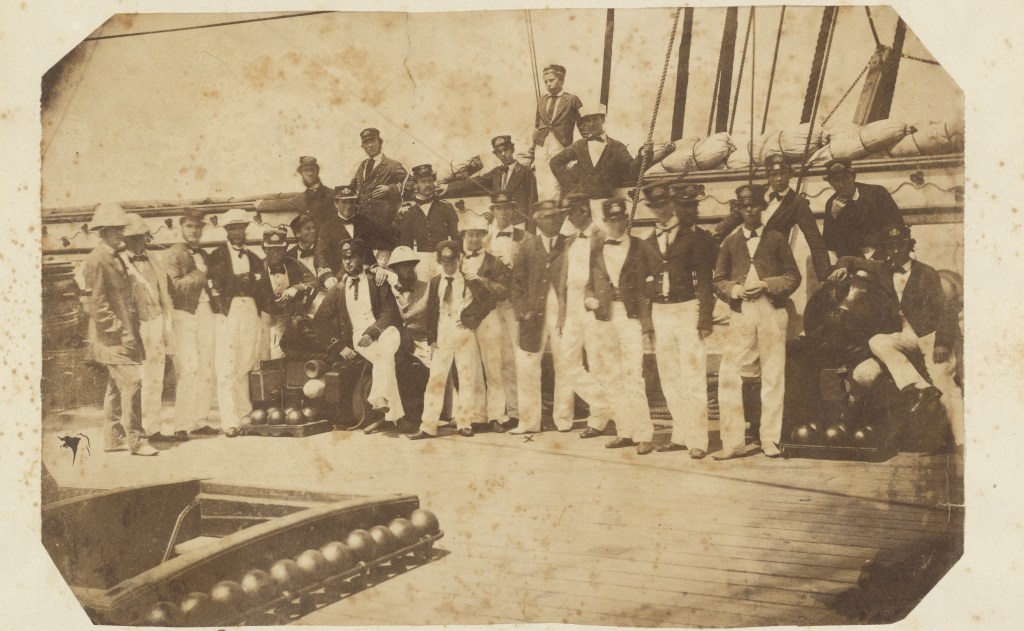
Tireless in the extreme, Captain Peel wasted no time while on board the Chuna in hailing English merchant ships he passed in the river ways, to call for volunteers -before he arrived in Allahabad, he had added another 100 men to his Naval Brigade, earnest volunteers who went through rigorous drill before they stepped foot on land again.
In Peel’s wake, Sir Colin sent Captain Sotheby of the Pearl formed his Naval Brigade on the 11th of September, with officers and men of the ship’s company. He followed Peel on the 18th by the river steamer Benares, carrying a complement of officers from the Shannon – Lieutenant Vaughan, Lieutenant Verney, ship’s mate, midshipman Mr. Way, and naval cadet Mr. Richards with 120 men in the attached flat, complete with arms and ammunition, a final reinforcement for the Naval Brigade. Both the Shannon and the Pearl remained in Calcutta with reduced crews, the Shannon under the command of Mr. Waters, master, with 140 men. Their duty was to see no further distress came to Calcutta, and the brass gun mounted in the main top was set to sweep the Maidan should anything untoward disturb the still frightened city.
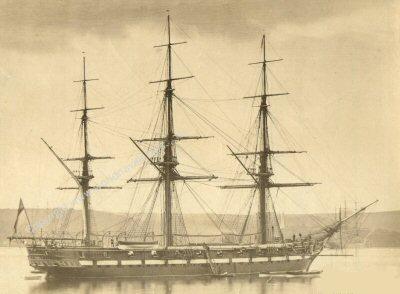
The rebellion was hardly over but it was about to meet its fiercest opponent; the road was now open for Sir Colin Campbell.
Sources:
The Shannon’s Brigade in India – Edmund Hope Verney (1862)
Kaye’s and Malleson’s History of the Indian Mutiny of 1857-9 Vol. I, III, IV, VI, edited by Colonel G.B. Malleson
A History of the Sepoy War – John William Kaye Vol III (1876)
The Story of a Soldier’s Life, or Peace, War and Mutiny – Vol II. – Lieut.Gen. John Alexander Ewart (1881)
Colin Campbell, Lord Clyde – Archibald Forbes (1895)
 Mutiny Reflections