On the 27th of October 1857, Sir Colin Campbell and his staff started from Calcutta. The decisive battle at Chatra had scattered the Ramgarh Battalion and while the Grand Trunk Road was still being being crossed by mutineers, Campbell’s line of communication was ensured as far as Fatehpur.
Preceding him was the 1st party of the Shannon under Captain William Peel who reached Allahabad on the 2nd of September; the 2nd party arrived on the 20th, bringing his numbers up to 520 exclusive of officers. The brigade from the Pearl under Captain Sotheby, 150 strong was sent to Patna, to be deployed at the discretion of the authorities. Throughout September and October, reinforcements from England, China and the Cape had been arriving in a steady stream at Calcutta and sent forward in batches of up to 200 men per day. In the second week of October, the remainder of the 82nd Foot, 198 men of the 38th, the 34th Foot, 144 men of the 42nd Highlanders and 102 recruits for the local European regiments all started their journey from Calcutta. Before the end of the month, a further 612 men of the Royal Artillery, 903 of the 2nd and 3rd Battalions of the Rifle Brigade, a further 290 of the 42nd Highlanders, 352 of the 54th Foot, 628 of the 88th and another 883 recruits were winding their way by bullock train, all advancing to form up against the scattered rebels.
Travelling without an escort, Campbell and his staff proceeded on the road to Allahabad. By no means secure, the road was regularly traversed by rebels moving from district to district, still unimpeded. Two companies of the 32nd NI, who finally mutinied in Bihar, lost their one opportunity to end the career of Colin Campbell, the man who would ultimately write the end of the rebellion of 1857. Leaving Shergotty, Campbell’s party had proceeded only 12 miles from the station when they suddenly perceived 14 elephants, loaded with troops, and escorted by 25 sowars on the road ahead. The driver of the foremost carriage called the warning – it was just enough time for Campbell to order his party to fall back on the bullock train, full of English troops, that was trailing some distance behind. The 32nd NI proceeded on their way, unaware that the carriages that had so hurriedly turned and fled had held the most important man in India. His capture might have spelt fame for the 32nd NI but his death could have halted the operations of the British forces in India. Campbell escaped and the 32nd who had gained the battle honours for Bhurtpore and Afghanistan disappeared in the twilight.
Curiously enough, while the rebels were comfortably traversing the roads, so was one British officer, unescorted, in a dak gharry, between Delhi and Calcutta. Lieutenant J.R. Turnbull (H.M.’s 75th Regt), former ADC to Brigadier Wilson was proceeding to Calcutta carrying duplicate dispatches from Wilson to Lord Canning, reporting the fall of Delhi. When Wilson left Delhi on the 4th of October, he entrusted the dispatches to Turnbull. He arrived in Calcutta on the 31st of October, dispatches intact and the accolade of being the first man to reach Calcutta from the Presidency.
In a letter written to his loved ones, Turnbull appeared to be enjoying the idea of this rather madcap journey.
Delhi Palace, 5th October, 1857.
My dear…
I am off, I suspect, tomorrow, from this place; the General has left the force, on sick leave, and has given
me duplicates of despatches sent via Bombay, to take to Calcutta, in case the road down country is soon open. Of course, to go now would be impossible, as all communication between Allygurh and Cawnpore is cut off; but we have a column of 3,000 men and eighteen guns at Allygurh, which, I suspect, will gradually open the communication southwards. The enemy, when driven out of Delhi, took different roads, and the columns have been sent out in different directions; one of these columns I start to morrow to join; it ought today to be at Allygurh; from that I hope to get on to Agra, and, when once at Cawnpore, where they say troops are arriving at the rate of 100 a day,
I shall be, most probably, all right. If I get to Calcutta before the others that have been sent by Bombay (which road is now also stopped), I daresay I may have a chance of being sent home with despatches by the Governor-General; but I am afraid this would be rather too good luck to happen to me…It will be rather fun to be the first officer arriving at Calcutta from Delhi, and, perhaps, in England also.
His next letter would not be for 10 days, written shortly after leaving Agra; his next from Wilson’s Hotel, Calcutta on the 31st of October. It describes a journey that would probably turn most livers into water.
My dear…
I am told that a kind of extra mail goes out today; so, in hopes of this reaching you before the next
regular mail, I write you a few lines.
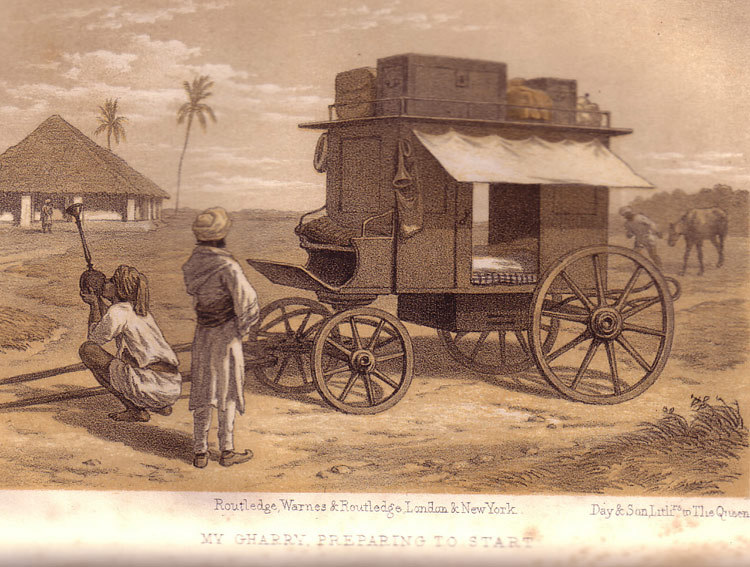
You will see from the date of this letter that I have reached my destination, and, am happy to say, I did not lose my despatch on the road. I should not wonder if this letter reached you before my two preceding ones, in which case this will be all Hebrew to you; however, I must go on with my story. I reached Cawnpore with Colonel Grant’s movable column on the 26th instant, having taken twenty days getting so far from Delhi; but this could not be helped, as the road is not safe except for a military force; from that to Calcutta they have managed to establish the mails, &c. On arriving at Cawnpore, I got a gharee, or kind of palanquin carriage on four wheels, on service, and started in it, at 11 p.m. for Allahabad, 128 miles. I arrived there, and dined with some officers, who were going up country; and started, at about 9 p.m., for Benares, about eighty miles. I got there all right by about eleven next morning.
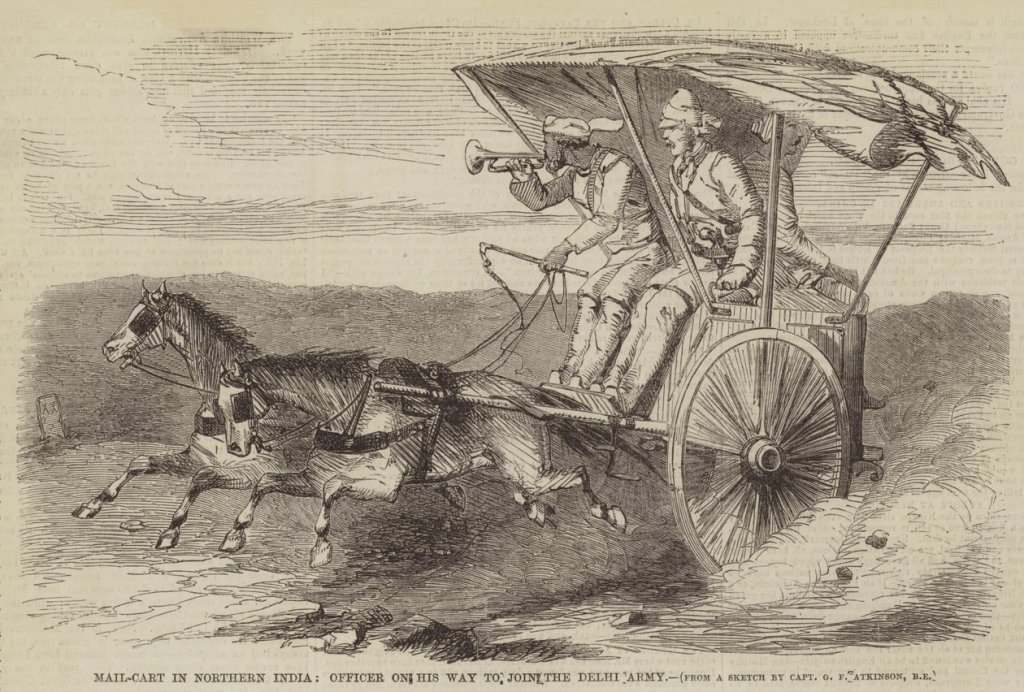
At this place, I could not get a gharee, and as there seemed to be some chance of a scarcity of horses on the road, I applied for, and got, an express mail cart, which was much faster and lighter than a gharee; it is like a wooden dog cart, built very strong, with places for two before, and a box inside for the letters; into this I put whatever I required; but could only take one change of dress. I started on this conveyance at about 1 p.m., 28th instant, for Raneegung (railway station), a nice little trip of 300 miles. The worst of these carts is that they are very rough, and, instead of lying down, as one is in a gharee, at full length in the cart, one is always up, and it is, therefore, very tiring. I went on this day and night and got to the railway about 3 p.m., 30th instant. I might have left there earlier; but, finding I could not be in time for the morning train, and should have, in any case, to wait for the night one, I took it easy at one of the Dâk bungalows, for about four hours, while I was having breakfast. I started from Raneegunge that night and arrived all safe at Calcutta yesterday morning.
On arriving at this hotel, I managed to dress up a little respectably; and, about ten, went over to Government House with my despatches. I there found Lord Dunkellin, the military secretary, and he took the despatches to Lord Canning; he asked me to come back at two o’clock to see the Governor-General, as he was not quite ready then. I came back at two and sat for about an hour with Lord Canning, who asked me all kinds of questions; on most of which, I am happy to say, I was able to give him information. After this, I, pleading being too much done up to dine at Government House that evening, took my leave of his lordship, who said he was very glad to have seen me.
I always had hoped that the bringing down despatches, especially as I have beaten Lowe hollow, who came by Bombay, and had three weeks start of me, might have led to my being sent home with despatches; but I am afraid there is no chance of this, as Lord Dunkellin said that in these times they are always sent by post; at the same time, it ought to get me my Brevet majority as soon as I get my company. As I am now second in my regiment, and first for purchase, it would be of the highest importance to me to be made a captain as soon as possible; and I cannot but think that if were worth anything and had represented my case, &c. , I might have been promoted into some of these augmented regiments at home. You had better direct to me merely ” 75th Regt. , Bengal, via Calcutta, ” as I don’t suppose I shall be here long. I met A…n four marches from Raneegunge, marching up towards Benares; and I need not tell you how astonished he was at seeing me; and my brother the same, when I wrote to him, yesterday morning, telling him to look me up. No one dreamt I was here, as I am the only officer in Calcutta who was at the siege of Delhi; and from Cawnpore I beat the mail. My present movements are very uncertain, except that I dine at Government House tomorrow. With best love to M…- believe me,
Your affectionate, J. R. T.
The commander-in-chief was all but caught by a body of rebels on the road that I came down. They seem to be all over the country.” For Turnbull, the mutiny ended in Calcutta. Despite his scrambling to find a place in the regiments proceeding towards Oudh, his health, after nearly 7 months of campaigning including the Siege of Delhi, had begun to fail. On Christmas Eve, 1857, he boarded a ship for England.
In the meantime, on the 1st of November, Sir Colin Campbell arrived in Allahabad. As for Peel, he was already on his way to Cawnpore. As Turnbull sat at Wilsons’ writing to his family and Campbell was on the last leg of his journey to Allahabad, Peel was getting to fight at Khajwa and Hope Grant’s column, increased to the effective strength of 5500 men had crossed the Ganges on the 30th of October.
Hope Grant and his men were now encamped on the plain between Banni and Alamabagh, waiting for the arrival of Sir Colin Campbell, who would follow in their footsteps on the 9th of November. In the preceding days before he too crossed the Ganges, Campbell spent the interval at Cawnpore arranging the base he was leaving behind. It would be left in the hands of Major-General Charles Ash Windham of Crimea fame, a thoroughly capable officer. With him, would remain four companies of the 64th, strengthened by men of other regiments, amounting to 450; 47 of the Naval Brigade too would remain in Cawnpore. An assortment of artillerymen and Sikhs manned a field battery of four guns. Windham was instructed to take up his position in the entrenchment constructed by Havelock in July and to not attack the rebels unless he could be sure his position would not be endangered, nor was any detachment of European infantry that was to arrive after Campbell’s departure to be detained in Cawnpore unless Windham was severely threatened – they were to be forwarded to Oudh with all haste. He could, however, keep back a brigade of Madras troops, expected on the 10th of November to aid in his defence.
Thus Sir Colin Campbell crossed the Ganges into Oudh – the final relief of the beleaguered garrison has begun.
Sources
The Shannon’s Brigade in India – Edmund Hope Verney (1862)
Letters Written During the Siege of Delhi – Lt.Col. J.R. Turnbull
Kaye’s and Malleson’s History of the Indian Mutiny of 1857-58, Vol IV- edited by Colonel Malleson (1889)
A History of the Indian Mutiny – T.R.E. Holmes (1891)
The Highland Brigade, its Battles and its Heroes – James Cromb ( 1902)
 Mutiny Reflections