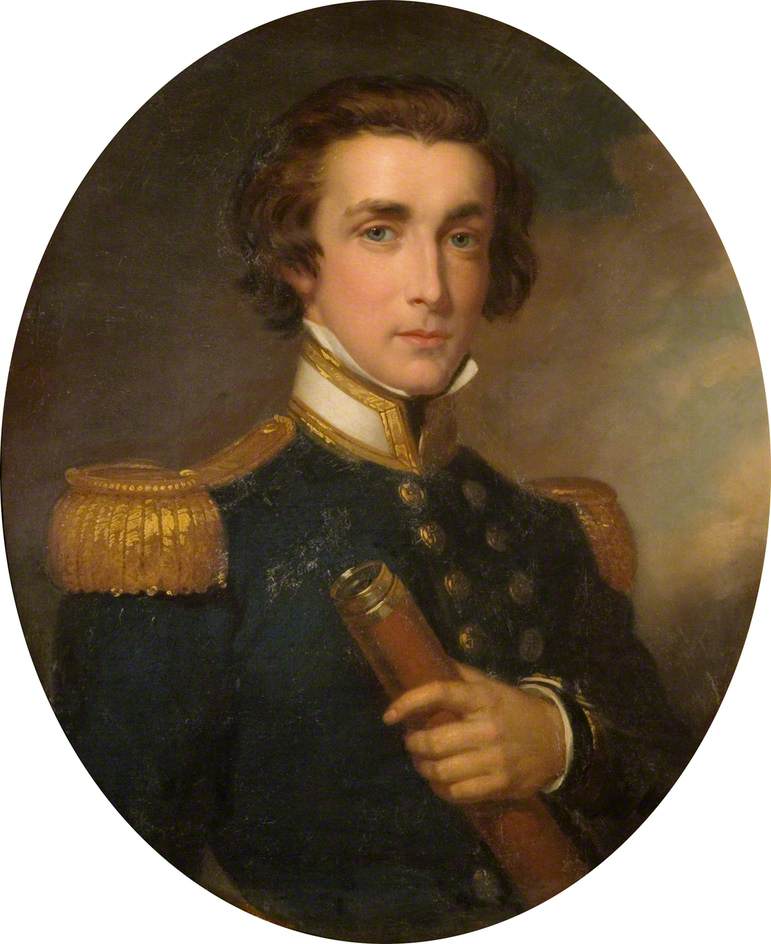
The Line and Naval Brigade troops had been ordered by Campbell to push forward towards Cawnpore – while some managed to reach the station with nothing noteworthy happening on the way, Peel would have his first taste of warfare, rebel style.
One detachment of the Naval Brigade consisting of 100 men and 4 officers escorting the siege train, had left Allahabad on the 23rd, followed four days by Captain Peel himself, leading the second detachment. Accompanying them was a wing of HM’s 53rd Regiment, a company of the 93rd, drafts and recruits intended for different regiments and a company of the Royal Engineers. The force was under the command of Colonel Powell of the 53rd.
The column arrived without incident at midnight on the 31st of October at Fatehpur. Powell had spent the mutiny chomping at the bit, with his regiment at Fort William in Calcutta. He had been watching and waiting for the moment he could take to the field – his men were ready and Powell was eager to make his mark.
On the afternoon of the 31st, Powell received information that the revolted regiments that Eyre had chased out of Bihar in July, their ranks now reinforced by mutineers from Delhi and other districts, had taken up a strong position in the village of Khajwa, 24 miles south-west of Fatehpur. They were estimated to be 2000 strong, not counting the various levies that had attached themselves to the rebels. Interestingly they had taken up their position in Khajwa – the very same place where nearly 300 years earlier, in January 1659, Aurangzeb had gained the upper hand in Hindustan, after polishing off the army of his brother, Shah Shuja. Now, in 1857, there would be another battle at Khajwa.
Close to the town stood a large garden, surrounded by a wall interspersed with turrets and flanked by various enclosures, all strong enough to provide solid resistance to the best of armies. Whoever held Khajwa barred to the road against anyone advancing from Fatehpur to Cawnpore – in other words, to reach his destination, Powell would have to clear his way first. Making his plans en route, Powell intended to attack the rebels the following morning.
At 5.30am on the 1st of November, Powell set off with a detachment – 100 men and three officers, men of the Naval Brigade under Peel acting as Powell’s second in command, one company of Royal Engineers under Captain Clarke, 162 men (2 companies) of the 93rd under Captain Cornwall and a company of made up men from different detachments, under Lieutenant Fanning. Accompanying the force were two 9-pounder guns under Lieutenant Anderson. In all, 530 men set off by forced march to meet the rebels. At 3pm, the next day, Powell caught sight of the rebels after a gruelling march of over 24 hours. What he saw to his surprise, was how easy the rebels intended to make things for him.
Instead of securing their position in the walled garden and the annexes, where it would have been troublesome to remove them, the rebels had opted to place their right on open ground which was dotted with sandy hillocks, – an impromptu embankment; while their left was on higher ground on the other side of the road. Three of their guns were on the road, two a little more in advance and a third in front of the bridge that crossed into the village. For cover, their skirmishers had settled into a field of standing corn in front of their position.
Powell wasted no time and ordered the attack. The skirmishers were quickly pushed out of the cornfield and Powell ordered the advance on the first two guns, which had, after the initial surprise, now sprung into action. The gun crews were quickly overwhelmed and those that could, fell back. With the guns secured, Powell had obtained at least one of his objectives – a bullet to the head put an end to his career and he fell down dead. Command briskly devolved onto Peel.
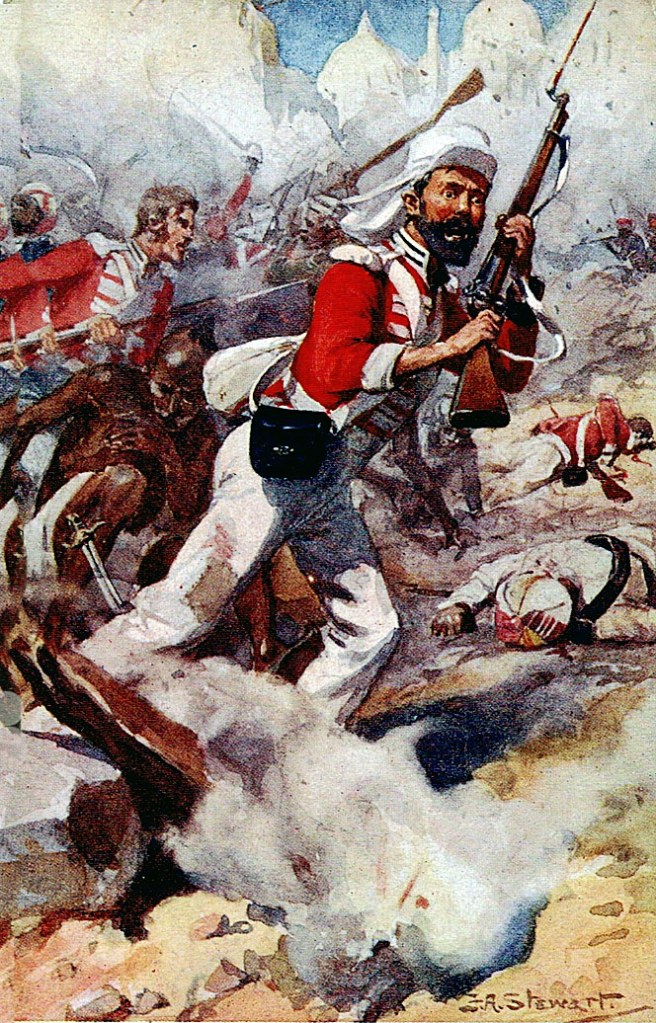
While the 53rd had been engaged with the guns the Naval Brigade, under Peel on the right, forced the rebels left back. Now, the rebels driven back on the left, faced the road and the British, with their right thrown forward directly faced them. Peel allowed no time for anyone to catch their breath. Posting a strong force to secure the position he had just won, he now led his men around the upper end of the sand embankment, effectively cutting the rebel force in two and thus drove them, step by step out of their positions, capturing not just their camp but two more guns and a tumbril. The sepoys, who had fought in full uniform, many with medals on their chests, lost 400 men killed in a battle that lasted less than three hours. Those that could, fled; Peel for his part had to let them go – he had no cavalry for a pursuit, and his men, tired after marching 72 miles in three days, 24 of which were by forced march, were too tired to follow. Peel returned to Fatehpur, his losses amounting to 95 killed and wounded. The dead had been collected and carted back to Fatehpur where they were buried and the wounded were promptly sent back to Allahabad where they arrived on the 13th of November.
Unhindered, Peel continued his march to Cawnpore; on the 3rd of November in his wake, arrived Sir Colin Campbell.
Returns of the Battle of Khajwa
The advance guard immediately went forward in skirmishing order, and firing commenced. The skirmishers were quickly reinforced by the remaining company of the 93rd who extended to the left of those already out. The skirmishers were now about 1000 yards from the village, and the enemy could plainly be seen forming for battle – their bayonets glittering in the sun. As the 93rd, the Engineers and the 53rd advanced, the main body of the enemy fired volley after volley with great steadiness and kept up a rapid fire of grape and round shot. By and by the fire of the British began to tell, the replies of the enemy became less steady and their formation less perfect. At length the 93rd and the 53rd got within striking distance; they ceased fire and gallantly led by Colonel Powell in person, levelling their bayonets, dashed at the guns.
HM’s 53rd Regiment of Foot
Lieutenant Colonel Thomas Sidney Powell – was killed by a bullet to the forehead
Captain Thomas Moubray – slightly wounded in the face by grapeshot
Lieutenants
Acton, Thomas – severely wounded
Corfield, James Winsmore – severely wounded
Sergeant Major Charles Pye – severely wounded
Colour Sergeants
James Deverey – wounded
Alexander MacFee – mortally wounded, since dead
Sergeants
Devery, Edward – dangerously wounded
Heathcote, Joseph- slightly wounded
Corporals
Crowley, Edmund- mortally wounded, died of wounds.
Nolan, James – dangerously wounded. Died of wounds, 6th November.
Ware, Edward – wounded
Privates
Ashton, William – killed in action
Ashworth, John – dangerously wounded “…by a musket ball, which entered two inches below
the great trochanter, and emerged in the front of the thigh at its upper third, having in its course fractured the bone; the limb is one and a half inches shorter than the other. July 14th, 1858.-Wounds healed; complains of weakness in the limb, but is able to walk about without the assistance of a stick.
September 6th .- Sent to modified duty.”
Barrett, Edward – dangerously wounded
Bedding, Patrick – dangerously wounded
Burnett, John – killed in action
Cashman, John – killed in action. He had been court-martialed at Fort William, in August 1857
Collins, James- dangerously wounded
Collins, John – dangerously wounded. Died of wounds
Creed, Denis- dangerously wounded
Camper, Richard – wounded by a bayonet
Davies, Thomas – dangerously wounded. Died 03.04.1858
Dirma, James – wounded
Downey, Michael- killed in action
Durne, John – wounded
Evans, George – dangerously wounded
Eyles, William – dangerously wounded
Farnham, Michael – killed in action
Frary, George – severely wounded
French, Francis – wounded
Gerrard, John – killed in action
Huxley, George – severely wounded
Johnson, Samuel – dangerously wounded, died of wounds 13.11.1857
Mathews, James – killed in action
McCarthy, John – slightly wounded
McCurray, Richard – killed in action
McDanaher, Michael – killed in action
McNally, Peter – slightly wounded
Miles, Henry – severely wounded
Mullins, Patrick – wounded, died of wounds 25.11.1857
Porter, Henry – severely wounded
Redding, George- severely wounded
Reilly, Francis – severely wounded
Rogers, Edward – severely wounded
Scanlon, Hugh – dangerously wounded
Sullivan, Michael – killed in action
Tobin, Richard- severely wounded
Young, Benjamin – severely wounded. Died 16th December 1858.
HM’s 64th Regiment of Foot
Privates
Curtin, Michael, slightly; shot through the leg
Feigh, John – shot through the thigh
Gear, Christopher – killed in action; gunshot wound through the head
Gerarrd; Thomas (attached; 1st Bengal Fusiliers) – killed in action; shot through the lungs
Hayer, John – severely wounded, shot through the intestines; died after removal from the field
Kelly, John (attached; 1st Madras Fusiliers) – severely wounded; shot through the forearm.
Magher; Daniel – slightly wounded in the thigh
Moore, Charles – slightly; scalp wound
Murray, James – killed in action; gunshot wound through the head
Rily, Thomas – killed in action, gunshot wound through the head
HM’s 93rd Regiment of Foot
For a moment the Sepoys gazed, first fascinated by the advancing line of glittering steel, then terror-stricken at the terrible aspect of the coming men. They fired one of two ineffectual shots, abandoned guns and positions, and fled through the village, the Highlanders pursuing and inflicting upon them dreadful loss.
Sergeant Andrew Fiddes – slightly; contusion above the right knee
Sergeant James Gow – killed in action
Corporal John Beatie – severely; gun-shot wound through right right
Corporal Archibald McKinnon – dangerously wounded; gunshot wound through the lower part of left side of the chest.
Lance-Corporal John Henderson – severely; gun-shot wound through the fleshy part of left side of the chest, not penetrating the chest cavity.
Ensign R.K.A. Dick-Cunygham – wounded.
Privates
Brooks, John – slightly wounded; contusion of the right shoulder.
Cowie, William – dangerously wounded,; gunshot wound through left thigh; also through left leg; with fracture of the bones of the leg.
Ellingsworth, Charles – slightly wounded, contusion from musket ball over the right temporal bone.
Feckner, George – killed in action
Hay, William – slightly; flesh wound at the upper part of the right thigh.
Hunter, Samuel – severely; gun-shot wound of the left thigh, with fracture. The musket ball “…struck
the outer side of the left thigh, at the juncture of the middle and lower third, fracturing the femur, and passed out on the inner side; a number of pieces of necrosed bone have come away. Was sent in a dooley to Futtchpore, where he remained nine days; the limb being placed in a short splint along both sides; was then sent by dooley to Allahabad, where the long splint was applied, and retained four months.” He was invalided on the 26th of September 1858
Jeffreys, William – severely wounded
Johnston, Samuel – severely; gun-shot wound through both thighs
Lindsay, Richard – severely, gun-shot wound of the scalp.
Levediley, Lewis – killed in action
McBean (or McBain) – killed in action
McFarlane, Andrew – severely wounded
McGregor, George – severely wounded
Melville, David – severely; gun-shot wound of the left hand; the ball lodged.
Murdock, Robert – slightly; gunshot wound through the fleshy part of the leg.
Scridley, Lewis – killed in action
Sheever (or Shilver), Michael – slightly wounded; contusion of the right arm.
Swindley, Lewis – killed in action
Tollan (or Tolin), Donald – slightly wounded
Royal Engineers
Captain A.J. Clerke – severely wounded
Sappers
Ancell, John – severely wounded
Clerke, A.J. – severely wounded
Malcolm, John – killed in action
Singleton, George- severely wounded
Smith, George – severely wounded
Yelland, John – slightly wounded
Wilson, Thomas – severely wounded
3rd Company, 5th Battalion Artillery
Bombardier O’Sullivan – contusion on the back from round shot
Gunner T. Williams – severely in left eye, with loss of sight.
Bullock-Drivers
Luchmaun – slight wound in right arm
Hanoo – slight wound on right brace
Unganoo – severely in hand and right foot.
Two bullocks killed and three wounded
Naval Brigade
Dispatch of Captain Peel:
Detachments amounting to 700 men under the command of Lieutenant Powell of Her Majesty’s 53rd regiment, in charge of siege-train guns, and a large convoy, were proceeding from Allahabad to Cawnpore, and had arrived on 31st ult., after a march twelve miles. at the camping ground of Thurrea. The same afternoon intelligence was received from Futtepore that the Sepoy mutineers of the Dinapere regiments, with three guns, had passed the Jumma with the intention of either attacking Futtehpore, or crossing over into Oude. The camp was immediately struck, and we arrived at the camping ground at Futtehpore at midnight.
Colonel Powell then made arrangements for marching at daylight upon the enemy, who were reported to be about 24 miles distant beyond the village of Binkee. The column of attack marched at daylight and was joined from the garrison at Futtehpore by a company of 93rd Highlanders, under Captain Cornwall, and two nine-pounder guns.
After marching 16 miles, the column halted for refreshment, and then resumed the march at a rapid pace, passing through the village of Binkee at about 1:30 p.m., where the intelligence was maimed that the enemy was at hand.
The troops passed on without any interruption; the Highlanders advancing in skirmishing order, supported by the Royal Engineers, and followed by the 53rd Regiment in column, and then by the Naval Brigade; the depot detachment was with the baggage. We advanced along the road which led straight for the village of Kudjwa, and is, that the enemy’s right occupied a line of high embankment, on our left of the road, which embankment, screened by a grove, continued towards the village, and that their left was higher up on the other side, with their guns posted in the centre on the road, two of them in advance, and one on a bridge near the village.
A round shot, coming down the road, opened the battle at about 2.20 p.m., and the column was ordered to edge to the right, and advance on the guns through the corn-fields—the skirmishers of the 93rd and the Royal Engineers pushing up on both sides of the road. The enemy’s artillery was well served, and did great execution, and the flank fire of musketry was very severe. The gallant Colonel Powell himself, on the left of the road, pressed on the attack and had just secured two guns of the enemy, when he fell dead with a bullet through his forehead.
In the meantime, the Naval Brigade had advanced on the right of the 53rd and carried the enemy’s position in their front. It was then that the death of Colonel Powell was reported to me, and I was requested to assume the command. The great force of the enemy, the long line of their defences, and the exhaustion of both officers and men after such long marches, rendered our position truly critical. The front of the battle had become changed to the line of the road, and the enemy with all their force behind their embankments, threatened to intercept our rear. I left Lieutenant Ray, R.N., supported by the two nine-pounder guns, to hold the position which his party had gallantly carried, and at which secured our flank; and collecting as many fresh troops as were available, assisted principally by Lieutenant Lennox, R.E., (Captain Clarke being unfortunately severely wounded), and by Ensign Truell, of the 53rd, we rushed across the road, and passing round the upper end of the embankments, divided the enemy’s force, and drove them successively from all their positions. The enemy then retired in confusion, leaving us master of their map, and with two of their guns and a tumbril in our possession.
The late hour of the evening (it was half-past four when the enemy fired the last shot) and the excessive fatigue of the troops prevented any pursuit. We therefore spoiled their camp, and leaving it with cheers, formed on the road by the bridge near the village, and sent out parties to collect our dead and wounded.
With the body of the colonel on the limber of the gun he had so gallantly captured, we then returned and encamped near the village of Binkee.
Our loss in the action was very severe, amounting to 95 killed and wounded.
The behaviour of the troops and of the Naval Brigade was admirable, and all vied with each other and showed equal courage in the field. The marching of the 53rd, and the accurate firing of the Highlanders, deserve special recommendation.
Captain After Guard Edward Baker, A.G., gunshot wound through the soft part of back of thorax; injury severe.
Lieutenant Edward Hay – slightly wounded, grazed on the back of his hand
Midshipman Lord A.P. Clinton – slightly wounded
Leading Seaman Alexander Hewston – round shot through hip and abdomen, died on the field.
Ordinary Seaman
Ballard, William – severely wounded; gunshot wound through left calf
Connor, John -severely wounded; gunshot wound through right arm
Jordan, John – shot through base of left lung. Died of wounds
Metcalf, John – Severely wounded, canister shot through the left hip
Able Seaman
Ashton, William – gunshot wound through left femoral bones not expected to live
Curran, Maurice – gunshot wound through the fleshy part of thigh; injury severe.
Finden James – slightly wounded
French, James – severely wounded in the ankle
O’Neil, William – gunshot wound through fleshy and upper third of thigh; severe.
Royal Marines
Lieutenant William Sterling – severely wounded in the calf of his leg
Private Thomas Langston – gunshot wound below left malleolus, fleshy
Royal Marine Artillery
Gunner Richard Kelly – gunshot wound, through femoral artery, died on the field
The wounded as they lay on the ground under the charge of a few attendants, found themselves in a most harassing position, being fired upon by the rebels from the bank on the left flank.
“While the main body of sepoys retreated through the village, many of their stragglers crept round the flanks, and the wounded were at one time in imminent danger from a body of men under a leader of some note, who collected and encouraged them to attack. This attack, however, was averted at the most critical moment by the steadiness of a handful of wounded men, who, maimed and bleeding as they were, and none able to stand to wield a bayonet, at the earnest command of a wounded officer who lay among them, reserved their fire, until just as the attack was about to be made, a well-aimed volley crashed into them, killing their leader (who was seen waving his tulwar on the top of the bank as they came on) and some others, and effectually prevented a repetition of the attack.”
One force after another began arriving at Cawnpore to set the scene for one of the greatest battles of the Indian Mutiny – the Relief of the Lucknow Residency.
Sources
The Shannon’s Brigade in India – Edmund Hope Verney (1862)
Military Surgery – George Williamson (1863) The descriptions of wounds in italics are attributed to this source
Kaye’s and Malleson’s History of the Indian Mutiny of 1857-58, Vol IV- edited by Colonel Malleson (1889)
A History of the Indian Mutiny – T.R.E. Holmes (1891)
Casualty Roll for the Indian Mutiny, 1857-1859 – compiled by I.T.Tavender
53rd Regiment of Foot in the Indian Mutiny
(https://www.thebluejackets.co.uk/research/action/NavalBrigadeKudjwa/html)
 Mutiny Reflections