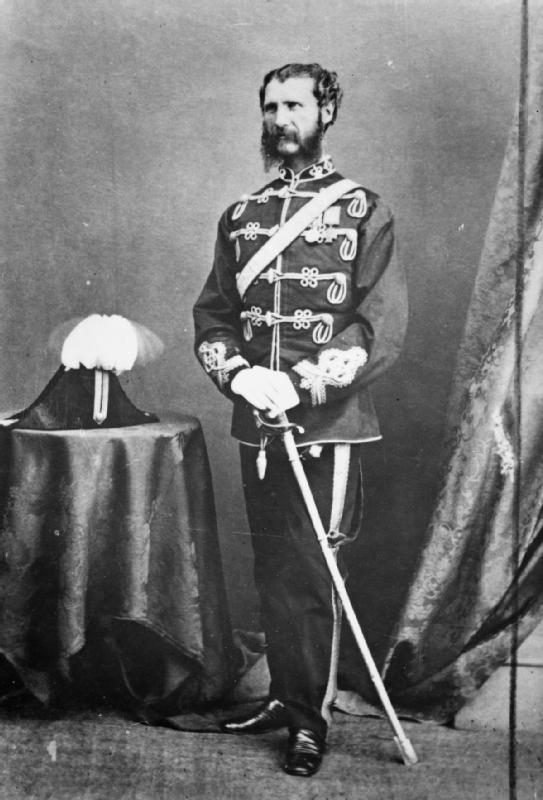
A third VC was awarded for Betwa, although erroneously, this has often been cited for actions at Jhansi. The citation is, however, quite clear:
“For conspicuous gallantry near Jhansi, on the 1st of April 1858, when No. 1 Company of the Regiment was ordered to take a gun, in dashing forward at a gallop, under a heavy musketry and artillery fire, driving the enemy from the gun, and keeping possession of it till the Company came up. Also for conspicuous gallantry in attacking the rear-guard of the enemy, when he had three horses shot under him in succession.” (“No. 22212”. The London Gazette. 24 December 1858. p. 5518.)
As no other action was fought on 1 April, the answer is, of course, Betwa.
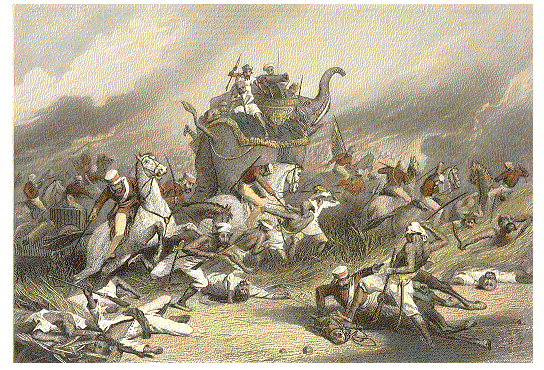
As we have already seen, the 86th Regiment had been detached under Brigadier Stuart with the 1st Brigade along the Bangaon road, eight miles from Jhansi, to oppose and outflank the rebels who had crossed at the ford; however, Stuart found no enemy at Bangaon and now turned towards the sound of battle. On their advance, his cavalry cut up some fugitives, but it was at the village of Kushabir where they found 2000 insurgents holding their ground with their guns.
Stuart now advanced his infantry in skirmishing order, his cavalry on either flank, and his guns were on the main road. The artillery opened fire at 600 yards from the insurgents’ position, and after a few rounds, Stuart ordered the infantry to storm the village. “The 86th Regiment and the native infantry
at once dashed forward and carried the village at the point of the bayonet, capturing all the enemy’s six guns. Falling back from there, the hostile troops rallied at a second village, but were instantly ejected by a charge of the 86th Regiment. The enemy then fell back in splendid order, pursued by the 1st Brigade, though 250 of the rebels were killed in this encounter alone. The troops had now been under arms for thirty-six hours, and besides killing 1,500 of Tantia Topi’s army, had taken all their stores and guns. So Sir Hugh Rose ordered the force back to their camp… The Adjutant, Lieutenant Cochrane, had three horses shot under him, and was mentioned in despatches, as was also Lieutenant-Colonel Lowth.” What singled Cochrane out, however, was that he had dashed the gun alone, ahead of his men, and then stood his ground until everyone else caught up., as Cochrane fought off an onslaught of foes to keep the gun he had so determinedly charged. He then kept his head about him and charged the rebels’ rear guard. Unfortunately, Cochrane would find himself unhorsed three times, but the fight went on until Tantia Tope and the “Army of the Peshwa” were on the run. It was not all that Hugh Cochrane would do—during the taking of Jhansi, it was Cochrane, when under heavy fire, who placed the British flag on top of the palace.
Born on 4 August 1829, at Kilmallie, Fort William, Argyll, Scotland, the son of George Germain Cochrane and his wife, Susan (née McColl).
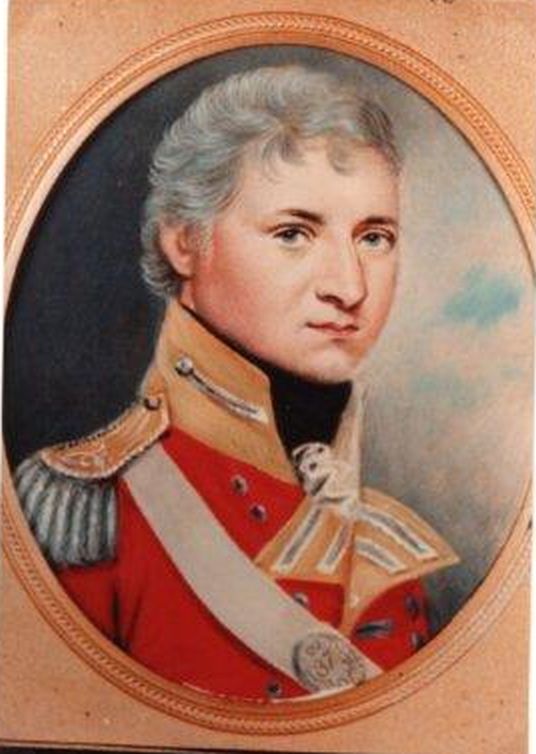
At the time of Hugh’s birth, his father was Deputy Sheriff of Argyllshire and Commandant at Fort William, but he had himself had a colourful life. He had started his career as an ensign in the 28th Foot in 1793, raised to lieutenant in the Royal Glasgow Regiment in 1794; with the same rank, he returned to the 37th and made captain in 1803. The regiment was posted to the West Indies from 1800 to 1809 and to Gibraltar from 1812. In 1814, Cochrane joined the army of the Duke of Wellington as Regimental Major of the 37th at Bayonne.
While we know very little of his early life, Hugh Cochrane would be commissioned as an ensign without purchase in the 86th Regiment of Foot on 13 April 1849. By the time the mutiny began, Cochrane was serving as adjutant to the regiment, a position he would hold throughout these tumultuous times. Slightly wounded in the storming of Chanderi Fort, Cochrane was back to fighting fit by the time of Betwa; he remained a very lucky soldier — he fought through the Battle of Gowali and then the Capture of Gwalior; as second in command of Meade’s Horse from 1858 to 1859, Cochrane took up the pursuit of Tantia Tope, a feat he completed as a commander of irregular cavalry under Sir Robert Napier.
In August 1858, Cochrane was promoted to captain; following the end of the mutiny in 1859, he transferred to the 7th Regiment, Royal Fusiliers for service in Peshawar, Ferozepore and Bombay. While at Peshawar, Captain Cochrane was invested with the Victoria Cross by Major General Sir Sydney Cotton.
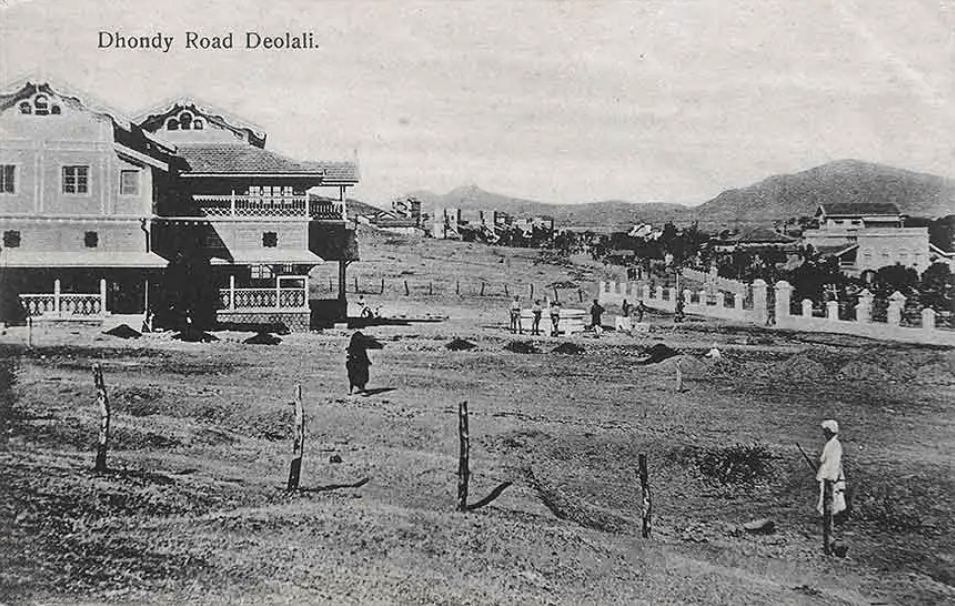
From 1863, he served as Brigade Major with the Yousafzai Force during the North-West Frontier War (present at the Ambala Pass), for which he was awarded the medal and clasp. By 28th October 1871, Cochrane was a full Major and returned to England with the 2nd Battalion, 7th Regiment to Portland, Dorset. In 1873, he was serving in Cork, Ireland, but the following year he was back in India as Brevet Lieutenant-Colonel at Poona and Bombay. From 1874 to 75, he was commander at Khandala and then for two years (1875-77) at the Deolali Depot, 100 miles north-east of Bombay.
Established in 1861, the depot in Deolali Cantonment housed soldiers newly arrived in the country and those awaiting ships to take them home. The soldiers’ name for the camp was “Doolally”, a shortened version of “Doolally tap” (tapa, meaning fever or heat/torment in Hindi or Sanskrit) and slang for madness. Deolali, at the best of times, although a minor hill station, was dull and the summers hot. It was said that the soldiers at the camp quite quickly became mad, thus the saying they had gone “doolally”, but in reality, it was most likely from sheer boredom. The wait for a ship home could be a long one, and the soldiers, disarmed and with only light duties to bide the time, had nothing sensible to do. New arrivals fared no better; when a lack of beds left them sleeping on the floor, many suffered from irritated sand flea bites. However, a stay of several weeks in Deolali served its purpose—new arrivals would carry out route marches and close order drill to acclimatise them to the heat. If the soldiers thought a visit to nearby Nasik was any better, many swiftly thought again—although Nasik offered the bored soldiers brothels and booze, plenty of them added VD to their misery. To solve any unruliness or to treat illness, Deolali offered a military prison and a sanatorium. However, no cases of madness were ever treated at Deolali—these poor men could either take some time in prison, or they were transferred to mental institutions elsewhere in the country.
After Deolali, in 1878, Hugh Cochrane transferred to the 43rd Light Infantry with the rank of Lieutenant Colonel, and after a brief stint at Belgaum and Bombay in 1879, Colonel Cochrane served his last posting at Thayetmyo, Burma. In 1881, he sold his commission and retired home, his health ruined. Four years later, in 1884, he died at Southsea. His medals are held by the Royal Ulster Rifles Museum, Belfast. Although he is said to have married twice — the second time in 1875 in Bombay to Mary A. Maitland (the daughter of Surgeon-General G.G. Maitland, who had seen considerable service himself in India) — neither marriage produced any children.
Sources:
History of the Royal Irish Rifles – Lt. Col. George Brenton Laurie (London: Gale & Polden, 1914)
https://vcgca.org/
https://victoriacross.org.uk
https://www.victoriacross.org.uk/bbcochra.htm
https://web.archive.org/web/20080513051209/http://www.memorials.inportsmouth.co.uk/vc/cochrane.htm
 Mutiny Reflections