The 86th Regiment of Foot
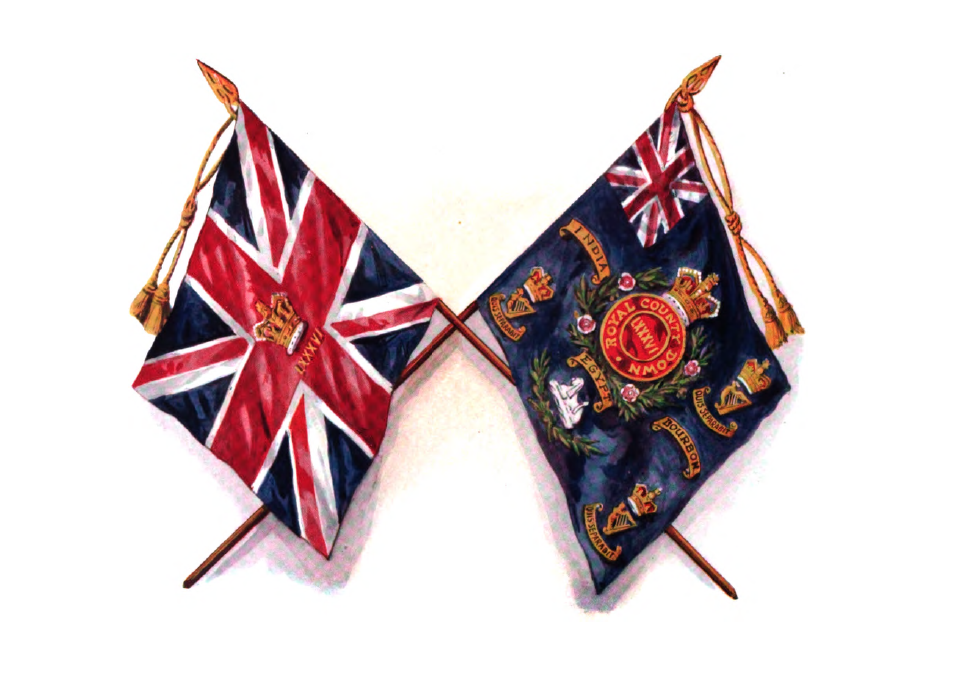
The 86th Regiment of Foot had been in India before – according to their records,
“On 20th February, 1799, it embarked for India and landed at Madras on the 10th of May. The appearance of the men was especially commented on. Well-grown, well set up, and 1,300 strong, the Regiment excited universal admiration. The Regimental Records add: ” Perhaps the finest body of men that ever came to that country.”
The 86th Regiment remained at St. Thomas’s Mount, near Madras, until the 8th June, when it sailed for Bombay, as the troops were no longer required on the east side of India, owing to the fall of Seringapatam on 4th May, 1799, and the death of Tippoo Sahib.
The Regiment landed at Bombay on the 22nd July, 1799, where it remained for the time being, sending small detachments by sea to Tannah and Surat, under Major Bell and Captain James Richardson respectively. Those detachments rejoined in December.“
Their service was long one:
1799 Madras, Bombay
1800 Ceylon
1801 Egypt
1802 Bombay
1803 2nd Maratha War
1806 Bombay, Goa
1810 Mauritius Campaign. They occupied the island in March 1811[before returning to Madras in February 1812. The regiment returned to India in 1816 and was stationed in Hyderabad. They fought in the Pindari War (1817-1818) before shifting to Ceylon to join in the 3rd Kandyan War (1817-1818) and embarked for home in April 1819. In 1827, they were off for their first West Indian posting, which lasted 10 years.
In 1842, however, they were back in India and were still there when the mutiny broke out. Their service in the Rajputana and Central India Campaign would see them awarded four Victoria Crosses.
In 1859, they returned to England and would spend the next two decades on garrison duty not only at home but in Gibraltar, Mauritius, the Cape of Good Hope and Bermuda. In 1881, they were amalgamated with the 83rd (County of Dublin) Regiment of Foot to form The Royal Irish Rifles.
Lieutenant Henry Edward O’Dell Jerome
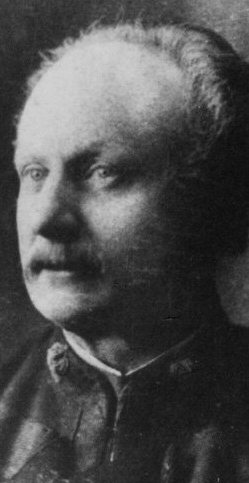
For conspicuous gallantry at Jhansi, on the 3rd of April, 1858, in having, with the assistance of Private Byrne, removed, under a very heavy fire. Lieutenant Sewell, of the 86th Regiment, who was severely wounded, at a very exposed point of the attack upon the Fort; also, for gallant conduct at the capture of the Fort of Chandairee, the storming of Jhansi, and in action with a superior Rebel Force on the Jumna, on the 28th of May, 1858 when he was severely wounded.
Born in 1830 in Antigua, West Indies to Captain Joseph Jerome of the 86th Regiment and his wife, Jane Walker. His father was an old 86th officer who had served the regiment as quartermaster for 28 years. One of his mother’s ancestors was an English soldier and Anglican priest, the Reverend George Walker, who was killed during the Battle of Boyne in 1690.
Both Henry and his older brother John served the 86th in India; however, only Henry is listed as having received the Indian Mutiny Medal. In all, his medal entitlement was, besides the Victoria Cross, the mutiny medal with clasp for Central India, the India General Service Medal (1854-95) with 1 clasp, North-West Frontier.
Educated at Sandhurst, Jerome joined the 86th as an ensign without purchase in 1852 and made captain on 1 July 1859. He transferred as a Brevet Major to the 19th Regiment and took part in the Hazara Expedition. From 1876 to 1884, he served as Fort Major of Guernsey and Alderney, and retired in 1885 with the rank of Major General. Jerome died on the 25th February 1901 at his home in Bath, the last of the Jhansi VC holders to pass away. His only son Lucien Joseph served as a career diplomat, while his nephew, John William Jerome served with the Royal Army Medical Corps and served in the South Africa War, 1899-1900, where he served with the 8th Division, and was present during the operations in the Orange River Colony, including the actions at Biddulphsberg and Wittebergen, and in Cape Colony, south of the Orange River. He retired as a lieutenant colonel and died, aged 55, in 1912.
Private James Byrne
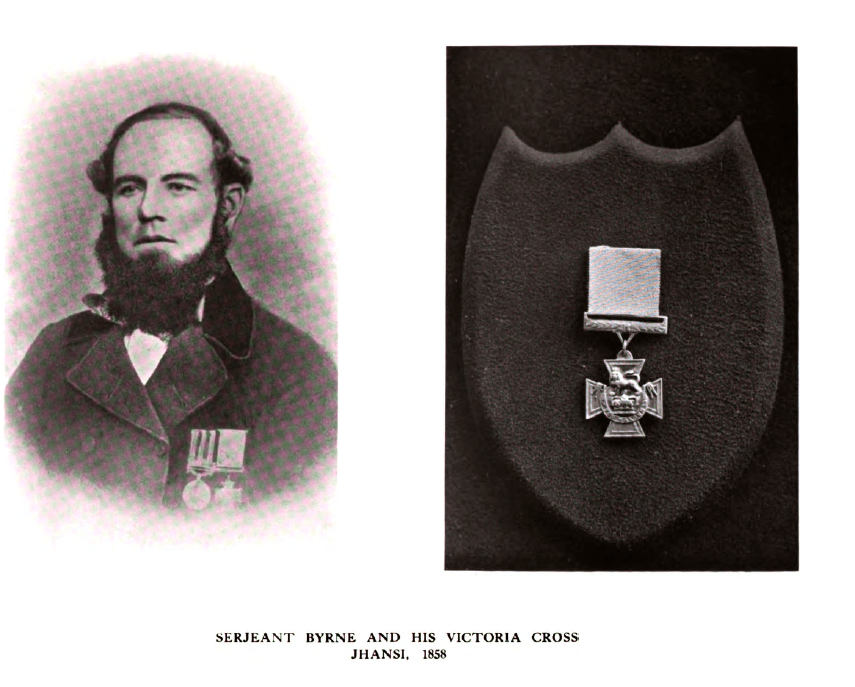
“For gallant conduct on the 3 April 1858, at the attack of the Fort of Jhansi, in carrying Lieutenant Sewell, who was lying badly wounded, to a place of safety, under a very heavy fire, assisted by Captain Jerome, in the performance of which act he was wounded by a sword cut.”
When Lieutenant Colonel Lowth’s 86th led the main attack to force the breach in the wall at Jhansi, a second group led by Major Stuart attempted an escalade of the Rocket Tower. Stuart’s men came under heavy fire and suffered many casualties, however, the insurgents were beaten off the top of the walls and retreated to the houses below. From here, they continued to pour a heavy fire on the advancing 86th. The 86th, with Rose at their head, and mad with battle, rushed the houses in their front “in a most business-like manner…. Suddenly, this party came under a severe fire from the fort, under which they were obliged to retire, as they were unable to get into it, and lost in a very short space three officers killed-Captain Darby, Ensign Sewell, and Lieutenant Halroyd (an attached officer)— and many men severely wounded. Ensign Sewell was very badly hit, but Lieutenant Jerome and Sergeant Byrne carried him off at the risk of their lives.”
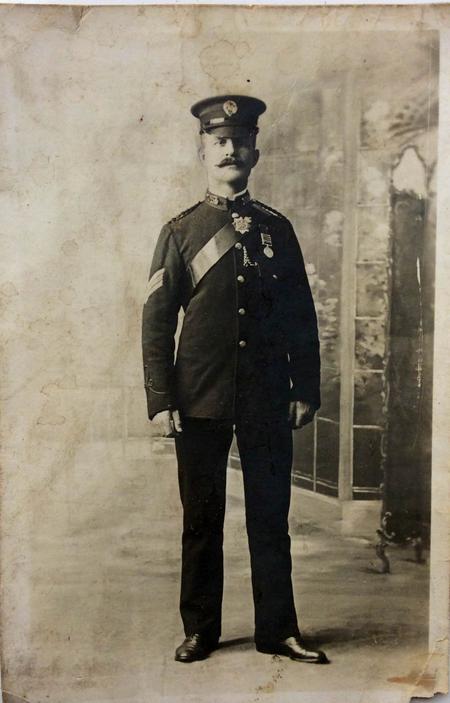
https://livesofthefirstworldwar.iwm.org.uk/lifestory/693105
Born in 1822, Newtown, Mount Kennedy, Co Wicklow, Ireland, very little is known of his life before he joined the 86th or indeed after the mutiny. He received his VC from Queen Victoria in 1860. His original award was stolen, so in 1865, he was presented a replacement in India in the presence of the officers of the 86th. Sergeant Byrne died in 1872 in Dublin, Ireland.
His nephew, Augustine, (the son of his brother Myles and his wife Maria McGarry) enlisted at the age of 18 in 1887 in Naas with the Royal Dublin Fusiliers but it appears, following his marriage in 1899, he moved to London with his wife and worked as a tram driver and later as caretaker for a block of flats. With the advent of WWI, Augustine, now aged 45, enlisted again in the RDF and in 1918 was discharged due to illness, having spent some time in Croydon War Hospital due to wounds in his left leg. He retired an army sergeant and died in 1952.
Private James Pearson
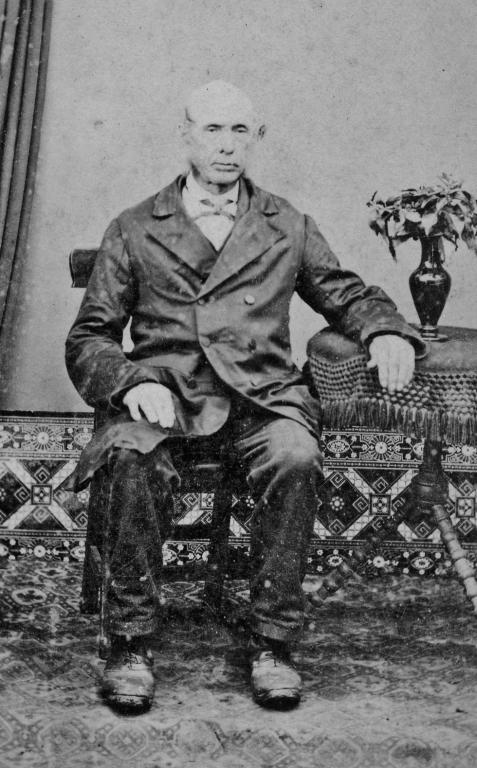
James Pearson was born in 1822, in Rathdowney, Queen’s Co (now Laois), in Ireland to Jonas Pearson. He began his career with the 86th Regiment in 1840 when he joined up in Co. Tipperary and found his first fight in the Crimea when he was present at Balaklava.
His VC citation is for two separate actions, Jhansi and Kalpi:
” For having gallantly attacked a number of armed rebels, on the occasion of the storming of Jhansi, on the 3rd April, 1858, one of whom he killed, and bayonetted two others. He was himself wounded in the attack. Also, for having brought in, at Calpee, under a heavy fire, Private Michael Burns, who afterwards died of his wound.”
Pearson was promoted to sergeant in 1860 and received his VC during an investiture ceremony held in Bombay in 1861, where it was presented to him by Lieutenant General Sir William Rose Mansfield.
It would appear that returning home held little interest for James Pearson. Following the mutiny, he remained in India, married one Sophia (née Payne), the widow of Samuel Bonner of Madras, in 1861. Following his discharge from the army, he served for a time as Prison Governor in Madras, India. He died on 23 January 1900 in Poonamallee, Madras and was buried: Pursewalkum, Madras Presidency.
The saving of Private Burns was a complicated affair, and one man who undertook the same risks as Private Pearson was somewhat irritated at being passed up. Writing to the Adjutant General, Lieutenant Holroyd of the 86th Regiment pointed out that in the General Order by which Pearson received the VC, the entire credit for his actions at Kalpi was given to Pearson alone. While his name had been “entirely omitted,” Pearson was in fact acting on Holroyd’s orders. While Holroyd was not asking to be awarded the VC, he had been promised a mention in despatches, which never materialised. The answer from the Adjutant General was hardly fair:
“This board has recorded an opinion that you behaved with great gallantry in rescuing, with Private Pearson’s assistance, a wounded soldier before Calpee, but that the act, however gallant, was not, under the circumstances, deserving of the high honour of the Victoria Cross.”
The Royal Artillery
The first company of the Royal Artillery to serve in India sailed in November 1747. During the 1800s, their service in the East Indies was mainly in Ceylon until the Indian Mutiny in 1857.
Bombardier Joseph Charles Brennan
“For marked gallantry at the assault of Jhansi, on the 3rd of April 1858, in bringing up two guns of the Hyderabad Contingent, manned by Natives, lying each under a heavy fire from the walls, and directing them so accurately as to compel the Enemy to abandon his battery.”
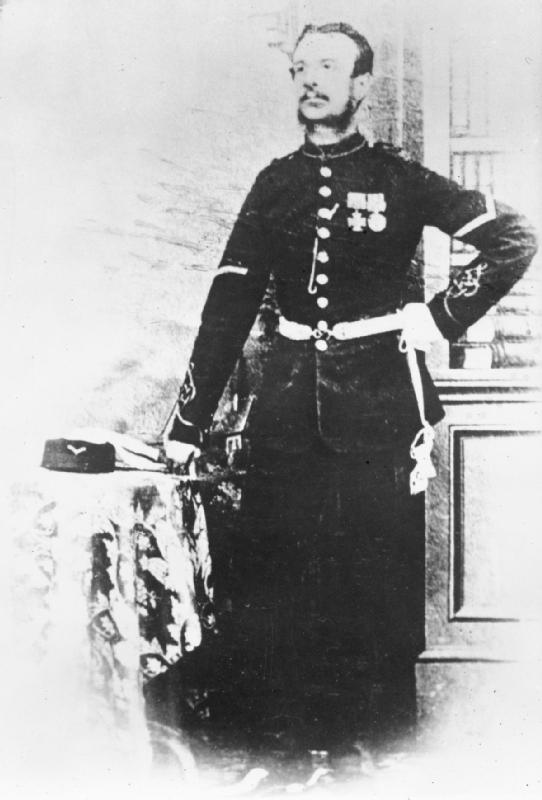
Born in St Columb, Cornwall in 1836, the son of Augustine Brennan, a schoolmaster and his wife, Maria, Joseph Charles Brennan enlisted with the Royal Artillery in 1853. Apparently, the life of a clerk, which he gave as his occupation, was not particularly exciting. His life would certainly change when, in 1857, he found himself in India. He served through the Central India Campaign and the Capture of Gwalior, but it was at Jhansi that he made his mark, not at the storming itself, but the bombardment of the breach.
“In order to bring an enfilade fire to bear upon the breach, a new battery, No. 5 Left Attack, was begun near the Jokun Bagh, where two 54-inch mortars were in action. It was determined to replace them by two 10-inch mortars for vertical and a 9-pounder and 24-pounder howitzer supplied by the Hyderabad Artillery for direct fire. While the new battery was being made, the two field guns were worked in the open under the command of Bombardier J. Brennan, of 5/14 R.A. The bearing of the young non-commissioned officer attracted the notice of Sir Hugh Rose, who there and then promoted him, and he was afterwards awarded the Victoria Cross.”
Promoted to corporal on 1 August 1858 and to Sergeant in June 1860, the same year he received his VC at a ceremony held in Morar, he was reduced in rank in September to Bombardier. and then, three years later, he was raised back to Sergeant in January 1863. The rank appears to have been jinxed for Brennan. In October of 1863, Brennan was court-martialed in Delhi for failing to attend morning muster, found guilty, demoted to bombardier and then, later, reduced again, to gunner. So he began his slow climb back up. The Bhutan War of 1864-65 saw him back on active service, his last before he returned to England. In 1869, he was promoted to bombardier in September, and a year later, he married Mary Eliza (née Broomfield), the daughter of a Royal Artillery pensioner. They swiftly had two children, Alexander Charles Augustus born in 1871, and Margaret Elizabeth, born in 1872. Things were going well – Brennan was promoted to corporal in 1871 and by March 1872, was once again Sergeant Brennan.
However, suddenly everything ended. Sergeant Brennan died of pneumonia at Shorncliffe Camp, Folkestone, Kent, on the 24th September 1872, and was buried in the Shorncliffe Military Cemetery, leaving behind his widow and two infants to mourn his loss.
The Royal Engineers
The Siege of Delhi and the defence of Lucknow were both carried out successfully by engineers of the Indian Establishment, but the advent of the Royal Engineers in India could not have come at a better time.
A portion of this force, on reaching Singapore, was diverted to India, and amongst others the 23rd Company Royal Engineers, under Captain A. J. Clarke, with Lieutenants Lennox, Malcolm,
Pritchard, and Harrison. This Company landed at Calcutta on August 11th 1857, and took part in the relief of Lucknow.
The 4th Company, under Major Nicholson, with Lieutenants Scratchley, Wynne, Swetenham, and Keith; the 11th Company, under Captain Cumberland, with Lieutenants Maquay, Walker, and Paterson, and the 21st Company under Captain Fenwick, with Lieutenants Edwards, Gkissett, Webber, and Festing, all arrived in November, the two former being landed at Calcutta, and the latter at Bombay.
Lieutenant-Colonel Harness, then Commanding Royal Engineer at Malta, received telegraphic instructions at the same time to proceed to India, to take command of the Royal Engineers, whilst Sir Robert Napier held the post of Chief Engineer over the amalgamated force. Captains Cox, Neville, and Lieutenant Beaumont were also ordered to the country unattached to any Company, making the number of Royal Engineers twenty-four officers and four Companies. The 4th and 23rd Companies joined the force which Sir Colin Campbell was collecting for the recapture of Lucknow and served throughout that operation.
The 21st Company, with Corporal Michael Slevin, joined the Central India Campaign.
Corporal Michael Slevin
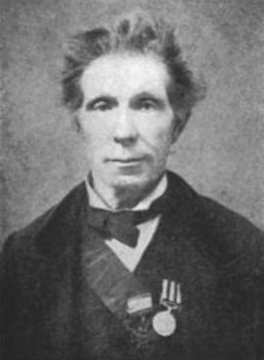
Corporal Michael Slevin, 21st Company, R.E., gained the Victoria Cross during the fight for Jhansi and his actions are thus recorded:
” For determined bravery at the attack of the Fort of Jhansi, on April 3rd, 1858, in maintaining his position at the head of a sap, and continuing the work under a heavy fire with a cool and steady determination worthy of the highest praise.”
Born in 1826 in Magheraculmoney, Co. Fermanagh, Ireland, Michael Slevin, when he enlisted in the Royal Artillery at Lowertherston (Irvinestown) in 1847, had been working as a stone mason. He was certainly an industrious man, for at the age of 20, it was said he had already built several houses in Kesh for one Mr. William Archdale – perhaps it was the Irish Potato Famine that sent Slevin searching for different prospects; as it is, the army would be where he would make his name. After two years as a Gunner & Driver with the Artillery, it was decided that a man of his talents was actually better suited for the Royal Engineers and on 1 September 1849, he joined the Sappers & Miners. This change took him off to foreign lands, and he served four years in Bermuda with 21st Company; in 1855, he was promoted to 2nd Corporal, a year later to Corporal, and the same year he arrived in India.
The engineers with whom he served formed a part of the Central India Field Force in 1858 and were an essential part of the campaign, proving themselves over and over again in front of the myriad of forts Sir Hugh Rose was required to take, in the treacherous mountain passes and across stubborn rivers. It was at Jhansi, however, that they were faced with a formidable task.
A letter dated 26 October 1858, written from Jhansi by Captain John Baillie, Executive Engineer and Sub Assistant Engineer, Central India Field Force, to Lieutenant J.B. Edwards RE, Commanding 21st Co. Royal Engineer, details Slevin’s bravery, and gives an insight into the harrowing capture of Jhansi on 3 April.
“Sir,
I reply to your semi-official letter of the 4th inst, requesting me to state the circumstances of an act of gallantry performed by Corporal Sleavin, 21st Company Royal Engineers, at the capture of Jhansi, I have the honour to forward the following detailed statement for your information.
On the failure of the attempt to escalade on the left attack to which I was attached as an assistant field engineer. I proceeded round to the breach and joined the column of the night attack under Brigadier Stewart, which had forced its way to within a short distance of the Palace. In reaching this position, the column suffered very severely from the flank fire of the Fort at a point where it had to cross a small open space at the junction of several streets, upon which the enemy’s matchlock men concentrated their fire.
Dr Stack H.M. 86th Regiment was killed there as I reached it, and several other officers and a number of the men had been wounded. It occurred to me that by running a rough parapet across the opening, a direct communications with breach and a safe removal of the wounded would be secured and the line of buildings thus connected would form an advanced parallel of great importance in the event of the enemy (as was to be expected) holding out at the front.
I pointed this out to Capt Coley, the Brigade Major, and he requested me to put the plan into execution immediately. I directed Corporal Sleavin, 21st Company Royal Engineers, who with one or two others of the company, was present with the column, to commence the construction of the parapet by piling up doors and bedsteads, boxes and such other materials as were obtainable from the surrounding houses so as to afford the required cover.
He commenced at once, and the enemy, perceiving our intention, opened a severe musketry fire upon the spot. Scarce a plank was laid without being struck and frequently perforated by bullets, and from the great command the enemy had over us at less than 200 yards distance, it was almost impossible to raise the parapet sufficiently to avoid exposure. A Sepoy of the 25th Bombay Native Infantry was shot through the head close to me while pushing forward materials for the sap, and several others wounded, and I was compelled to substitute continuous rope to carry forward a constant supply of materials to the sap.
Corp Sleavin however who was at the head of the sap and consequently much exposed, maintained his position under this heavy fire with a cool and steady determination worthy of the highest praise and he continued his work until the capture of the Palace had placed the greatest part of the town in our possession and open up a safe line of communication with the camp by the Poncha and other gateways. As there was no longer any necessity for exposing the men at the sap, I directed Corporal Sleavin to withdraw and suspend the completion of the work till nightfall.
Capt Coley, Major of Brigade, 1st brigade C.I.F.F. and Lieut Gossett C.E. who personally assisted in the construction of the parapet, will, I have no doubt, add their testimony in support of this statement, and I shall be most gratified with their aid. It may be the means for obtaining for this brave man the due recognition and reward for an act of gallantry unsurpassed, if not unequalled throughout this campaign.“
Later that day, Michael Slevin led a party of men who, “in the face of death,” rescued Dr. Stack’s body, ensuring he would receive a proper burial.
As no investiture took place, it is likely Slevin received his VC by post in 1860, but unfortunately, he lost the original medal a year later and was issued with a replacement.
For Corporal Slevin, life continued – he was promoted to Sergeant on 8 May 1858, the same year he proceeded for service to Mauritius. Unfortunately, he did run into some trouble as he was court-martialled in 1862, which led to his demotion, and according to the VCGCA, his final rank on his retirement was Sapper. His entire service lasted 24 years, and he retired in 1871. Following his retirement, Slevin returned to civilian life and was known for his “most unassuming character, never parading his deeds of fame in India or elsewhere, living very quietly on a farm on the Archdall property and whenever alluding to the heroic part he took in the taking of Jhansi, for which he received the Victoria Cross, always ended by saying, “that in doing a soldier’s part he only did his duty to his Sovereign and Country.” He married Margaret McGoldrick; together they had two children, Edward and Bridget. Michael Slevin died in 1902 at Ederney, Co. Fermanagh and lies buried at St Mary’s RC Church, Bannagh, Co. Fermanagh, in the Slevin family plot. In 2009, a commemorative headstone was unveiled in his honour.
For the actions at Jhansi and subsequently, Lohari, one man would be honoured with the Victoria Cross and we shall, in the next post, look at the life of Frederick Whirlpool of the 3rd Bengal European Regiment, the man without a past.
Sources:
https://vcgca.org
https://www.impartialreporter.com/news/13850548.tribute-to-gallant-fermanagh-soldier/
https://www.liverpoolmedals.com/product/qsa-major-ramc-surgeon-irish-military-family
https://web.archive.org/web/20060810230716/http://www.remuseum.org.uk/rem_his_vc.htm#1s#1s
The History of the Royal and Indian Artillery in the Mutiny of 1857 – Col. Julian R. J. Jocelyn (London: John Murray, 1915)
History of the Royal Irish Rifles – Lt. Col. George Brenton Laurie (London: Gale & Polden, 1914)
History of the Corps of Royal Engineers, Vol I – Witworth Porter (London:Longman, Green & Co. 1889)
https://family.ray-jones.org.uk/rootspersona-tree/william-rice-morland-holroyd/
 Mutiny Reflections