In 1831, Humphrey James and his wife, Lavina, welcomed a baby boy into their lives, the third of ten children, in County Carlow, Ireland. The family moved to Dundalk in County Louth around 1838. Humphrey had been a policeman for fourteen years with the Irish Constabulary, which was formed in 1836 upon the amalgamation of the county forces. Posted to Dundalk, they took up their residence at 28 Jocelyn Street, where the family would live until 1875.
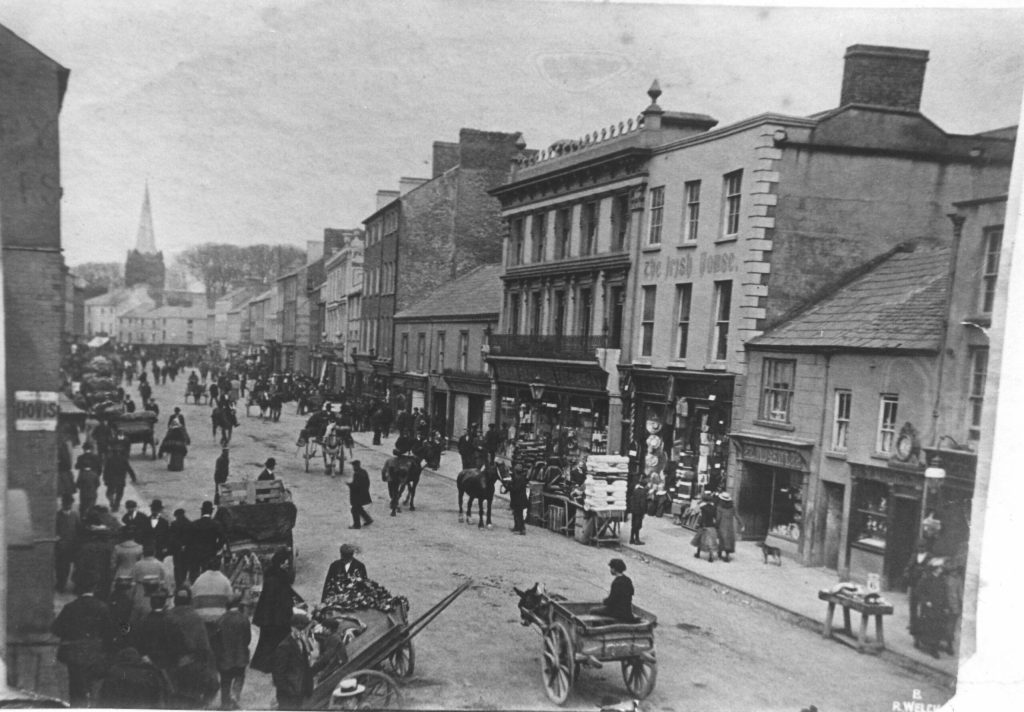
https://www.olddundalksociety.ie/gallery/
An educated man, Humphrey James insisted that his children receive the best schooling he could afford. His sons attended the Dundalk Institute, and one of them, his namesake, Humphrey, excelled. The boy was offered one of the thirty free places at the institute, a boon for a father who had so many children to educate. Young Humphrey James remained at the school well into 1848. The education he received, which for its time was well-rounded and included grammar, algebra, history, reading, writing, geography, Euclid and bookkeeping, would serve him well in later life.
After leaving school, 17-year-old Humphrey swiftly found a position as a clerk at the Dundalk Poor-Law Union, where he soon rose to a position of some responsibility as an assistant in prosecutions. Unfortunately, the work was terrible, and must have left a mark on the young man’s mind, for he would have witnessed the evictions of the poorest people in society for their inability to pay the tenement tax. When Humphrey worked there, during the latter part of the famine, the scenes would have been most distressing. He managed to put up with the whole misery of it until 1854, when he enlisted in the EICo army for service in India.
According to his obituary which carried a statement by a friend John Dick Smith, Humphrey James had apparently been prone to “violent passions” in his youth, leaving his exasperated father to declare the lad had a temper like a “whirlpool.” Following a quarrel, Humphrey left home with his father’s words in his ears and enlisted as Frederick Whirlpool. We must imagine Humphrey’s prospects at the time – Ireland offered little hope of a bright future, thousands were emigrating to America or further afield, and even his own brother, Thomas, had joined up as a sailor. For a brighter future, young men set their sights away from home. Unfortunately, Thomas died in Rio de Janeiro; perhaps Humphrey had broached the subject of enlistment for foreign fields to his father, who, distressed at losing one son, was horrified at the prospect of losing another. Yet Humphrey would not be dissuaded – the tempting EICo recruiting party who offered a passage to respectability, wealth, and splendour must have sounded almost like paradise to a young man, looking for a better life. The path Humphrey James chose that day would change his life forever. But it was the recruit Frederick Whirlpool who last saw Ireland fading in the distance as the ship sailed for Liverpool; one wonders if he realised at that moment, he might never return home again.
After a short stay in Liverpool, Frederick made his way to Glasgow to present himself at the EICo Recruiting District Office on 23 October 1854. He was noted as being 23 years of age, 5’7″ tall with brown hair, grey eyes and “fresh complexation” although the nape of neck was scarred by cupping, a process believed to “align the humours” and could best be described as “artificial leeching” in which a small incision was made and a cup then placed over the wound to draw out the blood. Unsightly as it might have been, the recruiting officials were not put off – they had before them a well-educated young man who answered their questions, filled out their forms and presented himself with good deportment, in all, an excellent recruit. With care, he now erased his connection to Ireland – he was Frederick Whirlpool, of Liverpool, occupation: clerk. He enlisted for a term of ten years. At the Warley Depot, near Brentwood, in Essex, Whirlpool was posted to No. 5 Company, 3rd Bombay European Regiment.
With the mandatory training course absolved, on 29 November 1854, he set sail for India. For the next eighteen years, he would write letters home, even to his father.
The 3rd Bombay European Regiment
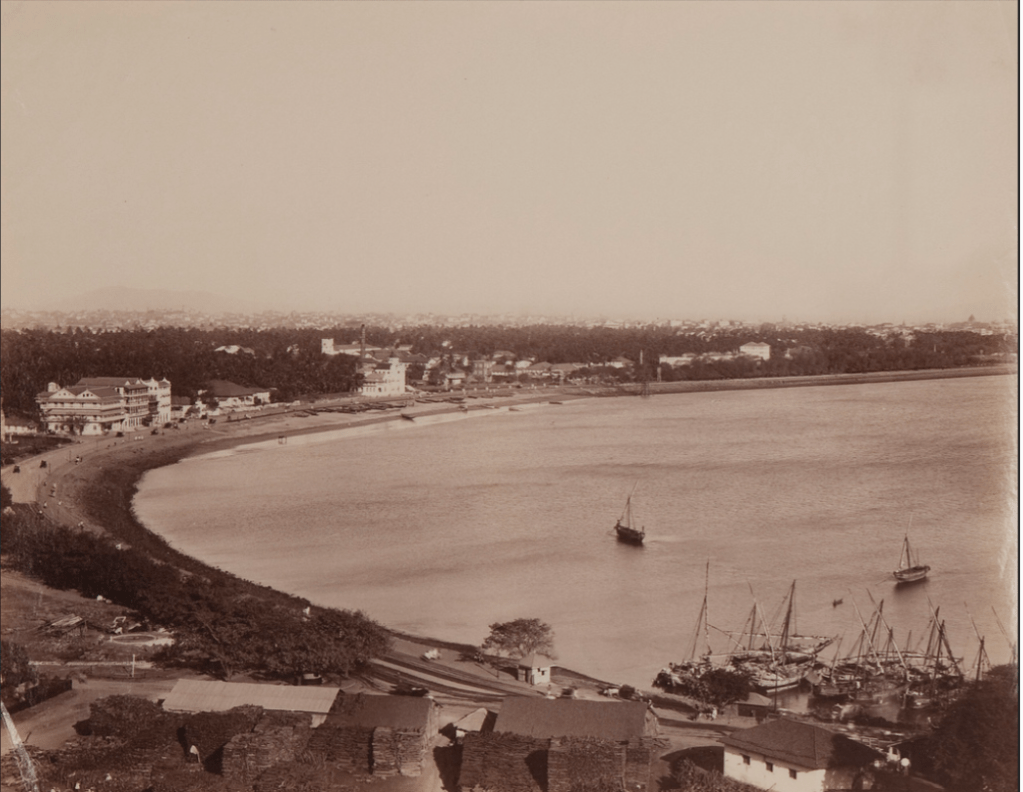
Raised in 1853, the regiment had originally been created to defend Bombay and was stationed in Poona. They were raised over an older regiment, called the Bombay Regiment of Europeans, created by King Charles II in 1662. When Bombay was ceded to the EICo in 1668, the regiment formed the beginnings of the Bombay Army and was, in effect, loaned to the EICo from the Crown. By 1808, the Bombay Army boasted of 26,500 men, of which 6,500 were British and another 20’000 were Indians. At this juncture, a regiment of cavalry was raised. The Bombay Army officers were trained at Addiscombe Military Seminary or recruited by direct appointment. In 1853, as the EICo continued to increase its military strength, a third regiment was raised.
“These were to be brought on establishment on 15th November, 1853, and were to consist of 1 colonel, 2 lieutenant-colonels, 2 majors, 12 captains, 20 lieutenants, 10 ensigns and 920 other ranks. By Bombay General Orders of rst December, 1853, the new regiment in that presidency was to be entitled the 3rd Bombay European Regiment and the existing 1st Bombay Europeans (Fusiliers) and 2nd Bombay Europeans (Light Infantry) were each to furnish as nucleus 2 sergeants, 2 corporals, I sergeant for promotion to colour-sergeant, 10 corporals for promotion to sergeants, 10 lance-corporals or privates for promotion to corporals, 2 drummers or buglers and 50 privates. The first officers were Lieutenant-Colonel Commandant H. Cracklow, promoted from the Line; Lieutenant-Colonel J. E. Hume, promoted from the 10th Native Infantry; and Lieutenant-Colonel G. Le G. Jacob, promoted from the 2nd Grenadiers Native Infantry.“
Poona
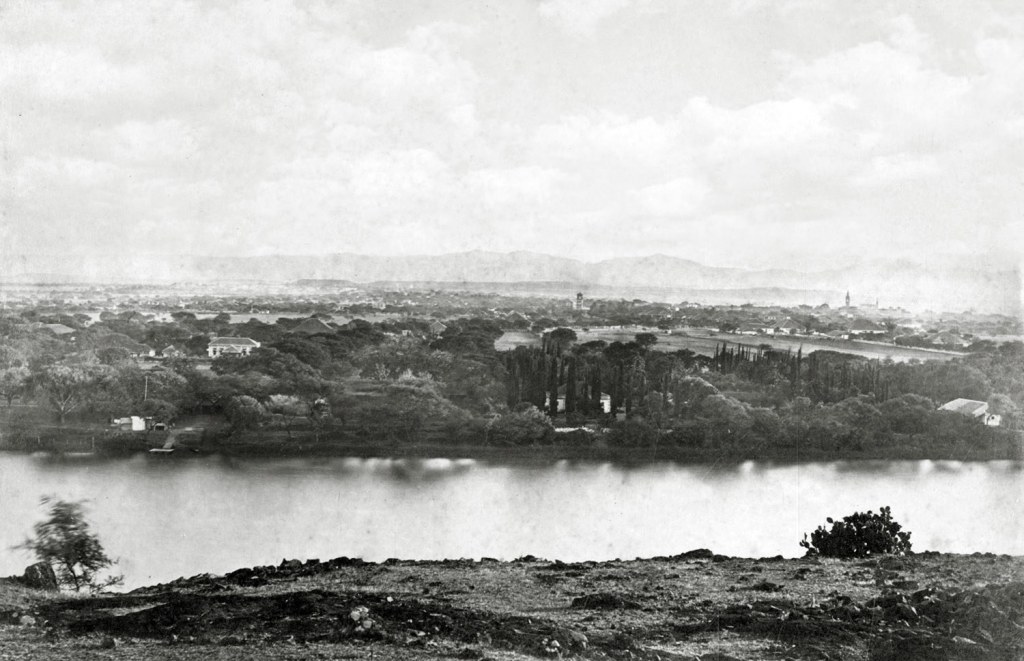
Situated some 60 miles from the coast at an elevation of 1800 feet, Poona City (Pune) was the headquarters of the Poona District, Bombay. It boasted of an agreeable climate, and by the time Frederick Whirlpool was stationed there, it was home to the Normal School, Bombay Army (later the Army School of Education), which also saw to the education and training of the men of the 3rd Europeans. The College of Engineering was established here in 1854, and Poona had long since been home to the Deccan College, founded in 1821 by Mountstuart Elphinstone.
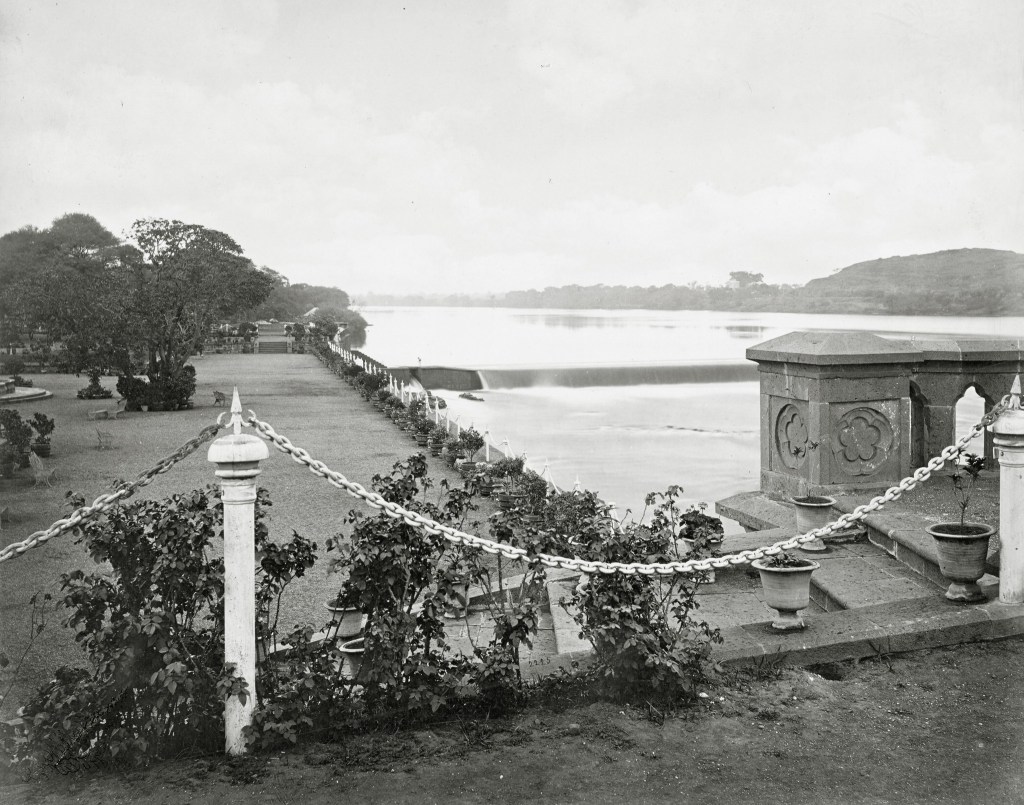
The Sadar Bazaar provided all the comforts and necessities required in its European shops, while the embankment or Bund by the river and its gardens were a place to ride in the evenings and meet. Wherever there were soldiers, there was a Lal Bazaar or, in our terms, a Red Light District; however, this did not necessarily hold attractions for every man, and for those who preferred other forms of entertainment, Poona had a selection of churches, parks, theatres and public institutions. While some of these would not have been accessible to a private soldier like Frederick Whirlpool, as Poona also served as a hill station for Europeans wanting to escape the Bombay summer, it was undoubtedly a lively place.
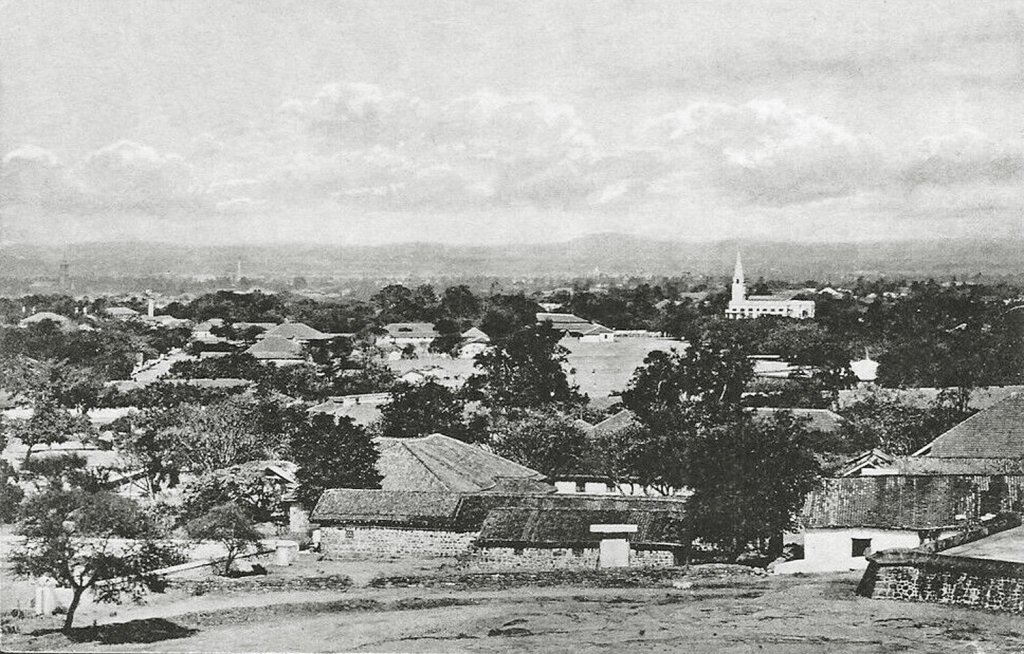
For the duration of 1857, the 3rd Europeans were essentially prevented from moving due to the lack of European troops in India – it was considered unwise to draw off regiments from the Bombay Presidency, and until the end of the year, when the first plans for the Central India Campaign were drawn up and sufficient reinforcements were brought in either from England or diverted from the China Expedition, the 3rd Europeans had to wait it out in Poona. They finally marched on 1 October 1857 and made their way to Mhow.
Frederick Whirlpool, VC
As we have looked in detail at the campaign itself, we will turn our attention back to Private Frederick Whirlpool, whose time would come at Jhansi on 3 April and 2 May at Lohari. “Whirlpool would have been at the forefront and used his bayonet unsparingly…He may have been part of the attack on the Villayets in the palace stables. In any event, he had no escape from the killing, as his sense of duty dictated…”
The first part of his VC citation is for Jhansi, stating merely,
“For gallantly volunteering on the 3rd of April, 1858, in the attack of Jhansi, to return and carry away several killed and wounded, which he did twice under a very heavy fire from the wall.” Whirlpool is known to have saved two comrades who had fallen from the broken ladders, for which he was mentioned in despatches; however, more men owed their lives or their decent burials to his gallantry.
And then came Lohari.
“…also, for devoted bravery at the Assault of Lohari on the 2nd of May, 1858, in rushing to the rescue of Lieutenant Doune, of the Regiment, who was dangerously wounded. In this service, Private Whirlpool received seventeen desperate wounds, one of which nearly severed his head from his body. The gallant example shown by this man is considered to have greatly contributed to the success of the day.”
The citation itself says very little; however, when it is clear what actually happened, Private Whirlpool’s bravery suddenly takes on a different light.
As the walls of the Lohari fort could not be battered in by artillery, it was decided to storm the place by blowing in the gates, a feat admirably performed by Lieutenant Bonus with his powder-filled bellows. However, when the 3rd Europeans stormed the place, they were faced with insurgents who were as determined as they were.
“Before the smoke had cleared away, the 3rd Europeans burst in, the first man through being a bugler, Private Whirlpool, who just forestalled two officers, Newport and Donne. Now appeared a lane leading to the fort proper, and on either side of this lane was fitted with scaffolding lined by rebel swordsmen. The bugler was cut down at once, and immediately the two officers stood over him and tried to get him away, but both fell, slashed with sword cuts. However, the remainder of the 3rd Europeans were pressing on from behind and in a moment had swept their way into the fort. Then there was desperate work. Every male in the fort was put to death. One rebel who endeavoured to escape with his wife, finding salvation impossible, smote off the woman’s head with one blow and then cut his own throat. Thus, the fort of Lohari was won by an operation in which ‘‘ the 3rd Europeans particularly distinguished themselves.’’
In a more harrowing telling of the story, Private Whirlpool, who was “at the front of the charge and immediately behind his felled leaders, fought the rebels with his bayonet…He stood between the enemy and Lt. Donne and would not retreat.As the rebels sought to thwart the advance upon them, Whirlpool still refused to yield. He was repeatedly cut by their tulwars and did not fall until he had received seventeen sword cuts to his body, arms and neck. It is almost unimaginable how this man stood his ground, receiving cut after cu to his head and upper body. Yet he did not only that, but continued to parry and thrust with his bayonet, using his rifle to deflect tulwar blows…The neck wound was the severest cut, but his skull was also fractured by a blow.”
When all was over, and Whirlpool was placed in the dhoolie, still conscious, he asked his helpers to be careful. ” Take care lads and don’t shake my head, or else it’ll come off.”
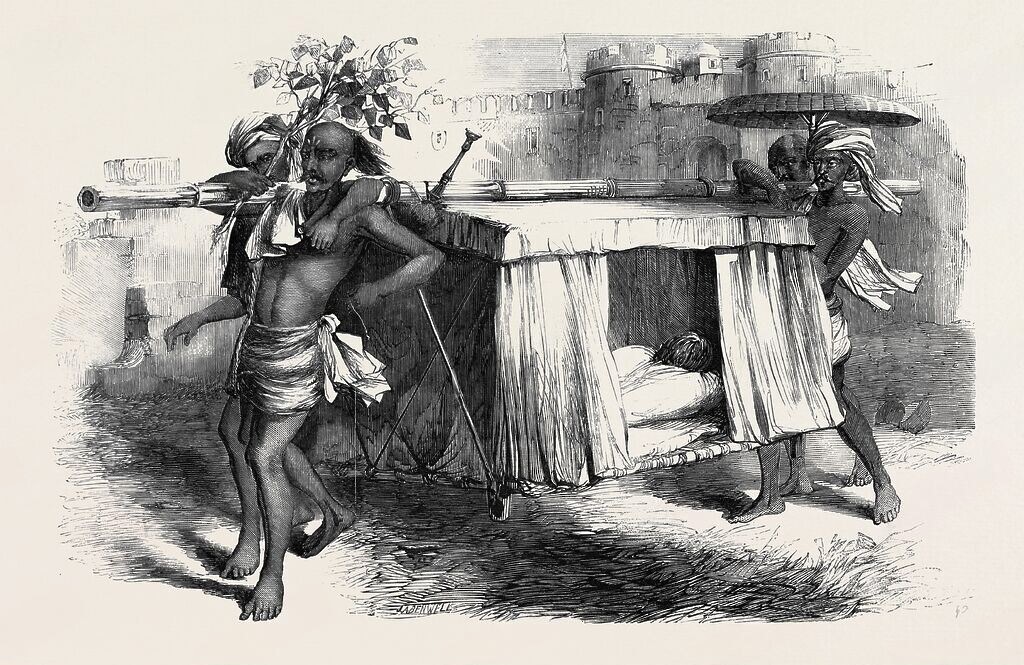
Whirlpool was taken back to Jhansi to be treated for his wounds. The hospital there was certainly better than most of those in the field at the time; an attendant was assigned to him to keep off flies while his dressings were regularly changed, the food provided was decent, and the rooms, in what had once been the Rani’s Palace, were well-ventilated. Of all his wounds, the skull fracture proved the most troublesome and required an extensive surgery, which included affixing a silver plate to his skull to close the hole. In all, he would spend five months in the hospital. Lieutenant Donne, whose life Whirlpool had saved, fared but little better. He had received severe wounds on his back, left arm and elbow.
By November, Whirlpool had recovered sufficiently to be moved to Poona; here he would wait until the army decided what his future would be, and ultimately it would be tied up in politics.
The East India Company had lost its administrative power following the Government of India Act of 1858, through which all of its possessions and armed forces were taken over by the Crown. While the Company itself would not be officially dissolved until an Act of Parliament was passed in 1874, declaring Queen Victoria as Empress of India, which heralded direct imperial rule, the dismantling of the EICo was by this time complete.
Besides the problems in the administrative sector, the biggest hurdle faced by the army would be the dissolution of the three Presidency armies. The work would fall to Sir Hugh Rose, for at the end of his campaign, he would be appointed Commander in Chief in India, making him directly responsible for the restructuring. While this will be looked at in detail in a separate post, for Whirlpool, the restructuring came with the very real possibility of being transferred to a British unit and sent home, something he was still anxious to avoid. Fortunately, the Medical Board reviewed his case before any further service could be considered – as such, Whirlpool was found to be unfit for continued service and received his medical discharge on 2 February 1859. As this meant a discharge from all further duties to the EICo, he was no longer eligible for a position as school master at Poona, a vocation he had been hoping for well before the outbreak of the mutiny. Now, with his modest pension of 1/3d a day and his yearly £10 stipend for his VC (which would commence as soon as the VC was confirmed and he was gazetted; the pay would subsequently be backdated to the date of the last action), and still only 27 years old, Whirlpool set his sights on Australia. He did meet his brother Benjamin while in India, who had also served in the Indian Mutiny; he would be the only sibling Humphrey would ever see for the remainder of his life.
Sir Hugh Rose paid a visit to the hospital in Poona before Whirlpool was discharged: Rose had long suspected the man he was meeting was living under an assumed name, but the situation did not bother Rose; after all, Whirlpool was hardly the first man in the army to take a pseudonym and if everyone could overlook that Sir Colin Campbell had started life as Colin Mcliver, Whirlpool’s choice, though odd, caused no consternation either in England or in India. While it is supposed that Rose told Whirlpool of his nomination for the VC, this has not been reliably confirmed, but considering the attention he paid to the men who fought under him, wholly possible.
When Whirlpool arrived in Melbourne, Australia, has never been established – he left Bombay, most likely shortly after his discharge, but for reasons known only to him, Whirlpool was again covering his tracks. He travelled under his assumed name, but deliberately chose to hide the name of the ship; once in Australia, he deliberately changed his birth year to 1833. Whatever his reasons were for choosing Australia, by October 1860, he made to join the Victoria Police as Frederick Whirlpool. By now, the confirmation of his VC was well-known, and he even alluded to it on his application, offering himself for Mounted or Foot Police, his education and his rigorous discipline as an infantryman. As it is, when he did join the Hawthorn and Kew Volunteer Rifle Regiment while his police application was still being processed, he was no longer Frederick Whirlpool, but Humphry James.
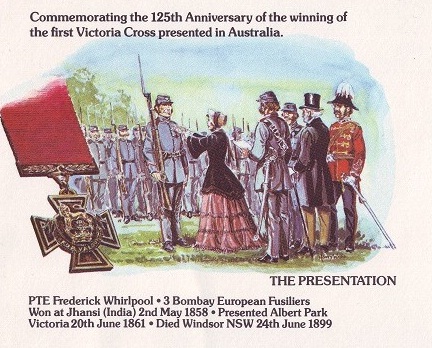
While two other VCs had been awarded in private presentations in Australia in 1858, for services in Crimea, as it was, Whirlpool would become the first person wearing an Australian uniform to be publicly awarded the Victoria Cross with this much pomp and circumstance. Lady Barkly, the wife of Sir Henry Barkly KCB, Governor of Victoria, pinned the medal on his chest at a celebratory ceremony on 20 June 1861, which, besides being witnessed by some 2000 troops and their officers, garnered so much attention that reportedly 14000 spectators turned up. He was invested as Frederick Whirlpool – the name Humphrey James, which he used to enrol in the Rifles, was considered to be assumed!
A correspondent of “A Bell’s Life in Victoria,” reported that “Mir Whirlpool is a well-built man of middle age, and his wiry frame appears capable of great endurance. The effect of the wound on his neck is still apparent. On his name being called, he stepped out of the ranks and with shouldered rifle stood in the attitude of attention.” As soon as Lady Barkly affixed the cross to his left breast and had spoken a few words, the same correspondent noted that “Private Whirlpool was so much moved by his well-deserved reward that he could hardly express his heartfelt acknowledgements.”
Following a levee “for the gentlemen of the colony” hosted by Sir Henry Barkly to celebrate the Queen’s birthday, albeit belatedly, Frederick Whirlpool removed the VC from his uniform, placed it in his pocket and never wore it again. He tried to return to a life of anonymity, having secured a position as a teacher while he waited for the Victoria Police to answer him, but he could hardly avoid recognition – he had become a minor celebrity in a small community, and he could hardly escape the unwanted attention.
Around this time, he made a petition to have his name on his citation changed by the Victoria Cross Register, officially to Frederick Humphrey James, and to ensure all further payments of his pension and VC monies would be paid out in that name, but he was unable to provide the required birth certificate attesting what he now claimed was his real name. In any case, the name was never changed as the request was denied, and shortly after, he was begrudgingly offered a position with the Victoria Police after his case had been presented in parliament, where it was decided he would be guaranteed preferential treatment due to his VC status. James most likely considered this undignified: it would also have placed him ahead of men who had waited much longer than he had for a spot on the force, and being a man of principles, James refused and shortly after, set sail for Tasmania.
By the time he returned to Australia in 1862, interest in Frederick Whirlpool VC had died down, and he was now able to start his new life with the New South Wales Police Force in Sydney on 22 September 1862 as a supernumerary officer. He had now begun using the name Frederick H. Whirlpool, but did not mention his VC on his application. Promotion was swift, but so was his dismissal from service – on 10 June 1863, barely 5 months after becoming a constable. He was charged “in default of sureties to keep the peace, “ and was ordered by the court to serve one month in prison, which he duly did. When he left the prison, it is anyone’s guess what he did next, and he did not return to Sydney for a full year – by now, he had given up on Frederick Whirlpool and returned to his real name, Humphrey James.
For the next years, he made his living as a teacher, but none of his postings lasted long. It would seem his experiences in India had left more than physical marks on Humphrey James. He was described as exhibiting “eccentric behaviour,” though this did not raise his neighbours’ eyebrows too far up their heads. However, he was arrested four times between 1870 and 1881, and the charges in some cases were indeed drunkenness, but in a time when intemperance was hardly unusual, his record is not excessive. However, even as Humphrey James continued to withdraw further and further away from society, he was still a man who “maintained his home, fed and clothed himself, took pride in his appearance and refused charity.“ As for his Victoria Cross and his India Mutiny Medal (one bar, for Central India), James kept them safe but well hidden in a box at the Pensions Office in Sydney. He was also a man who had written in a letter to his sister he was “damned and going to roast,” and his various eccentricities certainly show he did not rest easy with this soul, or for that matter, his conscience. He drifted away from society, keeping hardly any outside contacts; letters to his family had ceased in 1878.
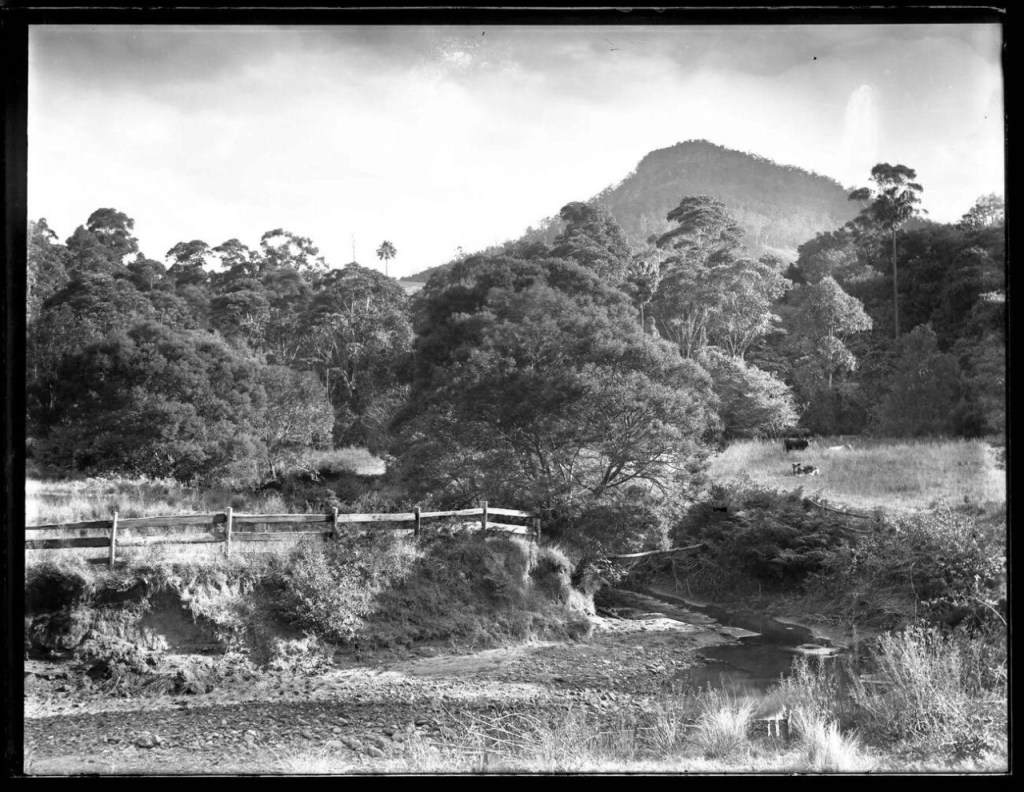
He finally wrote to his brother Josiah a month before his death and included another to his sister, which was forwarded to her. The letters had taken him nearly four months to complete. Sadly, her reply was dated five days after James’ death, and he never learned her news from home. He kept up a regular acquaintance with one man, John Dick Smith in Pitt Town (on the Hawkesbury River in New South Wales and is now a suburb of Sydney) and would later take up residence on Smith’s property “near the junction of Cattai Creek and O’Hara’s Creek, “ until urged by Smith, in his declining years to move to McGrath’s Hill. As such, James led a reclusive life for the last 30 years of his life, acknowledged by his neighbours as a teacher and a soldier, but as to his past, no one enquired – he was simply the old man who lived in a “hand hewn slab hut at McGrath’s Hill,” with two rooms and a floor of packed earth; surrounding his settlement he grew vegetables. He died alone in his bed on 24 June 1899 of heart failure. His body was found two days later by the delivery man from Smith’s shop who was bringing James his regular, albeit meagre, twice weekly supplies.
With no one else to take the role, Smith would be the executor of James’ estate and arrange for his burial in the Presbyterian churchyard. Besides the priest, Smith was the only person who attended his funeral. A headstone was never ordered, for in Smith’s estimation, there would never be anyone to read it.
Sources:
Frederick Whirlpool VC – Australia’s Hidden Victoria Cross – Alan Leek (Big Sky Publishing, Newport, Australia, 2018)
Rulers of India – Clyde and Strathnairn – Maj.Gen. Sir Owen Tudor Burne KCSI (Oxford: Clarendon Press, 1892)
https://www.alanleek.com.au/support-growing-frederick-whirlpool/
https://www.alanleek.com.au/tribute-at-dundalk-grammar-school-dundalk-co-louth-ireland/
https://www.awm.gov.au/collection/C93855
https://www.victoriacross.org.uk/bbwhirlp.htm
Misconceptions
There is no evidence that Humphrey James ever referred to himself as “Frederick Conker.” This particular story stems from Burne’s book, in which he writes of an incident which supposedly took place in Ireland during Sir Hugh Rose’s visit. According to Burne, relating an anecdote told to him by Rose, an old couple sought out Rose to thank him for caring for their son during the mutiny and afterwards; Burne notes their name was Conker, and the elderly man was a postmaster at Dundalk and their son was a resident of New South Wales. Burne makes no mention of the name Frederick. As it has been found, there never was a postmaster in Dundalk named Conker. While it is possible the James’ did seek out Sir Hugh Rose, it is likely Rose, who at the time of the telling of the story to Burnes was known to have been quite frail in health, it was likely a mistake on Rose’s part, and Burnes merely related what he heard. However, Burnes never turned Postmaster Conker into a “major in the British army,” and how that happened is anyone’s guess.
Humphrey James was not born in Liverpool. While he gave this story out himself, and in truth, a sister of his did eventually move to Liverpool, this was long after Humphrey had left Ireland.
At one point, he calls himself Frederick Humphrey James – again, it has not been proven that he was ever named Frederick; as it is in the letters written by his siblings, he is called Humphrey; according to his biographer, Alan Leek, it is likely he kept the name Frederick as he would likely have found it more familiar by now than Humphrey.
The mistakes continue to be repeated, and the Liverpool Echo proudly announces him as one of their own, stating his name as James Frederick Humphrey Whirlpool, born in 1829 in Liverpool.
https://www.liverpoolecho.co.uk/news/liverpool-news/frederick-whirlpool-1829-1899-3392035
 Mutiny Reflections