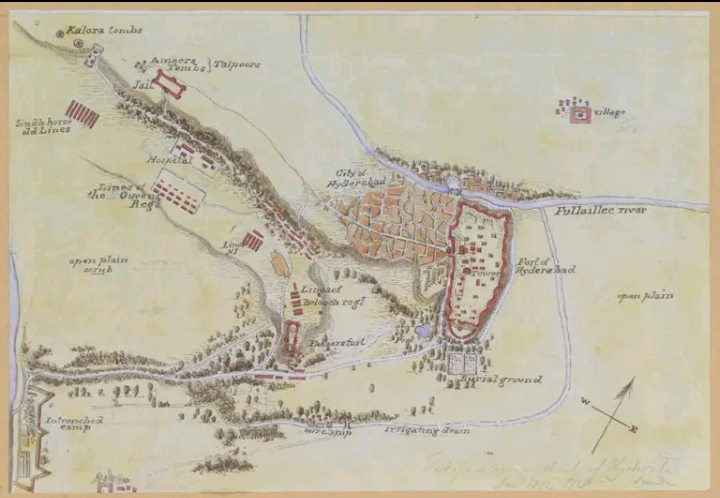
The situation in Sindh was slowly but surely becoming untenable for all sides; however, the men who were suffering, ultimately, were the Mirs. As we have seen in Sindh, Charles Napier was appointed by Lord Ellenborough as the pan-ultimate officer, the man who had unlimited power, both civil and military. That he had never served in India, knew nothing of her people and did not speak any of the languages current on the subcontinent did not seem to interest anyone. He arrived in India in 1842 and was almost immediately appointed by Lord Ellenborough to the command of all the troops in Sindh and Baluchistan, given complete control over every political agent and all civil officers. Ellenborough then informed him that, in addition to what was already a hefty responsibility, another laurel for his already full crown:
“If the Ameers, or any one of them, should act hostilely, or evince hostile designs against the British forces, it was the Governor-General’s fixed resolution never to forgive the breach of faith, and to exact a penalty which should be a warning to every chief in India.”
In other words, Napier could do as he pleased if it was in the interest of the government, and that included whatever military action he should choose to pursue. No one, not even Lord Ellenborough, had given Napier permission to invade and then annex Sindh.
General Sir Charles Napier
Napier was by no means a young man when he arrived in India. Born in 1782, he had served in the Peninsular War with HM’s 5th Regiment, but it was a brief career – severely wounded at the Battle of Corunna, Napier was left for dead on the field. He was rescued by a French drummer named Guibert, who effectively took him as a prisoner of war. When Napier would be returned to the British in 1809. He volunteered to go to the Iberian Peninsula in 1810 and fought not only at Busacco, but Fuentes de Onoro and Badajoz. He was in command of HM’s 102nd Regiment and, as their lieutenant-colonel, won the silver medal with two clasps for his deeds at Onoro and Bussaco. In 1812, he was stationed with the 102nd in Bermuda and would, later the same year, take part in the American War. In 1813, Napier transferred by exchange to HM’s 50th in September 1813, and the next time we see him is in Kefalonia in the Ionian Islands of Greece, where he was serving as governor. Life must have been rather dull, for Napier found time to write three books about Greece, Kefalonia and the Ionian Islands during his 8-year (1822-1830) sojourn. After Greece, Napier returned to England; in 1835, he was designated Governor of the new colony of South Australia, but it did not seem to be something he coveted, and he ceded it to William Light (eventually, John Hindmarsh, who seemingly wanted the position more than anyone else, would be sent instead). Instead of Australia, in 1839, Napier was given the post of General Officer Commanding of the Northern Districts. In 1842, quite suddenly, the 60-year-old Napier was appointed Major General to the command of the British Indian Army in the Bombay Presidency.
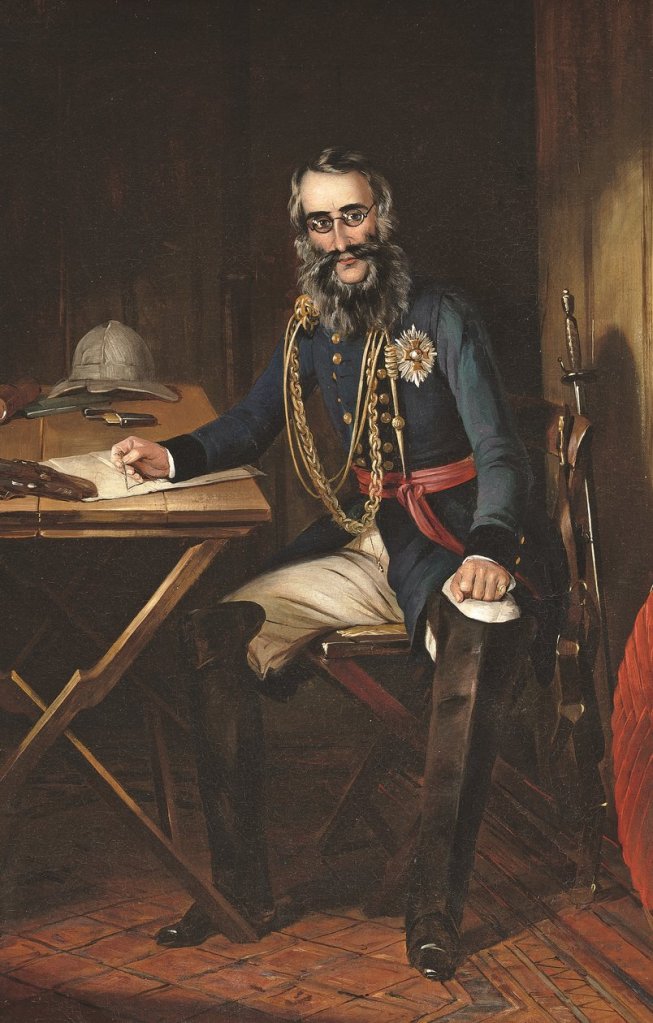
He was something of a boastful man and wrote from Karachi of his upcoming exploits with a sense of excitement, optimism and braggadocio.
“Danger from their warfare I see none. I can beat all the princes of Scinde when England joins me, for I shall then have twelve thousand men. No cavalry, however, and I should feel the want of it if the Ameers attack me; but I shall have some soon. My difficulty will be to act as chief political agent to the Governor-General. I believe his intentions to be just and honourable. I know my own are. But Hell is paved with good intentions, and both of us may have great difficulties to encounter. Yet I feel neither diffidence nor hesitation. My plan is formed, so is Lord Ellenborough’s, and I believe they are alike. The hill tribes threaten to fall on England’s column as it descends the Bolan pass. There are, however, reasons to doubt this, and I have sent to advise and authorise the Commander in Upper Scinde to make a forward movement towards the pass, which I hope he will be able to do, and thus favour England’s retreat by menacing the rear of his enemies. He has the mass of my troops with him; I have only four thousand in Upper Scinde. I ought to have been here two months ago. I have now to travel two hundred miles up the Indus, with a guard of only fifty men, through a hostile country. This appears foolish, but I must get to my troops. I set off tomorrow, and there will be no small interest in threading the windings of the noble river Indus.”
Major James Outram quickly formed his own opinion of the man.
“Prior to Sir Charles Napier’s arrival, the Princes of Sind had been treated with the consideration due to their rank and that demanded by their own ideas of propriety. No sooner did that officer arrive amongst them than all was changed. They were addressed in a tone of arrogant contempt, which was as offensive as it was unexpected, and the conventional courtesies to which they had been accustomed were suddenly dispensed with. Rumour told them that we contemplated the seizure of the country; and in the sudden dismissal from office of the diplomatic body, to which they had been accustomed, the imperious tones of the dictator who succeeded, and the extensive military preparations which they beheld, all tended to convince them that such was really our intention.”
For Outram, his dismissal from Sindh was akin to disgrace – he received no explanation except a curt letter instructing him to return to regimental duties.
Napier gave the Mirs a stern warning, which his biographer (his brother) calls austere and timely, but it must have come across as horrifying. He stated their “deceitful practices” would no longer be tolerated. For a man who had no experience in India nor had taken much time to acquaint himself with either the Mirs or their history, it must have come across like thunder. He left Hyderabad after a very brief stop and made his way to Sukkur to take stock of a small body of troops that had been put at his disposal. Making them fighting fit took up some of Napier’s time, and while he wholly threw himself into this task, he began inquiring, locally, into the treachery of the Mirs. What Napier did not understand was that in this volatile time, everyone was in the pay of someone else – his information might have been right, or it might have been idle talk. It would seem Napier did not bother to differentiate between the two.
For their part, the Mirs were aware of what he was up to, and according to their information, Napier was intending to force them into another treaty. However, like Napier, who was listening to anyone who would talk, the Mirs’ information was no better than his. The treaty was undoubtedly coming, but “its terms were not known and had to be invented in the bazaars. No wonder that daily reports came of secret conclaves, gatherings of armed men and summonses sent to border tribes.”
Shortly after his arrival, Napier was approached by Mir Ali Murad, the youngest son of Mir Sohrab. Sohrab had been one of the founders of Talpur rule, but he died in 1829 and left his possessions to his three sons. Murad, as the youngest and only an infant when his father died, believed he had been defrauded of his rights by his brothers. Murad fought a battle against his brother Rustum and his nephew, Nasir Khan (son of his brother Mubarak, who at this point was already dead). Rustum and Nasir were defeated, and they were compelled to sign a treaty which ceded nine of their villages to Murad. It was hardly all that Murad had up his sleeve – he suspected that Rustum was again intending to defraud him, as he had given the chieftain’s turban to his son instead of passing it on to his brother, which would have been the accepted custom; Murad saw this as a good enough time to pay a visit to Napier. Napier, seeing he had an opportunity to practice some of the diplomacy he had been instructed to carry out, assured Murad that should Rustum die, the EICo would uphold Murad’s rights. Rather pleased with his small coup-d’état, Murad pledged his allegiance to Napier. There was nothing in Napier’s directions to desist from meddling in internal affairs, and, like an opportunistic tiger, he exploited the situation to what he saw as his own benefit by winning a supporter for English interests.
In December 1842, the treaty so dreaded by the Mirs was tendered at Khairpur and Hyderabad. Any doubt lingering about the EICo’s intentions now disappeared. The treaty stipulated the cession of Karachi, Tatta, Sukkur, Bukkur and Rohri, in perpetuity, to the British Government. A tract of land north of Rohri (which had been taken from him by the Mirs)was to be returned to the Nawab of Bahawalpur as a reward for his faithfulness to the British. Furthermore, the treaty strove to establish the guilt of Rustum and Nasir Khan as the persecutors of Ali Murad. The treaty further apportioned the shares of each Mir in the cessions, and while there were several more tedious clauses which would excite the Mirs, they would also have to concede that they also stood to gain, as the payment of tributes would be cancelled. Outram, who had been recalled to Hyderabad, believed, if the whole thing was presented palatably, the Mirs would sign.
But, this, however, was Sindh, where nothing would be so simple.
The treaty was “.. presented at Khairpur by messenger on 4th December and on the 7th the Mirs signified, under protest, their willingness to sign it. Sir Charles issued a proclamation on the 8th, intimating that he would now take possession of the lands ceded by it to Bahawalpur and forbidding anyone to pay revenue to the Mirs after the 1st of January. A few days later, he crossed the Indus with his little army. Mir Rustam, eighty-five years of age, feeble in mind and body, distracted by the plots of Ali Murad, the violence and disobedience of his own sons and the intrigues of a scoundrelly wazir, was at his wits’ end to guess what all this portended. He wrote to the General to say that he would come to his camp and throw himself on his protection. He was told to seek the protection of his brother, Ali Murad. He went to his brother’s fort Deji-ka-kot and a few days afterwards, Sir Charles Napier was informed by Ali Murad that Mir Rustam had, by a solemn engagement on the Koran, resigned the turban and his territories to him. It was afterwards proved that this abdication had been extorted from the old man against his will, which indeed Sir Charles himself strongly suspected at the time and wanted to see him, but he fled to the desert and took refuge with his sons. Major Outram attributed his panic to the “villainy ” of Ali Murad, to whom, of course, it was an imperative necessity to prevent any chance of a personal explanation and who had both the means and the will to intercept letters, circulate false reports and scare the old man with fears of being made a prisoner by the fierce General who respected no man. Meanwhile, consternation spread through Khairpur and the town was forsaken. All Murad “protected” it and took possession of all that was Rustam’s. The news filled the Baluchi chiefs with fury, not at the British primarily, but at Ali Murad, and they resolved to agree to nothing till Rustam was reinstated. Sir Charles Napier, on the other hand, resolved to treat with nobody who did not acknowledge Ali Murad as now the legal Rais. He was offended at Mir Rustam’s flight and believed he had joined his sons in the desert to prepare for war. He resolved to produce an effect by the unprecedented feat of a march through the desert to the fort of Imamgarh, the Gibraltar of the Khairpur Mirs, as he was informed, where they massed their treasures. He found it deserted and empty, save for a little corn, and some had gunpowder, so he blew it up and marched for Hyderabad, where he had ordered all the Mirs to collect and given them till the 7th of February to sign the treaty and disband their forces. But a secret message from the agents of the Mirs at the British camp had gone before him:
The General is bent on war. Be ready.”
 Mutiny Reflections