The Behar Field Force, June-August 1858
June 12 1858 – Camp Buxar – Dispatch, Brigadier John Douglas to Brigadier Lugard
Force detailed as:
3 guns Royal Horse Artillery;
3 troops Military Train;
1 troop 4th Madras Cavalry;
Her Majesty’s 84th Regiment.
“Sir,
I HAVE the honor to state, for the information of Brigadier-General Sir Edward Lugard, K.C.B., that according to his instructions I proceeded on the evening of the 7th instant, with a force as per margin, en route to Buxar. I arrived at Shahpoor at 11 p.m., and bivouacked;
8th, marched to Saumgunge, 12 miles, and encamped. Two men of the 84th died from sun-stroke this day.
9th. Marched to Buxar, 14 miles, and encamped.
10th. Understanding that the rebels occupied the village of Ghamur, I advanced to attack them; at 3 miles from Buxar, crossed the Sarronuddy by a plank bridge; when within a mile of the Korumnassa river, I received information that a body of the enemy had crossed to this side of the river. I sent forward the cavalry and horse artillery, under command of Major Mitchell, Royal Horse Artillery; the artillery advanced to the river side, marked by the cavalry, and discovered the enemy, who had re-crossed the river, in a tope at some 500 yards; they fired about twelve rounds, dispersed and killed several of the enemy. The river not being fordable, and there being no bridge, the cavalry and artillery returned to the main body; the force then proceeded to Chawsa, 9 miles from Buxar, and encamped during the afternoon a bridge of boats was thrown across the Korumnassa by Captain Wilkinson, Deputy Assistant Quartermaster-General, and a guard sent over for its protection.
11th. No certain information of the enemy’s movements could be obtained; crossed the river at 4 a.m., and advanced through Barra to Ghamur; a thick tope of trees surrounds the village; at about 1,200 yards distance, a number of people were seen in the tope; two companies of the 84th advanced in skirmishing order and drove them off. I then moved to the rear of and round the village, sending skirmishers through it, but could not discover the enemy; the accounts of his movements were very conflicting. I sent the cavalry and artillery forward to Sheopoor Ghaut, to intercept them if they were crossing the river, having heard that the main body had taken that direction; but they did not see them. I heard afterwards that they had gone south and south-west. I burned the villages of Ghamur and Barra, re-crossed the Korumnassa and encamped near Chawsa. Three men of the Royal Horse Artillery died during the night from the effects of the sun, and 1 man of the 84th, 1 horse, and 1 trooper of Rattray’s Seikhs were slightly wounded while burning the villages; the detachment of this regiment joined me on my marching out of Buxar. The heat during the operations was intense, and the troops suffered much, particularly the 84th Regiment, who have now been thirteen months in the field. I consider this regiment at present to be quite unfit for active service; the men have no positive disease, but they are so exhausted that they can neither eat nor sleep.
12th. I returned to Buxar, and encamped. In the village of Ghamur, 4-5 brood mares belonging to Government were recovered and handed over to Mr Jackson, of the stud establishment here, who accompanied the force. In conclusion, I beg to state that I have every reason to be satisfied with the way in which all did their duty.”
This was just a taste of what was facing Brigadier John Douglas, for shortly after he sent off his dispatch, Brigadier Edward Lugard left India for the last time. On 21 July 1858 he boarded the Hindostan at Calcutta and set sail for home, leaving Douglas in command of the “Disturbed Districts of Ghazipoor and Behar.” The area under his command was vast, and although it did not include Dinapore, the government stud farm at Buxar fell under his jurisdiction. Douglas was expected to keep open the river routes and the roads and ensure that some semblance of peace was kept up in the towns and villages. As it was, even as late as July 1858, the British had not been able to re-establish their rule in Bihar and the local population, either pestered by the continued infractions by rebel bands, or harassed by the British, was not in the mood to be forthcoming. It was clear to Douglas that establishing his command in Ghazipur and Bihar was going to be a complicated task.
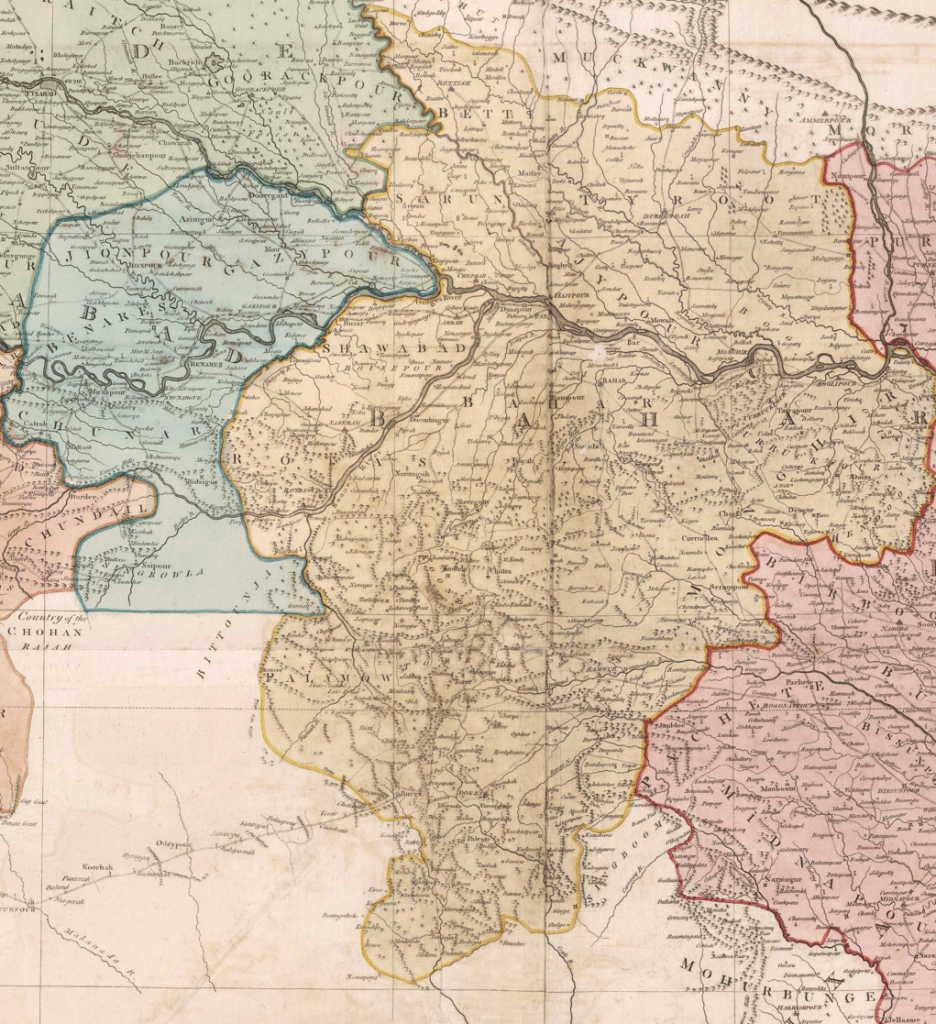
His first move was to establish posts throughout the districts, each manned by a small but mobile detachment of men, who could, at a moment’s notice, act against any incursions by rebels in their immediate vicinity. From the trusted sepoys he had at hand, he chose men to infiltrate the ranks of the rebels to bring him information about their movements; as for the rebel leaders, they now had a price on their heads and anyone bringing in just such a man, dead or alive, would be liberally rewarded. To make things easier to move his troops, Douglas continued the practice of cutting roads through and around the jungles. Although he could not take Jagdispur just yet, he could certainly make the lives of the rebels difficult.
As a portion of the Grand Trunk Road traversed lower Bihar from east to west and was of vital importance to Sir Colin Campbell and his future plans, large numbers of troops under Colonel Turner (97th Regiment) were relegated to keep the road open. For the four months of monsoons, Turner and his men would hardly find a day of peace as they chased, routed and fought rebels up and down their portion of the Grand Trunk Road.
As for the rebels, those under Ammar Singh had quickly reoccupied Jagdispur, and throughout the monsoons small parties of his followers kept the districts in continuous disturbance. They were not following any particular plan and could attack anywhere and at any time, more or less from any direction, as they pleased. Their “principal depreciations”, however, were concentrated on the country just south of the Ganges and west of the Son rivers.
In July, Douglas shifted his attention to the Ghazipur District as he received information from Dinapore that his outpost at Beyriah was under siege. The 120 Sikhs (of the Sikh Police Corps) he had posted there to hold it had been swamped by no less than 1000 rebels, 250 of whom were said to be mutinied sepoys. They had advanced to within a quarter of a mile of Beyriah and half past six in the morning on 11 July, surrounded Captain McMullin and his men. McMullin’s position was fortunately defensible, being a strong house in a large enclosure with a high wall, with a deep, impassable tank on one side, a nullah on another and on the fourth side, several smaller, loopholed houses. He had further fortified himself with breastworks and barricades and had ensured he had plenty of provisions.
After sending for reinforcements, McMullin wasted no time in deploying 30 men of his cavalry and 80 of his infantry, all under Lieutenant Costley, to advance immediately on gathered rebels, giving them no time to get themselves organised. As soon as they were in range, Costley ordered the men to open fire. The rebels, somewhat surprised at this sudden attack, attempted to close around the right of the village, where just the day previously, McMullin had thrown up an entrenchment. McMullin quickly sent word for the village to be set on fire. By half past eight in the morning, with the fire raging and unable to approach McMullin’s position without getting shot, the rebels moved back to a large tank, one mile away from the fortified house. Here they remained for the rest of the day, taking time to exchange shots with McMullin’s advance picquets. For now, they would have to hold their own but help was on the way.
On 14 July, upon hearing that Beyriah was besieged, Douglas proceeded with 200 men of HM’s 10th Foot, accompanied by Major Sir Henry Havelock and Captain Stevenson; as speed was foremost on Douglas’ mind, the force marched without tents and without any baggage at all. They marched to Sheopore Ghat, just six miles from Beyriah where they were met by Lieutenant Jennings (commanding the Sheopore Ghat) and Mr George Probyn, magistrate of Ghazipur. Probyn, much to Douglas’ relief, was able to report that Beyriah was still standing and the rebels had retired to Bulliah. To spare his men any unnecessary marching, Douglas left his force at the ghat and rode off with Probyn to Beyriah to consult with McMullin. He found the captain and his men in excellent spirits, and reported they had killed some 20 sepoys; their losses were 1 sowar killed, and one horse wounded. In an unfortunate turn of events, three of McMullin’s infantrymen had been murdered within his sight when they tried to re-enter the entrenchment.
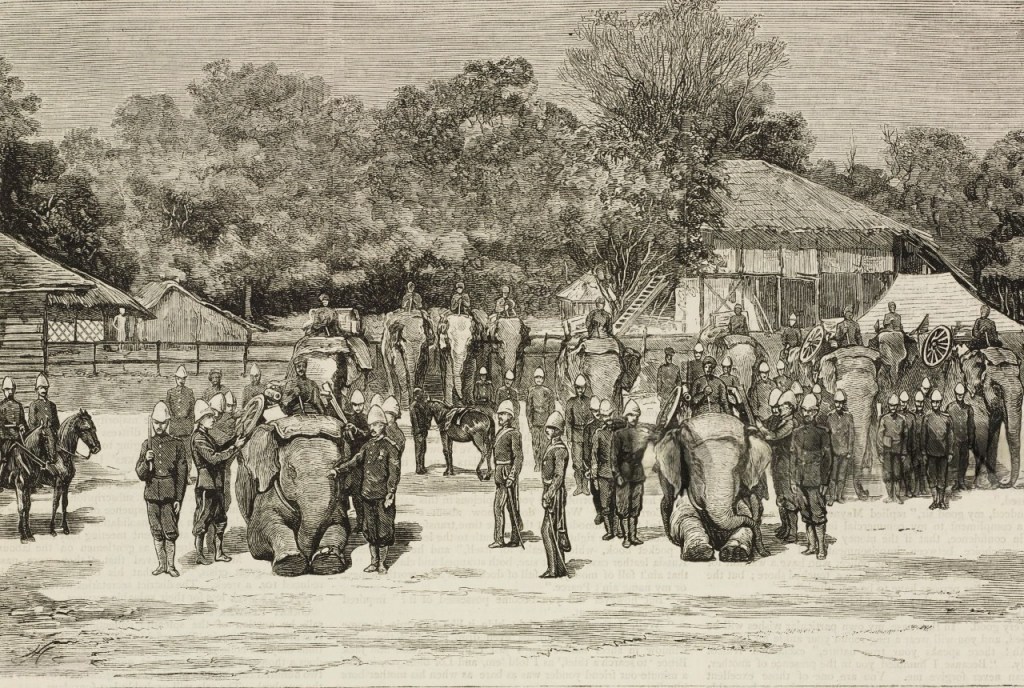
As there was no work in Beyriah, in the afternoon Douglas marched to Ballia and arrived there on the morning of the 16th. Here he found that McMullin’s messages for reinforcements had been received in Buxar and the commander had wasted no time in sending off as many men as he could spare. The rebels had been more than discomfited by this turn of events and had once again retreated. Douglas decided that this time he was going to have it out with them, come what may. In pursuit, he now sent Major Rolleston with 24 men of the 84th Regiment (on elephants), 72 sowars of the Madras Cavalry and the 3rd Sikh Cavalry (under Lieutenant Baker) along with another 392 of the Police Battalion (under Captain McMullin). After four hours of hard chase, they came across the rebels who, after exchanging a few shots with the oncoming force, retreated with some haste into countryside, using the cover of the oncoming night to their advantage.
On the morning of the 17th, Douglas, leading the men himself, took 20 men of the 84th, once again on elephants, with 60 sowars of the Sikh Cavalry and 30 men of the Military Train to form a junction with Rolleston. Rolleston, to Douglas’ surprise, had not moved at all, for as luck would have it, he had no idea in which direction the rebels had gone. The villagers had proved singularly unhelpful, and their information proved in every instance wrong. So the force waited. Late in the afternoon, Major Havelock returned – he had found the right track.
Douglas sent him on ahead with the cavalry, and if possible, intercept the rebels until he could come up with the infantry. However, by the time Havelock found them again, it was 6 in the evening. The rebels were “marching in regular order in column of companies”, and there were some 200 of them. Intercepting them was not an option at this point, so he kept on their flank and followed them until he lost them in the dark. Douglas, in the meantime, tried to push his force onwards, but it was hopeless. The elephants were slow, the day was very hot, and his men were tired, and yet, he pushed them on for 40 miles. At 8 in the evening, unable to catch up to Havelock, Douglas called it a day and the force halted at Munuhar on the banks of the Gogra. With no information on which direction the rebels had gone, Douglas now decided to wait for news from Major Havelock.
Havelock restarted the chase early on the morning of the 18th. He picked up the rebels’ track quickly but soon realised they were marching with some speed and were at least ten miles ahead of him. Saddle sore and their horses fatigued, Havelock nevertheless continued in the pursuit. He followed the rebels as far as the village of Phursata on the border of the Azamgarh District before sending a messenger back to Douglas, requesting orders. By now the rebels were making their way through the Azamgarh District towards Oudh, and Havelock was informed that, as Douglas could not catch up to him in any meaningful amount of time, it was best he leave off and return.
 Mutiny Reflections