Brigadier Douglas in the Ghazipur District
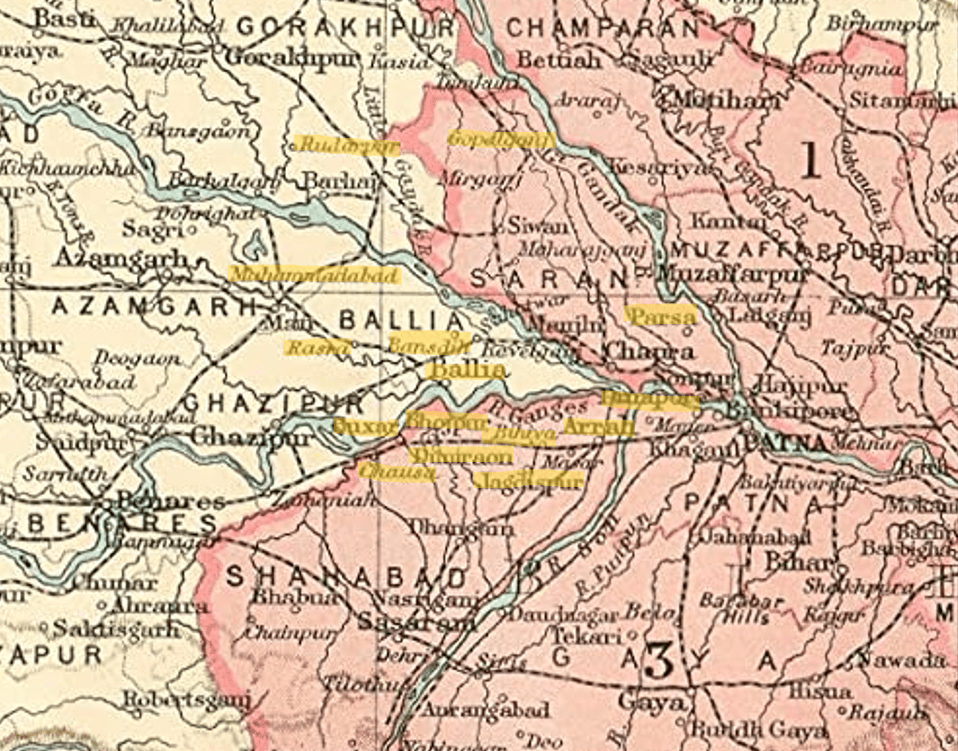
On 14 August, Brigadier Douglas was at Dinapore. It would not be a long sojourn, for late at night, he received an urgent dispatches from the Russoorah outpost that they were being besieged by no less than 2500 rebels. It was also stated that the intention of the force appeared to be to cross the Ganges and join the rebel leader Ummar Singh, lately of Jagdispur.
At Russoorah was Captain Freeman, commanding detachments of the 2nd Police Battalion and the 4th Madras Light Cavalry. He had been particularly vigilant – his sowars had spotted the rebels well before they arrived at Russoorah, leading Freeman to conjecture they would most likely take the time to besiege him. He sent off his dispatches to Dinapore and made his preparations. He would make his stand in a large serai which had been loopholed and barricaded for just such an event. Accompanying him were the thanadars and zamindars of the place whose men would be set to watching the loopholes around the clock.
On 18 August the rebel sowars came in sight at 8.30 in the morning, followed closely by sepoys, matchlock men and assorted rabble. On approached Russoorah, they divided into two parties – one headed for a dense clump of trees in front of the serai and the other went into Russoorah itself from the opposite side and took shelter in a series of ruined houses. From here, they commenced firing on a party of Sikhs Freeman had detached to garrison a mosque that overlooked the serai. The Sikhs had been very industrious and had, for the past two days, been fortifying the mosque with bags of earth behind which they were relatively impervious to the shots that the rebels now insisted on sending their way.
With no reinforcements in sight and reckoning that Douglas could not reach him sooner than the 21st, he sent an urgent message to Lieutenant Stewart, garrisoning Mahomedabad. Unfortunately, the two sowars of the 4th MLI he had sent off with the letter never arrived. Pursued by sowars who had been sent out to intercept any messengers Freeman might send, they had dug in their heels and made a rush for Casimabad, where they rejoined their regiment a few days later. However, Freeman, at the time of writing his despatch believed they had been killed and returned them as missing.
As the ground in front of the serai was broken up and he had been forced to garrison the mosque, Freeman could not consider attacking the rebels. For their part, they sent forward a villager to set fire to the thatch roof of the serai. The Sikhs shot him. With the fire spreading, the bhistis sprang into action and climbed up on the burning roof, throwing skin after skin on the flames until the blaze was extinguished. Freeman now attempted to send another message, this time hidden in a cake of chapatis, and given to the care of fakir, who volunteered to take it to Bulliah. He set off as soon as it was dark but the rebels were too were vigilant. They caught the poor man and sent him back the next morning to die in the serai. He had had his left arm cut off at the elbow, his right arm was gashed through and all the fingers cut at the top joints, his nose was cut off and just to make sure, the rebels had also shot him three times. He was deposited at the gate. The Sikhs carried him inside and made him over to their doctor who, after a few minutes, declared the poor man dead.
The rebels did not attack the serai but with some insistence, twice tried to set fire to it. During the whole of the 19th they surrounded the serai, but once again, did not make any move, it was as if they were simply biding their time, perhaps hoping Freeman would surrender or starve to death.
On 20 August at around 4.30 pm, the rebels in the tope of trees just in front of the serai suddenly began to withdraw, and as far as Freeman could ascertain were taking the road to Nagra. It was too much for the Sikhs in the mosque who were not going to let them off without at least a fight.
“Subadar Nehal Singh and about 12 sepoys made a rush from the mosque to where some rebels had been firing from behind a mound of earth, trees, and ruined houses ; they say they found about fifty men cooking ; they all ran away, leaving a few arms behind, which were seized by the Seikhs.”
Over night, the remaining rebels disappeared and the siege of Russoorah was over.
List of Casualties.
Killed, 18th instant—Tara Singh, sepoy, Sikh Police Battalion.
Wounded, J9th instant—Cher Singh, havildar, Sikh Police Battalion.
Missing—Mahomed Oosman, trooper, 4th Madras Light Cavalry.
Missing—Nusseroodeen, trooper, 4th Madras Light Cavalry.
Where, in all of this, was Brigadier Douglas?
On 15 August, two companies of HM’s 35th Regiment had arrived in Dinapore in the steamer Jumna and Douglas was quick to requisition not just the soldiers but the steamer for his purposes. Along with Major Havelock and Captain Stevenson he intended to sail to Bulliah. However, the river had other ideas and the current proved too strong for the steamer and it would take him two days to reach Ballia, arriving late on the afternoon of the 18th. He had already sent another steamer to Buxar to pick up a company of the 84th and for force of cavalry to cross the river and join him at Ballia. By the 19th his force was assembled:
1 officer, 50 sabres, Military Train;
1 European officer 72 sabres, 3rd Sikh Cavalry;
7 officers, 194 men, 35th Regiment;
7 officers, 180men, 84th Regiment;
2 European officers, 300 men, 2nd Punjaub Infantry.
Giving strict orders that no baggage or tents of any kind was to be taken along, Douglas set off early in the morning on 20 August. The men bivouacked that night in the open having covered half the distance to Russoorah. The next day, the 21st, they arrived at the serai to find the rebels were gone and Freeman was still alive and well.
The rebels, Freeman informed Douglas, were on their way to Ratsar and Douglas now had no choice but to follow them. At 5 in the evening the assembly sounded and the force marched off. The monsoon now decided to give Douglas a greeting and the rain came down in torrents. The countryside was flooded, leaving the men with little choice but to wade through the waist-high water. The guide lost his way and Douglas managed to drag his force into Gopalpur at 8 that night. As many of the villagers had left the place, the men took up quarters for the night in the empty huts, a far sight better than sitting in the rain.
The next was no better. The direct road to Ratsar was under water and impassable for both man and beast, unless they cared to swim. Douglas now put in a wide detour to Garwar, where after a long and exhausting march, he halted his men. The rebels had apparently had the same idea but they were still well ahead of him, and were on the road to Bandsee (Bansdih). He sent orders to Captain McMullin at Ballia to move north and try to cut off the rebels from that direction, while he would marched to Ratsar and try to prevent them from crossing the Ganges or from turning westwards.
Captain McMullin marched from Ballia on the morning of the 23rd with
Her Majesty’s 2nd Battalion Military Train, 1 officer and 49 men, under Lieutenant De Vine;
3rd Regiment Sikh Cavalry, 6 officers and 21 men, under Lieutenant Battye;
2nd Regiment Sikh Police Battalion, 6 officers and 252 men, under Captain McMullin.
He headed for Reoti, some 17 miles distant, halting at Gherowli for a few hours to rest his men and allow the men of the Military Train to have their dinners. At 2pm he set off again and reached Gaighat at 6pm. He found the rebels had occupied a village about a mile and half from Reotee. As a large jheel covered the right of their position and thick corn fields extended around the other sides, McMullin nevertheless sent out 50 Sikh skirmishers to see if they could reach the village, but they were unable to find a path. McMullin was not going to be defeated by water and corn, however. He simply advanced with the remainder of the Sikhs and, at their head, stormed the position in one swift rush, clearing not just the village but chasing the rebels through the countryside for another quarter of a mile. As by now it was quite dark, he called a halt to the proceedings.
The Military Train were unable to follow up on the advantage McMullin had gained, hindered not only by the dark but by the very corn that McMullin had dashed through. Their horses stumbled and after a dismal hour, concerned that there were still rebels hiding in the corn whom they could not see, they returned to camp.
McMullin’s losses, for such a small skirmish were terrible.
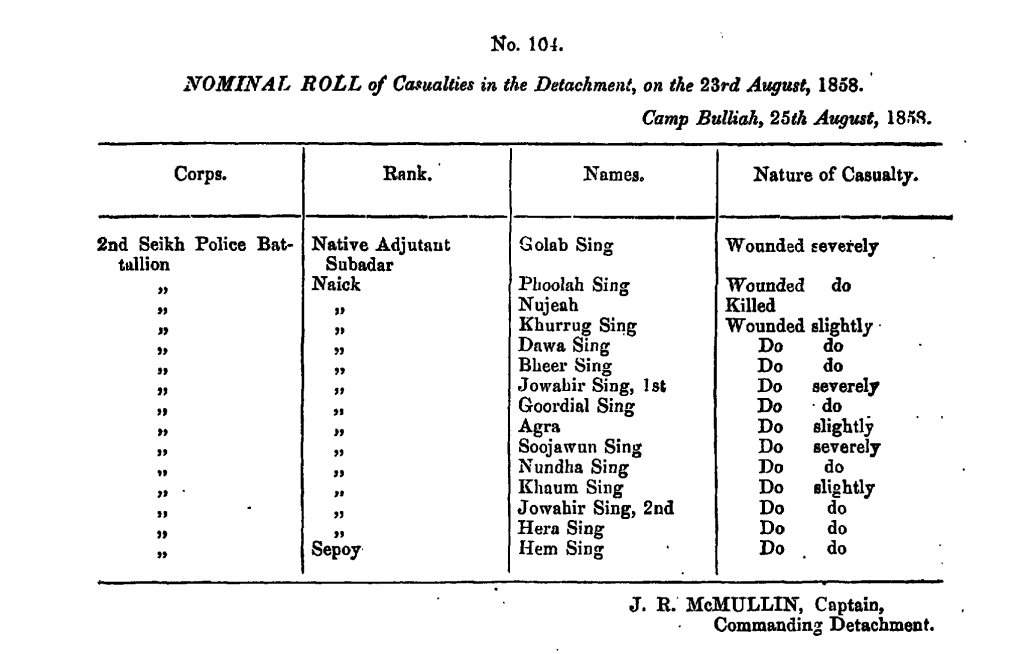
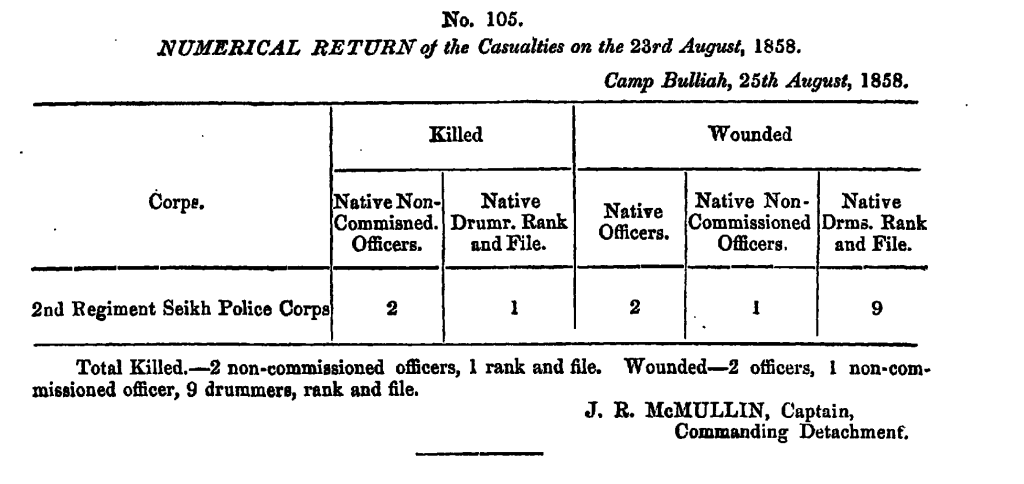
However, he had attacked a force of no less than 500 sepoys. His men had killed 25 of them and wounded a further 40. One of them was a “former native officer” who had been acting as their leader. The bodies of the dead sepoys were rifled through and it was found that many of them were still wearing their campaign medals – Kabul, Sutlej and Punjab. McMullin bivouacked his men for the night in a tope of trees close to Reotee. It rained heavily that night and continued to storm until 11 the next morning. Pursuit was futile and his scouts informed him that the rebels had made off across the countryside, in the direction of Haldi and Ballia. As there was little point now in remaining in Reotee, McMullin headed back to Ballia.
Brigadier Douglas was not having any luck. His men were wet through, and there wasn’t a rebel in sight. A convoy of supplies meant for him that had started from Ballia was attacked by a band of rebels but these were sent packing by the escort; another party was said to be passing through Bandsee during the night, passing westwards. They were too far to follow. Douglas received word that a party, rather closer to his position were heading for Saintwar and on 25 August he decided to take up the chase. As it turned out, by the time he arrived, the rebels had resorted back to their old tricks – they had broken up into smaller bands and had scattered in all directions. Major Havelock, Magistrate Probyn and a party of cavalry followed as far as they could but eventually lost sight of them. It was ascertained that some of the parties were heading for the Gorakhpur District, where, waiting for them, was the Sarun Field Force.
Frustrated, Douglas returned to Ballia.
Page 5/5
Sources:
Edinburgh Gazette 6859, November 19, 1858, p. 1981-1983
London Gazette No. 221983, September 17, 1858, p. 4172-4173
Supplement to the London Gazette 22224, 31 January 1859, p. 344 / 345-346 / 348-349 / 382-385 / p.345-346
Behan, T. L., ed. Bulletins and Other State Intelligence for the Year 1858. Part III. London: Harrison & Sons, 1860.
Caine, Caesar, ed. Barracks and Battlefields; or, The Experiences of a Soldier of the 10th Foot in the Sikh Wars and Sepoy Mutiny. London: C. H. Kelly, 1891.
Kaye, John William, and George Bruce Malleson. Kaye’s and Malleson’s History of the Indian Mutiny of 1857–8. Edited by G. B. Malleson. 6 vols. London: W.H. Allen & Co., 1888–1889.
Gordon, Sir Charles Alexander. Recollections of Thirty-Nine Years in the Army. London: Swan, Sonnenschein & co., 1898
O’Malley, L.S.S. Bengal District Gazetteers, Shahabad. Calcutta: The Bengal Secretariat Book Depot, 1906
 Mutiny Reflections