The Government Stud Farms
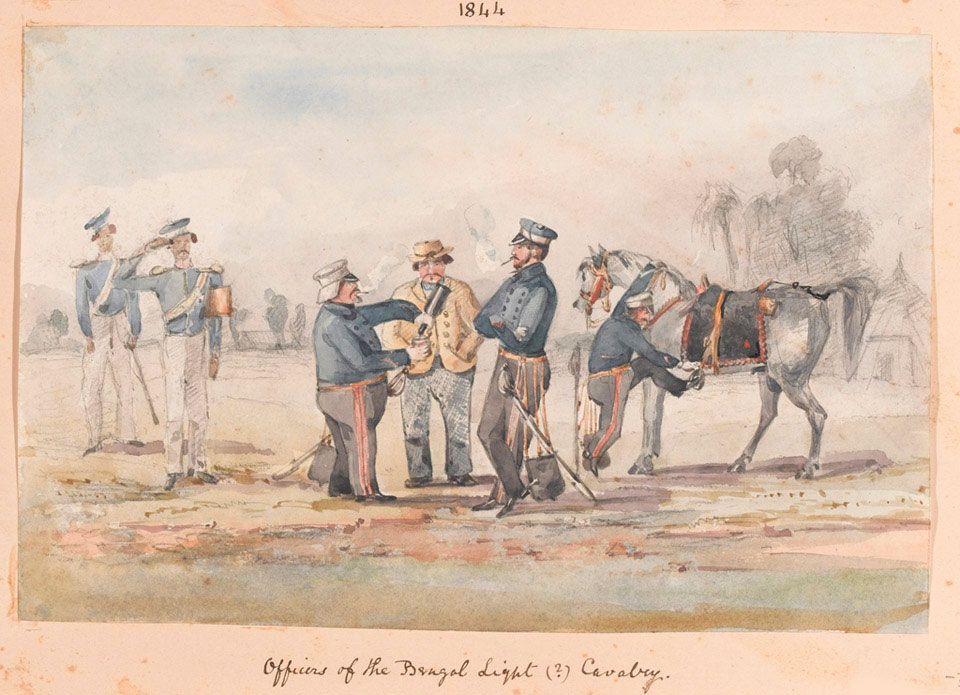
Watercolour by Lieutenant (later Major General) Charles Walter D’Oyly, 58th [Bengal] Native Infantry, 1844.
NAM. 1981-04-92-3, National Army Museum, Out of Copyright
Buxar, located some 441 miles from Calcutta is, even to this day, known as a place of pilgrimage and the Brameshwar Nath Temple, dedicated to Shiva, is said to be the oldest temple in Bihar. In the Vedas, Buxar was spoken of Vedagarbha, or the womb of the Vedas, connected to the early life of Lord Rama. While this might well have inspired many an amateur archaeologist for indeed many terracotta sculptures dating back to the 2nd and 1st centuries BC for students of lore it presented the tale of Lord Rama killing the demoness Rakshasi, and for later historians, as the place where Humayun fought Sher Shah at nearby Chousa in 1539 and in 1764, Sir Hector Munro defeated the combined armies of Mir Qasim (Nawab of Bengal), Shuja-ud-Daula (Nawab of Awadh), and Shah Alam II (Mughal Emperor), transforming the East India Company from traders to a sovereign ruling power, changing the political landscape of colonial India. It also marked the beginning of the end of Mughal control.
However, the British would soon discover that Bihar was not the sort of place where anyone was destined to have easy control. During Mughal times, the zamindars of Bihar had been autonomous rulers and administrators of the district, each one controlling his own parcel of land, be it a small holding or a vast estate. Each zamindari had their own army, usually consisting of his clansmen. Most of the zamindars belonged to Hindu communities (Bhumihars, Rajputs, Brahmins, Kayasthas) and others adhered to Islam. However, as the Mughals soon found out, Bihar was not a place to be trifled with.
The Zamindars played their games with the Mughals, ensuring that at every turn they, unlike their brethren in Bengal, were able to increase their rights and powers, rather than see them reduced. A 19th century civil servant, John Beames, writing about Mughal rule in Bihar noted, quite sardonically, “everyone who was powerful enough to rob the state or his neighbours, robbed to his heart’s content.” Payment of dues was often decided by one zamindar attacking another, quarrels and disputes were settled frequently with violence. The British, following their victory, soon found out that the zamindars were already, in most respects, independent of Mughal rule and had thumbed their noses at not only the Mughals but the Nawabs of Bengal and Murshidabad, who were supposed to be the nominal governors of Bihar. They had been unable to extract either tax nor revenue from Bihar until 1748 and when some of them grudgingly paid up, they ensured it was never the amount demanded. The British would soon find out that the zamindars were not interested in cooperation.
Following the Battle of Buxar, the zamindars staged an open revolt against the British in 1781 in a bid, like Chait Singh’s rebellion, to regain their autonomy. What started as one battle fought against one zamindar, soon turned into a running fight with several and although the British would eventually reassert their control over Bihar, it came at a price. The zamindars who had revolted were deposed and their lands forfeit. They would then see to it that “loyal” zamindars were installed in the place of the rebels, men who could be relied upon to pay revenue and do as they were told. However, the British were wary of meddling too much in the affairs of Bihar. The British wanted a simple, uniform tax system but they found the zamindari system in Bihar was too deeply rooted to challenge. The rebellion of the zamindars had showed them it was wiser to avoid any radical changes in Bihar, even though many landlords failed to pay their increased government fees.
This policy would eventually pay off. The zamindars, particularly those the British had installed, had become the backbone of local administration and ultimately, the British used the revenue to claim the highest possible share of agricultural production, eventually locking in a permanent, fixed payment rate under the Permanent Settlement of 1793. While some of the zamindars would face a curtailing of their powers following the settlement, the restrictions were less than in other British-controlled districts. The Rajputs continued to have the upper hand, exercising their dominance in land ownership and tax collection, and the old pattern of forced labour, high rents, low wages and harassment of the peasantry continued. It would not be until 1949 that the Bihar Abolition of Zamindaris Act was passed.
So in 1857 and indeed throughout the mutiny, the British would face an uphill struggle in Bihar, where no one was even remotely interested in what the East India Company had to say. The zamindars had their personal quarrels regardless of the British; the local population saw no gain from either zamindars or these wayward foreigners, going along with the tide as best as they could, enduring raids, plundering and pillaging, while the few zamindars who had taken the side of the British were powerless outside their own boundaries. If the British were going to retake Bihar it would be through relentless fighting.
And yet how does this have anything to do with stud farms?
Following the Treaty of Allahabad, the EICo acquired a large patch of land at Pusa (Poosah), near the right bank of the Gandak River, in 1796 and Major Frazer was sent to establish a stud farm on it. Buxar at the time was a military outpost, consisting of the fort and a small town. The fort was admirably positioned, standing on a high bluff above the Ganges and thus commanding not just the river but the countryside around it. It passed into British control after the Munro’s victory and would remain under direct military command until 1840 when the bazar, which had sprung about around it, was passed over the civil authorities. The fort, however, continued on as cantonment for another two years, when in 1842, it was handed over to the Stud Department.
The studs themselves were a vital part of the British war machinery in India. As the EICo expanded, the need for military-grade mounts began to rise. Gone were the days of importing horses from Central Asia and the Middle East (mainly Arabian horses) or dealings with Indian horse merchants. The time had come to change the supply chain altogether. However, for that, the British first needed the right kind of horse. Breeds local to Bengal and Bihar, although sturdy and indigenous, were thought too small and not strong enough to either pull artillery pieces or carry the heavier British cavalrymen. The studs were therefore tasked with breeding the right kind of horse and it was men like L’Etang who first came up with the idea of creating it. The sires were imported, high-quality stallions, including English thoroughbreds, Arabians and Cape Horses. The mares on the other hand were breeds local to northern and western India which were chosen according to their natural qualities such as hardiness, temperament and even disease resistance.
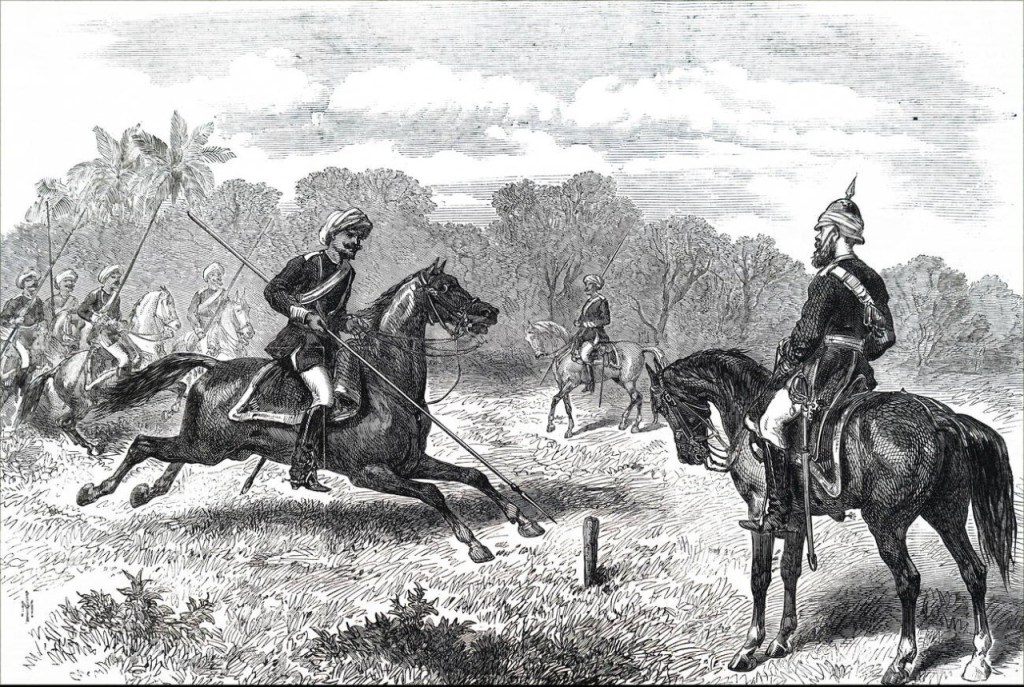
Located close to the river, Pusa, and later Buxar, facilitated easy transport of horses via boat to the major military cantonments downriver, such as Dinapore, or upriver, towards Central India. The surrounding land was rich and fertile, providing an abundance of excellent fodder for young horses. However, the Pusa farm was initially not a roaring success and it would take the machinations of one William Moorcroft (the first Englishman to formally qualify as a veterinarian surgeon) to put things right. He arrived in Pusa in 1808 to find the farm was badly run, the books had been cooked and the local stock was too small. The horses were also malnourished and many had to be culled. Moorcroft initiated a systemised breeding program and introduced a large scale agricultural project, clearing 3000 acres of land around Pusa just for the growing of oats. Both studs were managed by a corps of experienced EICo military men and European horse experts, one of whom was Chevalier Antoine de L’Etang, a French aristocrat who would serve in the EICo stud department between 1816 and 1840. From 1824 he was at Buxar, serving as First Assistant under the superintendent, Major J. Mackenzie. There would be fundamental differences in the approaches to breeding between Moorcroft at Pusa and L’Etang at Buxar, but ultimately, the French method of championing “temperament, psychological “gentling,” compact structural balance, and alignment with the local climate” over the tape measure, speed and aggressive breaking (the British metrics for horses) turned out to be the sensible approach – the Buxar stud bred horses would be found in the Bengal cavalry, the Bengal Horse Artillery and the Governor-General’s Bodyguard.
The Company Bred horse was physically impressive, taller, faster and above all, more uniform in size, the pride of any well mounted cavalry unit. The EICo had, in essence, created their own horse. However, as genetics are a fickle master and over generations, the continuous back-crossing of the horses with English thoroughbreds would lead to severe infertility issues and the loss of the very hardiness so sought after by the military. The Pusa Stud finally closed its doors in 1874 following a devasting epidemic of Glanders Disease and Buxar was phased out in the 1870s.
However, none of this would have been possible without the Bihari zamindars and the relationship, it would turn out was symbiotic. To maximise output without going through the trouble acquiring thousands of acres of expensive land, the stud department relied directly on the rural estates of the zamindars and leased the land instead. While still growing local crops, they could rent out their grazing lands to the studs, ensuring a steady stream of revenue. Besides this, while the central stables kept a hold of the imported horses, the British provided these stallions to Zamindars and their local managers (often traditional horse managers known as nalbands) to cover the Zamindars’ native mares and under this arrangement, the Zamindars or their tenant farmers would rear the resulting foals on their own land. Once the colts reached a certain age (usually between 1.5 to 3 years), the British Stud Department had the “first right of refusal“ to buy them back at a fixed government rate for military service.
And then came 1857.
The socio-economic leverage given to the Zamindars through systems like the horse trade now proved dangerous for the British. While the Buxar stud’s immediate infrastructure was commandeered by the British military, to their horror, many local Zamindars rebelled. The very networks of horse-breeding, animal husbandry, and local logistics that the British had cultivated through the Zamindari class were now being weaponized against them by the insurgents. Holding the studs now became vitally important for as the mutiny progressed, the need for horses would only grow. Buxar, which unlike Pusa, specialised in the training of young horses and was a vital shipping port on the Ganges. It was from here that the British would need to draw their remounts, not only for their cavalry but their artillery. Losing it would have spelled disaster for not only the operations in Bihar but further afield.
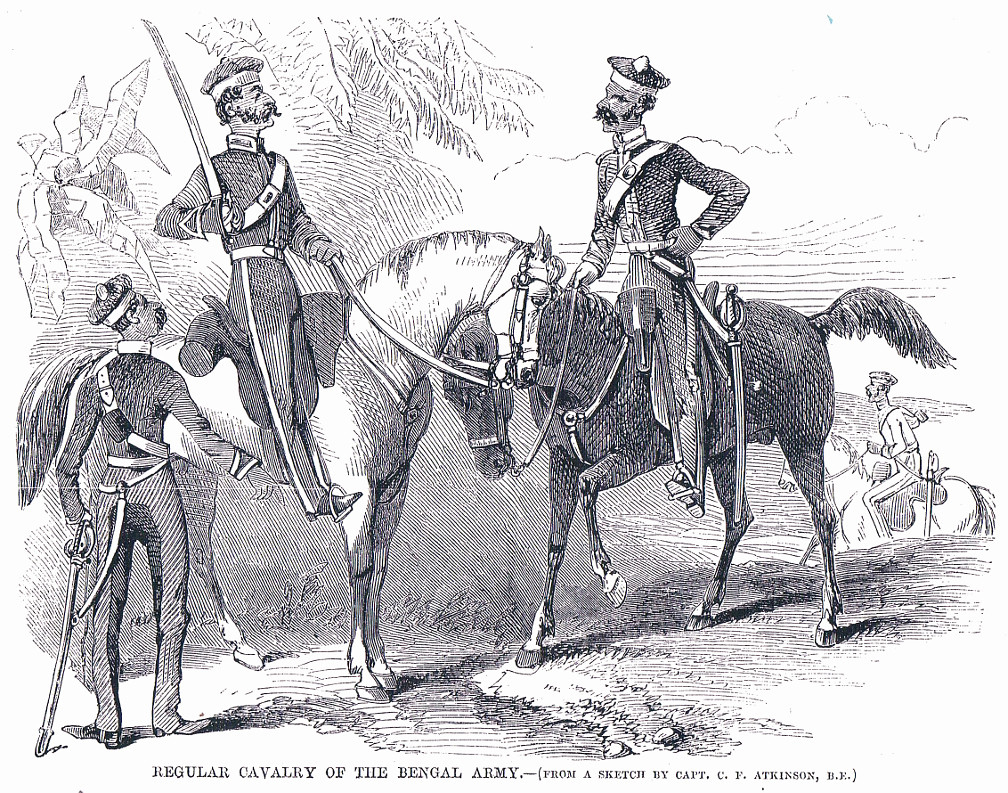
Bengal Light Cavalry in undress uniforms, 1857. Drawing by Captain C.F. Atkinson, Bengal Engineers
 Mutiny Reflections