Major Carr at Buxar
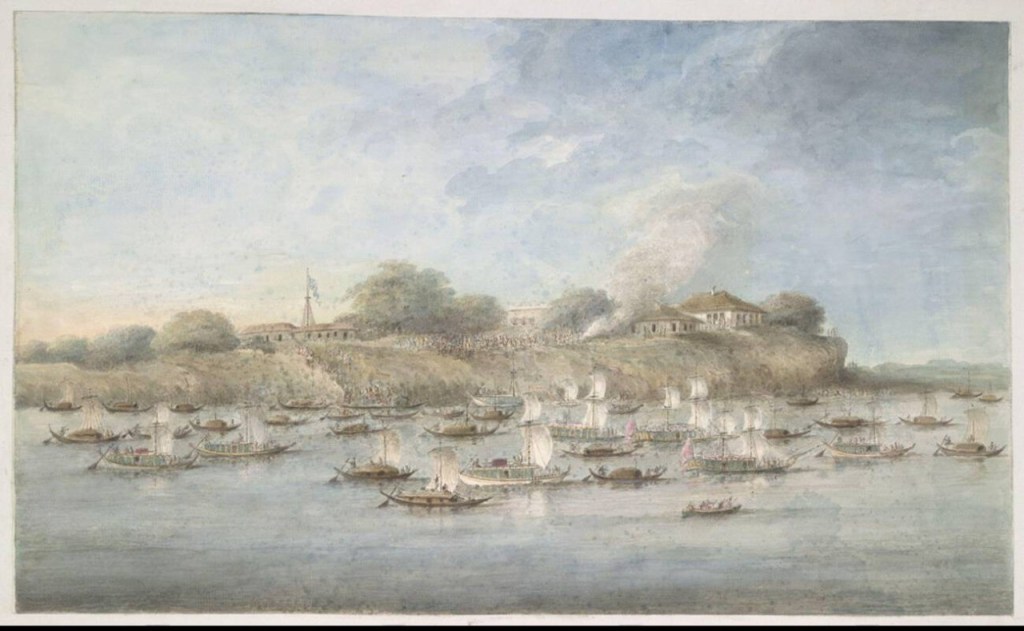
In order to patrol districts the size of Ghazipur and Bihar, Brigadier Douglas relied on the competence of the men whom he had placed, with detachments, at various strategic outposts. One of those outposts was Buxar, under the command of Major Carr of the Madras Rifles.
Carr had been holding Buxar since June and had had his skirmishes with transient groups of rebels, mostly those making their way towards Gorakhpur and Oudh. He had managed to keep the stud running and, as far as possible, maintain communications along the river. His patience, however, would be tested in August.
On the evening of 7 August, Major Carr received word from Captain Broome at the Dumraon advance post, some 12 miles from Buxar, that a large body of rebels, some 900 in number, were moving not only on Dumraon but on Bhojpur. Early the next morning, Carr took to the field to see if he could find the rebels. He proceeded with:
1 troop Military Train (under Captain Inglefield), 40 sabres ;
112 sabres of the 3rd Sikh Cavalry (under Lieutenant Ryall);
2 companies of H. M,’s 84th Foot (under Captain Brown);
50 Madras Rifles (under Lieutenant Gray).
The Sikhs had been sent on ahead and arrived in Bhojpur shortly before daybreak. Carr arrived shortly after with the Military Train, while the HM’s 84th Foot trundled in on their elephants shortly before nine in the morning, the Madras Rifles just ahead of them. Carr sent the Rifles to Dumraon to protect the place and called on Captain Broome to bring two-thirds of his force up to Bhojpur. Broome arrived shortly after with his own company of Madras Rifles, accompanied by the Dumraon Raja and the magistrate, Mr Garstin. The information was scant, and if it proved to be true, the rebels were in just then some two miles beyond a village, known as New Bhojpur.
Carr and his men were only a mile past New Bhojpur when the Sikh cavalry brought word that the rebels were in a grove of trees a half mile ahead of Carr and were beginning to move to the right. Until now, they had been wholly unaware of Carr, even though they had seen the cavalry; this was enough for them to start retreating. Carr, realising they would most likely scarper before he could get at them, ordered the Sikh Cavalry to attack without hesitation if they were seen to be moving out of the grove. If the rebels did not move, the cavalry was likewise to hold off until Carr arrived.
The rebels were not going to wait for Carr. They began to abandon the grove of trees and ran straight into the waiting sowars. With Captain Inglefield at the fore, who saw a perfect opportunity to create as much mayhem as possible, the sowars charged. By the time they were done with the sudden slaughter, no less than 60 rebels lay dead on the field, and the rest were running for their lives. Another party of Sikhs, 40 sabres in all, sent out from Dumraon to assist Carr had joined in the rout, and they added another 20 to the death toll.
Carr, for his part, now trailed on behind the cavalry, but he was unable to close the distance. After a short run, he gave up.
All the dead were sepoys, some still in their red coats along with a few mutinous Sikhs. In their flight, the rebels had thrown down their weapons, and Carr collected 30 percussion muskets from the field. The sowars reported that the sepoys appeared to be badly off for caps and their resistance, as such, had been punitive.
On 11 August Carr once again received a message from Captain Broome that a large body of rebels were moving on him. Carr immediately sent off a troop and half of the Military Train – 50 sabres and a further 120 sabres of the Sikh Cavalry (Lieutenant Ryall commanding), all under the command of Captain Nason of the Military Train. Concerned that this advance party might well run into considerable resistance, Carr set off that night himself with 2 companies of the 84th Regiment, on elephants, and 40 men of the Madras Rifles. When he arrived, the Dumraon Raja rode out to meet him with his levy.
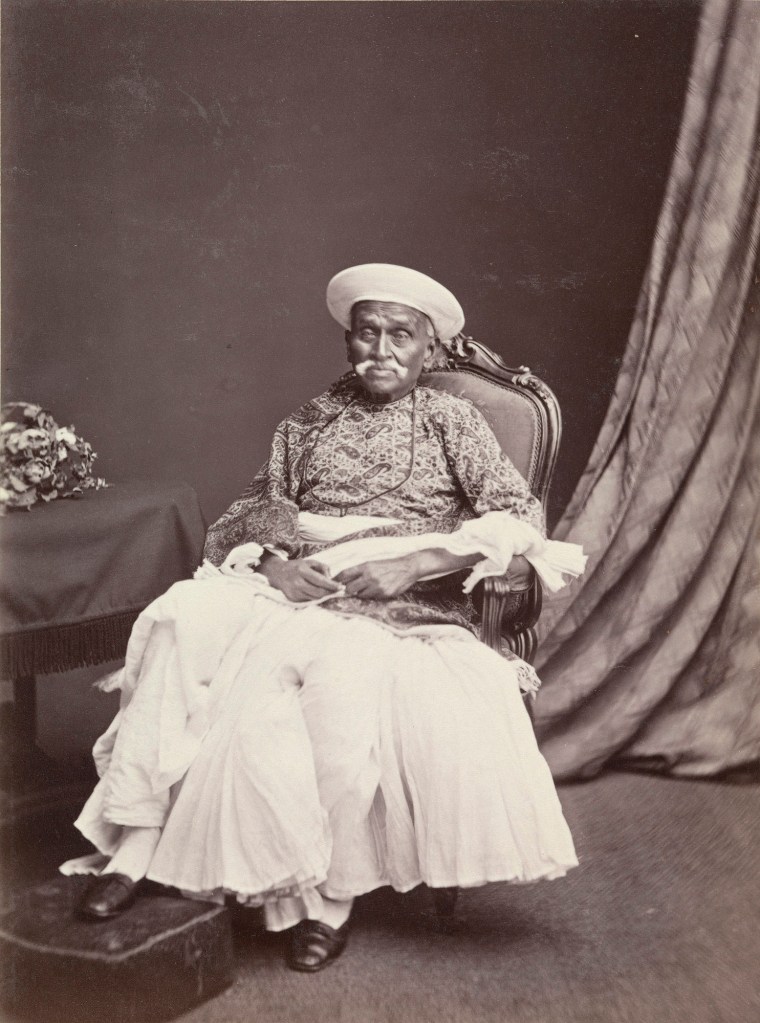
The Dumraon Raj, an old Rajput family of some standing, had been treated with favour by the EICo – the estate covered some 485,000 acres, a source of some interest to the Company. The family had been settled in Bihar since 1320 AD, tracing their pedigree back to Raja Bikramajit – 69 of their ancestors had been rulers of Ujjain in Malwa. During the war between Humayun and Sher Shah, there had been a split in the family, with two rival princes of the family taking opposing sides. Both were liberally rewarded for their services, with Gajan Shahi receiving the title of Raja and the extensive Dumraon jagir as a reward; the other prince, Dalpat Shahi, was made commander of Humayun’s cavalry. Raja Gajan Shahi continued to oppose the Mughals and for several years had had some success, but eventually he was captured and thrown into prison. However, after paying a substantial ransom, he obtained his freedom, only to continue his defiance. The Mughal emperor Jahangir had had just about all he could stomach from this irritating zamindar and promptly attacked and sacked his estate. The family, however, was allowed to continue to exist, and by 1621, on their continued good behaviour, the Mughals granted them the sole proprietorship of Jagdispur and Bhojpur, along with the title of Raja and a grant to keep a levy of 7000 troops. In 1745, Raja Horal Singh established his residence at Dumraon, while his nephews, settling in Jagdispur and Buxar, established two rival families in the process.
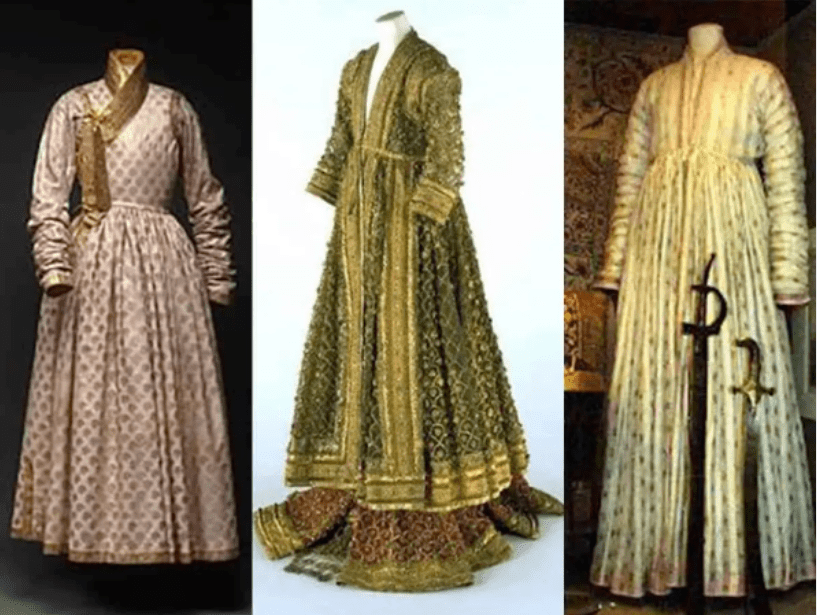
With the rise of the British, Raja Bikramajit Singh decided to throw in his lot with the EICo and joined them at the Battle of Buxar; he then raised a large body of troops to assist in the defeat of the Zamindari rebellion in 1781. Warren Hastings was suitably impressed and granted the Raja an allowance of Rs 4000 a year as he had lost some villages during the rebellion – the Raja did not disappoint the EICo and became one of the “great farmers of the revenue” in the early days of EICo occupation of Bihar. The favours continued to arrive at the doorsteps of the Dumraon Raj. Following the death of Raja Bikramajit Singh in 1816, his son, Jai Prakash Singh, was presented, by the Marquis of Hastings, the title Maharaja Bahadur. Twice during his reign, two successive Governors-General saw fit to present him a khilat, or a robe of honour and a commendatory parwana during and after the Nepalese war. When he died in 1838, the estate passed to his grandson, Janki Prakash Singh, who likewise received a khilat; however, he died before he came of age. His uncle and guardian, Maheswar Bakht Singh, succeeded him. The government recognised him as Raja, and he too received a khilat; however, this time it came with a condition that he continue to pay a tribute of 78 gold mohurs and Rs 2000 (in cash) as had been done by his predecessors into the EICo coffers. The EICo was eager to keep his favour, and in later correspondence he was addressed as Maharaja and recognised in the Patna Division as the second in rank in the hierarchy of Bihar rajas.
The following morning, Carr was informed that the rebels were no less than 2000 strong, 800 of whom were trained sepoys. They had not moved on Dumraon as yet but had taken up a position in and around the village of Chowgain, only 6 miles from Dumraon. Without wasting time, Carr took his force towards Chowgain, but his progress was slow as he attempted a roundabout approach, thinking a surprise attack was his best chance at routing the rebels. The cavalry horses could not manage the terrain, sinking up to their chests in the muddy water – Carr, realising this was futile, returned to Dumraon and sent a message to Buxar to bring up the two Naval Brigade guns and further company of the 84th. They arrived on the night of the 12th, “night; “this they were enabled to do, by the fortuitous presence here of some bullocks and drivers of the Bengal Artillery, which have been detained here by the closing of the communications.”
The next morning, Carr and his force proceeded along the direct road to Chowgain, with the Dumraon Raja and the magistrate, Mr Garstin. By now the rebels were well aware that Carr was in the vicinity – all chances of surprise were long gone. Four miles along, the rebels were reported to be directly in front and were advancing in three large bodies. Carr reached a walled enclosure and stopped. He now saw one body of rebels posted in a tope of trees which was conveniently behind a rise in the ground, and 400 yards to his front left. Carr ordered a company of the 84th to extend on that flank and then advanced Captain Batt and his guns. As the skirmishers advanced, the rebels began to retreat – Captain Batt, as a means of hurrying them along, threw three shells at them; the last set for 1200 yards fell in the centre of the retreating men, killing two and sending the rest flying.
Carr now began to advance on this body; however, word now came to him that there were some 700 sepoys, with 150 cavalry passing by his right flank and attempting to get around to his rear; Carr quickly sent Captain Henry Nason with his men to stop them. As soon as Carr saw the rebels to his front clearing off, he retired back along the road, keeping two companies of the 84th between himself and the rebels. As soon as he was parallel with them, he sent a company of the 84th and half of the Madras Rifles to dislodge the remaining rebels from a village that Nason had seized. He sent with them one gun. The appearance of the gun was a little too much for the rebels, who now threw away their weapons, some of them tore off their red coats, and others threw off their shoes and ran for it.
A third party attempted to go around Carr’s left flank with the intention of getting them around Dumraon. Carr’s skirmishers managed to get off a few shots at them, as long as they were still to Carr’s front, but he desisted from pursuit. As a portion of Sikh Cavalry had been sent to stop them, Carr was anxious to hear what they would report. The cavalry returned shortly, saying the rebels had halted on hearing the discharge from the gun and were now rushing up the road towards Arrah. The Sikhs had continued the chase for a time and reported the rebels had plundered Jewinggunge on the way.
Having successfully beaten off the rebels on his front and right, Carr was still not happy about those on the left; however, a solution presented itself in the very enthusiastic plan of Captain Nason, “prompted by the spirit which carried him victorious through his subsequent operations, requested my permission to pursue the enemy with the cavalry. At first I demurred on account of the fearful odds against him, and of my own position; but on his second appeal, seeing his determination, I yielded to him, and to his dashing gallantry, ably supported by his brave men, and the party of Seikhs under Lieutenant Ryall, the success, which by God’s blessing was achieved, is entirely due.”
Captain Nason certainly approached his task with some gusto. Taking Magistrate Garstin with him, who was well acquainted with the country, the men set off.
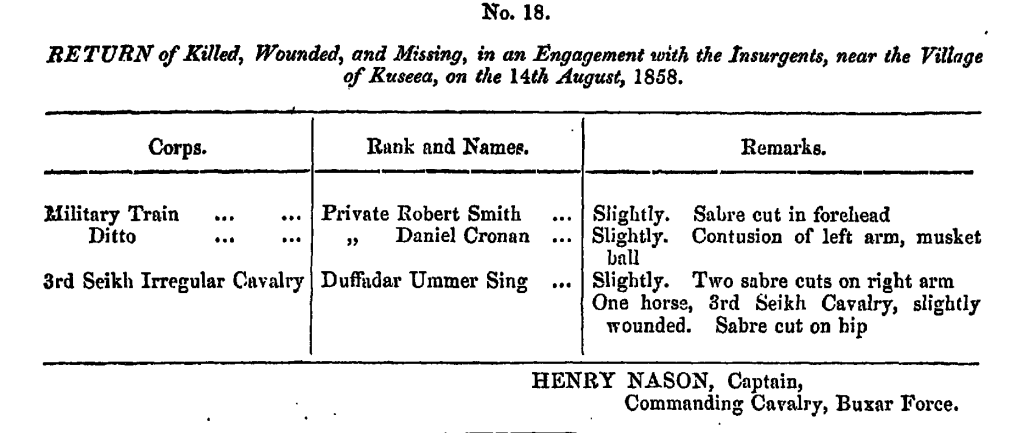
“…after a sharp gallop of three miles through kheets interspersed with nullas, I came up with him (the rebels), and observed he was moving on the village of Kuseea in compact order, in two divisions of about 400 each, flanked by cavalry, the distance between each division being about 400 yards. On seeing my party approach, he immediately drew up his forces in battle array, with very marshy ground in his front, and the village in his rear; I moved steadily on between the two masses, my object being if possible to prevent his concentrating his force; this he at once noticed, and moved the division nearest the village up in double time, but was too late-; when within 300 yards, I directed the Military Train to charge, supported by the Seikh Cavalry, which they did in a most gallant manner under a heavy fire, and cut up in the space of half an hour between 40 and 50 of the enemy, all Sepoys, with the exception of one man, who was found to be a Seikh. These men were well supplied with ammunition, the greatest portion of which was ‘Minié’: finding it rather hot work, the enemy retired in a very confused and hurried manner on the village. Our horses, from the heavy ground we were working upon, were completely exhausted; after resting them for a short time, I marched back to camp.”
Carr was well pleased with the venture. The casualties were light, with two men of the Military Train wounded, and one sowar of the Sikh Cavalry and one horse. Nason had his left shoulder strap cut by bullet but otherwise was unharmed. Nason’s men had acted admirably, and he took care to make a special note of Doctor Corbyn, who, regardless of the danger to him, had attended to the wounded under a heavy fire; Lieutenant Bodkin and Adjutant Thompson the Military Train had been gallantry personified, when leading their troops in the charge. He spares a word for Lieutenant Ryall but also notes, “Nothing could surpass the gallantry and soldier like conduct of the non-commissioned officers and men of both regiments, who appeared to vie with each other in their anxiety to close with the enemy.“
For now Dumraon was safe and the banner of war would now be taken up by Brigadier Douglas.
 Mutiny Reflections