The Battle of Dubbo
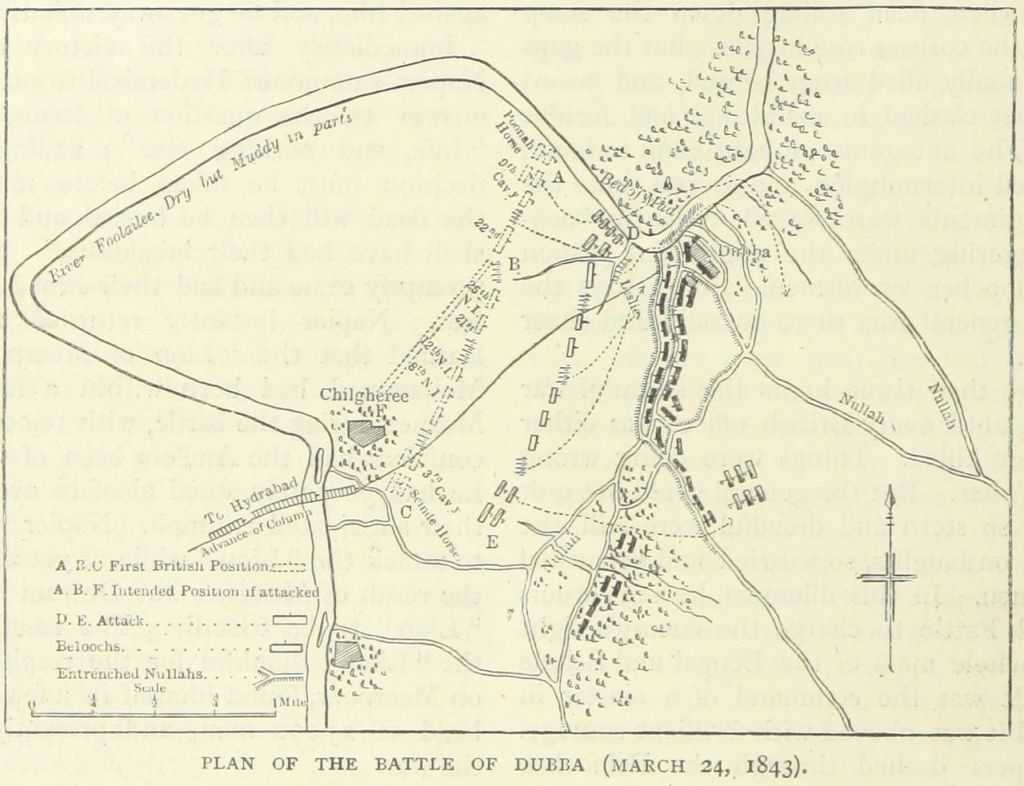
If Napier thought he could now rest on his laurels, he was wrong. He was reinforced by troops from Sukkur on 22 March and, realising that Sher Muhammad of Mirpur, one of the Mirs who had not surrendered, was getting himself ready to attempt to reclaim the Talpur right to Sindh, there was little for it but to fight again. On 24 March, the Baluchi army, numbering some 20,000 men were found in a strong position at the village of Nareja, in the Dubbo District, near the River Fuldi. For this, we shall rely on Napier’s own dispatch to tell the story.
“The forces under my command marched from Hyderabad this morning at daybreak. About half-past eight o’clock we discovered and attacked the army under the personal command of the Mir Sher Muhammad, consisting of 20,000 men of all arms, strongly posted behind one of those large nullahs by which this country is intersected in all directions. After a combat of about three hours, the enemy was wholly defeated with considerable slaughter and the loss of all his standards and cannon. His position was nearly a straight line; the nullah was formed by two deep parallel ditches, one 20 feet wide and 8 feet deep, the other 42 feet wide and 17 feet deep, which had been for a long distance freshly scarped, and a banquette made behind the bank expressly for the occasion. To ascertain the extent of his line was extremely difficult, as his left did not appear to be satisfactorily defined, but he began moving to his right when he perceived that the British force outflanked him in that direction. Believing that this movement had drawn him from that part of the nullah which had been prepared for defence, I hoped to attack his right with less difficulty, and Major Leslie’s troop of horse artillery was ordered to move forward- and endeavour to rake the nullah; the 9th Light Cavalry and Poona Horse advancing in line on the left of the artillery, which was supported on the right by Her Majesty’s 22nd Regiment, the latter being, however, at first considerably retired to admit of the oblique fire of Leslie’s troop.
The whole of the artillery now opened upon the enemy’s position, and the British line advanced in echelon from the left, Her Majesty’s 22nd Regiment leading the attack. The enemy was now perceived to move from his centre in considerable bodies to his left, apparently retreating, unable to sustain the cross-fire of the British artillery;, on seeing which, Major Stack, at the head of the 3rd Cavalry, under Command of Captain Delamain, and the Sind Horse, under command of Captain Jacob, made a brilliant charge upon the enemy’s left flank crossing the nullah and cutting down the retreating enemy for several miles. While this was passing on the right, Her Majesty’s 22nd Regiment, gallantly led by Major Poole, who commanded the brigade, and Captain George, who commanded the corps, attacked the nullah on the left with great gallantry, and, I regret to add, with considerable loss. This brave battalion marched up to the nullah under a heavy fire of matchlocks, without returning a shot till within forty paces of the entrenchment, and then stormed it like British soldiers.
The intrepid Lieutenant Coote first mounted the rampart, seized one of the enemy’s standards, and was severely wounded while waving it and cheering on his men. Meanwhile, the Poona Horse, under Captain Tait, and the 9th Cavalry, under Major Story, turned the enemy’s right flank, pursuing and cutting down the fugitives for several miles. Her Majesty’s 22nd Regiment was well supported by the batteries commanded by Captains Willoughby and Hutt, which crossed their fire with that of Major Leslie. Then came the 2nd brigade, under the command of Major Woodburn, bearing down into action with excellent coolness. It consisted of the 25th, 21st, and 12th Regiments, under the command of Captains Jackson, Stevens, and Fisher, respectively. These regiments were strongly sustained by the fire of Captain Whitlie’s battery, on the right of which were the 8th and I St Regiments, under Majors Brown and Clibborn: these two corps advanced with the regularity of a review up to the entrenchments, their commanders, with considerable exertion, stopping their fire, on seeing that a portion of the Sind Horse and 3rd Cavalry in charging the enemy had got in front of the brigade. The battle was decided by the troop of horse artillery and Her Majesty’s 22nd Regiment.”
Sher Mohammad escaped at Dubba with some 1000 men; he would be defeated again by Roberts and Jacobs, 40 miles north of Hyderabad in August. It was the last time he would put up a resistance; after the battle, he became a fugitive. Sindh was officially annexed, and General Charles Napier was appointed the province’s first governor.
 Mutiny Reflections