Last Minute Diplomacy – Outram Intervenes
Major James Outram would now try one last time to save the Mirs from what he knew was undoubtedly impending doom. He petitioned Napier to be allowed to go to Hyderabad to meet with them. Permission was first denied and then granted. Outram intended to go alone, unescorted; Napier insisted that he take an armed retinue with him. With a heavy heart, Outram set off.
He was received with joy and courtesy at Hyderabad by the Mirs. They expressed their willingness to sign the treaty, even conceding they would accept every single term, so long as Rustum was given back his rights. Unfortunately, Outram had not been given the power to negotiate and had no authority to open the question. The Mirs then said they would settle the problem that was Ali Murad themselves; Outram apprised them of the fact that the EICo and particularly Napier, would see this as an act of hostility.
Before he had left his camp, Outram had asked Napier to wait for the outcome of his mission before he marched with an army to Hyderabad, but Napier, obviously convinced the matter was done and dusted, and the Mirs would never relent until they were shown a measure of force, ignored Outram and marched on Hyderabad. However, things were not going well.
“It is clear that Sir Charles had for some time ceased to contemplate the possibility of a peaceful solution of the quarrel. He distrusted all the professions of the “barbarians” and believed they were only trying to gain time, which he resolved not to give them. Major Outram, on the other hand, was convinced that they had too wholesome a fear of the British power to desire war and would never resort to it unless driven to desperation.” (Aitken)
Outram managed, after much wrangling, firmness and tact, to induce the Mirs at both Hyderabad and Khairpur to put their seals on the treaty on 12 February and sent word to Napier that the matter had been solved. Unfortunately, this only made things worse, for as soon as it was known that the Mirs had signed, the Baluchi tribes lost all pretence. Outram, in all his years in Sindh, had never seen such an outcry, and as he left the fort, the people hooted and jeered, cursing him with every word. That evening, the Sandar Baluchis met and took an oath on the Koran to never sheathe their swords until the wrongs against Rustum had been righted. On 15 February, they then attacked the Hyderabad Agency.
The Fighting Commences
Early in the morning, the Residency, which stood on the banks of the river and was surrounded by a low compound wall of only five feet in height, was attacked by 8,000 angry Baluchis. A company of HM’s 22nd Regiment, who had arrived three days previously, were on the ready, but they only had 40 rounds of ammunition in their pouches. The young officers and James Outram managed to keep the attackers at bay for four hours, assisted by the guns of the river steamers, the “Planet” and the Satellite”. However, it was all for nothing – the Baluchis brought up six guns of their own, forcing the garrison to send off the baggage and the camp followers off to the “Planet”, while the officers organised their retreat from the building. The manoeuvre was carried out with skill and precision, and soon the 22nd found themselves back on the ship and steaming to Napier’s camp. Among them was James Outram. His efforts to save the Mirs from destruction had failed.
Napier, of course, viewed this as an open hostility on the part of the Mirs, even though none of them had been involved in attacking the agency. He would put them to the sword at the Battle of Miani. He only had 2,00 men of all arms as he had left a strong force to guard Sukkur, and for all he knew, the Talpur Army was anywhere between 30 to 100,000 men. In reality, it was no more than 8000 (including cavalry) and he would not know that it consisted of:
“The Talpur forces were composed of Shahdadani, Chakrani and Khanani Talpuris…. Mir Naseer sent a message to Malak Ibrahim Khan, sardar of the Kalmati tribe, requesting an attack on the British with the support of the Nomri and Jokhiya tribes. The Kalmati sardar departed with a band of about 400 warriors, but Jam Khan (sardar of the Jokhiya and Nomri tribes) did not join, and Ibrahim Khan returned home…
Baloch tribes that joined the Talpur forces included the Nizamani, Bagrani, Mari, Jamali, Chang, Gopang, Jatoi, Qarai, Rind, Lashari, Bhurgri and Chuulgri. In addition to these Baloch tribes, other groups such as the Khokhar, Khatiyan, Soomra and Khaskheli also gathered under the banner of Sindh. Members of the Sadaat of Sindh are reported to have joined, reportedly motivated by religious fervour. Mir Jan Muhammad Khanani served as commander of the Talpur forces. His subordinate commanders included Mir Ghulam Shah Shahwani (vice-commander), Syed Abdullah, Ibrahim Khan, Nawab Ahmed Khan Lighari, Ghulam Muhammad Lighari, Bakhtiyar Khan, Bahawal Khan Rind, Moro Khan Chang and Syed Fateh Muhammad Shah Lakiyari. Hosh Muhammad Qambrani, Mashedi Irani and Mr Hawel were in charge of the Talpur artillery. ” (Rahimdad Khan Molai Shedai; Janat ul Sindh, 3rd edition 1993, pp. 737-739; Sindhi Adbi Board Jamshoro)
Compared to Napier’s army, the Talpurs and the Baluchi tribesmen were badly equipped, utilising old-fashioned matchlocks, pistols, spears and swords; outdated cannons (although they had 15 of them), which were three feet in length, and they also had several old breech loaders. While all of this was sufficient for tribal skirmishes and general localised warfare, Napier was marching on them with an army of disciplined, well-trained sepoys and British troops, each armed with the Brown Bess; his artillery was the best the EICo had to offer.
Napier sent out the recently raised Sindh Irregular Horse under Captain John Jacob to scout out the Talpur position, whom they found at Miani, some 9 miles outside Hyderabad. He also deputed Major Outram on a razing mission to burn down the shikargarhs or lush, forested hunting grounds of the Talpuris, which might be used for cover. As the smoke rose over the field, Napier formed his plan of battle.
The Battle of Miani – 17 February 1843
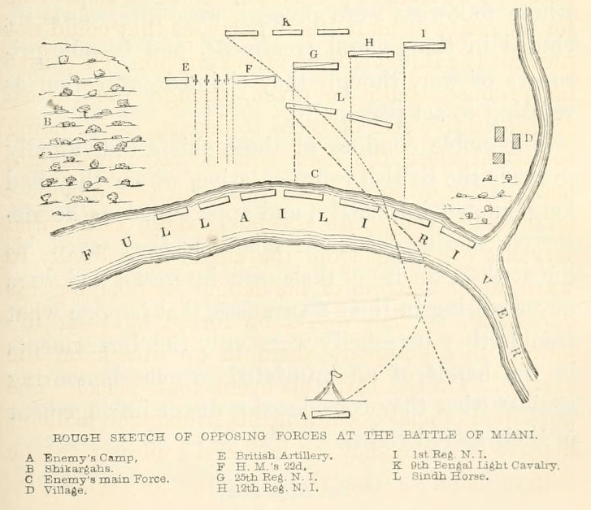
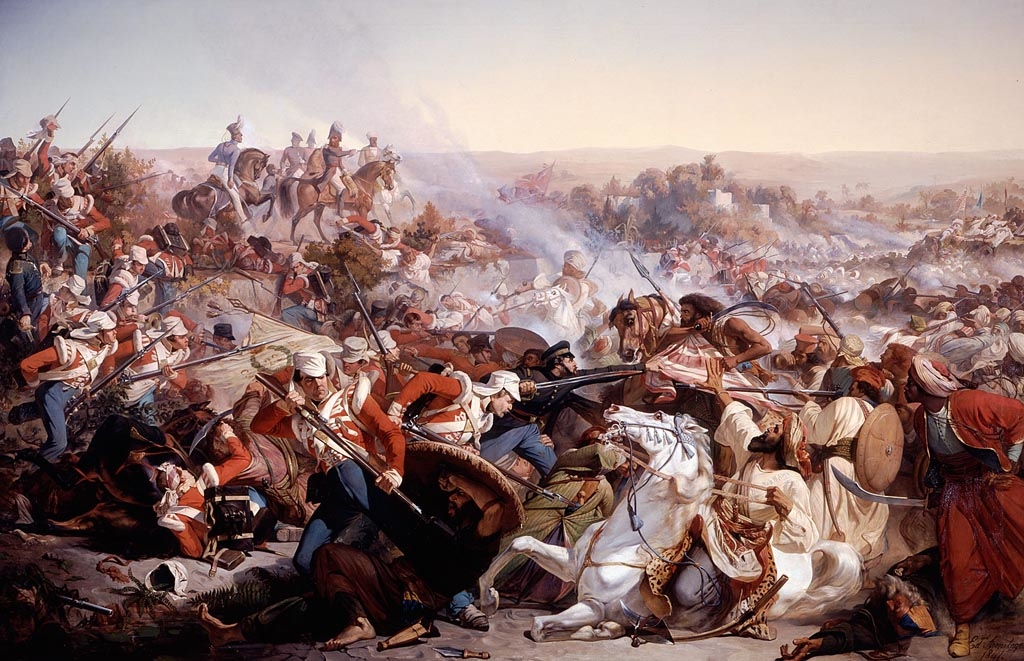
Napier marched his force out at 4 in the morning, preparing to do battle with what he presumed was 22,000 men. He resolved to attack first, considering himself gravely outnumbered. It was not a bad plan, as he wanted to gain the advantage before the Talpur Army had a chance to consolidate. However, things always look better in theory. It took until 8 in the morning for the advance guard to find the Talpur camp; at nine, Napier formed his line of battle (2800 men, 12 artillery pieces), and now well within range of the Talpur guns, the proceedings commenced with the Talpur artillery opening fire. Napier’s guns replied. If he was surprised that the Talpur Army was ready for him, he was even more surprised to find they were not the barbarians he had expected.
“The enemy was very strongly posted; woods were on their flanks, which I did not think could be turned. These two woods were joined by the dry bed of the Fuleh, which had a high bank. The bed of the river was nearly straight and about 1,200 yards in length. Behind this and in both woods were the enemy posted. The front of their extreme right, and on the edge of the wood, was a village.”
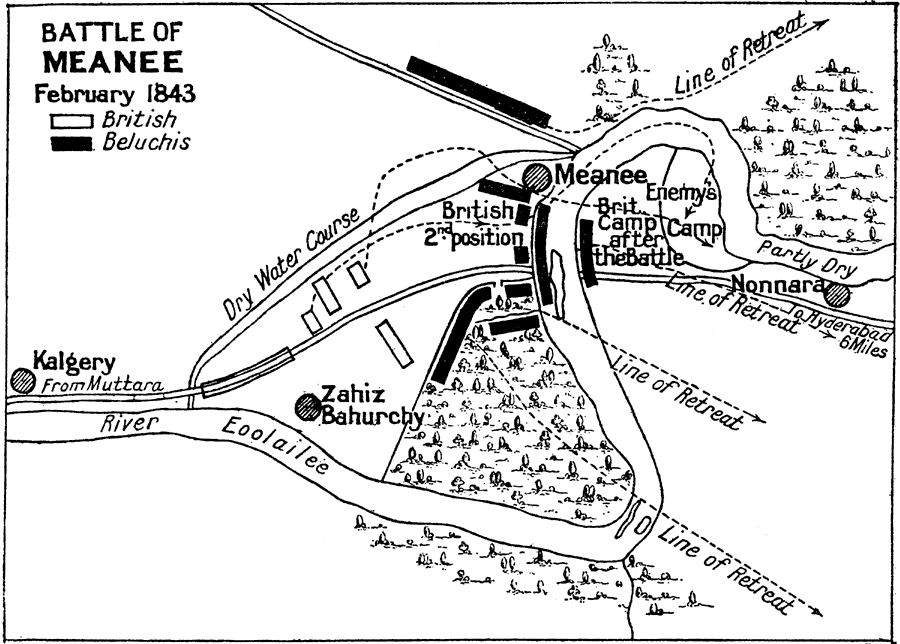
Napier took this in and decided he would change his plans. He now posted his artillery to the right of the line and sent forward some skirmishers and Sindh Irregular Horse to try and force the Talpurs out into the open; he then advanced from the right in echelon of battalions, away from the left, to prevent their coming under fire from the village. The 9th Bengal Light Cavalry, which formed the reserve in the rear of the left wing, and the Poona Horse, with four companies of infantry, were left to guard the baggage. In this order, Napier now advanced “as at review” under the very heavy fire of the Talpur artillery. The artillery and HM’s 22nd formed the leading echelon, with the 25th Native Infantry in the second, the 12th Native Infantry and the 1st Grenadier Native Infantry in the third and fourth respectively. The Talpur Army began their advance when Napier was no more than 1000 yards to the fore, and they quickly closed the open space. At 1oo yards, Napier’s infantry opened fire from the riverbank, to which the Talpur army replied, and in a few minutes, it became a general melee all along the river. Heavy hand-to-hand combat, “with great fury,” ensued. Napier was somewhat taken aback by the Baluchis, but he trusted to the “superiority of the musket and the bayonet over the sword, shield and matchlock.” However, even he had to concede his opponents were very, very brave.
“The brave Baluchis, first discharging their matchlocks and pistols, dashed over the bank with desperate resolution, but down went these bold and skilful swordsmen under the superior power of the musket and bayonet. At one time, the courage and numbers of the enemy against the 22nd, the 25th, and the 12th Regiments bore heavily in that part of the battle. There was no time to be lost, and I sent orders to the cavalry to force the light of the enemy’s line.”
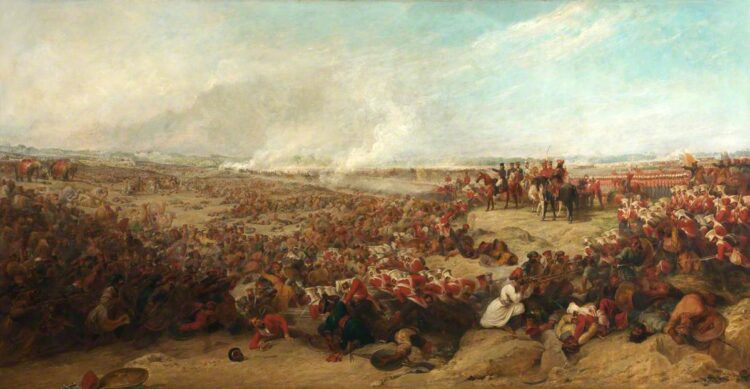
The 9th Bengal Light Cavalry and the Sindh Horse made their attack, which Napier believed was most gallant; however, he was still so engaged in the right and centre that he did not see their charge. However, he most likely did see the Talpur cavalry, which launched itself time and time again on the British line, each time cut down by the cannon fire, only to regroup and charge again. It was here that Napier found himself dashing about, rallying both officers and their men to stand and face the oncoming cavalry, who finally, after repeated attempts, broke through the British line. The fierceness of their attacks, the relentless manner in which they executed them, and above all, their determination to fight to the death must have seemed overwhelming, even to a man like Napier, who had seen Badajoz. As it was, the 9th was successful and managed to capture not only several standards but also several guns; the Sindh Horse, on the other hand, took the Talpur camp.
A large body of cavalry, still fighting, slowly retired from the camp – they were pursued for two miles by Lieutenant Fitzgerald, who, after slaying three sowars, returned to the Meani. Outram would later find out that the Mirs who accompanied this body of cavalry had been scanning the field for any sign of Outram, as they had made up their minds to surrender to him. However, Outram was absent from the field, as he was still out setting fires; the Mirs, unable to recognise anyone they knew among the British officers, continued their retreat.
By now, the battle was practically over. HM’s 22nd was able to force the riverbank, followed swiftly by the 12th and the 25th, with the latter regiment capturing the remaining guns. The Talpur army lost all the stores, ammunition, standards and even their treasure.
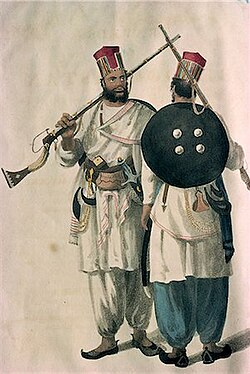
Sindh foot soldiers
Major Outram who had missed the battle completely, returned to camp very early on 18 February:
“February 18. — At 2 a.m., marched with 100 men for the camp, eight miles distant, which we reached just before daybreak; our road lay along the course of the Falaili. The field of battle, over which we passed, plainly showed, in the bright moonlight, from the heaps of slain covering it, how severely contested the action must have been. We were soon in possession of the particulars of this very sanguinary, at one time doubtful, and finally decisive conflict. Our loss, in proportion to the numbers engaged, was very heavy : 19 officers and 256 men, and 95 horses killed and wounded out of about 2,700 actually in the field. There were many chiefs, and upwards of 5,000 killed and wounded of the enemy,
Early in the morning, messengers came into camp to tender the submission of the Amirs. Sir Charles gave them till midday to surrender unconditionally; otherwise, our troops would march at that hour on the capital. Before the time specified had elapsed, Amirs Hasan Khan, Shahdad, and Husain Ali Khan, the Amirs of Haidarabad who had led the enemy, came into camp and surrendered unconditionally. The two former were detained as prisoners, but the latter was released by Sir Charles at my intercession, out of respect to the memory of his late father, Mir Nur Muhammad, who, on his death-bed, had consigned the youth to my guardianship. Overtures were also made by the Amirs of Upper Sind, who were informed that no other terms than unconditional surrender would be given.”
The Baluchis had fought with valour and immense bravery, but leave it up to a British narrator, who had been at the battle, to say, it was no more than “dispersing what was little better than a vast mob…They had no discipline, and a band of twenty men would rush out at a time with no order or method, only to impale themselves on the bayonet or be swept away by grape.” Captain Postans, however, would have disagreed. “The People of Sindh fought against the English army like persons who may fight for something which is more dearer to them than their lives.”
On 19 February, Napier marched to Hyderabad and took the fort, the surrender of which Napier’s brother, William viewed as cowardice. A seething Outram saw it differently.
General William Napier talks of the surrender of the Fortress of Hyderabad as an act of “miserable cowardice.” It was not so. It was surrendered because the Ameers trusted to the honour of his brother! They required not to be told that his field pieces would be useless against their fort, and that till reinforced, he was impotent to molest thorn. ‘But they knew also that even could his army be destroyed, other armies, and as able a commander in their estimation, would invade their country and destroy them. To resist him, they knew, would be—not courage, but—madness. But for this conviction strong on their minds, would they have allowed the Emaumghur party to return scatheless—would they not have fought Sir Charles Napier long ere he approached their capital—and daily harassed his line of march! But they never contemplated resistance. Whatever mild men could do to deprecate our hostility, the Ameers did. We forced them to the encounter, and THEY were foiled. Instead of seeking to retrieve their fortunes, they surrendered, reasonably hoping that as they were guiltless of any hostile views till driven to defend themselves, their fate would be a gentle one. They believed Sir Charles Napier, and they now rue their credulity.”
Mir Rustum Khan and his son, along with Nasir Khan of Khairpur, arrived shortly after and surrendered to Napier. They presented him with their swords, which he had the decency to return, but unable to rid himself of the idea that they were thorough villains, the worst sort of men he had ever met, he ordered all the Mirs to be chained in a garden, under guard, close to his camp. It is no wonder that allegations of mistreatment would be levelled against Napier by the Mirs. Considering his attitude, there is little doubt they were well-founded.
A petition, written by Mir Mahomed, bears out the base treachery Napier employed, even against an elderly man who had sworn his allegiance to the British. In obvious ignorance, Napier confuses him with the man’s youthful cousin who had attacked Outram in Hyderabad:
Major Outram, Lieutenants Leckie and Mylne, are well acquainted with my disposition and qualities, and know that when the other Ameers used occasionally to quarrel among themselves about their territory, I always mediated between them, and never disputed with them myself. Major Outram was resident in Scinde for three years, during the whole of which time I faithfully obeyed him in everything, supplied fuel for the steamers, camels and every other necessary for travellers. Major Outram is now in England and will bear witness that all I have herein stated is true.
Most certainly am I bound to confirm ALL the Ameer has here advanced, as perfectly true, and I doubt not that the other gentlemen to whom he refers would do so likewise.
This Ameer elsewhere states,—The third day after the plunder of the fort, Colonel Pattie came to me and said, ‘ The General wished to see me’—and having made me mount on an elephant without a houdah, but with merely a pack saddle, took me to the spot where the other Ameers were imprisoned (four miles distant ) my solicitations to be conveyed to the General were not attended to, and I was forcibly imprisoned.—( Ameer’s petition.)
Outram added:
“No wonder the British General shunned to face the man who only six days before had been assured that no harm should befall HIM!”
Outram was once again dismissed from Sindh and he returned to Bombay. His was not an easy departure; he grown to understand and respect the people of Sindh and had admiration for the Mirs. Although he could ascribe that there was undoubtedly a villain or two among them, they did not deserve the fate the EICo had in store for them. On the steamer, just of Thatta on 22 February, he wrote to his friend Lieutenant Brown:
“As you are the custodian of the captive princes, let me entreat of you, as a kindness to myself, to pay every regard to their comfort and dignity. I do assure you my heart bleeds for them, and it was in the fear that I might betray my feelings that I declined the last interview they yesterday sought of me. Pray say how sorry I was I could not call upon them before leaving; that, could I have done them any good, I would not have grudged any expenditure of time or labour on their behalf; but that, alas, they have placed it out of my power to do aught, by acting contrary to my advice, and having recourse to the fatal step of appeal to arms against the British Power.’
Needless to say, Outram’s misgivings about the EICo and particularly Napier were well-founded. He would volunteer to return to Sindh in March when it was clear that Napier was not quite done administering lessons to Sindh, but his offer was turned down. Whatever happened now, Outram would not be there to witness it.
In 1846, Outram published “Conquest of Scinde; a Commentary” and he had this to say:
“I was employed amicably to control, not to subvert, the Ameers and did so for three years. Sir Charles Napier had ostensibly the same duty to perform for his Government; in less than as many months, he picked a quarrel with them and commenced hostilities; drove them from their habitations, hunted them until compelled to resist; hurled them from their thrones; sacked their capital; and seized their country!”
After the Battle of Miani, Outram had advised Napier to give amnesty to the Mirs. He believed they had learned their lesson and there was no need to take the matter any further. Having induced the Mirs to surrender, Outram notes:
“Had we remained satisfied with our success, and restored the Ameers to their thrones, we should now be holding Scinde in as peaceable subjection as any other province in India; and with little, if any expense. Nay, more—our forbearing to en- hance, by spoliation, the guilt of our repeated acts of injustice, might have been accepted by the world as magnanimity! Such a course I recommended Sir Charles Napier to adopt; and I had little doubt that, by his representations, such was the course which the Governor-General would have been inclined to adopt. Had not I hoped so, and been sanguine in my hope, should I have been justified in advising the Ameers to surrender, knowing as I did, and as the General acknowledged, that had they held out the city and fortress, owing to his deficient means, Sir Charles Napier must have retired on the river, and there entrenched himself till reinforced, — a measure which, even after the late battle, would have had almost as injurious an effect as the one previously proposed, of leaving the baggage at Muttaree. Had the Ameers not been induced by Sir Charles Napier’s assurances to expect a far different fate from that which has overtaken them, they would not have surrendered. THEY WOULD, LIKE ALL S OF THEIR CREED, RANK, AND CHARACTER, RATHER HAVE BURIED THEMSELVES AND THEIR WIVES BENEATH THE RUINS OF THEIR FORTRESS!”
 Mutiny Reflections