Born on 2 March 1833 at Howden Pans, Northumberland, to George Chicken, Master Mariner and his wife Elizabeth (née Bell). Baptised at Wallsend St. Peter’s on 8 December 1833, George would spend his formative years, along with his three elder sisters, at Saugh House, Howden Pans (parish of Wallsend). The village originally took its name from the salt pans used to boil river water and extract salt from as early as Tudor times. In the 16th and 17th centuries, it was also known for extensive glassworks. By the 1800s, the industry had shifted towards shipbuilding and coal mining.
Considering his father’s profession, it was little wonder that young George would take to the sea. His Seaman’s Register Ticket informs us he was an Apprentice at Sea in 1847, having been first ticketed at the age of 14. It is also the only physical description we have of George Bell Chicken – brown hair and eyes, of “dark complexion with a scar on his right cheek.” He could write and had never served in the Royal Navy. It appears Mr Chicken was determined to have an eventful career, no matter what.
He served as 2nd Mate aboard the Anna on 24 February 1852, bound for America; by July of the same year, he was 1st Mate aboard the Darlington, having joined up at Valparaiso, Chile. In 1853, he was still with the Darlington, serving on the Baltic Routes and in Copenhagen. A year later, Master Chicken obtained his Master’s Certificate and was appointed skipper of the Darlington on the Baltic routes.
Then things changed. In 1855, Master Chicken first sighted Madras from the good ship, the Hastings, and something must have appealed to the young man, for as soon as he arrived in Calcutta, he turned his back on the Merchant Navy and joined the Country Merchant Service. From here, we must proceed with a little caution, as there have been many misconceptions regarding Master Chicken, the first being that he was part of the Naval Brigade, which unfortunately has been given to mean he served with the Shannon or the Pearl brigades. Master Chicken did neither. When we put aside these two glorious ships and their crews, we have the Indian Naval Brigade.
The Indian Naval Brigade
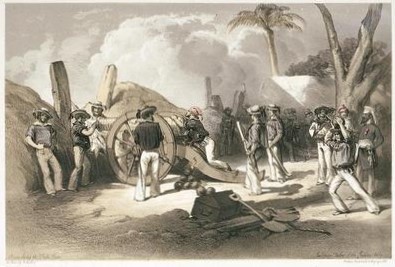
The first Detachments of officers and seamen of the Indian Navy, landed at Calcutta in June and July, were from the ‘Auckland,’ ‘Punjaub,’ ‘Semiramis,’ ‘Zenobia,‘ and ‘ Coromandel’, and further bodies were drafted up-country on the requisition of Sir Frederick Halliday, Lieutenant-Governor of Bengal.
In May, 1858, an important change took place in the control of the Indian Naval Brigade employed in assisting in the suppression of the Mutiny, or holding military posts in order to free the British troops for service in the field. During the interval between June, 1857, and the 22nd of May, 1858, a period of twelve months, large numbers of officers and seamen, had been landed from the ships of the Indian Navy, and bodies of men, recruited from the merchant ships and trained and officered by the Service, were despatched up-country as fast as they were disciplined and supplied with arms and equipments from the Indian Navy depot at Fort William. These Detachments, of from one hundred to two hundred men, each with two or more 12-pounder howitzers, were scattered over Bengal…” (Low)
It was just such a detachment that was sent to Dacca in 1857 to act in the capacity of policemen and augment the Europeans at that station. With them went one Arthur Mayo who, in November, would win his VC. Under Lieutenant Lewis, they would then see service in the Abor territories in 1859, when they were sent to replace Lieutenant Davies and the crew of the Zenobia.
“One of the first Detachments of the Indian Naval Brigade to land for service at Calcutta, if not the first, was No. 2 Detachment, drawn from the ‘Auckland,’ which had done such good service in China, and commanded by Lieutenant George O’Brien Carew, First-Lieutenant of that ship. In consequence of representations made by this officer to a member of the Governor-General’s Staff, that there was on board his ship a body of seamen drilled to use the field-piece and rifle equally well, a party of a hundred sailors and marines — Bombay European artillerymen — with Midshipmen H. W. Brownlow, of the ‘ Auckland,’ and H. G. F. Cotgrave, of the ‘Semiramis,’ was drafted for duty on shore under his command, and proceeded to Barrackpore, where it was attached to No. 20 horse field-battery (Capt. Hungerford’s).‘
In April 1858, Lieutenant Carew finally received permission to proceed up country, joining Brigadier Corfield in the Jagdispur District of Bihar. One detachment of sailors remained in Calcutta for the entirety of the mutiny, known as No. 1 Detachment, forming up to one-third of the European soldiers guarding Fort William, the state prisoners and Calcutta. However, with need for troops still pressing, in December 1857, Lieutenant Duval proceeded to Gaya in Bihar with No. 5 Detachment, two hundred men with a complete field battery of six guns. Further detachments left Fort William in April and in July 1858 to take up posts in Chota Nagpur, Muzaffarpur, and for a time in Patna. Hazaribagh, Ranchi (or Dorundah), Purulia, Chyabassa, and Sumbulpore. However, the longest in the field was No. 3 Detachment (100 men, four guns) under Lieutenant Batt. They would see action in the Patna Division, having proceeded up country in the latter part of July 1857. Batt would subsequently take command at Buxar, where he relieved Captain Sotheby and the Pearl Naval Brigade. This is where we now find Mr Chicken.
Mr Chicken VC
It is also, however, where the estimable Rathbone Low throws a spanner in the works.
” Captain Campbell appointed Mr Chicken to the Service on the 31st of July, 1858, and after doing duty at Fort William for eight months, on the 23rd of March, 1859, he left for Buxar to join No. 3 Detachment, taking with him a party of seamen to replace the sick and dead of No. 7 stationed at Dehree.” (p. 483, History of the Indian Navy, Vol II)
The problem is, Mr Chicken won his VC on September 27, 1858, a full six months, before, according to Mr Lowe, he had even left Calcutta. As we do have a letter written by Master Chicken to his uncle in February 1859, we may attempt to clear up this discrepancy.
My Dear Uncle,
your truly welcome letter dated February 7th 59 I had the pleasure to receive on the 2nd inst. Need I say how truly pleased I was to find that at least one of my relatives had not forsaken me. How thankful we poor mortals ought to be to Almighty God for giving us health and strength and the means also through the medium of pens, ink and paper of having an interchange of thoughts and sentiments of friends and relatives when separated, however distant that may be. Now that a correspondence has been opened, I trust that it may always remain so. I would only be too happy to receive and answer any letter of my cousins.
You say that you would like to know a little of my history since I have been in India. It is not very interesting but however I will give you the outline. I arrived in Calcutta per ship Hastings some time in August 1855. After I left the Hastings I entered the Country Merchant Service when I made the voyage to Batavia, Singapore, Penang, Malacca etc. etc. During the last voyage I lost money with speculation which disgusted me with Merchant Service so I left and entered the Govt. River Surveying Service where I had remained nearly two years when the Mutiny broke out. When the news of the massacre at Cawnpore came down to Calcutta, I laid down my sextant and entered the navy as Master on condition that I was to serve on those against the rebels. This was the commencement of 58.
It would appear that Mr Chicken had remained in the River Survey throughout 1857. He first appears on the books of the HMS Calcutta on 31 July 1858, appointed by Captain Campbell as Acting Master. Chicken states in his letter, he was in Calcutta when the mutiny broke out; the news of the Cawnpore massacre did not reach the city until July 1857. Until he joined the Naval Brigade “at the commencement of 1858”, there is a possibility that Mr Chicken was, for a time, part of the many gentlemen volunteers in Calcutta, which would account for Lowe’s “eight months service in Fort William”. Their duties would have ranged from patrolling and local policing, to attachments with the regiments stationed in Fort William. If we look at the mistaken dates presented to us in Rathbone Lowe’s book, it would make more sense that he joined the Indian Naval Brigade in March 1858, which would tie in with Chicken’s own letter (and not as Lowe states, sent up country in March 1859), he then completed his mandatory training and was taken on the books of the Calcutta in July 1858.
“I was sent up country 2nd in command of a Bengal unit. From that time up to last one it was one campaign; marching and countermarching, advancing and retreating and fighting whenever we met or overtook the enemy. To write the particulars of what happened in that time would be impossible. Suffice to say that retribution has been terrible I will now proceed to give you some account of the action in which I had the honour of winning the Victoria Cross. I will do so because you have asked me, but do not think me an egotist when I have occasion to speak of myself.”
Here, Mr Chicken leaves us in a conundrum. No official appointments exist that state Mr Chicken was nominated as 2nd in command of a Bengal unit. The only Bengal unit per se at the time was the Bengal Military Police, but their second-in-command was very clearly Lieutenant Charles George Baker. As we cannot say for sure when Mr Chicken left Calcutta, nor do we know what mode of travel was employed. He was not an officer of importance so he would not have been given sanction to use a dak gharry, nor due to the dangerous state of the Grand Trunk Road would this have been deemed advisable As we know he was proceeding upcountry, he would either have travelled by Ganges river steamer via Allahabad, a journey of 3 to 4 weeks, or by bullock train, which again would take 3 to 6 weeks. Since Captain Rattray comes across Chicken at Dehri, it is likely the bullock train was in effect for his journey. Chicken leaves his letter vague, and likely this deception is deliberate – we have to consider that he was likely not in his family’s best books, nor had he been for some years. A little hamming up for the family back home might have been his way of improving their opinion of him. Second-in-Command of a Bengal Unit sounds preferable to Second-in-Command of a bullock train transport. He was assigned to No. 3 Detachment, Indian Naval Brigade, which at the time was in Buxar, where he would serve as an artilleryman. At the time No. 7 was at Dehri and the men travelling with Chicken were being sent as new replacements for the sick and dead of that detachment. It was here that Lieutenant-Colonel Turner was assembling his force to take to the field and Master Chicken volunteered his services to Captain Rattray, who states Chicken applied, “with a determination as he expressed it, to win his medal.“
We return now to Mr Chicken’s letter:
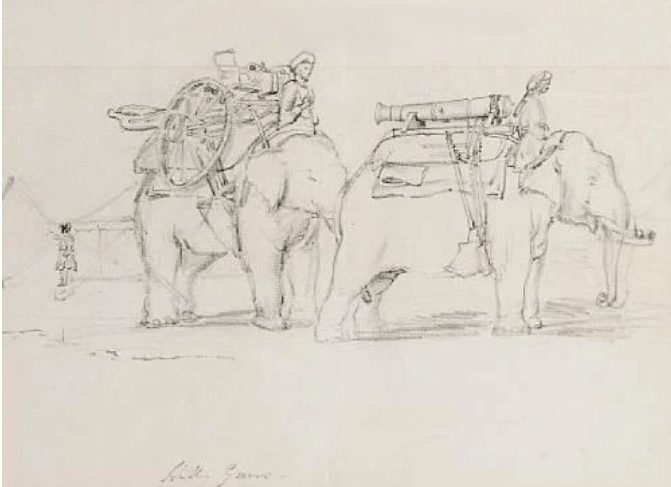
“On the morning of the 27th of September at 1 a.m., we were awoken by strains of a bugle. We were soon upon our legs, thinking that the enemy was coming down upon us. I had the command of the guns so it was my duty to get them ready in order to receive the rebels with all honour, but we soon learned that the Col. had got information that the enemy was encamped some 18 miles from where we were., Certainly this was good news, but we had been disappointed so often that we did not place much faith in it but however, that was not the thing: we had to obey orders which were to prepare for marching across country. I got my guns upon elephants’ backs; in about 40 minutes we were all ready. So the march commenced. At noon we halted for breakfast; when that delightful performance was about half over, a spy came and said the enemy was only 4 miles off. The Col. gave orders for the Cavalry to mount. He then came down amongst them and told them that they had to start at once and engage the enemy on the left and to keep them in play until he came up with the infantry and guns, but as the guns were upon elephants’ backs I asked permission to go out with the cavalry and to join the guns upon the field which was granted. The Colonel gave the last order, which was, ‘If you cannot play with them for God’s sake go right through them and kill as many as you can.’ Wishing us success, he left us.”
Unfortunately, neither Mr Chicken nor the despatches tell us from where they were starting on 27 September; however, we do know that Lieutenant-Colonel Turner breakfasted his men at Kharauna. Turner then received news that the rebels were encamped in and around Piro; he split his force into two columns, with him leading the infantry in the direct road to Piro and the cavalry sent around the rear of Piro. We can now read the account of the action that followed directly from Chicken himself.
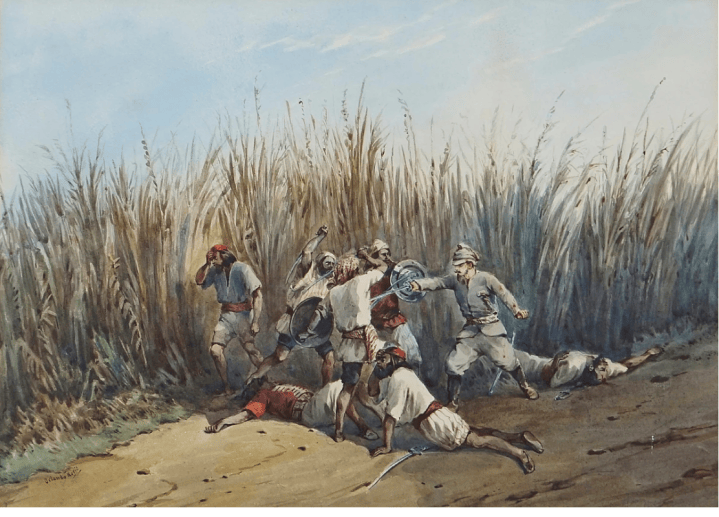
We then started, raining fearfully. After 45 minutes march we came upon them. They, seeing our small force (100 strong), came out into the open. We then had an opportunity of counting them, which was 1000 foot and 50 horse. They then threw out skirmishers and advanced in line. The firing being very hot we relocated about a mile, saw no signs of the Col. coming and called a Council of War. The majority agreed to charge their centre. The enemy seeing us coming at a hand-gallop did not think it worthwhile to form Square; intending I should say to crush us with one volley. When we were within 20 yards of them they fired. I was wearing my sword at the time a ball struck the hilt and sprained my right wrist. The volley did very little execution, it did not check our speed, so we went right through their centre and in a moment they were a flying mass.
There was a small river on their left into which hundreds plunged hoping to escape in that way. I called upon my fellows to follow and jumped in after them. The slaughter there was tremendous but forward was the cry. When I got to the opposite side of the river (under a heavy fire) and was climbing up the bank, my horse got his first wound. A fellow after us shot at me and missed me, clubbed his musket and hit my horse over the left eye, which sent us both rolling back again into the river. After a short time I again mounted the bank and succeeded in getting across and after a short struggle forced the passage. By this time 10 of my men got across, we then continued the chase. My horse being the swiftest I soon distanced the men. At the entrance of Jugdespore jungle (where) the road is narrow, the enemy was forming square.
I saw at once that if they did so they would rally, and as we were all broken up it would be a case with us all. So I again called upon my fellows to follow and I rode right at it and sprang into the centre. I then had to fight for my life which I was determined to sell as dearly as possible. My pistol miss fired twice and when I got my wound on my shoulder my sword was through a fellow’s skull and I could not liberate it. The struggle lasted five minutes when they fled, leaving 16 dead on that spot. There were 5 men came in after me, one was killed; the rest all severely wounded.
In the process, George Bell Chicken was severely wounded, and he did not spare his uncle any of the details.
My wounds were as follows:
My left shoulder cut into the joint and across the breast, 7 inches. Severe bruise on the left arm, ditto on the back with clubbed musket; a slight wound on the right side of the neck where a musket bullet had just missed me. My horse was wounded on the left side of the neck with a sword cut 10 inches long, two bullets in his foreshoulder; his forelegs cut across, a severe contusion over left eye.
So you see both master and horse were wounded not a little. This was the last affair, and happy was I to see the enemy flying, for just as they did so I fell from my horse, fainting, caused by loss of blood. After a short time our main body came up, and I was picked up and carried into camp with the rest of the wounded, where my wounds were dressed. So ended this eventful day. In fair hand-to-hand encounters, I killed seven men that day, which I consider a very fair day’s work.
George Bell Chicken of the River Survey
Sadly, here is where Mr Chicken’s letter ends, and we must return to all that we know of the remainder of his life.
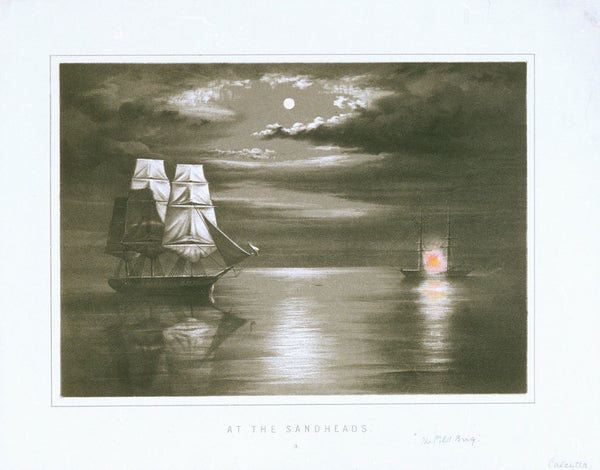
The severity of his wounds would exclude George Bell Chicken from any fighting in the immediate future, and he likely remained on garrison duty with No. 3 Detachment at Buxar. In November 1859, No. 3 Detachment was returned to Calcutta from disbandment. “On their quitting Buxar, a correspondent of an Indian paper writes: — ” On the departure of No. 3 Naval Brigade, upwards of one half were hors de combat from fever, and the chaste obelisk which these gallant, well-conducted fellows raised in generous sympathy to the memory of their lost shipmates, and which adorns the Buxar burial ground, tells too truly how the brigade suffered.”
In March 1860 a new opportunity presented itself to Mr Chicken when he was given command of the schooner, HM Emily. It would appear he had returned to the River Survey Service for the Emily and was a part of the river surveying and coastal flotilla. She was designed with a shallow draft to navigate shifting sandbars and the shallow river mouths, operating with a small crew, the complete complement not exceeding 30 men. She also carried 2 guns, most likely either light brass or iron pieces (3- or 6-pounders) meant for signalling and for basic defence against local piracy. Considering the mutiny was still very much in living memory, there might well have been some law enforcement involved in Emily’s work. However, there is perhaps another reason why the work would have appealed to Chicken – it was, after all, perilous.
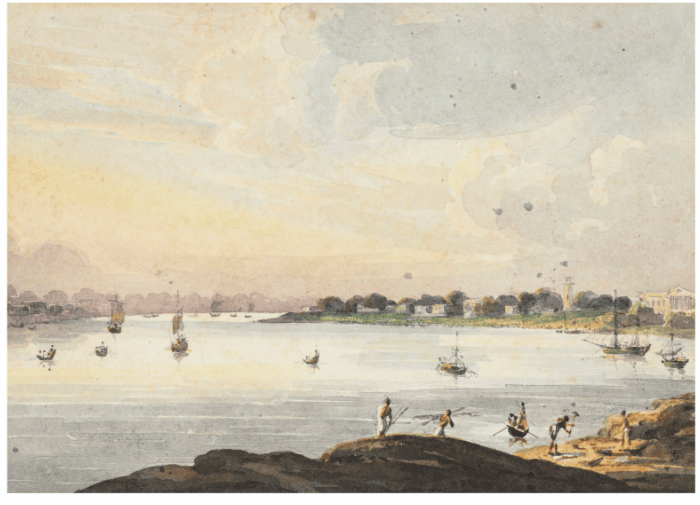
The main focus of the river survey was Sandheads — a convergence of sandbanks deposited by the river system extending roughly 212 miles downstream from Calcutta into the open Bay of Bengal. As the Hooghly River is a shifting distributary of the Ganges, underwater channels could completely change position after a single monsoon season. Surveying ships had to drop anchor in volatile, shallow waters to take depth soundings, and just about anything could happen. Extreme tidal flows, fast ebbing waters and even tidal bores were a threat; poor visibility, especially in the winter months due to fog or during the monsoons, undoubtedly added some further interest to any day’s work. If this was not enough, the area was also prone to sudden storms and severe cyclones.
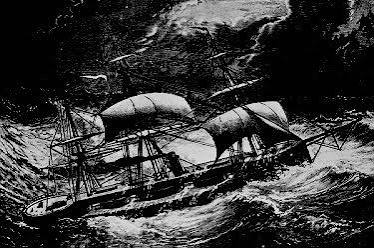
It was just such a violent squall in the Sandheads that ended the life of George Bell, Chicken VC, in May 1860. The Emily went down with all hands, and although an attempt was made to find her, neither the schooner nor the crew were recovered.
The Victoria Cross
Like Lieutenant Charles George Baker, Chicken was gazetted some years after his act of valour and the citation did not appear in the London Gazette until April 27, 1860, shortly before his untimely death. As we have seen from the letter to his uncle, he was well aware that he had received the Victoria Cross, as it had already been revealed in a letter to Lord Canning, in which Sir Colin Campbell directed his Adjutant-General, Lieutenant-Colonel William Mayhew, on 6 October 1858, to write:
“I have the honour to request, on the part of his lordship, that you will have the goodness to direct the attention of the Right Honourable the Governor-General to the brilliancy of the exploit performed by Lieutenant G. C. Baker, of the Bengal Police Battalion, which is deserving of the highest encomium, on account both of conception and execution. His lordship is of the opinion that the Victoria Cross should be awarded to Lieutenant Baker, and to Mr Chicken, of the Indian Navy, and he will take immediate measures for the execution of his intention in this respect.“
The despatch from the Government of India conveying Lord Clyde’s recommendation was not forwarded to the India Office in London until 21st December 1859. This again might seem like a long time; however, we must bear in mind that, like the VC of Charles George Baker, the request was an unusual one. Chicken was a volunteer, so technically a civilian, doing duty with the Indian Naval Brigade and attached for this one action to Rattray’s Sikhs. He was not officially a part of the battalion, nor was he considered a seaman. In the end, Chicken’s VC was officially classified as a civilian VC and not a military one, making him one of 4 men to receive just such a cross for the Indian Mutiny.
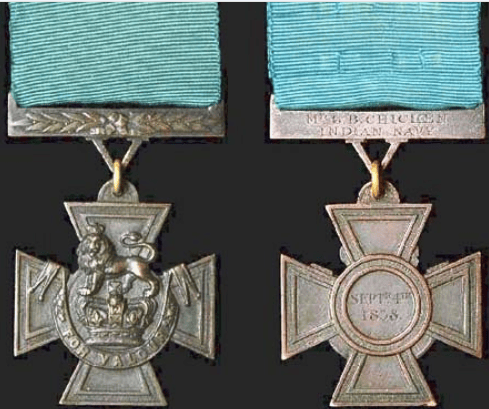
Two Victoria Crosses were produced for Chicken – the first medal was incorrect, stating on the reverse,
“Mr G. B. Chicken, Indian Navy, Sptr 4th 1858.” It is unclear if it was ever presented to him or if he received it by post, but regardless, the cross was either lost in India or deliberately returned due to the erroneous date. It only turned up again in 1922 when it was discovered in the collection of one John Sandford Saltus after his death. It is this first VC that now forms part of the Lord Ashcroft Medal Collection.
Hancocks therefore produced a second, or technically, a replacement VC for George Bell Chicken. However, as news of his death had already reached home, the medal was sent to his father, as next-of-kin, in the post. The reverse text now read:
GEO. BELL CHICKEN ESQE
INDN NAVL BRIGADE
SEPTR. 27TH. 1858
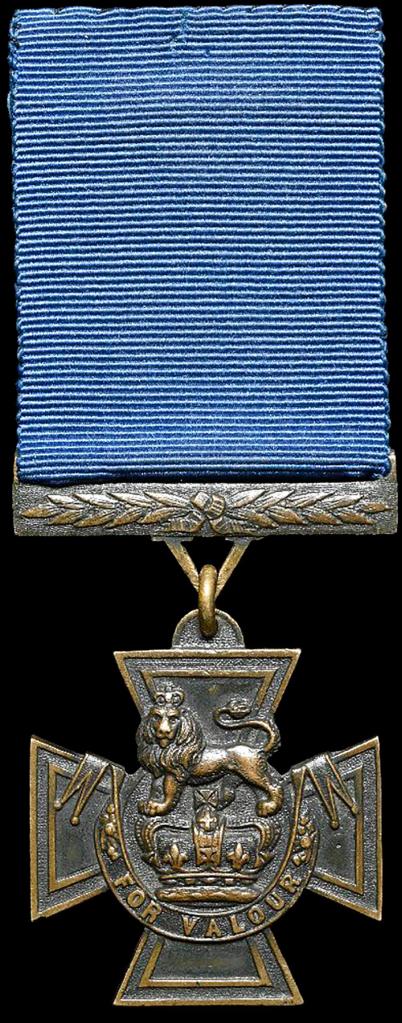
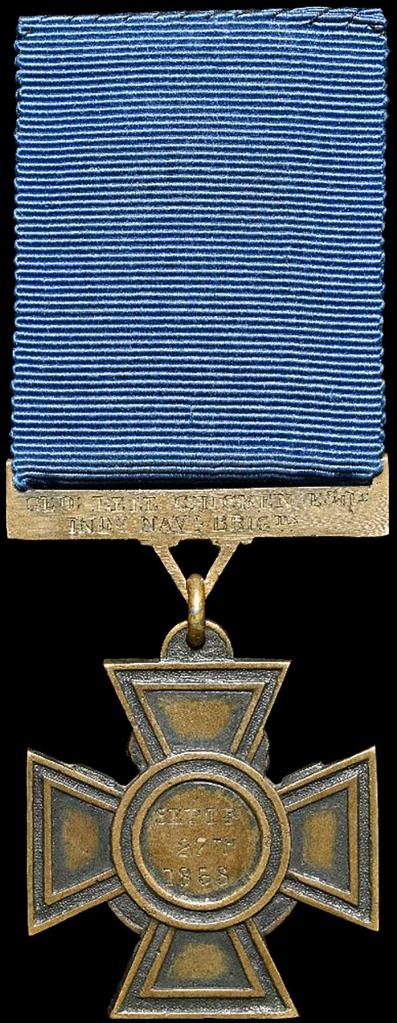
The medal was received by his father in 1862 and was accompanied by a letter from Sir Edward Lugard, dated 4 March 1862:
Sir,
I am directed by Secretary Sir George Lewis to transmit to you the decoration of the Victoria Cross [which] would have been conferred, in accordance with Her Majesty’s intentions, upon your son the late Mr George Bell Chicken, of the Indian Naval Brigade, had he survived, in recognition of his gallantry at Suhejnee, near Peroo, on the 27th of September 1858, as recorded in the enclosed extract from the London Gazette of the 27th of April, 1860. This award is sent to you by The Queen as a memorial of your late son’s gallant conduct on that occasion. You will be so good as to acknowledge the receipt of it.
I have the honor to be, Sir,
Your most obedient servant,
Edward Lugard.
It is believed to be the only VC in existence with the Esq.e suffix and is the only one to be issued to a civilian volunteer of the Indian Naval Brigade.
George Chicken Snr held on to not just the cross in its original box, but Lugard’s letter, his son’s correspondence and his sword (which had been returned to him) for the remainder of his life. Shortly before his death, he gifted the relics to his daughter, Elizabeth. The medal remained with the family and was passed on to a cousin, Mr Rupert Chicken of Nottingham, upon Elizabeth’s death. However, for reasons unknown, the whole lot – medal, box, sword and letters turned up at auction in 1923. The items were sold again in 1932 to a private collector, supposedly from Canada. Either he was somewhat lackadaisical about his collection, or his relatives were clueless, for the next appearance of the medal and the letters would be 55 years later, when they turned up in a suitcase, along with other medals, in a basement in Alberta, Canada. The medal was sold in 1987 and bought once again by a private collector. It came up for auction (with all the letters and the box) once again in 2022, when it was sold by Morton and Eden in London for the price of £280,000 to an unnamed purchaser. The sword, however, vanished somewhere along the way and has never been found. If George Bell Chicken had received the India Mutiny Medal, it likely went down with the Emily; like his sword, it too has disappeared.
Sources:
Low, Charles Rathbone. History of the Indian Navy (1613–1863). 2 vols. London: Richard Bentley & Son, 1877.
Supplement to the London Gazette 22224, 31 January 1859
“London Gazette”. No. 22380. 27 April 1860. p 1596
https://vcgca.org/our-people/profile/1155/George-Bell-CHICKEN
https://freepages.rootsweb.com/~chicken/genealogy/belltree.htm
https://www.invaluable.com/auction-lot/the-unusual-indian-mutiny-‘naval-brigade-victoria-846-c-bd44a34b04?srsltid=AfmBOoo8sMg0OfPogisbDdE5R1Y0pDPi25aqGAO9KfmiIz2BrfYBEi3W
https://www.victoriacross.org.uk/bbchic22.htm
https://www.memorialstovalour.co.uk/vc279.html
 Mutiny Reflections