

On the 25th of November 1857, Sir Colin Campbell proceeded to Cawnpore with the women and children of Lucknow. Taking with him the greater portion of the effective troops of the garrison, he left Sir James Outram behind at the Alambagh with a force of the now reconstituted army that had taken the Residency, numbering no more than 4000 men. Outram’s orders were clear – hold Lucknow and “its armed hordes in check” until Sir Colin Campbell returned.
Sir James was not holding Lucknow, but the wall-enclosure of the Alambagh and the directly it, including the Jellalabad Fort, and the Bunee Bridge (12 miles distant). He further controlled the Cawnpore Road along which he received reinforcements and supplies. Outram had been expecting a speedy relief; instead, he found himself, for the next three months, surrounded by an increasingly hostile population who would make various attempts to march on Cawnpore. It became his sole occupation to keep the rebels in check and the road in British hands. As such, his position was a mile and a half from the suburbs of Lucknow, and his most advanced post was well within gunshot range of the rebel outworks. However, Outram had three admirable field batteries under Vincent Eyre, ‘Hellfire Jack’ Olpherts, Francis Maude and George Moir’s Bengal Garrison Artillery. “Any quantity of ordnance bristled in the embrasures of our entrenched camp; in all, we had 51 guns, including howitzers and mortars.”

Outram was sorely deficient in cavalry; until reinforcements arrived, he had 370 sabres of which 222 were drivers from the Military Train, 68 volunteers and 80 Irregulars from regiments that had opted not to mutiny. It must have been something of a shock for the men of the Military Train – they had been comfortably on their way to China when Lord Elgin had ordered them to India.

Outram’s force was, in reality, rather less than 4000 men of all ranks. Six hundred men were occupied in holding the Alambagh and Jellalabad; brigade and camp duties took up another 450. After reckoning out the sick and wounded, Outram had little more than 2000 men of all ranks available, as he was obliged to send, in fortnightly convoys, 450 men to Cawnpore. These spent some two-thirds of each month on the road, and their departure and return, “the enemy were of course as well informed as ourselves…”

The infantry, however, were all well-seasoned men: seven battalions in all, comprising the 5th Fusiliers, the 75th, the 78th (Highlanders), the 85th, the 90th Light Infantry, the 1st Madras Fusiliers and Brayser’s Ferozepore Sikhs. A company of Royal Engineers under George Hutchinson too, had remained behind at the Alambagh.
As there was a need to graze their animals and collect grass for the horses, Outram found it impossible to reduce the size of his camp and outworks to less than 10 miles and 1200 yards. His small force was defending not only an “ incompact position against a foe who could have brought large bodies of troops to bear against us simultaneously at several distant points, but of supplying foraging parties, and of being prepared to move out beyond our limits to meet the enemy, whenever by his attempts to cut off our communications, to menace Bunnee or Cawnpore, or by other hostile demonstrations, he might render such an operation necessary.” To secure the Bunee Bridge, Outram detached a force of 400 infantry with two guns.

Sir Colin Campbell did not forget Outram, nor did he neglect the precariousness of his position. Between 27 November and 12 February, he reduced his own force to send Outram reinforcements – 1216 men of all arms, and several pieces of ordnance. He also furnished him, on 13 February, with 1200 undrilled sappers and miners, who replaced the 75th Regiment of Foot that Campbell needed elsewhere. Ten days later, 587 men of the 1st Bengal Fusiliers appeared and on the 24th, two squadrons of Dragoons, a troop of Horse Artillery and Hodson’s Horse. However, these were but a trickle compared to what the rebels could throw against Outram

Besides this, they had an unlimited supply of artillery amounted to some 131 guns, and not including the wall pieces and guns they brought with them from Fatehpur. How many gunners they had, Orr could not estimate. However, he was able to ascertain that the armed followers of the various talukdars and zamindars still in Lucknow were on 26 January, no less than 20’000, augmented by roving bands of armed badmashes. To make matters even more interesting, a further five regiments descended on Lucknow following Campbell’s taking of Fatehgarh and fed the force with another 3000 men and several guns. In all, when Orr threw out a conservative estimate, by January 26, the forces in Lucknow had swelled to 120’000 men. While many of the zamindari men left, they were quickly replaced by other mutinied regiments. Strong in infantry and cavalry, the rebels could have overrun Outram at a moment’s notice; however, as things turned out, they did not. For once again, a decided lack of leadership and curiously, a reluctance on the part of the mutinied sepoys to attack Outram played a part in their subsequent defeats.
Life in the Alambagh

The Alambagh had once been a palace, but it was also well suited for defence. The building consisted of a square enclosure with a large gateway in the middle of the wall facing the road. On either side of the gateway, there were good-sized rooms both on the ground level and above the gateway itself. The wooden doors were studded with iron knobs, each with a small window, closed by a stout shutter. At each angle of the enclosure were round bastions covered with gilt cupolas, which were hastily converted into batteries; two or three guns were placed in the front angles and field pieces in the rear. On entering through the gate, a broad pathway led through a beautiful garden bordered by water courses and myrtle, leading up to the building itself.
The palace itself was a large square house with a ground and upper floors covered by a broad, flat roof, in the centre of which was another roof from which there was an unbroken view of the surrounding countryside. On this, the British had erected the semaphore, which they used to communicate with the Residency, and at night they signalled using fire and different coloured lights. A large centre room on the upper storey had been converted into a hospital with the doors and windows barricaded with sandbags and shutters. The balustrade that ran along the roof had long since been smashed to pieces by the rebel artillery, and the verandah pillars were pitted with shot. At each corner of the building was a turret in which the staff officers made their quarters and kept a “rather jolly Mess.” For practicality, all the trees were cut down, and soon there was little left of the garden – a few deer were seen on occasion under the trees, reminders of better days in Lucknow.


Once the disappointment of being left behind at the Alambagh had sunk in, Francis Maude and his friends decided that what they needed to make their unpleasant sojourn tolerable was a mess house. Enlisting their “little army of bullock drivers,” enticed by a little extra pay, Henry Moorsom took charge of the operations and soon had them digging up the soil – it was not the best material to work with, he admitted, for while it was admirable for planting crops, it was too loose for actual bricks. After some experimentation, Moorsom found that if the soil was kneaded to a softer state with some water, it could be built up to form blocks, which in fact proved better than sun-dried bricks, for, when dry, it was solid and surprisingly tenacious without a tendency to crumble. The mess house was quickly put up and inaugurated in Maude fashion, with a blazing fire, several rounds of toddy and rubber of whist. Moorsom and three others were allowed as honorary members, and the artillery settled down, for the first time in months, in a building that was neither riddled with shot nor had a leaky roof.
Maude had brought with him from the Residency a bull terrier, a beloved pet that had somehow been secreted away during the siege. The dog was in fine form, and Maude soon found it was fond of exercising its prowess in the Alambagh. Its nightly battles with pariah dogs, jackals and the occasional porcupine soon became legendary, and Maude’s dog never lost a fight, although the porcupine quills required some pulling to remove, the dog was always ready for another battle. He was well and truly a battery dog, and Maude was rightly proud of his mascot.

The 75th Regiment had been rather longer at the Alambagh than Maude, having remained behind at the final relief of the Residency – only a company of them ever saw Lucknow and that from their position at the Dilkusha. Having suffered terrible losses at Badli-ki-Serai in June 1857 and more on the march from Delhi to Cawnpore, the 75th were no longer considered fit enough to accompany Campbell to Lucknow; if appearances were anything to go by, they were more motley than the rest. Their uniforms, once khaki in colour, had faded into a variety of dirty stains, and their commanding officer, Gordon, was such a sight, he gave even the battle-hardened Campbell a turn. Gordon had fashioned himself a uniform of sorts, the likes of which no one had ever seen before. On his head he wore a “kind of thing shaped like a basin…made out of an old shako with a brass ventilator on top made in a bazaar…” that was held on his head by an overlong “old regulation chin strap with brass scale rings…” that hung so far under his chin that it mixed into his ragged beard which”adorned the lower part of a most peculiar countenance.” His jacket was something no one had ever seen before and was certainly not a 75th regimental but boasted of a standing collar and was “hooked around his throat and decorated by a row of small Regimental brass buttons while his shoulders displayed a pair of faded gold cords of the very shabbiest description.” His once khaki trousers were sunk well into his jack boots, reminiscent of the troopers of the Irregular cavalry, and he had attached the largest brass hunting spurs any man had ever seen. To finish his appearance, Gordon had a leather sling belt to which he attached an “enormous light Cavalry sabre, to which by way of sword knot was attached a pyjama string of green, yellow and pink silk, the finishing touch being given to this martial costume by a pair of old and what had once been white gloves…” In this curious attire, he had gone to meet Sir Colin Campbell – behind his back, his men called him “Dirty Gordon” and while no one doubted his bravery, Gordon was unflinchingly the most eccentric commander, “perfectly useless as a parade officer, and rather worse at Regimental interior economy, but he was a capital horseman…” and if allowed to do things his way, Gordon was an able leader of men. At the Alambagh, this “queer fellow” fell into the habit of standing stark naked in front of his tent while talking to the orderly Sergeants while flapping away flies with the towel he neglected to cover himself with. If not too distracted by the sergeants, Gordon would then proceed to have his bath, which consisted of several dousings of water from a mussack, tossed on him where he stood. Until he was ready to don his uniform again, Gordon slipped into a green choga and a scarlet comforter made into a cap and then, with slippers on his feet, he proceeded from tent to tent of the 75th, delivering small talks to the men.

They had also chosen a fine spot for their tents – the 75th pitched up in the garden around the Alambagh itself and dug trenches to allow the men to move about in relative safety. The only point they avoided was a clump of mango trees, while revered for their shade, were known to be the favoured target of a meddlesome 32-pounder the regiment had dubbed “Nancy Dawson.” If the balls fell short, they generally lodged in the tope. Newcomers to the Alambagh soon realised their mistake, for without fail, each one tried to pitch his tent under the trees. One man, named Fisher, recently arrived to take charge of the Commissariat, decided that no gun would send him flying, and he insisted on the tope. The rebels appeared to have developed a sixth sense for newcomers. They waited until the opportune moment when Fisher was in his bath. They then sent a ball flying towards the Alambagh, ripping off the top of Fisher’s tent in the process. The portly gentleman was seen performing a curious “arial exercise” as he leapt out of his bath, through the hole in his tent and ran sharply, “in purus naturalis” for cover. As soon as the cannonade was over, he took down what was left of his dwelling and retreated out of reach of Nancy Dawson.
For one man, this sudden halt at the Alambagh proved to be a little too much for his fragile mind – Lieutenant Delafosse, who had survived the Siege of Cawnpore and had, with three companions, become one of the few survivors of the Satichaura Ghat massacre, had recovered, under the watchful care of a kind talukdar from severe sunburn and then had bravely joined Havelock’s force only to be holed up in the Residency until November, he entered the Alambagh quite “deranged” and unfit for any work. For the first few weeks, he threw out wild accusations at his tent companion, Lieutenant Lithgow, complaining that Lithgow had stolen his keys, which, as it was found, Delafosse did not possess, nor did he have anything in his scanty articles that required a lock. It was determined the best cure for Delafosse’s ailment was work; within a few weeks, he ceased terrorising Lithgow, and he would go on to fight through the rest of the campaign.

Garnet Wolseley, too, remained at the Alambagh. While he found life monotonous, it was far from dull, but his main gripe was the lack of books, which he found more tiresome than the want of wine. He might have considered making friends with the men of Maude’s battery who had managed to get their hands on “the devil’s picture books” and a good many of the officers were “whiling away “their spare time in this rather dubious delight. Instead, he amused himself by taking part in camp races, for ” where is that two or three Englishmen are ever gathered together for any length of time without a race meeting?” Gambling was the sport of the day, and the men bet heavily not only on races but on other games – there was nothing else to spend money on. He threw himself with much enthusiasm into picket duty, which was done, “at least in my battalion, by companies, in true system, the only possible good system on active service.” While the work did keep him from his bed at night, he enjoyed walking around his line of sentries to see that they were not sleeping either and the rebels were keeping quiet.
It also gave Wolseley the chance to bury the hatchet with Major MacIntyre of the Gordon Highlanders. It was a long-standing feud, going back to October 1857. Wolseley and a portion of the 90th had arrived in advance of Sir Colin Campbell; they were sent from Cawnpore to the Alambagh, where Havelock had left Major MacIntyre of the Gordon Highlanders in charge of a minimal force of 260 men to secure the position which housed not just the sick and wounded but all the tents and impedimenta Havelock had left behind. From the first, the 90th displeased McIntyre, who saw them as reckless and a nuisance to his carefully managed camp. It was Wolseley in particular who came in for McIntyre’s wrath when he and several others had had the impudence to venture outside the Alambagh to provide covering fire to their grass cutters. As the officers’ horses were starving and the cutters were forced to collect grass well away from the enclosure for their charges, Wolseley felt it was only right that he and his officer friends should act as their protectors. Armed with their rifles, they had formed a little square around the grass cutters well within sight of the rebels, who lost no time in sending forward several skirmishers. Wolseley and his party, which included Captain Bigge of the Northumberland Fusiliers, quickly formed up and returned fire; the rebels, however, decided they wanted the upper hand and sent a 32-pounder shot in their direction instead. McIntyre, who had been on the roof of the Alambagh, was so furious at Wolseley and his friends for endangering the camp by their “act of delinquency,” he ordered their commander, Major Barnston, to arrest them. Barnston ordered the men to their tents. The next morning, Barnston tried to smooth things out with McIntyre, insisting that officers of his regiment were not accustomed to being arrested, and if the charges held water, they should be tried. Once McIntyre had ceased fuming, the men were released with a severe wigging. Unfortunately, this act hardly endeared McIntyre to Wolseley, who noted, “We all improperly disliked him and thought little of him as a soldier.”
Now, Wolseley was back in the Alambagh, and his old nemesis, Major McIntyre, was still there. Shortly before Christmas 1857, Wolseley found McIntyre was the field officer of the day and, as he was just coming off night duty, could not rightly avoid him.
“I clambered to the flat roof of the biggest house in the village to have a good look-out all round, and Major McIntyre quickly followed me there. The mutineers in front were playing our ordinary reveille on their drums and fifes as they had learnt it in their regiments. A sentry stood between me and McIntyre, and we all three peered earnestly into the twilight towards the enemy’s position. Just then, two wild geese flew over at about duck-shot range from us.
Quick as lightning, this major snatched the sentry’s rifle and fired. One of the geese fell not far in front of us. Had he not been known well as a first-rate shot, I should have looked upon this as a mere ‘fluke,’ but in his case, one could not think so. Quite involuntarily on my part 1 exclaimed,
‘Well done, a splendid shot.’
I was soon relieved and marched my men back to camp.
In the afternoon, a native servant came to my tent with a note, a bottle of port wine, and this wild goose. The note was very civil, asking me to accept the goose for my Christmas dinner the day following, and hoping I would wash it down with the bottle of wine he ventured to send me. So ended my enmity with this old major. He had entered the Army when I was still in swaddling clothes.”
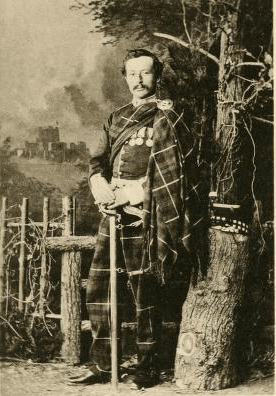
Not everyone was finding the Alambagh onerous – Lieutenant Irby of the 90th was thrilled to find the jheels (marshes) around Jellalabad Fort were filled with a variety of game birds. Already a dedicated ornithologist, he had, during the brief intervals in the fighting in Crimea, used his time to shoot and skin local birds and now he put his skills to use identifying edible birds of Oudh to fill the cooking pots of his regiment. Wolseley often accompanied him on his expeditions if only to stare in astonishment at Irby’s “soldier servant”, who was employed as a retriever. The man, with untiring enthusiasm, would scamper off after the stricken bird, no matter how deep the water was and bring it back to Irby. It was a curious symbiosis, and the two remained inseparable until Irby left India.

Surgeon Home too, had been left at the Alambagh, still in charge of the sick and wounded. He found the camp an uncommonly well-managed one and even managed to replace his horse with one purchased at the regimental bazaar. He was also pleased to find none of his possessions, which he had left behind on 25 September, were looted, and his coolie and bearer were still in attendance. However, like Wolseley, he found the lack of books alarming – the only one which fell into his hands during those months was a curious collection of three of Shakespeare’s plays that someone had brought out of the Residency. It was just as well, he thought, there were no candles in camp, or lights of any sort, for it meant everyone was tucked up for the night by 7 pm. Fortunately, the bazaar had a good stock of quality tobacco and convoys regularly brought luxuries from Cawnpore, such as clothing, “charpoys and tent-tables,” but above all, they brought letters and newspapers, their only connection to an outside world that now seemed even further away.
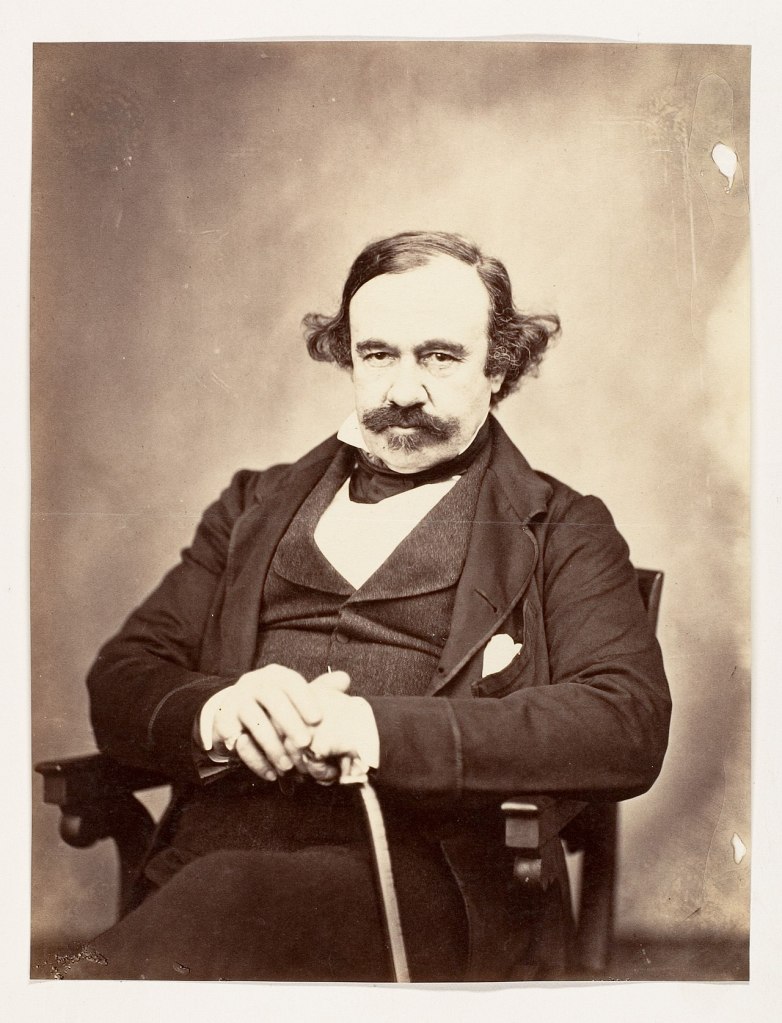
Sir James Outram often invited officers to dine in his tent, and according to what was becoming a fast tradition, after the meal, Outram would receive a paper, which he dubbed “The Lucknow Cour News,” and he would read out items which he could safely convey to the audience that had gathered outside the tent. Some of the intelligence from the city was of a most bewildering, if not amusing nature,
“The 40th Regiment and the regiment of the Monkey have bound themselves to carry death into the British camp, have, in consequence, each received a small increase in pay,” Outram noted that the Rani had acted rather hastily since the Alambagh was still waiting for the 40th to appear.
On another occasion, following another futile attack on the British outposts, the report read, “As a gift to the Commander-in-Chief of Her army, after his late attack on the British camp, the Rani has sent him a woman’s dress.” The Rani referred to here was Begum Hazrat Mahal – a woman who certainly should receive more notice in the annals of the Mutiny than she is currently wont to receive. It was she, after all, who had defied Campbell and forced his flight from the city. She was presiding over her court now with far more efficiency than her late husband, while holding several thousand mutinous men in check. The Begum had never wavered from her loyalty to Oudh and her people; nor had she shown any interest in paying favours to the British; mutiny for her was a calling to free her lands from the EICo. Had she had the military leaders she so sorely needed, there might have been another end to mutiny. Unlike Tantya Tope and the Nana Sahib, Begum Hazrat Mahal remained in Lucknow, and she would stay there until March 1858, when Sir Colin Campbell once again came knocking at her door.
Christmas in the Alambagh
Christmas Day dawned on the Alambagh, and for once, the meddlesome guns were silent. The convoys from Cawnpore brought “exotic delicacies” for the occasion, and the surrounding countryside sent in their finest products for sale in the local market. Officers and men alike revelled in the sight of these delicacies and spent the day, as was their fashion, visiting their friends and colleagues in other regiments. While Wolseley devoured his goose and wine, Surgeon Home was astonished to find the hospital servants had organised a gift for him, consisting of a brass tray, heavily laden with fruit and flowers. They lined up in front of the doctor, all dressed in their spotless clothes, their colourful cummerbunds and turbans tied to perfection as they salaamed Home while Mr. Hurst acted as translator, conveying his sincere thanks for their kindness. Home, embarrassed to the hilt, smiled graciously and, as was custom, touched the tray with two fingers to signify his acceptance. As the servants melted away, Home returned to his tent carrying the tray.
He had no idea what to do with it. There was more fruit on it than one man could eat in a week, and he could not rightly give it away without causing offence. Instead, he spotted the children of his syce running about, and Home had long since thought they could do with a change of diet. He ordered his servant to bring the children to him – they appeared, now less boisterous with a fear in their eyes, which Home surmised meant they expected to be beheaded. Instead, he offered the overflowing fruits to the children who, in their delight, ran screaming from his tent, each holding as much as they could carry.
Nor was Christmas lost on Sir James Outram. He insisted everyone hold their own banquet, and the regimental cooks were sent into a flurry to prepare the best spread they had to offer. For Home and the men of his mess, which happened to be Dr. Bradshaw and Dor John Brown, it was soup, followed by tinned salmon, a roast leg of mutton served with potatoes and peas, a dish of chicken, and, how he managed it was certainly a secret held dear by the cook, an actual plum pudding.
The cooking itself was a wonder – the cook had no kitchen range, but ingeniously dug a hole in the ground, big enough to receive a large copper pot purloined from one of the Lucknow palaces. The mutton was placed inside and covered with a heavy metal lid while the sides and top of the pot were covered with wood for firing – the subsequent hot ashes filled the pit, and the mutton was thus slowly roasted.
Although the usual precautions were taken against rebel attacks, the rebels themselves called an unspoken truce for the day. Not a single shot entered the camp that day, and the night was allowed to pass by in unaccustomed silence.
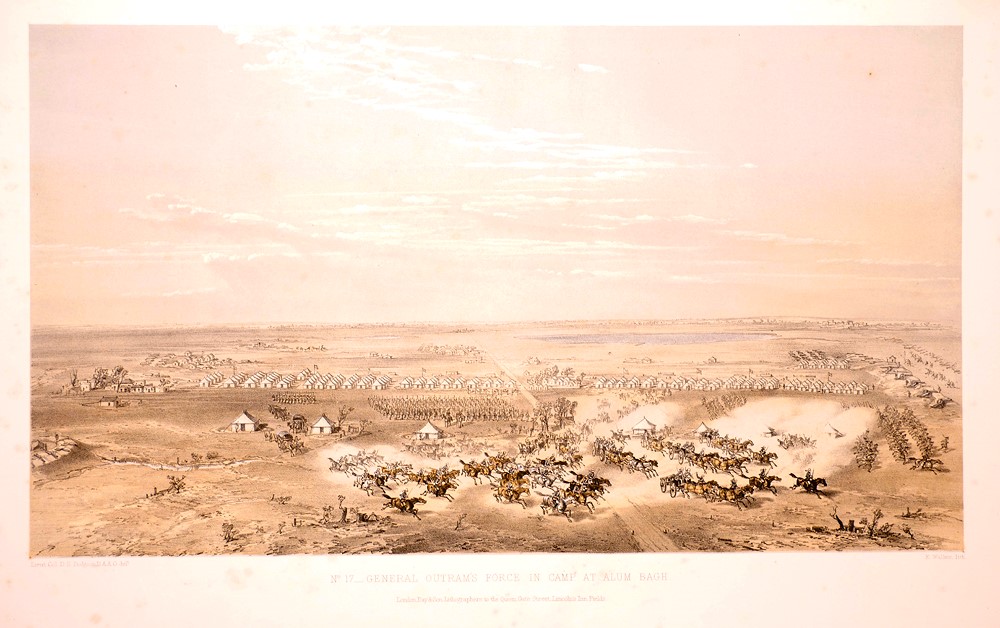
The Alambagh was neither a siege nor a blockade. The Cawnpore road was open and the from that direction at least, supplies and troops could move with relative freedom. The British were undoubtedly facing a formidable foe, who, had they had their wits about them, could have decimated Outram and his force. Instead, they chose to engage in curious antics and half-hearted attacks, which we shall now see in the next post.
Sources:
The Siege of Delhi – The Mutiny Memories of an Old Officer – Richard Barter (London Folio Society, 1884)
Kaye’s & Malleson’s History of the Indian Mutiny of 1857-58, Vol IV – edited by Col. Malleson (London: W.H. Allen & Co., 1889)
Lieutenant-General Sir James Outram’s Campaign in India, Comprising General Orders and Despatches – Printed for Private Circulation (London: Smith, Elder & Co., 1860)
Memories of the Mutiny, Vol II – Francis Cornwallis Maude (London & Sydney: Remington & Co., 1894)
The Story of a Soldier’s Life, Vol I – Field-Marshal Viscount Wolseley (New York: Charles Scribner’s Sons, 1903)
Service Memories – Sir Anthony Dickson Home (London: Edward Arnold 1912)
 Mutiny Reflections