July-August 1858
The victory of Hope Grant’s force at Nawabganj-Barabanki threw the rebels into some disarray. The 15’000 that had congregated had been effectively dispersed, and as was becoming a feature of their retreats, the rebel army split up and marched off in different directions, making a pursuit impossible. However, Grant had secured Lucknow from further attacks and it was now time to turn his attentions to another pressing problem.
Raja Man Singh…
There had come to Sir Colin Campbell’s attention that a purported friend of the British, one Raja Man Singh of Shahganj, was facing some issues of his own with the rebels. He sent an impassioned plea to Campbell for assistance, but he was met with some hesitation. The problem was that this particular Raja had not always been the friend he claimed to be.
Before the start of hostilities in 1857, it was well known that as a talukdar of a vast estate, he had been treated with some prejudice during the annexation of Oudh. His grievances were justifiable, and when the time came, in 1857, he decided to engage in a very dangerous game. Operating from the heavily fortified estate of Shahganj near Fyzabad, he navigated the chaos by playing the EICo, the rebel sepoys, and the court of Oudh against one another. When the sepoys mutinied in Fyzabad, Man Singh immediately leveraged his private army to protect British civilians. However, this was not purely humanitarian; it was his insurance policy. He carefully sheltered British officers and their families, ensuring they were treated with respect, but while guarding them, he explicitly told the British that he could only protect them if they followed his strict rules of secrecy, gathering intelligence on exactly how much authority the British had left. As it was not all the British were convinced that the Raja’s hospitality was a good idea, and many chose instead to try their luck by boat. Those who did find refuge with the Raja were indeed well treated, but the Raja, nervous of their presence and threatened by mutineers, had them escorted, by boat, out of his territories at the first opportunity. Inevitably, he guaranteed that no matter how the war ended, the British administration would owe him an unpayable debt of gratitude.
As the Oudh countryside fell entirely to the rebels, Man Singh was facing impossible odds. If he remained neutral, the sepoy armies would sack his forts; if he stayed overtly pro-British, his own tenant soldiers would desert him. To preserve his power, he finally marched his forces to Lucknow and formally joined the revolutionary court of Begum Hazrat Mahal. However, this would not prove entirely to Singh’s liking. The Begum was fighting for the complete independence of Oudh, but Man Singh was only interested in his own survival. When he joined the court, he was treated cautiously, knowing of his previous good services to the British and his possibly duplicitous nature. As a pragmatist, Man Singh refused to sacrifice his army to the court’s ideology; he paid lip service to the demands of absolute unyielding loyalty from the Begum and continued to communicate with the British. During the Siege of Lucknow, he contributed troops to satisfy the rebel leadership, but purposely held back his main fighting force from suicidal frontline charges. At the same time, he sent word to Outram that he was willing to evacuate the women and children from the Residency and offer them protection, something Outram, considering what had happened to Wheeler, wisely ignored. British intelligence files state that administrators knew Man Singh was “ever-shifty,” deliberately pacing his military involvement based on who was stronger at the moment. What the British thought of Man Singh would have met with agreement from the Begum’s inner circle, particularly her chief military adviser, Mammu Khan, who deeply resented Man Singh’s calculated hesitation, viewing him as a parasite waiting to see which side would win.
Then came March 1858.
Just before the final British assault that crushed the Lucknow rebel stronghold, Man Singh abruptly pulled his private army out of the city and retreated to his home fort at Shahganj. He had, in fact, sent secret envoys to the British, tendering his full surrender and offering to switch sides once again, and the deal was brokered, in part, by Jung Bahadur of Nepal in his camp before Lucknow. His defection to the British caused a massive rift in the rebel ranks; as one of the most influential landlords in Oudh, the move shattered the unity of the regional uprising and prompted thousands of other fighters to abandon the cause. While it might have secured him favour with the British, his double-crossing nature made him the most hated man among his former allies. Enraged by his desertion at the height of the battle, Begum Hazrat Mahal formally branded Man Singh a traitor and ordered the confiscation of all his properties, lands, and assets across Oudh. The fallout quickly escalated from political manoeuvring to a direct threat to Man Singh’s life. The revolutionary court authorised rebel commanders to treat Man Singh as an active enemy of the state, and he received explicit intelligence that if rebel sepoy forces captured him, he would face immediate execution for treason against the court of Oudh.
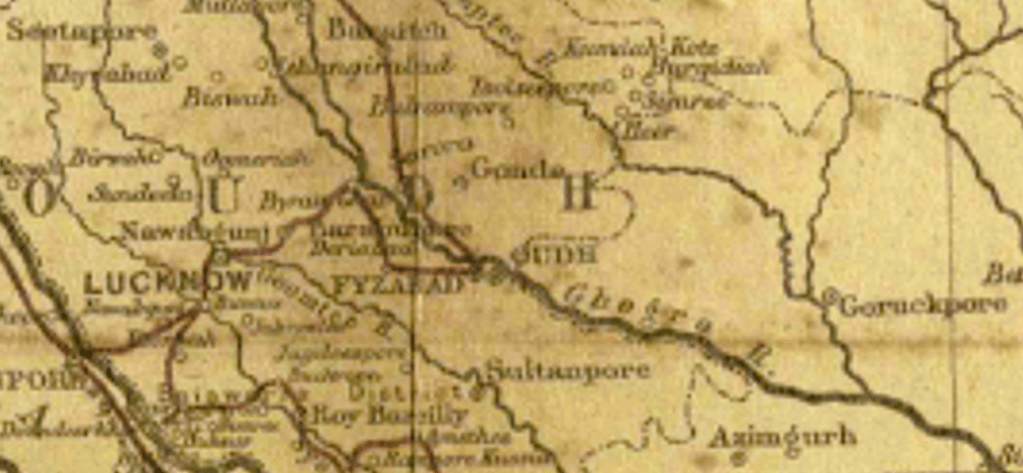
With Lucknow out of their grasp and defeated at Nawabganj-Barabanki, the rebels now took an opportunity to deal with the problem that was Man Singh. As a consequence of his actions, an enormous and very angry army of nearly 20,000 men marched on Shahganj to eliminate him. Man Singh’s answer was to lock himself up in his fort and send desperate pleas to the British for succour, reminding them at every turn of his faithful service in saving Europeans in 1857. For their part, the British, at this juncture, could not afford to lose this particular ally if they hoped to restore their domination in Oudh.
The rebels themselves were still very much at large. There were in all nine separate factions, and amounted to no less than 60’000 armed men with at least 50 guns. More than half of the men were under the direct command of Begum Hazrat Mahal and Mammu Khan. When Sir Hope Grant marched, this particular army was on Chaoka Ghat on the Gogra River close to Fyzabad, and some had been sent to besiege Man Singh. The rest, led by various talukdars, petty rajas and Firoz Shah, were scattered throughout Oudh, always on the move and plundering or fighting, depending on what was the order of the day.
….and the Siege of Shahganj That Wasn’t Raised by Grant
So now the British would have to make good on their promise to stand by their allies, and much to the chagrin of Sir Hope Grant, he was ordered by Sir Colin Campbell to deliver Man Singh from the hot water he was currently in. So on 21 July, at the height of the monsoon rains, Grant was back in the saddle. He left Lucknow and went back to Nawabganj to gather the troops selected for this expedition –
7th Hussars
Hodson’s Horse
2nd Battalion, Rifle Brigade
1st Madras European Fusiliers
5th Punjab Infantry
F Troop, Royal Horse Artillery (Capt. H.P. Yates)
5/12 Royal Artillery -Q-Battery (Capt. Johnson)
5/13 Royal Artillery – Heavy Battery (Capt. Talbot)
The next day, and only eight miles along the Fyzabad Road, Grant was informed that a rebel force of 12’000 men was determined to block his passage at a village twelve miles further up. Undaunted, Grant immediately detached the 5th Punjabis, 200 of the 7th Hussars, 200 of Hodson’s Horse and D’Aguilar’s troop of Horse Artillery, all under the able command of Brigadier Hagart, to clear the way. Hoping to surprise the rebels, Hagart marched at night, only to find, the next morning, there wasn’t a rebel in sight. Only the remains of their camp showed they had left in some hurry and were now to the wind. Pursuit was hopeless. As it was, Singh had now written personally to Grant that if relief was not forthcoming, his beleaguered garrison would undoubtedly starve to death, as they only had four days of provisions left. Sending a message to Hagart to ride directly to Dariabad, the force was reunited there on 24 July.
Man Singh was obviously fond of writing to his friends – while Grant was pushing on with all haste to relieve him, Singh sent him another letter, and this time he was “in better spirits.” Instead of begging for relief, he now pressed Grant to march a little faster – the rebels had got wind of the oncoming British army and were hastily decamping; if Grant did not hurry up, there would be no one left to fight at Shahganj. It turned out to be true. When within a day’s march of Shahganj, Grant was informed the rebel force had “melted away.”
At this juncture, the rebel leaders were either unwilling or unable to meet the British in the open. Instead of waiting for Grant at Shahganj, the besiegers broke up into three units – one fled towards Gonda, the second towards Sultanpore on the Gomti, and the third towards Tanda, on the Gogra, and rejoined Begum Hazrat Mahal. Once again, Grant had moved his men on in all haste only to find himself facing no army at all. He decided, instead, to make for Fyzabad. Here, he would see some rebels, but it was hardly an engagement to write home about.
“On 29th July, we entered Fyzabad. After halting there for about an hour, I proceeded with the cavalry and horse-artillery to the Ghat of Ajudia (Ajodhya), four miles lower down the Ghogra, and formerly the capital of Oude. There, we found several boats pushing off for the other side. We fired a few shots from our 6-pounders into them, and most of the crews threw themselves overboard and swam down the river. One boat, however, braved us all, and though we fired shot after shot, not one struck it, and it escaped to the opposite bank. Out of some deserted boats we took a double-poled tent, a Dollond’s telescope, two European carts, and a quantity of powder.”
The next day, Man Singh, very much relieved, paid Grant a visit. “He was an intelligent, slight, short man, about thirty-eight years old, rather pleasing-looking than otherwise. With him was his younger brother, a jolly, stout, good-natured fellow…” Singh regaled Grant with stories of his terrible sufferings and the enormous courage of his troops; however, Grant was less inclined to believe the former. Grant promised to repay the compliment on 2 August and visit the Shahganj Fort, only 12 miles south of Fyzabad.
“…at 9 A.M. on the morning of that day, accompanied by an escort of 200 cavalry, I arrived at his residence. I was received with a salute and then conducted through the gates to the interior of his large fort, and to a small, comfortable-looking house, which he called his palace. We inspected the walls of the fortress, which was about two miles in circumference; and the principal points of the enemy’s attacks were pointed out to us. There were few traces of any damage, and the houses had not apparently suffered. The Rajah presented to me several men, who, he said, had fought very bravely; and two guns were shown which it was alleged had been taken from the rebels during a sortie. In addition, Maun Singh had ten of his own; and he very wisely said, “ Now that the British have become possessed of the country, they will be of no more use to me, and the walls of my fort may come down.” He himself was, for the present, our servant, and was better as a friend than a foe.”
However, Hope Grant was somewhat dismissive of Man Singh in his estimation of the siege. The fort itself, though not formidable in any grand sense, had heavily compacted, thick earthen walls and ramparts reinforced with kiln-fired brickwork, which were very effective in absorbing the direct impact of heavy artillery without shattering; it was further surrounded by a moat, preventing both a cavalry charge and storming parties of infantry who would quickly find themselves in an unpleasant bottleneck. At intervals along the wall were circular bastions and loopholed parapets; if this was not enough, then the approach to the fort was cloaked in a thick jungle of bamboo, interspersed with thorny scrub. In construction, thus, it was likely similar to the fort at Ruiya but without any breaches in the walls. The rebels who attacked Man Singh faced exactly the same problems the British had, countless times, when besieging Indian jungle forts. While the rebels did indeed surround the place with 20 guns and did their best to storm it, the very layout made it considerably more difficult. As for Man Singh, he had his ten good and serviceable smoothbore, muzzle-loading brass and iron cannons. These fired standard iron roundshot to break up advancing enemy formations at long range, and devastating canister or grape shot at close range. In addition, he had Zamburaks (swivel guns) which fired large-calibre lead balls or iron scraps and could be quickly repositioned along the fort’s bastions to plug gaps in the perimeter. His men were armed with a variety of firearms – matchlocks, flintlocks and even a few Brown Bess’ purloined from sepoys at Lucknow. The elevation of the fort was on his side, his men bravely manned the walls, and gave a good fight: Singh was indeed a courageous leader who held out for weeks against a formidable rebel army before Grant turned up; and as for the rebels, caught between Man Singh’s jungle and his stubborn fort, with the British coming up behind, it is little wonder they finally decided to give up the enterprise as hopeless.
 Mutiny Reflections
” I hope I can continue to bring things to light that otherwise are overlooked!”
For sure, you do that.
What you bring is a human/ narrative element that is powerful yet never “dilutes” the history. You enrich it.
And I, for one, am glad of that.
These were “real’ people with real lives. And your narratives make that clear. This is history. Not ideology presented as history.
LikeLiked by 1 person
Your incredibly detailed stories are an antidote to the simplistic narratives we too often get told about the history of India. The complexity you unravel is extraordinary. The folie à deux (I know it more complicated than that but there was a reciprocity involved) of the past has led to the present.
This comment is a generalisation about my feelings about and reactions to your posts not specific to this story.
Thank you for the light you shine. Your posts are amazing in their historical detail and humanity.
LikeLiked by 1 person
Thank you Josie. I am glad that the posts do resonate – the mutiny keeps throwing out things that we don’t learn in regular history books, and so much is simplified nowadays. I have found that looking at the uncomfortable aspects is what makes history so intriguing, looking past what is obvious and coming to terms with what isn’t. I hope I can continue to bring things to light that otherwise are overlooked!
LikeLiked by 1 person