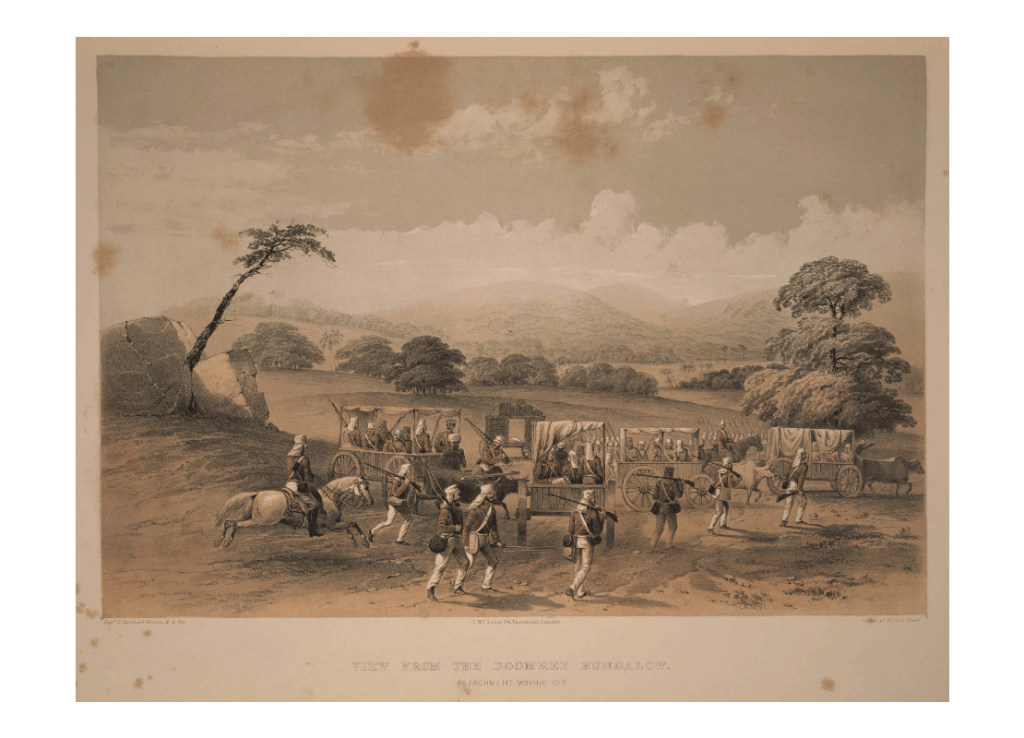
After the Fall of Lucknow in March 1858, the time of grand armies was over for a time in Oudh and the North-western Provinces. Sir Hugh Rose would lead the last great force in Central India all the way to the recapture of Gwalior in June, after which, much of the fighting, or as the British historians of the time called it, quite unfortunately, “mopping up,” would be done by smaller columns. By splitting up the larger armies, the British were able to cover more ground in less time and attack the remaining rebel forces from different directions. It was a tactic not unlike that used by the rebels themselves, who, after Lucknow, also split up their armies, making it more difficult for them to be caught, while retaining the ability to launch smaller attacks on various positions. It was a brutal game of cat-and-mouse, with both sides interchanging positions as the contest progressed.
For the rebels, it was a matter of survival, of prestige, of holding onto the essence of what the rebellion was supposed to be – a chance to drive out the foreign invaders from whichever territory they held dear. In Oudh, it was the dream of a province united under the now done and dusted Oudh Court that once reigned from Lucknow, but there was essentially no one left to lead them. The Maulvi of Fyzabad had pursued his own course, and Begum Hazrat Mahal was rapidly making her way towards the Nepal border, as was the Nana Sahib and his retinue. Tantya Tope, who had taken his army and waged war in Central India, was facing defeat after defeat at the hands of the relentless British forces, and Firoz Shah had, step by step, been pushed out of Marwar, into Central India, further onwards into Oudh and then into Rohilkhand. They left behind scores of zamindars, talukdars and petty rajas, each with their own interests in mind, to gain back the territory they had lost under Company rule.
For the British, this particular form of warfare was tiresome, costly and frustrating. Strategically, they had gained back most of their main stations – Delhi, Fatehpur, Cawnpore, Lucknow, Mhow, Indore, Gwalior, Fatehgarh, Azamgarh, Gorakhpur, Bareilly, Fyzabad and Sultanpore, to name a few, but there was still no end in sight to the fighting. The rebel forces kept them, in every sense of the phrase, on their toes. Sir Colin Campbell did have a plan, but it was a slow and laborious one. He never intended to defeat the rebels per se; instead, he would encircle them and push them out of India towards the Nepal frontier, where he intended either to crush them once and for all, or leave them to die of privation and disease in the Nepalese jungles. Until then, however, it is many months to go, and we shall now turn our attention to some of the smaller expeditions launched by the rebels that were solely intended to give the British headaches. We could fill a volume or two if we were to recount every single expedition, action or march of the British between April and the resumption of operations in September, and many of these barely receive a page in the dispatches of the day.
 Mutiny Reflections