Sultanpore
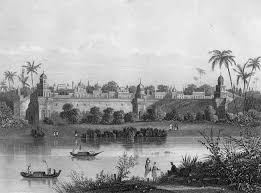
While at Fyzabad, Grant received a telegram on 1 August from the chief of Campbell’s staff, Mansfield. The orders now were that Campbell wished Grant to send two regiments of infantry, an artillery battery and 600 cavalry to push the rebels out of Sultanpore. They were then to occupy the town. Sultanpore was becoming something of a sore spot for the British. A battle had already been fought here on February 23 1858, by the Jaunpore Field Force. While there was very little left of Sultanpore itself by this point (the original city would be completely destroyed during the mutiny), the rebels continued to use it as a rallying point, causing a considerable nuisance to the surrounding areas and irritation for the British. It would be left up to Grant as to how he wanted to clear Sultanpore.
To undertake this operation, Grant ordered Brigadier Alfred Hastings Horsford to take command of a column and march to Sultanpore. The weather had now turned from hot and miserable to wet and impossible, for the rains had begun to pelt Oudh in earnest, leaving Grant little choice but to wait for a week before he sent anyone anywhere. Finally, on 7 August, Horsford marched. By the 11th, he was barely four miles outside Sultanpore. He had with him F-Troop, Royal Horse Artillery, the Madras Fusiliers, 5th Punjab Infantry, a detachment of the 7th Hussars and 200 men of Hodson’s Horse.
The town of Sultanpore sits directly on the south bank of the Gomti River, which loops and curves sharply through Oudh. Although already ousted once by the Jaunpore Field Force and harassed by Lugard, the rebel forces occupied the town itself and fortified the massive brick fort on the high riverbank. With the Gomti running through Sultanpore, the rebels had placed their heavy artillery on the opposite banks and higher points to cover not only the ghats but any position that might be fordable. Meanwhile, the Sai River flows parallel to and south of the Gomti. For Horsford marching from the south to Sultanpore, the Sai would now act as the first barrier they would have to cross. With both rivers completely flooded by the monsoons, there was no chance of a direct cavalry charge or even a fast infantry advance. Originally, old Sultanpore sat on the left bank (north bank) of the Gomti River, but the British had established their military station and cantonments on the right bank (south bank) at a village called Girghit. Over time, this military station grew and completely took over the name of Sultanpore, while the older town on the north bank declined,
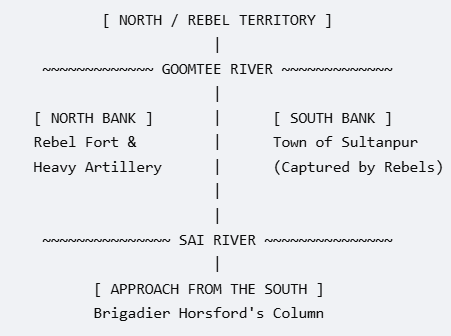
However, Horsford was undaunted. He first sent the 5th Punjabis forward, with two guns, to reconnoitre the rebel position. The Punjabis found that a large body of the rebels who were supposed to be holding the cantonment on the right/south bank of the river had crossed over to the left/north bank. Directing the operations himself, “They were immediately attacked and driven across the Gumti, from the further bank of which they opened a heavy gun and rifle fire upon No. 1 Company of the Regiment, then lining the left bank; their fire was, however, met and overcome by that of our guns and of the other companies of the Regiment as these came up in support.”
Horsford first sent the 5th Punjabis forward, with two guns, to reconnoitre the rebel position and occupy the town. However, the Punjabis found that a large body of the rebels who were supposed to be holding the cantonment on the right bank of the river had crossed over to the left bank. Directing the operations himself, “They were immediately attacked and driven across the Gumti, from the further bank of which they opened a heavy gun and rifle fire upon No. 1 Company of the Regiment, then lining the left bank; their fire was, however, met and overcome by that of our guns and of the other companies of the Regiment as these came up in support.” The firing from the RHA guns was enough to check the rebel artillery, and the musketry fire gradually died away when the Fusiliers came up. Horsford, however, could not cross the river, and he had no material with which to build a bridge. The rebels had destroyed or moved all the boats and had been very particular to leave nothing behind that might help Horsford improvise. So there was nothing for it. They were essentially trapped in the strip of land between the two swollen rivers. They could not easily cross the Sai without exposing themselves, and once across, they were pinned against the south bank of the even more formidable Gomti under the direct gaze of the rebel strongholds. Horsford dug in his heels and, with his small force, would now picquet the riverbank for some six miles to keep the rebels in check. If he could not get to them, Horsford would keep the rebels from recrossing the river and attacking him. He then sent word to Hope Grant and waited for reinforcements.
For the Punjabis, the Fusiliers and the gunners, the work set before them was harassing.
One company needed to be kept on duty, day and night, to hold the riverbank opposite the old Cantonments to ensure the rebels did not cross the river. As the company was extended along the bank, the men had to find shelter as best they could in ravines or ruined houses from the near continuous fire from the rebels opposite. The men were relieved in the morning and the evening to get their meals, and as the monsoon was showing no signs of relenting, the men were more often than not, completely drenched. Another company was detailed to guard the artillery picket and at intervals all along the river for the full extent of the six miles; still other pickets were set up to keep an eye on the rebels, while enduring near constant fire. Wrote Vaughan, commanding the Punjabis:
“I was inspecting the pickets in the early morning and was being sniped at from the opposite bank. The Sepoys would run out of cover and fire, and then scuttle back into safety. I was carrying a favourite sporting rifle, sighted to 800 yards, but not really sure at half the distance. One Sepoy appeared to me to furnish a fair mark, and I asked the Native officer who was with me what he judged the distance to be. He replied, 800 yards. I put up the sight and fired, when the man fell, and was dragged to safety by his comrades. I was a fair rifle shot, but this, of course, was a chance shot, for which I take no credit, but merely record it as a striking example of chance marksmanship.”
It must be noted here that the 5th Punjabis had not been issued with the Enfield. They were armed with the Brunswick rifle, a “two-grooved rifle carrying a belted ball,” and would continue to do so for some time to come. The 20th Punjabis (Brownlow’s) had been issued a short muzzle-loader. For Vaughan, he could see little disadvantage with the Brunswick, except that it took too long to load; his men could hit their targets up to 200 yards with remarkable accuracy.
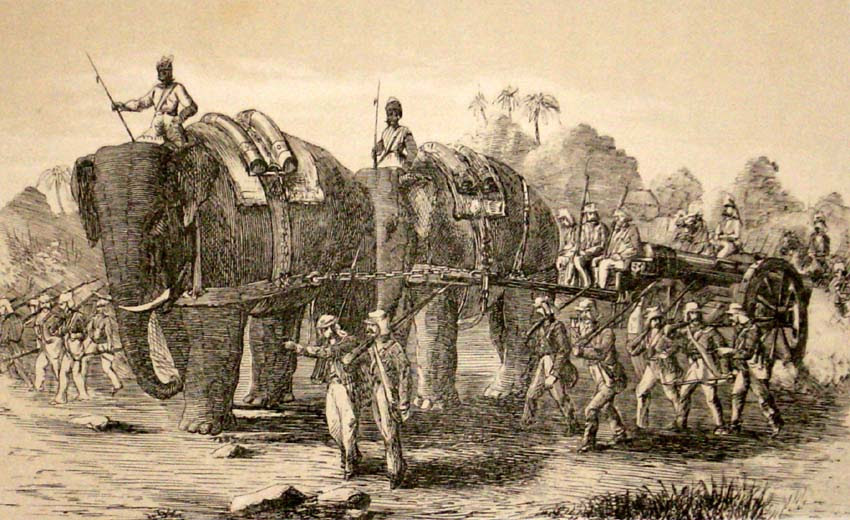
Back at Fyzabad, Grant received the news from Horsford with some relief, reassured that Horsford was at least still alive – the latest intelligence he had received was that the rebel force at Sultanpore was in fact much larger than initially anticipated; if the numbers were correct, Horsford was facing 14’000 men and an untold number of guns. The development and Horsford’s news set Grant into action without delay – by the 19th, he was on the march, having called for the support of a wing of HM’s 53rd Regiment, who were then at Dariabad, and he was taking not only the two nine-pounders of Q-Battery, RHA, but the 5/13 Heavy Battery as well, and the Rifles. As soon as they were out of Fyzabad, the trouble started. The four heavy guns and the four 8-inch mortars sank on the bad roads, their carriages stuck in mud and water, and any movement simply sank the guns deeper. When the horses failed, the elephants were put to work extricating the guns, with one elephant pushing the gun with his head and trunk, while the others dragged at the traces -working in unison, they could shift a gun by sheer strength alone, but it was slow and laborious work.
Grant arrived at Sultanpore on the 22nd to find that the site selected for his camp was too exposed, only 100 yards from the river and in direct sight of the rebel guns. He ordered the camp moved and went off with Horsford to see where the Brigadier proposed crossing the river. Unlike the camp, the position was well sheltered from fire and with two guns of the RHA providing cover, it would be possible to construct a passage across. The men of Q-Battery, among them Thomas Bland Strange, were somewhat put out that Grant had relegated them to guarding the crossing. They were to occupy an earthwork that until now had been home to two six-pounders, and Strange noted, “It was 600 yards from the river, thereby still further reducing the effect of the tiny armament. Evidently, there was some confusion in the mind of the military architect as to the protection necessary from Russian attack and the comparatively feeble efforts of the demoralised Sephais.” Annoyed that his battery would languish behind an earthwork while his comrades, “galloped free across the plain beyond the river…” Strange rode out with his sergeant to the riverbank. Just across, he could see a small temple, and the smell of cooking from the sepoy picket wafted across the water. Their sentry, still dressed in his red coat but wearing a dhoti instead of trousers, dropped to his knees and took aim. Strange scoffed – it was too far for a Brown Bess, he thought. He saw a puff of smoke, and “before he heard the report, he felt a sharp rap on the knuckle of his ungloved bridle hand. The bullet had grazed it and struck the wall behind. ” The sergeant picked out the bullet with his sword point and handed it to Strange – it was a belted rifle ball of the old pattern, and obviously the rifleman was better than Strange gave him credit for. The sergeant was all for “retiring with dignity,” and the two men retraced their steps. Horsford was not impressed – he rebuked Strange for not only causing an alarm but unnecessarily drawing fire on himself; Strange’s excuse was that he was short-sighted and wasn’t carrying field-glasses as his uniform did not have suitable pockets. Strange would have a few days to consider his actions.
The problem was that Grant, like Horsford, did not have any boats. The Madras Sappers had, however, procured three dug-out canoes, and they set to work turning them into one raft. Deputy Commissioner Reid found, on his reconnaissance, a further six small boats in a creek, which were handed over to the Sappers. They converted the boats to two additional rafts, and on the morning of the 25th, Grant was ready to cross. Lieutenant Dale and 50 men of the Madras Fusiliers were sent across first to cover the rest of the regiment, together with the Punjabis. Next would come the two 9-pounder guns, Strange’s battery, while Lieutenant Warren and the heavy guns covered the passage. Before dawn, the men were ready and down by the river. Strange was hardly impressed with the arrangement he found – the two canoes were covered in planking ripped off from ruined houses and looked hardly sturdy enough to convey horses and guns, much less infantry. It would have to do, but it would be a tricky operation.
“In the meantime, appeared that vision, ever aggravating to the tired soldier- the spick and span Staff Officer, just out of bed, clean shaven, waxed moustache and paper collar. He had an inspiration. Like the man in Dickens, who, walking with his girl, came to a church, and said, “Hullo! Here’s a church, let’s get married! – the staff officer thought, “Hullo! Here’s a raft and a gun. Let’s put the gun on the raft!”
Instead of waiting for Strange, who was absent, to direct operations, he ordered the sergeant to load the gun.
” A couple of stout planks were laid for the wheels, another for the trail, and the gunners ran the gun onto the raft, which swayed and slowly sank with its burden of gun and men. The men scrambled out, assisted by their comrades from the bank, and the bubbles rose and floated away down the stream from the submerged raft.” Strange returned, now white with rage and without further ado, stoutly abused the officer; in his turn, the man threatened to arrest Strange. Strange replied he would then leave it to the officer to continue “the embarkation you have so successfully begun?” The officer, somewhat shamefaced, replied, “No!” Strange pushed the advantage: “Then perhaps, as you don’t intend to relieve me from my work, you will be good enough to relieve me of your presence and report the situation to the General?”
The sergeant of Q-Battery plunged into the river and, struggling somewhat in the stream, managed to hitch a rope from the limber-hook to the sunken gun trail, and the drag ropes to the wheels. The sappers readjusted the planks under the wheels, and the driver now coaxed the horses. “They dug their hooves into the soil, the lusty gunners heaved, and the gun surged slowly up from the river…” As for the raft, it was the Punjabis who came to the rescue. Stripping down to their waistcloths, they dived in and lifted the raft to the surface. Then, together with the sowars of Hodson’s Horse, swam the remaining horses across the river. “Each man swam across leading a horse, of which he rarely loosed his hold, keeping clear of the animal’s heels, although he often became restive.” (Grant)
Within two hours, the force was over the river, and Grant directed Colonel Galwey (commanding the force which had crossed over to advance and take the two villages in his front, where the river formed a bend and rebels had their picket. The field guns, posted on high ground, commenced firing as the Fusiliers and the Punjabis rushed forward, took the picket and the villages.
“Our sub, on his powerful black charger, cantered to the front to detect any obstacle to the advance of his guns. His heart was full of pride in his ‘Jhungy Division.” He heard the cheers of the old ” Dirty Shirts ” and the shouts of the warrior Sikhs. The morning sunlight bathed the undulating plain, dotted with clumps of trees, and villages occupied by the enemy, over whose outlying camp the white puffs from the bursting shells of the heavy battery told they had turned their attention to a more distant object, rather than risk a close fire over the heads of the now advancing troops. Jingo’s guns, after rattling across a nullah with the reckless dash common to Indian Artillery, met a cloud of dust suddenly unrolling itself across the plain. Lance points glint like dancing stars, and now the Lieutenant can see the white clothing of the enemy’s Cavalry, and hear the shouts of command above the muffled thud of their horse hoofs. With no feeling but that of grim satisfaction, he sees them sweep along to charge the guns he knows they will never reach. Without turning in his saddle, his eyes fixed on the advancing horsemen, calculating the range, his sword raised in signals well understood, he awaited his guns.
The boy trumpeter has not been allowed to follow him to the front, for he is ” the only son of his mother and she is a widow,” and yet that boy has registered a vow to “git himself foughten some day.” The guns are up with him now. ” Halt! Action fr-r-ront! Shrapnel shell! 800 yards! 700 ! 600 ! 500 ! 400 ! Case-shot! ” They never came for the case-shot.
The custom inculcated by the methodical Major Gibbon, of ” Q,” was to carry shrapnel, filled, fused, and labelled in ranges, set in order in the limbers. He was lying wounded, many hundred miles to the rear, but his orders were obeyed. The sub got the credit, and the Sepoy sowars a very bad five minutes. There were confused shouts. The gunners could see but little, for their own smoke hung, but they caught a gleam of tulwars, they heard a patter of retreating hoofs, and when the smoke and dust-cloud had cleared, there remained a few dots upon the plain — the prostrate men and horses. And the dust-cloud trailed away in the distance. But there was more to follow. Hardly had the sub taken in the ranges he had made use of, when he heard the familiar rumble of guns, advancing through the dust left by the retreating Cavalry. There they came! The celebrated Black Horse Battery of a mutineer Brigade. Soon they spoke; shell after shell burst, all too high, showering bullets that rattled on the limbers, denting without penetrating, contusing men and horses, but causing no serious casualties. It was soon over. The accurate range and superior ammunition of ” Q ” speedily led to their withdrawal. The Infantry carried the villages previously shelled by the heavy guns.
Galwey’s force, having met their objectives, now bivouacked as Grant insisted there would be no pursuit. He sent over the Rifles as support and the day ended. As the main position of the rebels was still a few miles south of Sultanpore, Grant would continue moving his force over the river. Although the rebel force had swelled to 14’000 men and they had 15 guns, they refrained from an open attack and only kept up a desultory musket fire at night. “Night fire is seldom effective, but intensely demoralising, especially when the men have been under it for hours, wet, tired, hungry, and sleepless. It is too dark to see shirkers, and one never knows when a startled sleeper will open fire on his comrades, eventually to be taken up all round.”
On the evening of the 28th, the rebels made a stout attack, but impeded by the failing light, they gave it up, and Grant once again refused to allow a pursuit. Realising that this had gone on long enough, the next day, at 3 in the morning, he turned out his men and advanced up to the last position held by the rebels, but they had already retreated, leaving behind only a few straw huts. In fact, there was no one at all standing in his way. Grant marched into the Sultanpore cantonment to find it was empty. Once again, the rebels had vanished.
The following morning, the force moved out in pursuit, the skirmishers of the Rifle Brigade and the Madras Fusiliers covering the advance.
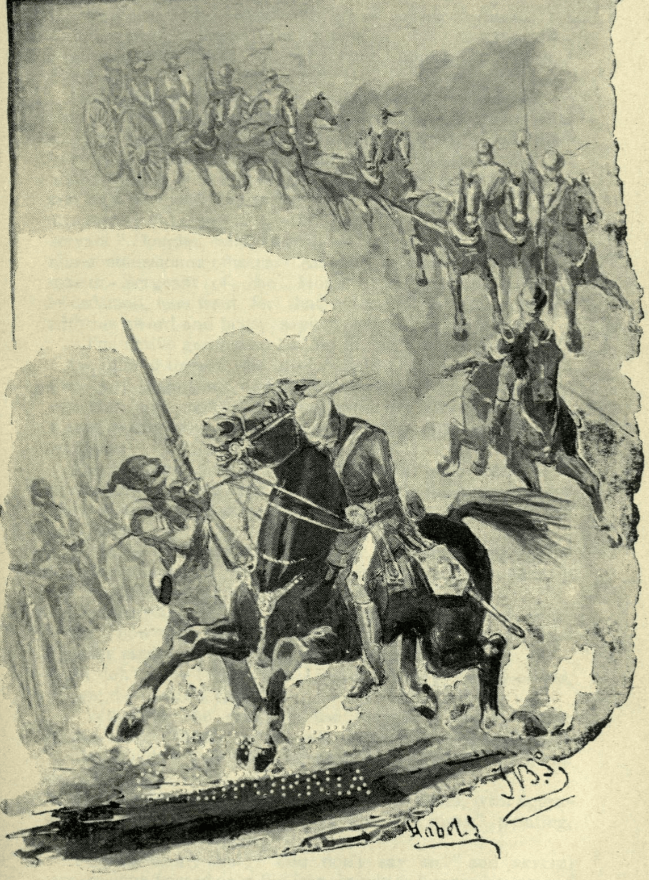
They had scarcely deployed when a heavy fire was opened up on the whole line of skirmishers; the cavalry attempted to turn the rebel flank as the skirmishers continued to advance, when suddenly everything ground to a halt as one of the Horse Artillery guns overturned, tumbling both horses and men into a ravine. While they disentangled themselves from the mess, the men of Q Battery, with Lieutenant Strange taking the lead, supported by the Blue Caps, took matters into their own hands. The battery that had opened such a resolute fire was none other than the “Black Battery” that Strange had already come across, and he was determined they had fired their last shot, so, without any thought, Strange, with his battery in tow, chased the guns.
“The headstrong Jingo heard perfectly and increased the pace. His guns broke into a gallop, rendering further commands inaudible, for his pursuer could not pass them to reach him, as the road was narrowed by the dense jungle through which the Cavalry had not been able to advance. He knew he was unsupported — behind him, disobedience of orders, court martial, etc., — before him, a moving cloud of dust — under his horses’ feet a trail of gram (horse feed) dropped from leaky nose bags, then a bag itself, artillery pattern, emphasizing the gun wheel tracks of the Black Battery. Jingo was now far in front of his guns, intent upon the trail. The road took a sudden turn, and, there, a short hundred yards before him, was the last division of the Black Horse Battery in action, two guns at close intervals, and only a corporal’s guard of Sepahis as escort.
To halt, in order to open fire, would be destruction; he saw the gun sponges turn in the air, heard the case-shot rammed home with a thud, the native gunners blowing the slow match to light the port-fires. With a sudden impulse, he gave a stentorian shout, and a fox-hunter’s, ‘tally-ho!’ that seemed to paralyze the native artillerymen, rang out above the rattle of the gun wheels. A trumpet sounded the charge — the guns were not fired — the native Commandant sitting stolidly on his horse now turned to ride slowly away. The English officer noted that he wore the gold belts and appointments of a brother officer, murdered by the mutineers, and Jingo’s blood boiled to close with him, but the Sepahi corporal stepped forward with his musket at the ready. His bayonet was not fixed (the Sepahi seldom fixed his bayonet), and there was no excitement in his handsome face, only a look of quiet, ‘Kismet!’ ‘Whose ?’ thought the Lieutenant, ‘his or mine? or both? ‘ He bent his head and body behind the horse’s neck to escape the bullet, and dropped the point of his sword. The man’s shoulder struck his right knee, and he fell without firing. Had sword and musket both failed then? There was no time to think, for he was among the native gunners, smiting and prodding, somewhat ineffectually. They had drawn their tulwars, but escaped between the gun wheels and under the horses’ bellies, into the jungle. The drivers tried to unhook and ride off their horses, but they were cut down in the attempt by the sword of the Lord in the hand of his servant, Douglas, who had ridden up with other mounted non-commissioned officers. Among them was the Quartermaster-Sergeant of the Horse Artillery, an excellent swordsman, who went for that native officer and returned with his sword and belts, saying, with a grim smile: ‘The native gentleman had no further use for them, sir.’ He offered them to the now radiant Jingo, who declined them with thanks and suitable encomiums. Lieutenant Black, who was now upon the scene with his mounted detachments, secured the abandoned gun teams and ammunition waggons.”
By the time the men returned to camp, they had pursued the rebels for 22 hours and covered 36 miles.
The river was now open, and all that was left to do was take up quarters in Sultanpore and Fyzabad, and wait for the rains to end. Grant had routed a force of 14’000 with less than 5000 men – HM’s 53rd Regiment had remained, with Talbot’s guns on the other side of the river the whole time. As for the rebels, they had once again split up into smaller units: one group made their way to Muzaffarnagar on their way to Rampar Kassia, and some had taken up with the Amethi Raja, Lal Madho Singh, 25 miles from Sultanpore, and
“…8 miles distant from Purtabgurh. This fort was one of the largest in Oude, being 7 miles in circumference. It was composed of mud walls and surrounded by a jungle. The foolish chief, who had taken up the cudgels against us, was doing his utmost to repair and strengthen the defences. Owing, however, to the present time of the year being so unhealthy, the Commander-in-Chief resolved to postpone attacking it until after the 15th October.”
So, for now, ends Grant’s campaign in Oudh.
Sources:
(By Authority) Historical Record of the 5th Punjab Infantry, Punjab Frontier Force. Lahore: Punjab Government Press, 1887
Grant, Hope. Incidents in the Sepoy War, 1857-58: Compiled from the Private Journals of General Sir Hope Grant. Edited by Henry Knollys. Edinburgh & London: William Blackwood & Sons, 1873.
Jocelyn, Julian R. J. The History of the Royal and Indian Artillery in the Mutiny of 1857. London: John Murray, 1915.
Malleson, George Bruce. History of the Indian Mutiny, 1857–1858. Vol 3. London: William H. Allen & Co., 1880.
Strange, Thomas Bland. Gunner Jingo’s Jubilee. London & Sydney: Remington & Co., 1893.
Vaughan, J. Luther. My Service in the Indian Army – and After. London: Archibald Constable & Co. Ltd. 1904
Wylly, H.C. History of the 5th Battalion, 13th Frontier Force Rifles, 1849-1926. Aldershot: Gale & Polden, 1929.
Wylly, H.C. Neill’s “Blue Caps”.Vol II 1826-1914. Aldershot: Gale & Polden, 1914.
 Mutiny Reflections