Action at Gangiri
In the meantime, the camp had been marked out, the baggage had arrived, and the men were starting to pitch their tents. Determined not to be caught off guard, Seaton ordered the artillery to keep their horses to the guns and the cavalry to let theirs remain saddled, ready to turn out at a moment’s notice. He had just finished a hasty breakfast when in galloped Major Light.
“ Captain Hodson desires me to tell you, sir,” he said, as soon as he came up with me, “that the enemy’s cavalry are advancing in force on both flanks.” After two or three rapid questions as to their distance, I called out, “ Bugler, the alarm !” —“ Gallop off, Light, to Hodson’s horse, bid them mount at once, and as you pass, turn out the artillery.” My Brigade-Major, Captain H. Le P. Trench, turned out the dragoons, who drew their girths and were in saddle in three minutes. At the well-known sound of the alarm, the 1st Fusiliers dropped their tents, and without waiting to put on their coats, slung on their accoutrements.”
In front of the camp, at some 400 yards, was a small village, and just beyond the ground rose gradually to a small ridge, crowned by hillocks, covered with tall grass. As the dragoons filed out through the ravines to the open ground, Hodson and his party came up “at a smart trot” around the village. Here he drew up and hastened to make his report.
He had seen the rebels in the distance and had watched them filing through a village a few miles in Seaton’s front, and they had artillery. He had sent Light back to report while he remained behind, watching their movements. His last words were barely spoken when two bodies of rebel cavalry appeared in sight, one considerably outflanking the other and taking their position on the ridge. Taking a small party of horse, Seaton rode out to the front, the dragoons with Hodson’s reconnoitring party moving up to “show front to the enemy.” On the left of Seaton’s camp, Hodson’s Horse had mounted and formed up waiting for Seaton’s orders; the infantry were in column, and the artillery was moving out. Just then, the rebel infantry appeared on the ridge, and their guns opened.
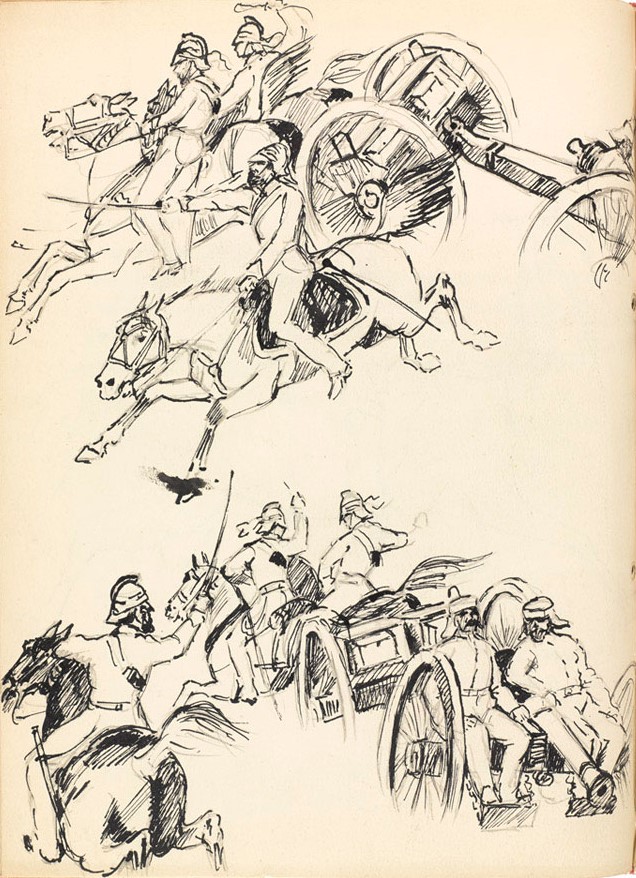
Pen and ink by Cecil Constant Philip Lawson (1881-1967)
NAM. 1965-03-45-25-156
Seaton, telling Farquhar to take command of the infantry and form the columns up to clear the ravines, then ordered Captain Bishop to the front with this artillery battery, with 2 further guns under Lieutenant Griffin speedily following. The rebels had not quite managed to get their range as yet, so their shot still flew wildly around Seaton’s men. Captain Bishop dashed to the front, carrying with him vast clouds of dust, which, a strong wind at our backs blew into the enemy’s faces. For several minutes these thick clouds enveloped the rebel, artillery, prevented them from seeing us; as soon as it began to clear off, our shot crashed in amongst them with terrible accuracy.”
He then directed Lieutenant Colonel Kinleside to move forward with the artillery and engage the rebels – while Kinleside checked their advance, Farquhar and the infantry could disengage themselves from the ravines in front and form up.
However, the rebels in the meantime had moved one of their guns off to the right and opened fire, raking Seaton’s front. Seaton had been unaware of their ploy until a bugler called out, “Look out, sir!” as a shot bounded along the plain, went over the head of Seaton’s horse and was followed immediately by another, close to his croup. Seaton moved up a few yards out of the line of fire and saw the rebel cavalry on the left, coming to attack Bishop’s guns. Seaton called on the dragoons to support, telling Captain Wardlaw he should charge the rebel guns if he “saw a favourable opportunity.”
Farquhar had now formed up the infantry and began to advance rapidly, with Hodson on the left moving his whole regiment forward against the rebel cavalry, who were still advancing to take the guns in the flank. The fire from the rebel guns, under Bishop’s onslaught, had begun to slacken, and as they fell silent, Wardlaw saw his chance and charged with the carbineers and the Lancers, capturing 2 guns; at the same moment, Hodson, who had anticipated Seaton’s next move, threw his men against the rebel right, driving them back in confusion. It was over almost as quickly as it had begun – the artillery and cavalry had carried the day, leaving the infantry in the centre without hardly a battle to fight.
“Immediately, without waiting for orders, I sang out, ‘Charge,’ and charge we did, and upset them in every direction for miles. I was nearly wounded once or twice in the pursuit, by desperate men fighting for their lives, but escaped without a scratch.” (McDowell, 2nd in Command, Hodson’s Horse)
It was a complete rout. The rebels left their last gun on the field and 2 of their ammunition wagons, while a number of their infantry threw away their arms and hid themselves in the cotton fields. The crop was growing between rows of thick ruhur plants, which provided ample cover to the hiding rebels. As the dragoons hunted through the fields, the rebels suddenly darted out, killing 2 officers and wounding a third, leaving Lieutenant Baker Russell in command.
Russell, realising his position was fraught, changed tactics. Instead of proceeding through the fields, he moved the men along the sides, making his men use their carbines at any sign of movement. He cleared the fields without any further loss.
Those rebels who did fight did so with the desperation of men cornered, selling their lives dearly. Others threw away their arms and could be seen, in broken parties, dashing headlong across the country. Seaton called the men back, and the action was over.
Seaton’s losses were small but of consequence – he had 22 men slightly wounded but three officers dead, including Captain Wardlaw, Captain Hudson and Lieutenant Vyse of the 6th Carabineers. Captain Head, leading the detachment of the 9th Lancers, was severely wounded.
In the despatch, it was compliments all around.
“The General will see by the list of casualties that Captain Hudson’s newly raised body of horse was not at all backward. It rendered excellent service; less it could not do under its distinguished commander, whom I beg particularly to mention to the Major-General as having, on every possible occasion, rendered me the most effective service, whether in gaining information, reconnoitring the country, or leading his regiment.
The troop of Horse Artillery, under Captain Bishop, and the 2 guns, under Lieutenant Griffin, the whole commanded by Lieutenant-Colonel Kinleside, mainly contributed to the defeat of the enemy, and the Major-General will duly appreciate their coolness and skill. I received the most efficient aid from my brigade major, Captain French, and from my orderly officer, Captain Light, of the Artillery, who conveyed my order to the Dragoons to charge, and went in with them, and I may say I never saw greater zeal and alacrity displayed than by the officers who accompanied me to the field, either as Field Engineers or as volunteers. I could almost regret the enemy did not make a greater show of resistance.”
The following morning, Seaton occupied Khasganj, a strongly fortified place filled with brick houses and surrounded by gardens, the whole encompassed by strong mud walls. If the rebels had had half a mind and occupied it, Seaton would have had a far harder fight. As it was, the remaining rebels had fled the night before, and he pushed on to Sahawar, reaching at daybreak the next day. The first thing Seaton saw as he entered the town was a man hanging upside down by the heels of a tree branch, his head barely three free from the ground. He was “quite dead,” his body covered in bullet wounds. The townspeople were quick to offer up his identity – he was a spy for the British, they said, and he had been caught. Like Nicholson’s missive, “the punishment for mutiny is death,” it would appear the rebels felt the same way.
Upon approaching the village of Bilram, he found out the rebels from Khasganj had, in part, crossed at the Kuchla Ferry, and the others had pushed onto Pattiali, 25 miles distant, in the direction of Fatehgarh. There, a large force of rebels had assembled of all arms, under the command of a ‘Hukeem, the hereditary commander-in-chief of the Nawab of Farruckabad’. Seaton stopped for the night in Sahawar and then, on the 17th, moved on to Pattiali, Hodson, as always, well in advance.
Returns, Action at Gangiri
6th Dragoon Guards
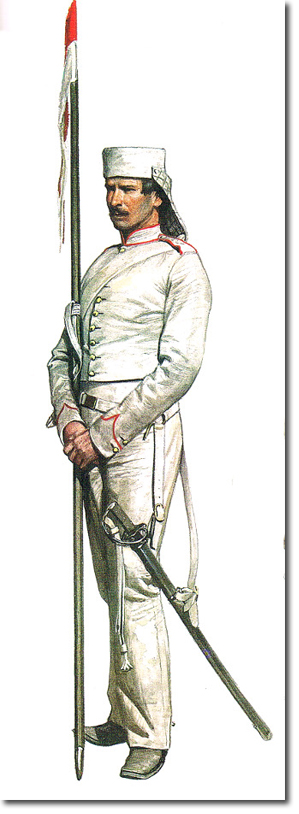
Pierre Turner from British Cavalry Uniforms Since 1660
Captain George Wardlaw – killed in action. Aged 28.
Born on 10 November 1829 at Abden, Fifeshire, son of Lieutenant-General John Wardlaw (1772-1848) and the Hon. Mrs Anne Wardlaw (née Lake) (1786-1845) – daughter of Lord Gerard Lake of “Indian Celebrity.” 55th Foot 1847. Exchanged to 6th Dragoon Guards (Carabiniers); Captain 1855. Served in the Crimea, 1855. Commemorated on a monument at Gangiri, Tahsilatrauli. His brother, Lieutenant Ramsay Wardlaw joined the 19th Foot in 1850 and died of wounds at Alma in 1854.
Lieutenants
Hudson, John – killed in action. Aged 25. Son of George Hudson, M.P.
Vyse, Sydney – killed in action. Aged 23. Son of Richard Vyse, of Holly Lodge, Luton.
Sergeant John Reynolds – wounded
Privates
Barrett, Joseph – killed in action
Bushell, James – severely wounded
Chapman, Robert – killed in action
Cossor, William – killed in action
Eastwood, Allan – killed in action
Maloney, Michael – severely wounded
Richards, John – severely wounded
Thompson, James – severely wounded
Slightly wounded – 1 farrier and 8 privates
9th Lancers
Captain John Head – dangerously wounded
Privates
Dyson, John – killed in action
Frampton, Henry – killed in action
2 privates slightly wounded
Hodson’s Horse
Killed in action—1 Risaldar, 3 sowars. “I lost a fine old risaldar, our dear old friend Muhammad Reza Khan’s brother.” (Hodson)
Wounded dangerously—1 duffadar, 1 sowar
Wounded severely—6 sowars.
Wounded slightly—1 duffadar, 10 sowars
 Mutiny Reflections