Two Lamentable Deaths
The end of the siege was marked by two deaths – Hervey Greathed, the political agent who had survived the mutiny at Meerut, hidden by his servants on the roof of his house and then secreted away to the Damdama so many months ago, died suddenly of cholera on the 19th of September, leaving his brothers William and Edward to bury him at Delhi.
The other was of John Nicholson.
Nicholson had been mortally wounded on the 14th of September – although he had been put in a doolie, the bearers had dropped their burden by the side of the road to join the camp followers in plundering the nearby houses. Roberts found him a few hours later, and, rustling up four men to carry the doolie and a sergeant of the 61st to act as escort, in the late afternoon, Nicholson was finally brought to the field hospital.
Another doolie was set down next to Nicholson, and it was that of his brother, Charles, who had been injured leading Coke’s Rifles to the assault – his shattered arm was amputated at the shoulder. The two brothers looked at each other, and Nicholson managed a feeble, “Oh, is that you, Charles?” as if they were just sitting down for a chat. They spoke little but said much – it was the last time they would ever see each other. Charles would survive his injury, but a strange, sad fate awaited him in the future.
Declaring recovery hopeless, Dr. Mc Tier was surprised John Nicholson was still alive. The doctor felt the only remedy was complete rest and absolute silence – which had, after all, saved Seaton’s life – but it was an impossible order for a man like Nicholson. He insisted upon hearing how matters in the city went and would continue to excite himself at every piece of news.
Lieutenant Montgomery of the Guides had helped to lift Nicholson out of the doolie onto a bed prepared for him in Henry Daly’s tent. The lieutenant continued to bathe Nicholson’s brow with eau-de- Cologne but could see the man was in “fearful agony.” He had been shot in the side, and the blood was still flowing freely, drenching his clothes and the sheets.
As soon as word reached the men of the Multani Horse who had followed Nicholson from their faraway homes, they gathered around the tent, wanting to see for themselves their wounded leader. Anyone who came out of the tent was eagerly questioned, and their conversations penetrated through the canvas to Nicholson. He sent for one of them and told him that talk annoyed him, he needed rest and ordered the crowd to be silent. For some twenty minutes, all was quiet, but then the conversation started up again. Ill and dying as he was, Nicholson was not a man to be disobeyed – so taking a pistol from a small table at his bedside, he fired through the tent wall. The bullet missed, but a cry of “Wah, wah, General Sahib ke hookum hai!” went up among the Multanis – “Oh, oh! There is the general’s order!” and they fell silent.
Nor was it easy for anyone else to see Nicholson. His stalwart friend and bodyguard, Muhammad Hyat Khan, swiftly shooed visitors away – besides the doctors, he permitted no one else to care for Nicholson, who would remain his charge until the end. The few he allowed to come in could only stay a few minutes.
Complaining of the heat in the tent, a room in a bungalow was found for Nicholson, to which he was removed without causing him too much discomfort. For the next 9 days, in a haze of pain deadened somewhat by opiates, Nicholson waited to die. Neville Chamberlain wrote,
“Up to this time, there was still a hope for him, though the two surgeons attending him were anything but sanguine. He said he felt better, but the doctors said his pulse indicated no improvement; and notwithstanding the great loss of blood from internal haemorrhage, they again thought it necessary to bleed him…From the 17th to the 22nd, he was sometimes better and sometimes worse; he gradually became weaker, and on the afternoon of the later date, Dr. Mctier came to tell me that there was little or no hope. On reaching him, I found him much altered for the worse in appearance and very much weaker – indeed, so weak that if left to himself, he fell off into a state of drowsiness, from which nothing aroused him but the application of smelling salts and stimulants. Once aroused, he became quite himself, and on that afternoon, he conversed with me for half an hour on several subjects as clearly as ever. He, however, knew and felt that he was dying, and said that this world had now no interest for him.”
Shortly after, Norman went to see him.
“It was a piteous sight, to see his splendid form lying on his bed outside the clothes, the chest heaving up and down with rapidity from the action of his wound and a vacant, distressed look in his eyes. I turned away in pain, knowing there was no hope.”
On the afternoon of the 22nd, McTier informed Chamberlain that Nicholson would soon be dead. Chamberlain rushed to his side – Nicholson, in between gasps, said he was sorry he had not dictated his will but wanted to defer the task until the morrow when he would be feeling better. He left his last message for his best friend, Herbert Edwardes, “Tell him that, if at this moment a good fairy were to grant me a wish, my wish would be to have him here next to my mother.” In the Punjab, Edwardes received the last message by telegraph, and shortly after, the news was sent all around India – Nicholson died at half past nine in the morning on the 23rd of September. His friend, Captain Lind of the Multani Horse, who had marched and fought with him from the Hoti Mardan down to Najafgarh, watched as Nicholson turned once on his side and died without a sigh.
The sirdars of the Multani Horse, his servants and his followers were allowed to take a look at Nicholson’s body. “Their honest praise, ” wrote Neville Chamberlain, who witnessed the sad parade, “could hardly find utterance for the tears they shed as they looked on their late master. The servants and orderlies who were in attendance on him, when the fact flashed across their minds that he had left this world forever, broke out in loud lamentations; and much as all the natives feared to displease him, there could be no question that he commanded their respect to an extent almost equal to love.”
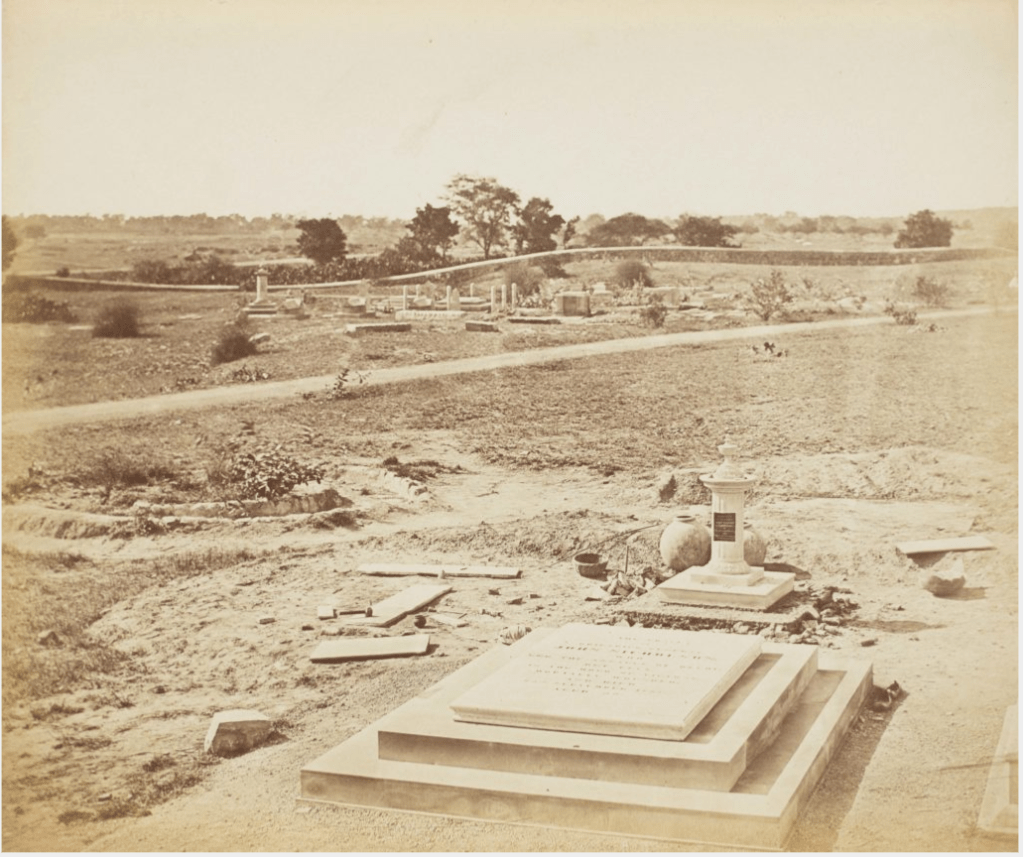
On the morning of the 24th, Nicholson’s remains were laid to rest in the cemetery that now bears his name. A small company of mourners, headed by Neville Chamberlain, followed the coffin, which had been placed on a gun carriage for its last journey. It was a walk in perfect silence – no band played the Dead March, and no volleys of musketry were fired to honour him. The men of the 52nd regiment had risked insubordination to attend the funeral, missing the early morning parade. Campbell had expressly forbidden them from going and had even threatened force if they did – to which an old campaigner answered, “And what force will you get, sir? The regiment will march through all the other regiments that are here…” Campbell was wise enough by now to not stand in their way.
Around the open grave stood officers and men, “some with sunburnt faces, some bleached white by fever and sickness, their plain kharkee uniforms contrasting with the picturesque dresses of the Pathans and Afghans and others of his Multani Horse. The solemn words of the beautiful burial service, read by the senior chaplain Mr. Rotton, were accompanied by deep sobs from those who stood around…”
There was more to come.
As soon as the coffin had been lowered into the ground, a wail rose from the men of the Multani Horse. They threw themselves on the ground and wept as if their hearts were breaking; men who would have been loathed to shed a tear for the shame it would bring on them now sobbed and tore at their beards. For them, Nicholson had been everything. For him, they had left their frontier homes and forsaken the hills to ride with him through the plains – they “acknowledged none but him, they served none but him, they obeyed none but him.” After the funeral, the men of the irregulars packed up their things. They never took any pay for their services but, in turn, would not take any more orders. When an officer ordered them to join the regiments marching to Agra, the men looked at him and declared they owed no allegiance to the English government – “We came to protect and serve Nicholson and loot Delhi, both of which we have done to the best of our abilities…” they would follow no one now. Laden with plunder they rode off back to their wild homes in the hills.
The loss of Nicholson was lamented throughout India as if a light had suddenly been extinguished. Those who had known him and many who had only seen him for a brief moment said they would never see his kind again – the Lion of the Punjab who subdued an entire frontier was gone, and all that would remain would be the legends of one of the last great leaders of men.
Delhi had been emptied of the mutineers – now the force would be deployed on other battlefields starting with Agra. The back of the revolt might have been broken but it was not over yet.
Sources:
Barter, Richard. The Siege of Delhi: Mutiny Memories of an Old Officer. London: The Folio Society, 1984.
Cave-Browne, Rev. J. The Punjab and Delhi in 1857. Vol. 2. Edinburgh: William Blackwood and Sons, 1861; repr., London: Forgotten Books, 1911.
Daly, Major H. Memoirs of General Sir Henry Dermot Daly, G.C.B., C.I.E. London: John Murray, 1905.
David, Saul. The Indian Mutiny: 1857. London: Viking, 2002; repr., London: Penguin Books, 2003.
Forrest, George W., ed. Selections from the Letters, Despatches and Other State Papers Preserved in the Military Department of the Government of India, 1857–58. Vol. 1. Calcutta: Military Department Press, 1893.
Gough, General Sir Hugh. Old Memories. Edinburgh: William Blackwood and Sons, 1897.
Grant, General Sir Hope. Incidents in the Sepoy War, 1857-58: Compiled from the Private Journals of General Sir Hope Grant. Edited by Henry Knollys. London: William Blackwood and Sons, 1873.
Griffiths, Charles John. A Narrative of the Siege of Delhi: With an Account of the Mutiny at Ferozepore in 1857. Edited by Henry John Yonge. London: John Murray, 1910.
Hibbert, Christopher. The Great Mutiny: India 1857. London: Allen Lane, 1978.
Kaye, Sir John William. Kaye’s and Malleson’s History of the Indian Mutiny of 1857–58. Vol. 4. Edited by Colonel G. B. Malleson. London: W. H. Allen & Co., 1889.
Lang, Arthur Moffatt. Lahore to Lucknow: The Indian Mutiny Journal of Arthur Moffatt Lang. Edited by David Blomfield. London: Leo Cooper, 1992.
Leasor, James. The Red Fort: An Account of the Siege of Delhi. London: Werner Laurie, 1956.
Lee-Warner, Sir William. Memoirs of Field-Marshal Sir Henry Wylie Norman. London: Smith, Elder & Co., 1808.
Medley, Julius George. A Year’s Campaigning in India: From March, 1857, to March, 1858. London: W. Thacker and Co., 1858.
Roberts, Field Marshal Lord. Forty-One Years in India: From Subaltern to Commander-in-Chief. Vol. 1. London: Richard Bentley and Son, 1897.
Rotton, John Edward Wharton. The Chaplain’s Narrative of the Siege of Delhi: From the Outbreak at Meerut to the Capture of Delhi. London: Smith, Elder and Co., 1858.
Seaton, Major-General Sir Thomas. From Cadet to Colonel: The Record of an Active Life. Vol. 2. London: Hurst and Blackett, 1866.
Spilsbury, Julian. The Indian Mutiny. London: Weidenfeld & Nicolson, 2007.
Taylor, A. Cameron. General Sir Alexander Taylor: His Times, His Friends, and His Work. Vol. 1. London: Williams and Norgate, 1913.
Thackeray, Colonel E. T. Two Indian Campaigns: In 1857–58. Chatham: Royal Engineers Institute, 1896.
Trotter, Captain Lionel J. The Life of John Nicholson: Soldier and Administrator. London: John Murray, 1897.
Vibart, Colonel H. M. Richard Baird Smith: The Leader of the Delhi Heroes in 1857. Westminster: Archibald Constable and Co., 1897.
 Mutiny Reflections
Another fascinating and absorbing read! A monumental piece of work!!!!!! Kudos to you for this!
LikeLiked by 1 person
Thank you so much!
LikeLiked by 1 person
You are very welcome!!
LikeLike