The North Angle
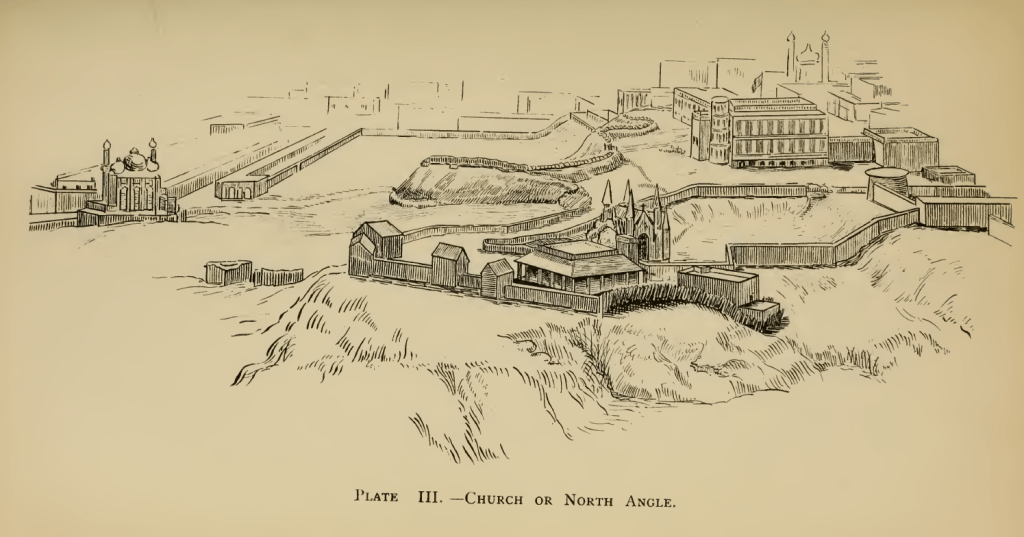
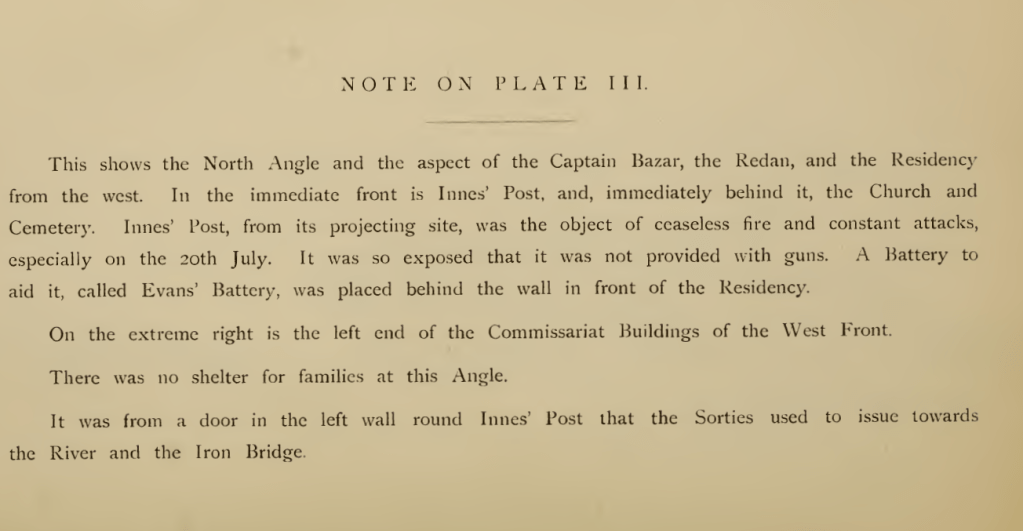
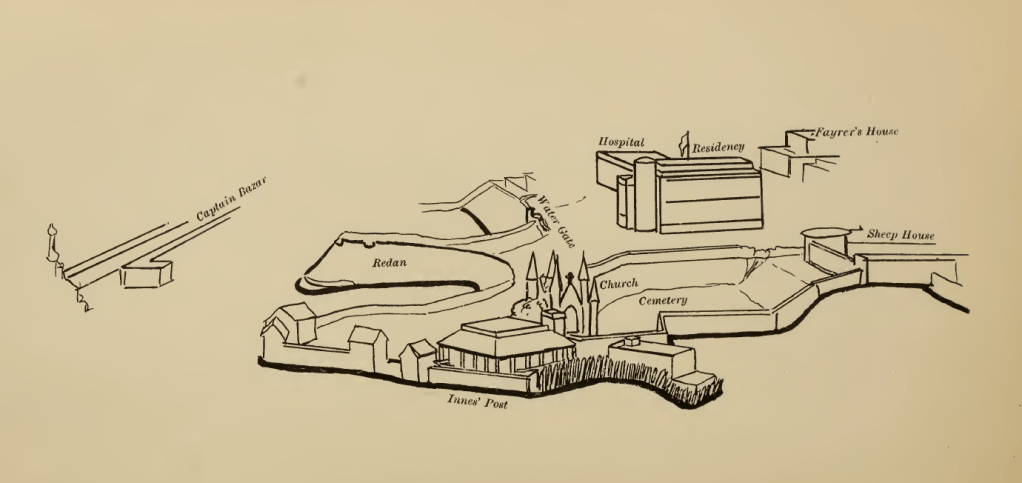
Innes’ House
Before the siege, here stood:
“A long commodious lower roomed building with a verandah to the east, covered by a sloping pukka roof and another to the north. It consisted of four large and several small rooms fronting the verandahs, and as many opposite them; in a centre room of which was a little staircase leading to the rook, and commanding through a hole in the wall a position to the west. Next, there was a sort of courtyard leading to a bathroom, which projected considerably beyond the walls of the main building, in this respect, resembling Gubbins battery. From the outside, the bathroom buildings looked considerably steep. To the left or south of them were several large houses, in front of which was a pond of stagnant water surrounded by reeds and long grass. To the right was a Mohammedan cemetery, on a very considerable elevation of natural formation, and commanding the outpost from the enemy’s side. In front of the house, and in the rear of the buildings already alluded to as possessed by the enemy, was an extensive low garden, then even covered with high, long grass, plantain trees and prickly brambles. A stockade protected a portion of the west side of our ground from that which we tacitly allowed to be that of the enemy.”
As the last defended building on the north-westerly side of the compound, it was called Innes’ Outpost, named after Lieutenant McLeod Innes, whose house it had once been. Only scantily protected by palisades, a compound wall made of mud and a wooden barricade, and separated from the enemy’s position to the north by a low mud wall. It was defended by a party of the 32nd, a few Indian troops of the 13th N.I., and some men of the Uncovenanted Services, one of whom was Rees.
To the right of Innes’ House was a Muslim cemetery situated on a natural mound. A stockade protected the west side of the grounds. To the north, an earth wall separated the compound of the Innes house from the enemy’s positions – these consisted of the cemetery mound, several mud huts, and three brick buildings scarcely 6 yards distant and topped off by a mosque opposite but commanded by several high buildings from across the river. Further on was a garden and the ruins of the house and office of the Central India Horse Company – both buildings had been levelled before the siege by the garrison engineers.
The whole north side of these positions was situated on the road leading along the river from the water gate to the Iron Bridge, from east to west. Stockades were located along the defences – at the end of one of those was a mud shed with a flight of stairs that led to an upper room, called the Cockloft. From here, it was possible to have a view of the Iron Bridge, barely 500 yards in the distance. The position was later extended to include the mound, which was further fortified with deep trenches running the distance from Innes Post to the mound, reducing the danger of being shot when moving between the two positions. The natural levitation of the mound made it an ideal place to shoot from, which the mosque and the headstones provided the necessary shelter.
The command of the post initially was given to Lieutenant Loughnan of the 13th N.I. but was subsequently handed over to Captain Graydon of the 44th N.I. The outpost had neither cannons not mortar so the occupants had to rely on their imagination as much as on their fighting skills. The attack on the 20th of July put this to the test:
“Our men, seeing the rebels come on swarming as thick as bees, and nothing but one sea of heads and glittering weapons before them, thought of retreat, but Mr. Loughnan and the civilians would not hear of it. “Give a shout my boys!” cried Loughnan, “a loud and a strong one.” And shout they did, with a right good will. “Hurrah, Hurrah! Hurrah!” resounded from all the different quarters where attacks were expected. The enemy were evidently checked in their advance by the cheering of our friends. They at once came to a dead halt, and not only imagined us stronger in number than we really were, but fancied (as we afterwards learnt) that we had received reinforcements from the Residency.”2
The shout did not stop the attack but it did give them a moment’s pause. The insurgents made it up to the wall, and took cover behind it, just out of reach of the musket fire from the outpost. However, the insurgents had their own problem. They had forgotten to bring ladders. So now, safe as they were behind the wall, they could not get over it to attack the outpost in one sudden rush. It was impossible to bring the ladders – every party carrying them was shot, so they bravely tried climbing it instead, with some success but were bayoneted on the top of it. Lieutenant Loughnan saw the danger should they get over the wall in large numbers, a retreat on a part of the outpost would have be inevitable. Without any hand grenades to dislodge the enemy from their position, the civilians resorted to throwing “bricks and mortar, and succeeded so well in dislodging the enemy with these and other missiles of a very impure nature that our friends soon had that part of the outpost clear.” 3
The enemy beat a hasty retreat but this put them again in range of the muskets and they were unable to approach the wall again. The attack which started in the morning, gradually relented around 4 in the afternoon neither side victorious. Had the enemy known that Innes Outpost, on that day was held by a force of less than 65 men, they may not have let off so easily. After the battle, the rebels sent a flag of truce, requesting the garrison to allow them to remove their dead and wounded. The truce was respected. On the 10th of August, a howitzer, nicknamed the Turk by the garrison was brought into play against Innes Post. The constant and precise firing of the rebels destroyed many of the roof beams turning portions of the post into a wasteland of rubble and burying some of the men in the ruins. By the middle of the month, two sides of the house had caved in and the roof was completely gone, but it wasn’t until September that the engineers declared the house unsafe.
The Church and the Graveyard
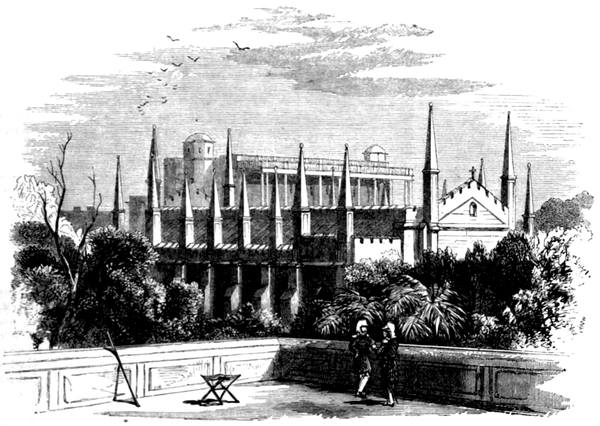
St Mary’s Church was constructed in 1810, and the last service was held here in May 1857, after which it was converted, in June, into a store room for grain. This proved to be a bad arrangement. Its close proximity to the outer lines made it an extremely dangerous position, and it was not possible to adequately defend it. It was abandoned early on as a post, and the grain was moved out through a breach in the east wall of the chancel.
The first burial in the churchyard took place in May 1857 – up to this point in time, there had been no graveyard in the compound. Siege burials were hasty and took place at night, with darkness providing some cover from the firing. The bodies were placed into mass graves, piled either on top of one another or side by side, and covered over with a thin layer of dirt as quickly and as quietly as possible. It was a thoroughly dreadful place.
“The smell there became so horrible, owing to the shallowness of the graves and the want of work people to make proper arrangements, that the medical men pronounced it positively dangerous for the living to go there.” (A Lady’s Diary of the Siege of Lucknow – Mrs Harris)
Contrary to convention, Reverend Harris conducted the funeral service over the bodies on the hospital porch to save himself the trial of accompanying all of them to the graveyard, feeling he was more valuable to the living. With as many as 20 burials to attend to in a night, his was not a job to envy. Brigadier Inglis disagreed most vehemently and ordered Harris to walk the distance with the dead as the reading of the burial service at such close quarters was having a detrimental effect on the living Harris sought to comfort. Harris did as he was ordered – even though the smell of the graveyard would leave him physically ill and vomiting for hours afterwards. Reverend Harris was not a man to mince his words and as weighty in his deeds. Reluctant grave diggers were held by him at gunpoint until their task was complete, as bullets whistled over their heads.
Besides visiting the sick and attending funerals, he took Holy Communion and held regular services at the Brigade Mess, the Hospital and Dr Fayrer’s House.
He was not exempt from military duties, and his wife noted in her journal in November that “…since the 30th of May, he has gone to bed in his clothes, or rather, not gone to bed at all. Ready for any emergency, he slept on the floor, with a wadded curtain or purdah to lie on.” Interestingly enough, there was certainly one Catholic clergyman present during the siege, but he was noted as hiding for its duration on a staircase in the Banqueting Hall, and was loath to show himself outdoors, going as far as to deny Deprat the right to a decent funeral. The scene was described by Rees, who, with three of his friends, carried Deprat’s body to the grave:
“During the lifetime of Mr Deprat, none received greater favour at the deceased’s hand than Father Bernard; yet because it poured bullets and rain, forsooth! The Padre objected to accompanying the body to the churchyard, alleging that Mr Deprat’s religious views were of a very loose kind and he did not deserve a Christian burial. Mr Harris, however, the Protestant clergyman, prepared to go and thus at last shamed the Father into compliance. He reluctantly went and mumbled a few unintelligible words, meant to be Latin and hurriedly took himself off, leaving the poor French gentleman’s body to be buried like a dog, for there were not even gravediggers ready, and we were obliged, therefore, to lower it ourselves, as best we could, into a hole almost filled with water. Mr Harris, however, read the beautiful burial service over Captain Cunliffe’s body, and we took it as intended for Deprat as well.*
Burials continued here long after 1857 – but with a curious twist. Only members of the original garrison and their families were permitted to be buried here, which accounts for the many family graves and the relatively recent dates.
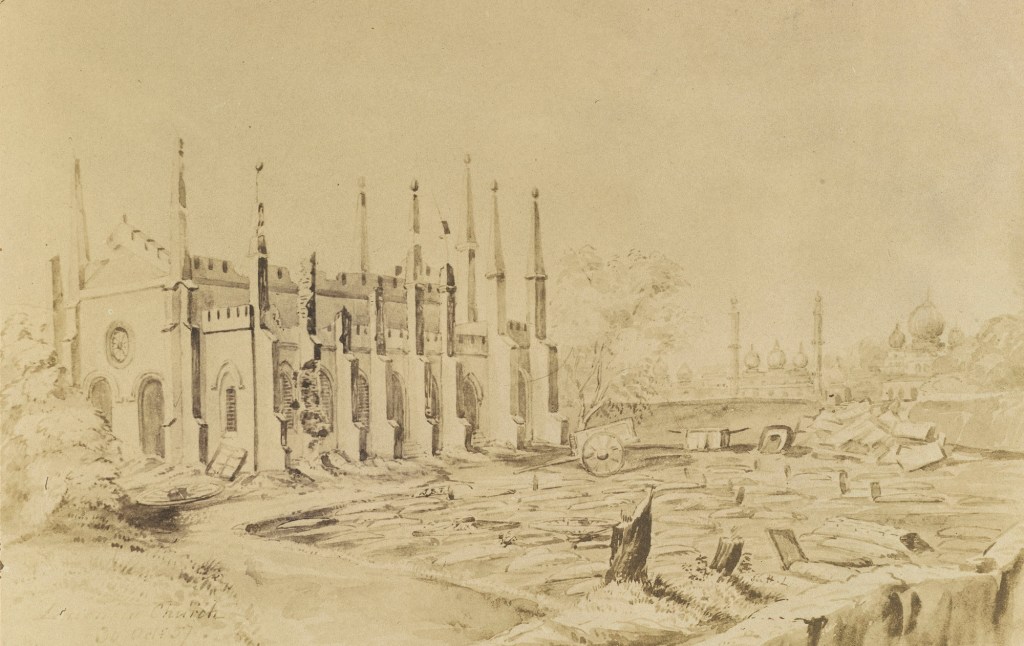
Although not noted on the plan, the area itself was not left completely undefended – on the road close to the entrance to the church stood Evan’s Battery, with 3 guns (two 9-pounders and one 18-pounder). A mortar battery was placed at the eastern gate of the church. The guns protected not only the church but gave some cover to the graveyard below.
As long as the church served as a granary, Lieutenant Ruggles held his position inside, lodging himself in the vestry. He was but momentarily joined by Captain Barlow,
“A more excitable man I never met; it seemed that he could not stand all that was happening; he was in the vestry with myself, but he had such disturbed nights I could hardly get any rest. At last, the idea seized him that I wanted to murder him, and his yells were awful. Then I thought it time that a doctor should see him, and he was ordered to the hospital. There his cries at night for help and assistance still continued, and I was told that a private who was a patient there cursed
me, because my name was continually dinned into his ears. Poor Captain Barlow! He did not live long, but retained his hallucination to the last.”
Ruggles continued to assist in handing out the grain as long as the position was tenable, but noted sadly that day by day, he could watch the church getting smaller, as round shot took off the ornamental finials on the roof, and large breaches caused the walls to crumble and finally collapse. It was finally decided to remove the grain and stores from the church and bring them to the more secure commissariat in the Begum Kothi.
 Mutiny Reflections