The North-Half of the East Front & Dr. Fayrer’s House
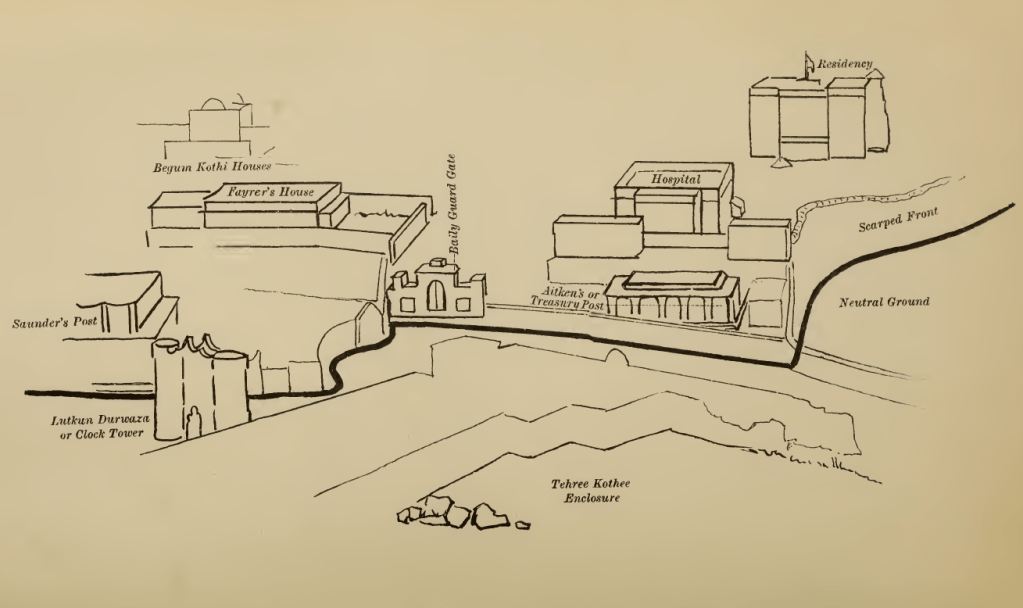
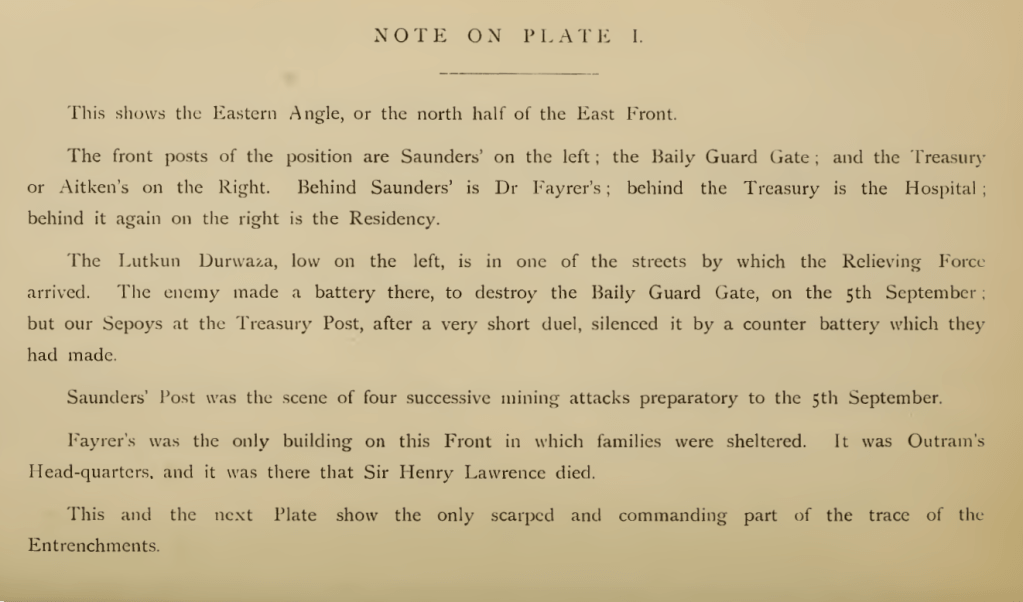
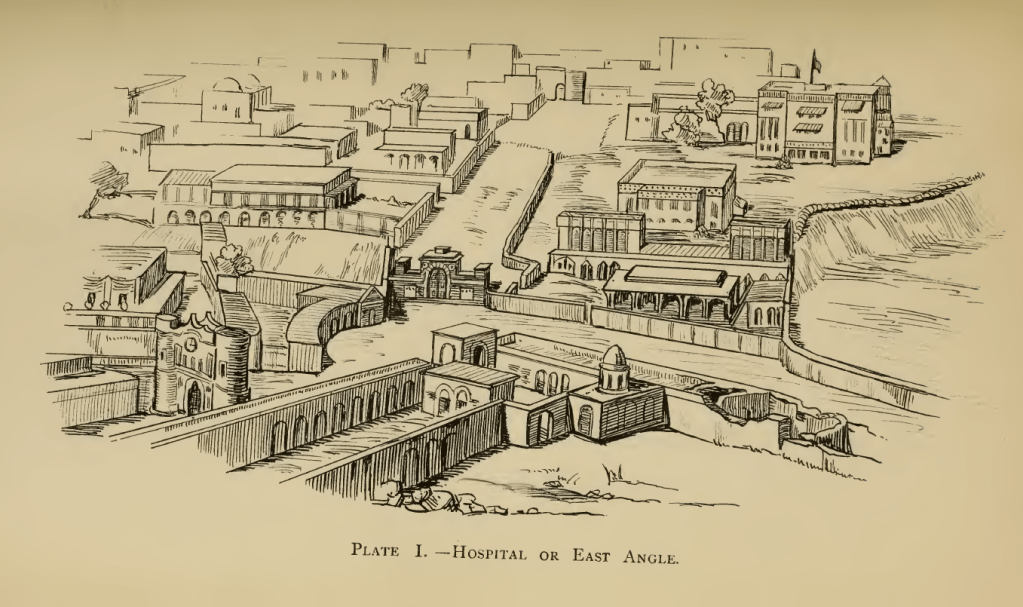
The Bailey Guard Gate
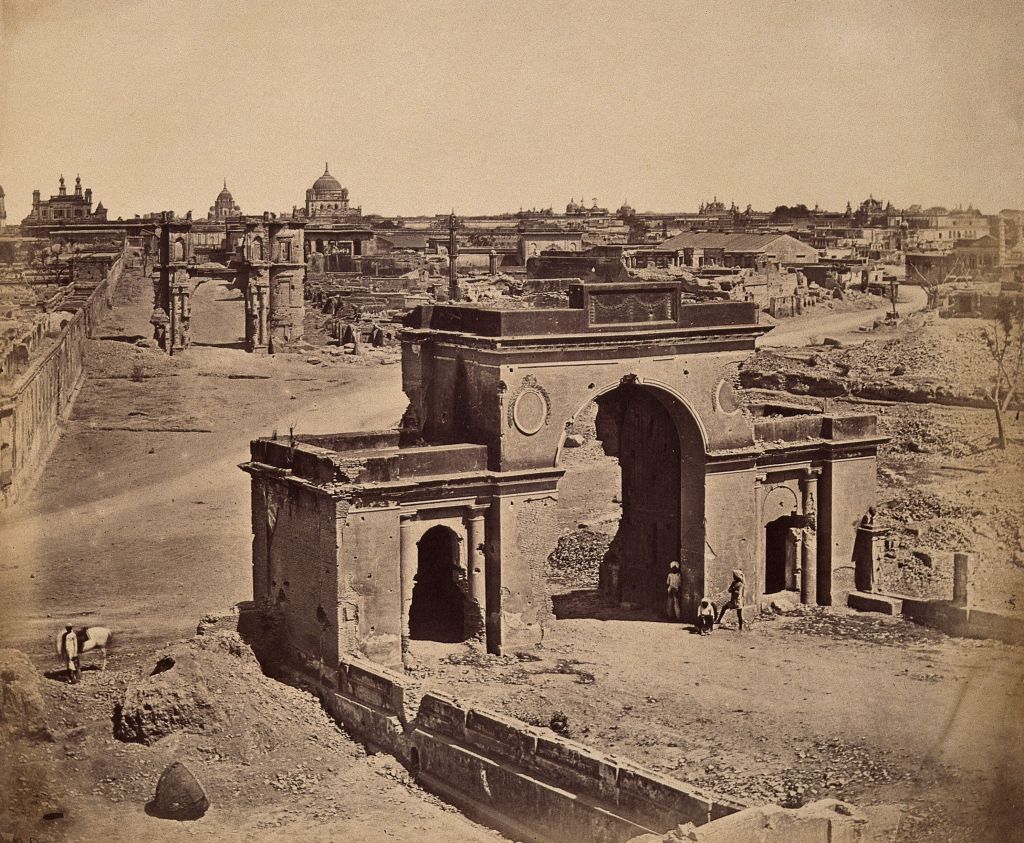
During the siege, the gateway was banked up from the inside with earth, so when the first relieving force arrived, they made their entrance through the defensive enclosure immediately to the right of the gateway. Known as Aitken’s Battery, it was manned by Lieutenant Robert Hope Moncrieff Aitken and the remnants of the 13th Native Infantry to which he belonged. For their defence, they constructed during the siege a battery for an 18-pounder gun to the left of the Bailey Guard Gate. The road leading from the gateway into the compound ascends steeply – in the event that the gate should have been forced, two 9-pounders and an 8-inch howitzer were put in position on the road to shower grape and canister into the assailants, thus completely commanding the ascent from the gateway. A triangular building which formed the external portion of the Bailey Guard, was abandoned.
Dr. Fayrer’s House
Fayrer’s House was the only building on this front that would house civilians, including women and children. It would later serve as Sir James Outram’s headquarters and was also where Sir Henry Lawrence breathed his last. Visible are also the “scarped and commanding part of the trace of the Entrenchments.”
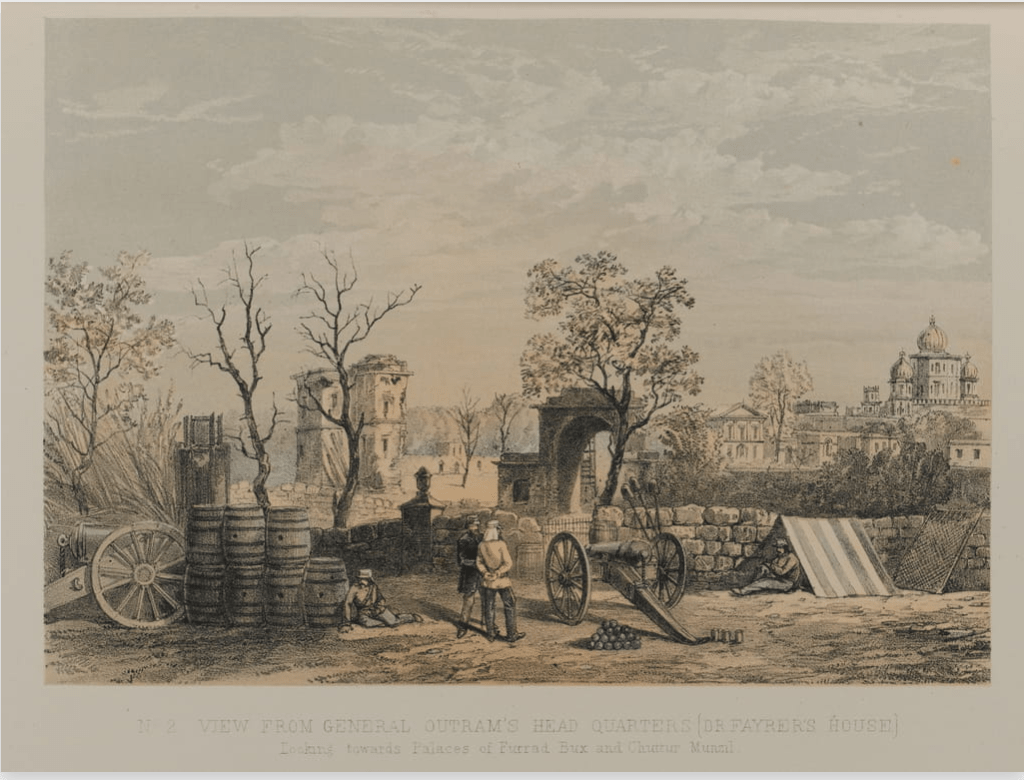
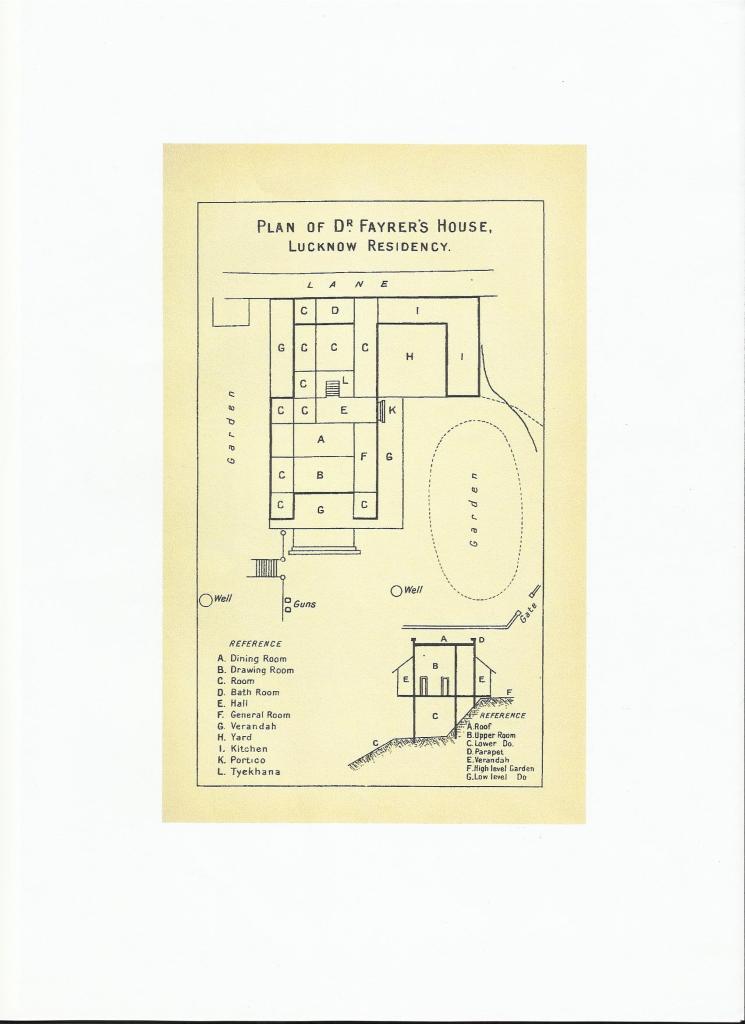
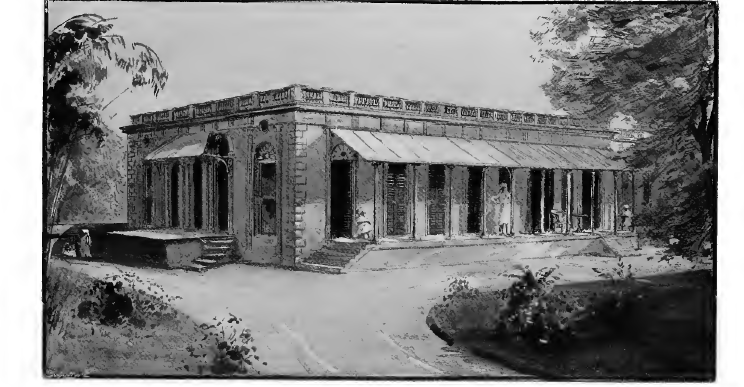
Initially, the only defence available here was a low compound wall. A 9-pounder, loaded with grapeshot, was placed at the front of the building facing a north-easterly direction to provide defence for the Bailey Guard Gate. On occasion, a second gun was made available for the same purpose. The house was single-storied with a flat roof surrounded by a 3-foot-high parapet. On top of this, bags of earth had been piled, and the side which faced the city was used as a breastwork for riflemen. The rest of the description is from Dr Fayrer himself:
“The house was built on a slope with a garden on both sides, one higher than the other. On the Residency side there was one floor, on the city side, two floors, owing to the lower level of the ground on that side. There was a suite of rooms from which the doors opened into the garden, and staircases in the rooms above. In one of these rooms was a swimming-bath; the other for general purposes, and there was also a tyekhana, or underground room for the hot weather. From near the front door, a flight of steps left from the upper to the lower garden, which was prettily laid out, had a Persian well in it and was bounded below by offices and stables for about eight horses.”
The house had a porch which was raised above the ground by flight of steps with a room at each end of it. Sir Henry Lawrence was brought to this porch when he was mortally wounded and in the room within this, he died.
The post was defended by a party of sepoy pensioners under the command of Captain Weston. The extensive tyekhanna below the building provided much-needed refuge for the women and children quartered here. The Fayrers hosted no less than 30 people at any one time. Mrs. Harris, the reverend’s wife, was billeted to Dr. Fayrers house for the duration of the siege, and from her we do get a glimpse into life in the Fayrers’ tyekhana.
“We all sleep (that is, eleven women and seven children) on the floor of the Tye Khanna where we spread mattresses and fit into each other like bits in a puzzle, so as best to feel the punkah. The gentlemen sleep upstairs in a long verandah sort of room on the side of the house least exposed to fire. My bed consists of a purdah and a pillow. In the morning we all roll up our bedding, and pile them in heaps against the wall. We have only room for very few chairs down there, which are assigned to invalids, and most of us take our meals seated on the floor, with our plates on our knees. We are always obliged to light a candle for breakfast and dinner, as the room is perfectly dark…We are all kept close prisoners to the dismal Tye Khanna…For about half an hour in the evening we are permitted to sit in the portico and breathe a little fresh air. After sunset the firing generally slackens considerably for a time…”
Nervous and as frightened as they were, even keeping night watches and sleeping in their clothes, it is surprising they got any rest at all:
“…our rest is much disturbed; with the frequent night attacks of the enemy, the crying and illness of the poor children, the mice and rats which run over us, the heat and the sleepiness of the punkah coolie…”
As they became more accustomed to the situation around them the women would sit in a little entrance hall during the day which was considered tolerably safe, dressing upstairs in a small barricaded room and racing back down to the tyekhanna when the shelling became severe. Many of them had work to attend to during the day mostly nursing the sick and looking after the children, Mrs. Harris occupied a lot of her time with sewing. By August they stopped sleeping downstairs – the monsoon had started and the rooms were now very damp – the dining room became their sleeping quarters at night. The house though was by no means safe:
“This morning, an 18 pounder came through our unfortunate room…It broke the panel of the door, and knocked the whole of the barricade down, upsetting everything. My dressing table was sent flying through the door, and if the shot had come a little earlier, my head would have gone with it…”
Her husband too, had a narrow escape, when round shots came through his dressing room, knocking down pieces of the wall and ceiling and smothering the unfortunate and nearly naked Reverend in dust.
During the siege, 26 people lived in the doctor’s house:
Dr. Partridge
Rev. Mr. Harris and Mrs. Harris
Colonel Halford, Mrs. and Miss Halford.
Mrs. Germon
Miss Schilling
Lieutenant Barwell and Mrs. Barwell
Captain Gould Weston
Mrs. T. Anderson
Lieutenant Calvert S. Clarke and Mrs. Clarke
Mrs. Dashwood and two children
Mrs. G. Boileau and four children
Dr. Fayrer, Mrs. Fayrer and child.
Two children were born during the siege, one to Mrs. Barwell and another to Mrs. Dashwood and two died – one of Mrs. Boileau’s and one of Mrs. Dashwood’s. Her husband, Lieutenant Dashwood died during the siege as did Colonel Halford.
Sources:
Fayrer, Joseph. Recollections of My Life. Edinburgh: William Blackwood and Sons, 1900.
[Harris, G.] A Lady’s Diary of the Siege of Lucknow: Written for the Perusal of Friends at Home. London: John Murray, 1858.
 Mutiny Reflections