The South Angle
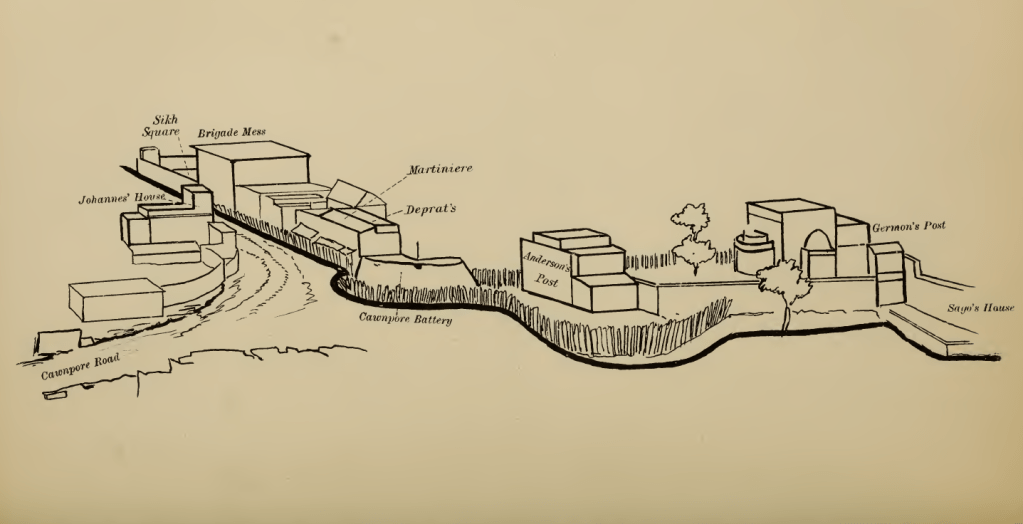
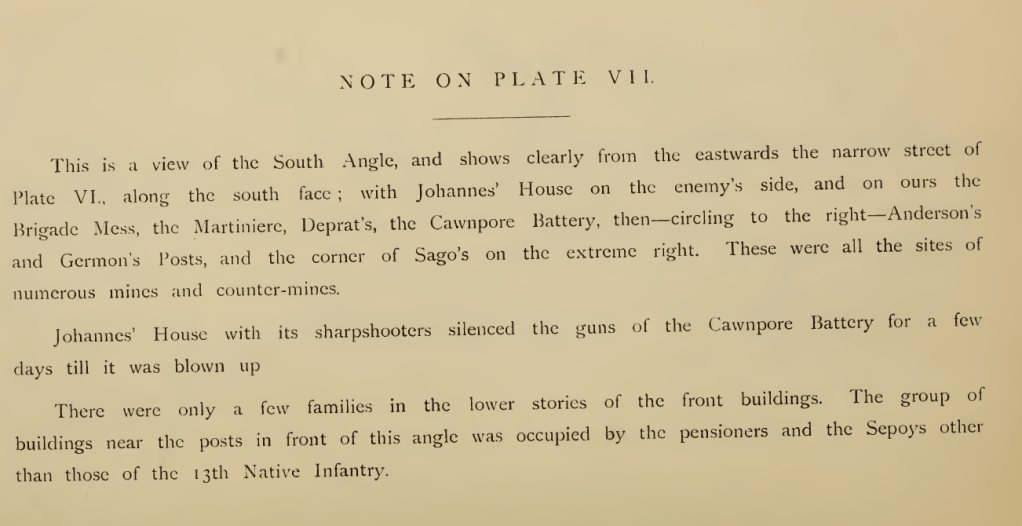
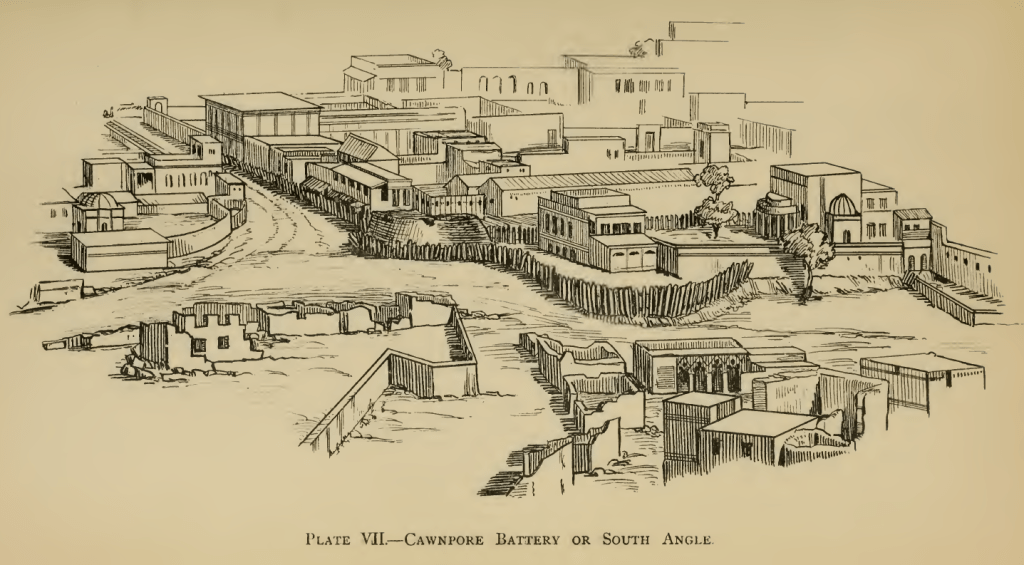
Following on from Dr Fayrer’s House was Anderson’s Post, one of the outer houses on the left flank of the defences. Outside the wall stood Johannes’ House, one of the buildings that Sir Henry Lawrence refused to level and would be a main position for the rebels during the siege.
At this point, the rebel forces were barely 40 yards to the left and approximately 80 yards along the front of the house, making it one of the most exposed and vulnerable positions in the defensive works. The post was battered mercilessly during the siege. During attacks, shells were thrown from the Post Office over Anderson’s Post and musketry fire swept over their left face from Sago’s and the Judicial Commissioners – not all the damage caused to Anderson’s Post came from without. The close proximity to the enemy, however, made it an ideal position for the digging of mines, intended more to hinder those being dug by the enemy. It was designated a “listening gallery” attempting to ascertain in which direction the rebels were mining next. The rebel forces were barely 40 yards to the left and approximately 80 yards along the front of the house, making it one of the most exposed and vulnerable positions in the defensive works. It was commanded by Captain Anderson of the 25th NI, a detachment of the 32nd Regiment and 8 Uncovenanted Civilians, but never numbered at any given time more than 20 men.
The compound wall of Anderson’s house had been demolished and a stockade put up in its place – in the stockade was a ditch, followed by a mound of about 5 feet, then another deep ditch at the bottom of which pointed bamboos had been placed. The rebel’s artillery was placed almost directly in front of the building on the other side of the wall- the constant fire from 9 guns and a howitzer that had been lost during the retreat from Chinhut caused tremendous damage. The howitzer was able to throw 8 inch shells clean through 2 walls of the house with one shot, leaving the house a ruin quite from the start. At the commencement of the siege on the 30th of June and following the disastrous battle of Chinhat, Anderson’s Post felt the first of the desperate shelling that would accompany them throughout the siege – on this day, a gun was brought to bear on the pillars of the veranda, crashing them one after the other, until the roof caved in, burying a certain Mr. Capper alive under some three to four feet of masonry. Setting to work displacing the pieces of brick masonry and making air holes to prevent the man from suffocating, with the enemy now concentrating their fire on the spot where they were working, forced now to lay on their stomachs, protected by some six inches of wall, shoveling the debris with their hands. Only Corporal Oxenham of HM 32nd braved the fire and exposed himself above the wall, in order to expedite the digging. It took nearly an hour to free Mr. Capper, after which it was found he had not been injured, beyond a few bruises.
Shortly after, the cannonade on the upper part of the house became so severe, with round shot and shells sweeping it from end to end, the defenders were forced to move to the lower level. The only useful room downstairs however, had been taken over by a sheltering family – rather then turn them out, Anderson and his volunteers chose to take up quarters in the corridor. They had no place to bathe or to dress, and cooking was impossible so the group subsisted for a time on whatever tinned goods they had, mostly biscuits and sardines. Captain Anderson eventually had the family removed from the post when living conditions had further deteriorated. It was just as well– in the course of a few weeks, Anderson s Post became so damaged by shot and shell that the chances of being shot were only marginally higher than being killed by loose bricks and the defenders were buried alive two more times by falling debris. Somehow, they held on to the post until November, though by then they were defending nothing more than a pile of rubble and a few walls.
“Then there was a constant state of anxiety as to whether we were mined or not; and we were not quite sure, whilst we were at a loophole, that we might not suddenly see the ground open, or observe the whole materials of the house fly into the air by the explosion of a mine! Shells came smashing right into our rooms…then followed round shot, and down tumbled huge pieces of masonry, and bits of wood and bricks flew in all directions…When an 8-inch shell exploded in the room, you could not see anything for several minutes, and all we heard after was the cry of individuals, asking each other from opposite directions, if it was “all right” and now and then a poor fellow would be seen to creep out of a heap of lime and bricks, and say, “I’m not hurt, thank God.”
A Personal Journal of the Siege of Lucknow – Captain R.P. Anderson (1858)
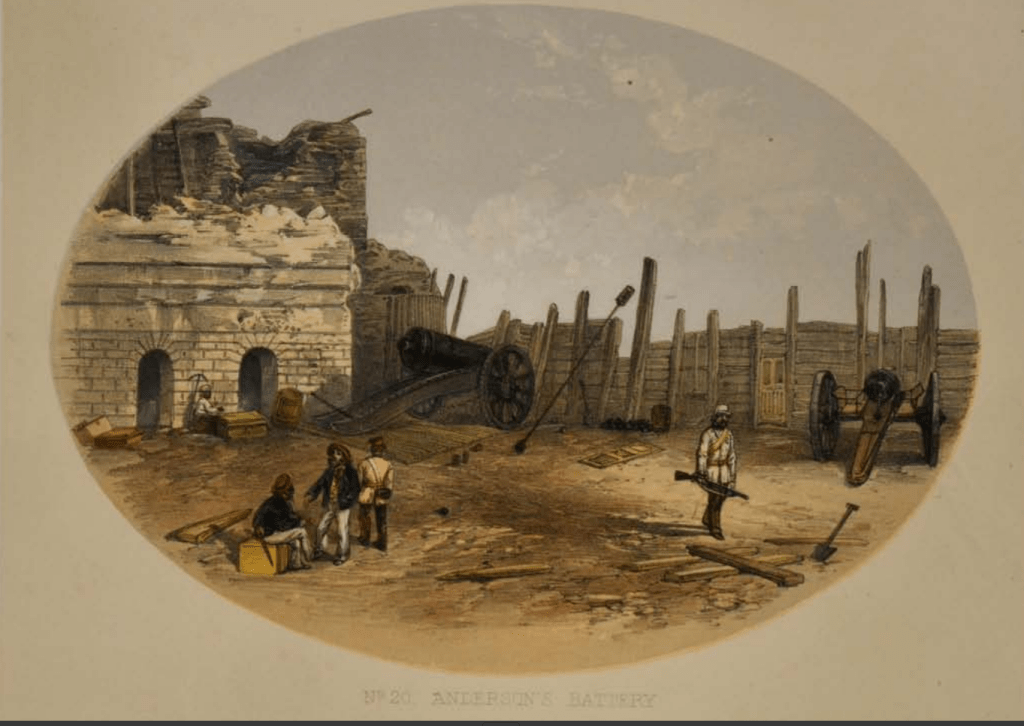
Cawnpore Battery
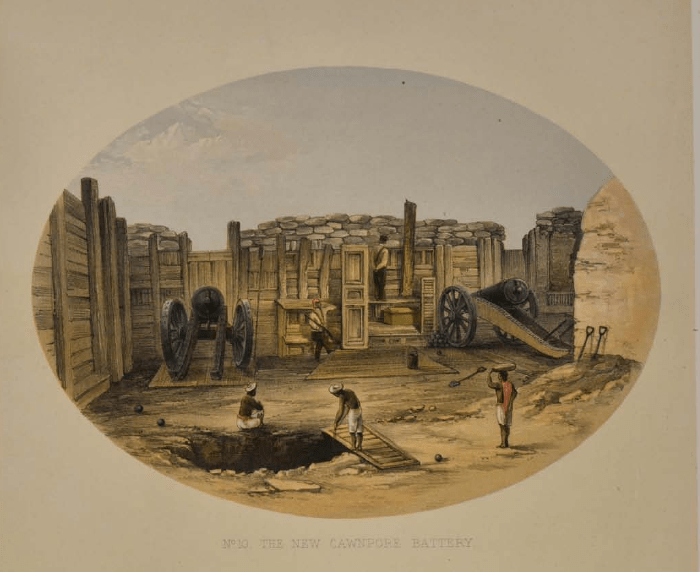
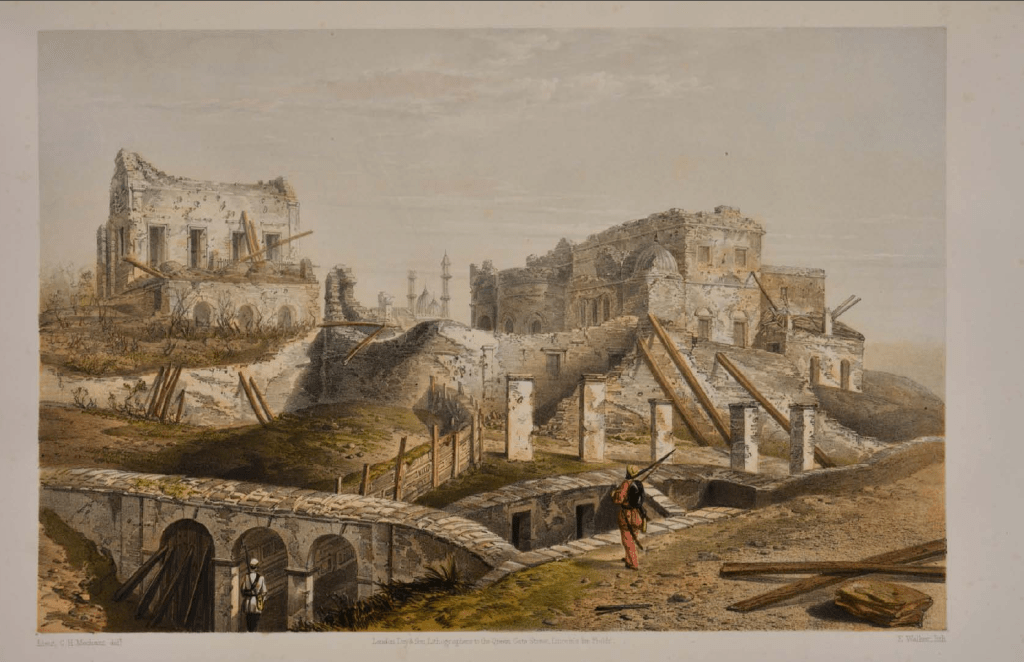
Next to Anderson’s Post was the Cawnpore Battery. Three guns – an 18-pounder and two 9-pounders consisted of the entire defence, while the battery itself was constructed of earth and palisades. The guns themselves were placed on a platform, which was protected by a stockade and trench. The trench led past Anderson’s Post. Despite its firepower, the battery was deemed by many to be of little use, as the men were unable to stand at the guns due to the heavy musketry fire levelled against them from the tower of Johannes House, almost directly opposite. A flanking fire was kept up by the Martiniere Post and the rifles of the Brigade Mess. Although this allowed the battery to be held, it was not without heavy losses of life. The picture represents the New Cawnpore Battery, which was strengthened by General Havelock’s reinforcements. Before the arrival of the relieving force, this battery had
“No woodwork, and no man could have walked unscathed to the place occupied by those guns and palisades in the illustration. The sentry on that post had to crawl to his position, and many men were shot while doing so, and also when on the look-out, as round shot kept continually crashing through the miserable earthwork which formed our sole defence. The fire s was so hot as to render it impossible to strengthen the position, and whatever repairs we contrived to make during the night were demolished by the enemy during the course of the following day. It was emphatically the most dangerous and desperate place to hold in the whole line of defence, and, as the necessary consequence, many lives were lost. Here fell dead at his post, on the extreme front, where the palisade now stands, that gallant and promising young officer, Lieutenant Arthur of the 7th Light Cavalry. Here, too, fell pierced through the brain, Lieutenant Lewin of the Artillery; and here, on the 25th of September, on the very morning of the day upon which succour arrived, Captain Radcliffe, of the 7th Light Cavalry, received a mortal wound from a shot from an eighteen-pounder. The large aperture in the foreground is the mouth of a mine which was sunk to meet and low up similar works on the part of the enemy, who were supposed to be pushing offensive mines towards the battery..” (Lt. C.H. Mecham)
Deprat’s House
The house of the French merchant, Deprat was a two storied building with a veranda along the front. A mud wall was built along the veranda to protect it and pierced to allow for musketry fire. The house overlooked Johannes wall, and had three large rooms under which was a tyekhanna that mirrored the rooms above. Another tyekhanna was present under the veranda. A mud wall of about 9 feet in height had been built leading in straight line to the wall of the Martiniere Post next door. The wall, though not very strong, provided adequate protection for a small yard in the centre of which was a well. By the 10th of August, Deprat’s House was almost completely in ruins – first the veranda was destroyed, followed shortly after by the outer wall. It is unfortunate that Captain Hayes, who was said to possess the finest library in India, had chosen Deprat’s House in which to store his valuable collection and it too was destroyed having been used as a part of the defences!
Deprat himself was something of an enigma, in life and remains so, in death. Before coming to India, he had been an officer in the Chasseurs d’Afrique, seeing active service in Algiers under Lamoriciére, Cavaignac, Changarnier, Pelissier and Canrobert. During the siege, Deprat served both as an artillery officer and as a rifleman, not only at his own post but at Gubbin’s Battery. He owned a heavy, large-bore rifle which he used with considerable skill, and had fought alongside the army at Chinhat. He performed deeds of “bootless boldness which none but a Frenchman or a madman would think of. “ One of his acts was to hold lengthy conversations with the enemy during exchanges of musketry fire, to the point where he would show himself to his aggressors, tempting them to take a shot.
He was “generous in the extreme, hospitable, warm-hearted, kind, – one could forgive his faults though they were many.” His generosity drove Rees to despair, that Deprat gave away his stores of provisions to “whoever wanted any…The consequence was that poor D. had soon nothing for left for himself soon; and the thousand and one cannon balls and musket balls…smashed to atoms whatever was not taken away.” (Rees)
Martiniere Post
On the 13th of June, led by their principal, Mr. Schilling, 67 boys, accompanied by 6 masters and the college estates’ superintendent to take up their position in a house called “The Martiniere Post.” It was a strong, single storied, flat roofed building with basements beneath it. In earlier times, the house had belonged to a native banker.
15 of the senior boys and their masters shouldered arms. Whereas the smaller ones were employed as messengers or servants and given hospital duty, (mainly pulling pankahs and fanning the flies off the wounded) the senior boys, besides their military duties, kept watch during the day until the masters came on duty at night, stood sentry with the soldiers, took charge of digging waste disposal pits and served as heads of sections, supervising the work of the younger boys. For the younger boys, their day consisted of 12-hour shifts pulling the punkahs and fanning the wounded at the hospital – 36 boys were so employed, with 12 boys working a shift.
As more and more servants continued to leave the compound, they became increasingly used for domestic duties which included grinding grain with a hand mill, fetching water, sweeping the compound and even some cooking. By September their duties were reduced as the boys had begun to suffer from ill health. Only Rees seems to have shown them some pity:
“The poor Martiniere pupils who go about the garrison more filthy than others, and apparently more neglected and hungry even than we are…That they too should contribute their share of usefulness is but just and fair; but that they should be placed in menial attendance upon the healthy in the garrison is, in my opinion, far from right…” (Rees)
The close proximity of the Martiniere Post to the outer walls meant they were constantly under fire from cannons and bullets and the threat of mines and open assault. The most serious of these attacks occurred on the 10th of August when a mine blew up in from of the Johannes House, just short of the post. The veranda was destroyed along with 50 feet of the palisades and defenses. The outer room, where Mr. Schilling and the Martiniere boys lived was severely damaged, though fortunately, the boys were away at prayers so no one was hurt. The door had been blown down but either due to the shock of the explosion or lack of coordination, the insurgents did not enter the room immediately, and it was it fortuitous that Mr. Schilling had presence of mind in those few minutes to barricade the opening with school tables. Later during the siege, the boys helped dig a mine, from an inner room, which then blew up Johannes House. A marble tablet, still visible, commemorates the spot where the mine was started. The eastern enclosing wall of the Martiniere Post was breached twice during the siege and was finally replaced by a stockade.
If it wasn’t enough to be under near constant fire from the enemy, the boys also had to pay attention to the shells coming from the Post Office – fragments regularly fell in the midst of the Martiniere Post, and Hilton notes, somewhat sardonically, that this was anything but “a pleasant neighbour to La Martiniere Post.” (Hilton)
Despite their hardships, the Martiniere Post was one of the healthiest in the garrison – only two boys died, both of dysentery. Two were shot and wounded, one while stooping to shoot and the other, named Smith, while on message duty. Their general well-being was probably benefited by the enforcement of regular discipline, including a daily inspection to ensure they were maintaining their personal cleanliness. For a month, the boys and their masters defended their post mostly on their own; they were later reinforced by men of the 32nd and volunteers of the Uncovenanted Services – Mr Schilling retained command of the post even after regular troops had been stationed alongside the boys, a rare honour for a civilian. The Martiniere Post continued to be defended by the boys until the 22nd of November and was only abandoned when the retreat was complete. The boys were present during the last large-scale assault on the 22nd, during which they were compelled to withdraw to the basement for shelter when the portico of the building collapsed. Having survived the fearsome cannonade and the final assault, they left the Residency and joined the retreating force.
The Martiniere College of Lucknow is the only school in the world to be presented with its own colours, and the boys and their masters received the Mutiny Medal. The last medal holder died in 1940 and was one of the younger Martiniere boys. His name was Charles Palmer. Just 9 years old at the time of the siege, Charles Palmer was relegated during the siege to his brother-in-law, Captain Ralph Ousely, to carry messages and ammunition. Although Charles’ father, Colonel Palmer, survived the siege as did Captain Ousely, it must have been a bittersweet achievement – both of Charles’ sisters died (the unfortunate Susanne and the kind Mrs Ousley) as did both of the Captain’s infant sons, Ralph and Gore. Before we imagine that the Martiniere boys were beyond reproach, there is an anecdote that shows that, finally, they were still only boys. The boys who carried arms used to take ten or twenty rounds, would go up to the top of the house in which we were located and fire through the loopholes at whatever seemed a fair target. This included pumpkins and other vegetables that were growing, just out of reach, in Johannes’s garden, outside the line of defense Unable to forage in this garden, and seeing that there was no other way they could get to the edibles without getting shot at first by the enemy marksmen, the boys made a sport of shooting at the vegetables, following the motto, if they could not have them, then nobody else could either. Following an altercation with Jim the Rifleman, who was lodged on top of Johannes House, which nearly led to one of the boys- Luffmann- getting killed (the other boy was Hilton), they received a severe reprimand from the Principal, who then ordered, to prevent any further target practice, that the ammunition was to be put out of their reach. (The Johannes House lay outside the defences of the residency and was actively occupied by the insurgents from the very beginning. As one of the houses Henry Lawrence was reluctant to tear down, it turned out to be a formidable position with high walls and a flat roof, which provided an excellent position for snipers. Two of these were given fitting nicknames by the garrison – Jim the Rifleman and Bob the Nailer.
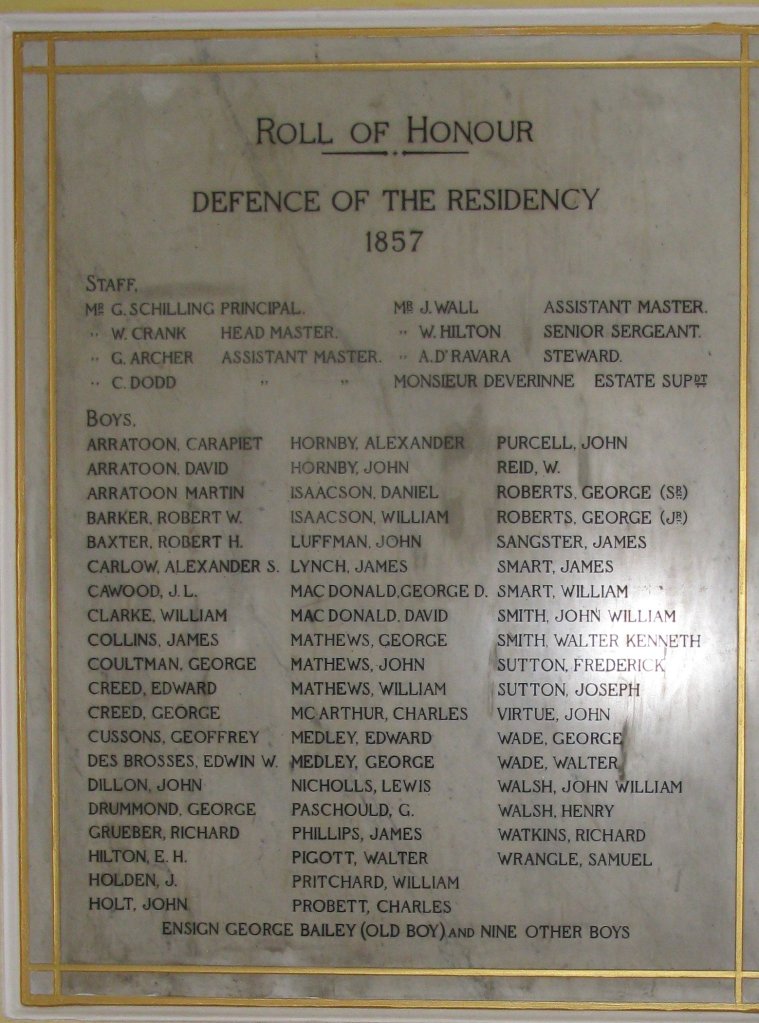
Who were the Martiniere boys? Although the list is by no means complete, or for that matter, absolute, the following names have been recorded for the boys and masters of the Martinere post:
Sources
Anderson, R. P. A Personal Journal of the Siege of Lucknow. Edited by T. C. Anderson. London: W. Thacker & Co., 1858.
Bartrum, Katherine Mary. A Widow’s Reminiscences of the Siege of Lucknow. London: James Nisbet and Co., 1858.
Fayrer, Joseph. Recollections of My Life. Edinburgh: William Blackwood and Sons, 1900.
Gubbins, Martin Richard. An Account of the Mutinies in Oudh, and of the Siege of the Lucknow Residency. London: Richard Bentley, 1858.
[Harris, G.] A Lady’s Diary of the Siege of Lucknow: Written for the Perusal of Friends at Home. London: John Murray, 1858.
Hilton, Edward. The Tourist’s Guide to Lucknow. Lucknow: Murray’s London Printing Press, 1891.
Home, Anthony Dickson. Service Memories. Edited by Charles H. Melville. London: Edward Arnold, 1912.
Hutchinson, George. Narrative of the Mutinies in Oude: Compiled from Authentic Records. London: Smith, Elder & Co., 1859.
Inglis, Julia Selina. The Siege of Lucknow: A Diary. London: James R. Osgood, McIlvaine & Co., 1892.
Innes, J. J. McLeod. Lucknow and Oude in the Mutiny: A Narrative and a Study. London: Innes & Co., 1895.
Joyce, Michael. Ordeal at Lucknow: The Defence of the Residency. London: John Murray, 1938.
Kavanagh, T. Henry. How I Won the Victoria Cross. London: Ward and Lock, 1860.
Maude, Francis Cornwallis. Memories of the Mutiny. 2 vols. London: Remington & Co., 1894.
Ruutz-Rees, Leopold Edward. A Personal Narrative of the Siege of Lucknow: From Its Commencement to Its Relief by Sir Colin Campbell. London: Longman, Brown, Green, Longmans, & Roberts, 1858.
 Mutiny Reflections