The Posts on the East
Saunders’ Post
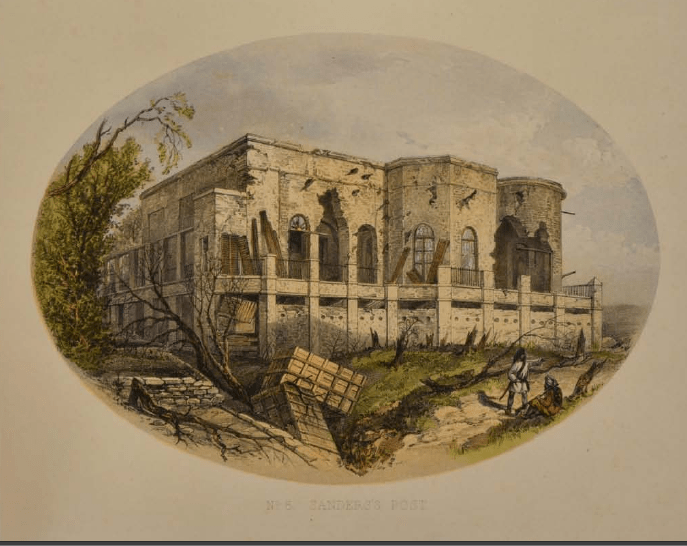
A barricade was erected to defend a lane which separated Dr Frayer’s House from the Financial Garrison, also known as Saunders’ Post. The enclosure wall of the latter building subsequently formed the line of defence. This was a large, double-storied building with two verandas. Both of these were barricaded with furniture and boxes filled with earth. The position was reached by slipping down a steep slope and ducking all the way to avoid the musket fire of the enemy. It was even worse trying to leave it:
“..the noise made by the falling bricks, displaced by the departing soldier as he nimbly scrambled up the ascent, terraced the attention of the insurgents, which brought on him a sharp fire.”
Although both dangerous and uncomfortable, Saunders Post was of vital importance, as it held the lower ground towards the outer walls of the compound. As a result, it was of great interest to the insurgents and between the 1st and the 5th of September, they ran three mines against it, though none of the attempts proved successful. During the “grand attack” of the 5th, the enemy managed to get up to the barricade that ran along the front of the veranda but after being driven off by hand grenades, desisted from making another attempt – in deed, the sheer number of mines that were blown up in front of the position broke up the ground so much that the position became “impervious” to further such attacks. It was, in all, the scene of four mining attacks. During the siege, the post was garrisoned by a party of the 32nd Regiment and men of the Uncovenanted Services under the command of Captain Saunders of the 41st BNI.
Sago’s House
Next in line to Saunders ‘ Post stood Sago’s House. Before the siege, it had been the property of Mrs Sago, a schoolmistress. The building was a small single-storied affair, difficult to defend due to its low-lying position and so exposed to shelling that by the 14th of August, it was completely in ruins. Only the house was defended; the compound and enclosing walls had been abandoned due to a lack of manpower to defend the position in its entirety. A party of the 32nd Regiment, commanded by Lieutenant Clery were garrisoned here.
On the 10th of August, a mine exploded at this post; it only brought down a few out houses. Two soldiers who had been standing sentinel at one of the out houses were blown into the air, but both survived. One of them was thrown clear out of the compound, and, landing in the middle of the road which separated the post from the enemy, he quickly jumped to his feet and legged it back to Sago’s Post, jumping over the wall, followed the whole way by a perfect shower of bullets raining about his head.
Post Office
Situated above both Sago’s and Germon’s Post was the Post Office. During the siege, it was the headquarters of the Engineers and Artillery and provided defence for the two lower lying buildings. Four guns were placed here, of which two were 18-pounders and a 9-pounder; two of the guns were positioned to cover the approach to the Baillie Guard Gate and two for frontal defence. Three mortars covered the Cawnpore Road. The southerly wall communicated by breaches with the Native Hospital, Martiniere Post, Cawnpore Battery, as well as the Judicial and Anderson Posts. A lookout was posted every day on the roof of the Post Office. A workshop was also established here for the manufacture of tools and for the preparation of fuses and shells in the initial stages of the siege. A party of the 32nd commanded by Captain McCabe was garrisoned here and provided for the subsequent defence of the position.
Captain McCabe was killed on the 1st of October. An exceptional soldier, he had been commissioned from the ranks in 1846 for outstanding heroism during the Battle of Sobraon, while serving with the 31st Regiment. For his gallantry at Sobraon, Sergeant McCabe was awarded a commission in the 18th Royal Irish Regiment and went to Hong Kong, taking part in April 1847 in a short campaign to protect the British ‘factories’ at Canton. Returning to India in April 1849, he transferred on promotion to Lieutenant in the 32nd Regiment. Throughout the siege, Bernard McCabe proved himself a gallant and capable soldier. He distinguished himself in repelling the second main assault of the mutineers, and then by leading a series of sorties into enemy lines, to blow up positions and spike guns. On the last of these, he was gravely injured and died three days later. Although he has no known grave, his Regiment placed a memorial tablet in the Lucknow Church. The garrison’s chief engineer, Major Anderson, directed all engineering operations from the Post Office – he did not survive the siege, and died of dysentery at the post on the 11th of August.
Germon’s Post, the Judicial Commissioners Office
..almost battered out of the perpendicular, and the walls were so crumbled away, and eaten into by the incessant rain of bullets that it is hardly too much to say it was breached by musketry.” (Mutiny Records Awadh and Lucknow, (1857-1859) –Edward Hilton (1913)
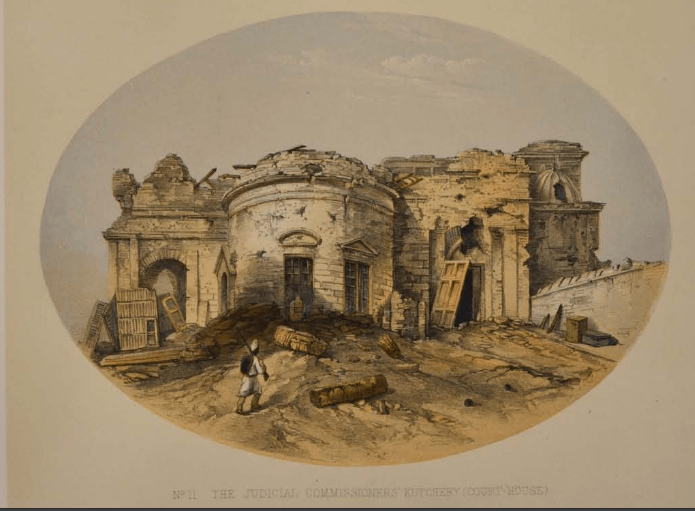
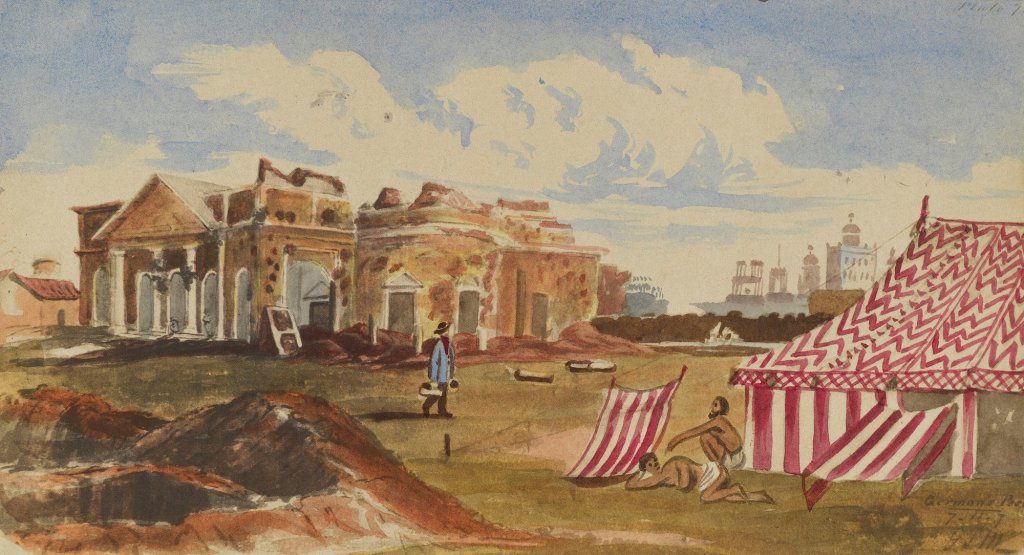
Known during the siege as Germon’s Post, the Judicial Commissioners’ Office was a large, double-storied building standing on higher ground, the external wall and compound of which were on a slope. Due to the severity of the slope, the wall was considered impossible to defend, so it was subsequently abandoned, and a line of defence was constructed by embedding large pointed stakes into the ground, protected by a bank of earth. The house itself was barricaded on all sides with furniture and boxes, while an earth bank and a wall of fascines protected it from the road. Manned completely by men of the Uncovenanted Services (whose families were also sheltered here) and the Sikhs of the 13th N.I. under the command of Captain Germon.
Due to its close proximity to the road and subsequently to the enemy whose position was just on the other side of it, Germon’s Post saw more hand-to-hand combat than any of the other posts and was frequently under assault – mines too were sunk against the position, but none were successful.
 Mutiny Reflections