Chanda, February 19th
The Nazim was preparing to march on Lucknow, but he had left a few factors out of his calculations. In February, Rowcroft and the Saran Field Force had established themselves in the Gorakhpur District; Jung Bahadur was moving his men towards Lucknow, and now, Franks intended to advance towards Sultanpur via Singramau. The 33 miles Franks needed to cross was still occupied by rebels, and their advanced position at Chanda, 13 miles from Singramau, was where the Nazim had placed his eight guns and 8000 men. No less than 2500 were trained sepoys of the 20th, 28th, 48th and 71st BNI. A further 10’000, under the Nazim himself, were posted only eight miles away at Wari. The Nazim decided it would be prudent to collect his divided forces at Chanda and bar the approach to Sultanpur. Unfortunately for the Nazim, things did not quite go to plan.
Banda Hoosam, his commander at Chanda, was very perturbed by Franks. He sent desperate messages to the Nazim, imploring him to march with all haste from Wari. The British were on the move, he said, and he would very much appreciate support – in his estimation, he could hold out for three hours. However, Franks was quicker. He left Singramau at 6 in the morning on 19 February, his force in the following order:
in the advanced guard was his entire cavalry, along with 240 selected marksmen from all three British regiments and four horsed guns, under Lieutenant Colonel Longden of the 10th Regiment; these were followed by the British Brigade und Brigadier Evelegh, and the six Gurkha battalions under Colonel Pulwan Singh. The rear and the baggage guard consisted of five companies of the 10th, 20th and the 97th, three companies of Gurkhas with two horsed-guns under Major Radcliffe of the 20th closing the rear.
Just as he passed Koiripur, his spies informed him Banda Hoosam was still alone – the Nazim had not come up. As Franks came up on the village of Chanda, he halted his force just out of range of Hoosam’s guns and went forward to reconnoitre. The village was larger than he had anticipated, and on the southeast corner stood a mud fort and a serai, both with high, loopholed walls. A breastwork ran around the village, the serai and the fort with a corresponding ditch, while six guns had been placed in position within the fort and on its left. Franks ascertained the position’s strength lay in the surrounding fields of high crops on three sides, which made approach considerably more difficult. Now that he knew what he was up against, Franks returned to the force.
At 11 am, he began his attack by extending the marksmen in skirmishing order, out of range of the rebel guns. They advanced to 700 yards and opened fire. The rebels returned the compliment without realising that Franks now knew exactly where their guns were – he could now bring up eight of his light horsed-guns with the two 9-pounders following on in support. Meanwhile, the main body followed in “contiguous quarter-distance columns, at deploying distance” with the British in the centre, three regiments of Gurkhas off to the right and three on the left, while the cavalry divided and covered the flanks. It was over almost as quickly as it started.
“Captain Thring’s four 9-pounder bullock guns accompanied the infantry in the centre. As they advanced into the plain, these columns deployed into line. The skirmishers and light guns now gradually moved forward, the enemy retiring before them; the Goorkhas threatening the flanks, and the British brigade advancing in support in the centre. In this manner, the force soon drove the enemy before it, carried the position, and captured six guns, following the rebels through and past the village. When the exhausted skirmishers could no longer reach the enemy, two of Major Cotter’s guns and the cavalry, galloping to the front, acted with great effect, the cavalry charging and cutting up a number of the rebels, and the guns following them with a destructive fire, till the dense thickets which bordered the plain forbade further pursuit.”
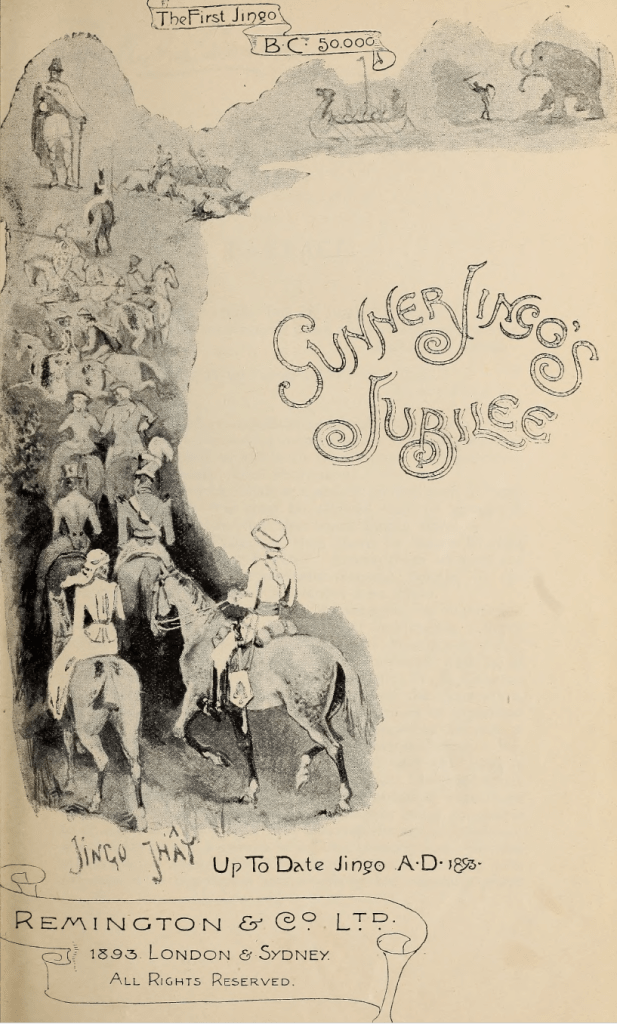
Lieutenant Thomas Bland Strange (Gunner Jingo) has a far more spirited telling:
“Now for a Cavalry charge! ” shouted the gunner chief, who had no right to indulge in such vanities, and turning to Jingo, ordered him to ride back for the General’s permission.
Jingo left with a heavy heart, knowing that his irrepressible chief would nail the Cavalry without leave, there being no distinct Cavalry leader for the mounted ”Tommies” of the l0th Regiment, the group of Indigo Planters, with their hog spears, under Mr. Venables, and the Punjabi Horse under Russeldar-Gholam-Ma-bund-Khan. Looking for a needle in a bundle of hay is nothing to looking for a General on a battlefield. When found, leave was granted, and the General became an accessory after the fact.
As Jingo rode back on his now played-out charger, he came across the handiwork of the Cavalry; scattered about were dead Sepahis and Mr. Venables with a lance thrust through his thigh that pinned him to his saddle, a couple of wounded ‘Tommies’ and some dismounted troopers leading their wounded horses.
Shortly after, the Colonel appeared, followed by a motley staff. Lieutenant Percival, Commissary of Ordnance, Captain Angus, interpreter, and Jenkinson, the civil magistrate, with Joe Smart, the adjutant, riding at the head of the returning Cavalry. They were flushed with triumph and nothing else, for no one had had anything since morning coffee. They took a smoke to keep off hunger, while Joe told his comrade how the chief had “led the Cavalry up the plain to the right, which was covered with Sepoy fugitives, who turned and stood at bay, firing their muskets and fighting with their swords until cut to pieces.” One little group stood splendidly at bay and the Colonel, who was a tender-hearted, generous man, called out —’Spare those brave men !’ But he had to change his mind suddenly, for he was only saved from a dangerous sword cut by the high cantle of his regimental saddle. He promptly shot his assailant, which was the signal for the rest to go down.”
Franks called a halt three miles beyond Chanda on the right of the road and waited for the Nazim, who he surely believed was marching from Wari. He detached the cavalry under Lieutenant C.N. Tucker (8th Bengal Light Cavalry) and two guns of Middleton’s battery to watch the flank, giving his exhausted troops a chance to rest, and a refreshment of “liquor and cooked provisions” was served out to them. He also took care to collect the guns Hoosam had left behind. As soon as was practicable, Franks took the ground to the left, just across the road from Amiripur village, to cover the baggage which was still coming up and all the better to meet the Nazim.
“After marching about three miles, the order was given to halt and pitch camp. The Ghoorkas, who had not been engaged, were thrown forward as outposts. The General was in a horrid temper — he had had no lunch — and growling that that ‘damned hot-headed gunner’ had spoilt his battle. The tent-pegs of his own old regiment, the 10th, were not properly aligned. ‘The regiment had gone to the devil entirely,’ since he gave up the command. The handsome old man strode up and down, swearing profusely, ordering the tents to be struck and re-pitched. The soldiers of the 10th rivalled their old chief in swears, not loud, but equally eloquent. They also were mostly Irish. ‘May the divil fly away wid the ould man from Munsther! Bad luck to the boys that didn’t shoot him at Sobraon! ‘ The General had a legend, and the men knew it. They loved his fighting qualities, but his strictness sometimes irritated them. “ (Gunner Jingo)
With sunset coming on and still no Nazim in sight, it was decided he was likely not going to show up today; however, just as it was decided to pitch camp, the Nazim appeared on the left front. Without any further thought, Franks ordered the force to change front and attack, using the same order as that morning.
“The Nazim, having suffered severely on his right, which was exposed on the open plain to our artillery and rifle fire, sought shelter in some thick mango-groves to his left, thus endeavouring to work round my right, and bringing an 18-pounder into action at a distance. But the attempt was speedily checked by the three battalions of Goorkhas on that flank, who, under Colonel Pulwan Singh, advanced, fired, and charged, driving the enemy before them. The complete state of preparation in which the Nazim found us, when he had anticipated coming unexpectedly on our left rear, took him by surprise. The heavy fire with which he was received completed his discomfiture and caused his almost immediate retreat in disorder towards Waree, his guns having never been closely engaged, with the exception of the 18-pounder before mentioned. The lateness of the hour and his rapid flight alone saved his artillery from capture.”
An hour after dark, Frank’s men settled down to rest. Owing to the difficult road, the baggage was late in coming and would not arrive until later on the 20th. All the while, the Nazim remained at Wari – Franks’ flank move and this sudden defeat at Amiripur had thrown him off balance and out of the direct road to Lucknow. He was now uncertain as to whether Franks would attack him in front at Wari or in the flank or if he should make for the fort at Bhadaiya, while not impregnable, was certainly defendable. Instead, he decided to wait and see what Franks was going to do, and accordingly, both sides sent out spies to watch each other.
At dawn on the 21st, Franks drew up his force in battle order so it would appear the Nazim he was planning to take Wari. He even allowed his entire baggage to file away to the right rear towards Lambhua, a village of a friendly zamindar named Rustum Shah. He then ordered a report to be sent out that he planned to halt at Lambhua, which the unfortunate Nazim believed, and he neglected to consider Bhadaiya Fort, thinking he would have plenty of time to occupy it. He did not expect what Franks did next.
“But I pushed the baggage rapidly through the village of Lambooah, and when this had been effected, my advanced guard under Lieutenant-Colonel Longden, withdrawing unperceived from Amereepore, overtook and headed the baggage, followed gradually by the whole force, which by a rapid movement seized Budhayan and occupied its fort. Five companies of Goorkhas were thrown into the fort, and six British companies, and two guns posted on the Nullah which runs under it, assured the main force encamped two miles in advance against attack on left flank or rear. The Nazim thus missed his opportunity. He had been deceived as to my intentions sufficiently long to allow of the safe progress of my incumbrances through the defile of Budhayan and had finally been forestalled in the possession of that strong position.”
General Franks was not done with the Nazim yet.

The General rode up and down the line, talking to the men. ‘Boys, me heart bleeds for ye. I know you’ve had neither bite nor sup this blazing day, but I’ve given ye your bellyful of fighting, and you must bivouac by your arms tonight.’ The call for Commanding Officers and Staff was sounded. ‘Gentlemen,’ said the General, ‘we must be prepared for another attack during the night. We have no outposts beyond our guns. I expect the utmost vigilance. The officers must set an example. I’ll have no shurrking and lurrking in doolies.’
In spite of excursions and alarms, the imperturbable native cooks improvised a meal. Jingo, with a pleasant sense of repletion and a pipe, lay down beside the guns and dozed but woke suddenly with the sense of some unfilled duty, and rising, visited the sentries along the line of unlimbered guns, loaded with canister. The moon was bright and shone in a fretwork of light and shade upon the white curtains of a doolie under a tree at some little distance in rear of the centre of the line of guns. He thought of the General’s last injunction, and lifting his sword scabbard to prevent clanking, he walked towards the suspicious doolie and raised the curtains.
‘Sheets by Jove and a round protuberance!’ He drew his foot back and administered a deliberate kick. It was followed by a fearful imprecation in the General’s voice. Jingo turned and fled to the utmost extremity of the line and flung himself down by the flank gun, a thoroughly demoralised subaltern, feigning the sleep which would not come. He felt utterly depressed. Here was his long sought bapteme de feu! He had helped his chief to spoil a battle, he had missed the ‘divarsion’ of a Cavalry charge, and he had finished up by kicking his General. What will be the end of a military career commenced in such a fashion? (Gunner Jingo)
Sources:
Caine, Caesar, ed. Barracks and Battlefields in India; or the Experiences of a Soldier of the 10th Foot (North Lincoln) in the Sikh Wars and Sepoy Mutiny. London: C.H. Kelly, 1891.
Franks, T. H. Operations of the Jaunpore Field Force and the Fourth Division under the Command of Brigadier-General T.H. Franks, C.B. in its Progress from Benares to Lucknow in the Months of January, February and March, 1858. London: Printed for Private Circulation, 1858.
Great Britain. Parliament. Further Papers, No. 7 & No. 8, Relative to the Mutinies in the East Indies. London: Harrison & Sons, 1857–1858.
Malleson, G. B. History of the Indian Mutiny, 1857-1858, Commencing from the Close of the Second Volume of Sir John Kaye’s History of the Sepoy War. Vol. 2. London: W.H. Allen, 1879.
Malleson, G. B., ed. Kaye’s & Malleson’s History of the Indian Mutiny of 1857-8. Vol. 4. London: W.H. Allen, 1889.
Nash, John Tulloch. Volunteering in India: An Authentic Narrative of the Military Services of the Bengal Yeomanry Cavalry During the Indian Mutiny and Sepoy War. London: George Philip & Son, 1893.
Strange, Thomas Bland. Gunner Jingo’s Jubilee. London: Remington & Co., 1893.
Pictures and Drawings:
Pinakpani. (2022, November 03). Ruins of an Indigo Factory. World History Encyclopedia. Retrieved from https://www.worldhistory.org/image/16641/ruins-of-an-indigo-factory/
https://www.britishempire.co.uk/forces/armyunits/britishcavalry/queensbays1852.htm
 Mutiny Reflections