The Formation of the Jaunpore Field Force
While the Sarun Field Force was plying its trade, the eastern front of Oudh was reinforced by the British, with troops sent to Jaunpore under the command of one of the ablest officers the army had to offer- Brigadier General Franks, C.B.
Born in 1808 in Mallow, County Cork, Ireland, Franks was commissioned as an ensign in the H.M.’s 10th Regiment of Foot in 1825. The 10th had seen service in many parts of the world, but in 1842, they set sail for the first time to India. They fought the 1st Sikh War – at the Battle of Sobraon, Franks was wounded and had his horse shot under him when the 10th, from the extreme right of the line, carried the Sikh army’s position in the front. Franks was made a Companion of the Bath. The 10th would be the first regiment to come up at the Siege of Multan in the 2nd Sikh War. When the siege concluded, Franks joined Field Marshal Gough on 10 February 1849 and served with merit at the Battle of Gujrat on the 21st. Promoted to colonel in 1854, he took command of the Jalandhar brigade in 1855.
When he handed over his command in 1857 to proceed home on sick leave, the mutiny had just broken out. Singularly single-minded, Franks refused to leave India and remained at Calcutta until he was well enough to return to the field. In January 1858, he was appointed commander of the 4th Infantry Division with the rank of Brigadier General. Directed to drive the mutineers out of the north-eastern frontier of Oudh, he was then to join forces with Jung Bahadur. The other force was formed under an equally capable officer, named Francis Rowcroft.
Colonel Francis Rawdon Edward Rowcroft was born in 1802. He was appointed ensign to the 18th Bengal Native Infantry in 1819 and then began a long list of transfers. He was posted to the 1/12th BNI in 1821, then transferred to the 1st BNI in 1824, was posted as Lieutenant Colonel to the 27th BNI in 1850, to the 2nd BNI in 1852, the 69th BNI in 1854, the 30th NI in 1855, and in September of the same year, to the 31st BNI. Finally, in 1856, he was commander of the 8th BNI in Dinapore, which promptly mutinied a year later. He was then left in Dinapore, his regiment gone and with little else to do but wait. However, things were changing. Rowcroft would be released from the onerous duties at Dinapore and form up the Sarun Field Force in western Bihar, comprising 30 men of the Royal Marines, 130 of the Pearl Naval Brigade, 350 Nepal troops and 50 men of the Bengal Police Battalion. For artillery, they had four 12-pounder howitzers, two of which were mountain-train guns. Their objective was to move from Tirhat along the Gandak River towards Gorakhpur.
The three corps, over the next months, were to clear the districts north of Benares and east of Oudh; when the aim was achieved, one corps would remain behind to keep an eye on things, and two would be brought under the direct command of Sir Colin Campbell, who would soon make his final move on Lucknow.
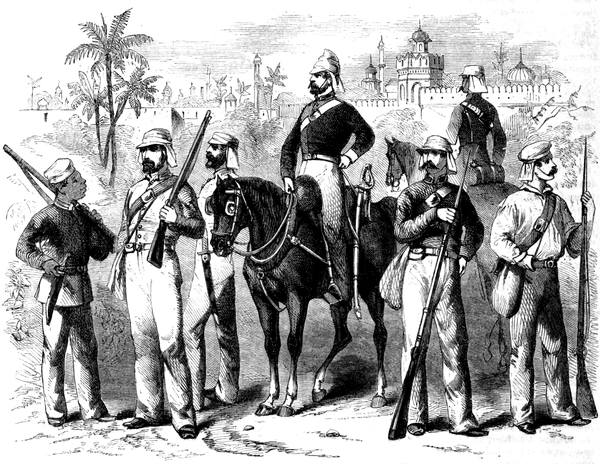
Ever since the mutiny of the Ludhiana Sikhs in June 1857, Jaunpore had been in a state of turmoil. The Europeans had fled the station – the magistrate, Mr Fane, had returned, but briefly, to pass the district’s governing to Raja Sheo Ghulam Dube and then had left again. Unfortunately, the raja’s appointment had done little to bring any order; lawlessness prevailed in the city as well as outside it. Zamindars who had lost their estates in the land acts of the EICo now took the opportunity to regain what was theirs and preyed on their weaker neighbours. Others felt their time would be better spent by forging alliances with the Nana Sahib. Dobhi Raghulbansis, more adventurous than the rest, cut off all communication between Benares and Azamgarh and then began invading the neighbouring districts, plundering as he went.
From Benares, Mr F.C. Chapman, an indigo planter by trade, set out into the district from Benares with a mixed force of Europeans, Sikhs and Hindustanis, and, in short, sharp actions, attempted to bring some of the lawlessness under control. Towards the end of June, Chapman made his way to Calcutta – he would be appointed second-in-command to Major Robertson of the newly raised Bengal Yeomanry Cavalry. Although he had not been able, during his short time in the district, to effect a lasting change, until September, Jaunpore remained relatively peaceful.
In September, the first contingent of Nepalese troops reached Jaunpore from Azamgarh. With the Gurkhas was Colonel T.J. Wroughton, who assumed command of the station. Captain Boileau, with Lieutenants Miles, Hall and Campbell – officers whose regiments had mutinied – were sent from Benares to cooperate with the Gurkhas. Shortly after, more Europeans descended on Jaunpore – Mr F.M. Lind took over the position of magistrate, with his assistants Messrs Jackson and Turner, swiftly followed by Messrs Carnegy and Astell. They swiftly reorganised the police, which was only operating in one thana, namely Jalapur, where the local chieftain, Ganga Saran, who had refused to be led into mutiny, had been keeping the Benares road open. Mr Carnegy moved towards Kirakat to assist Rai Hingan Lal with his police and to organise an efficient intelligence unit. Instead, we shall turn our attention to General Franks.
 Mutiny Reflections