March 1858
A juncture would now be formed between the Bengal Yeomanry Cavalry and the Sarun Field Force; however, it would take some doing.
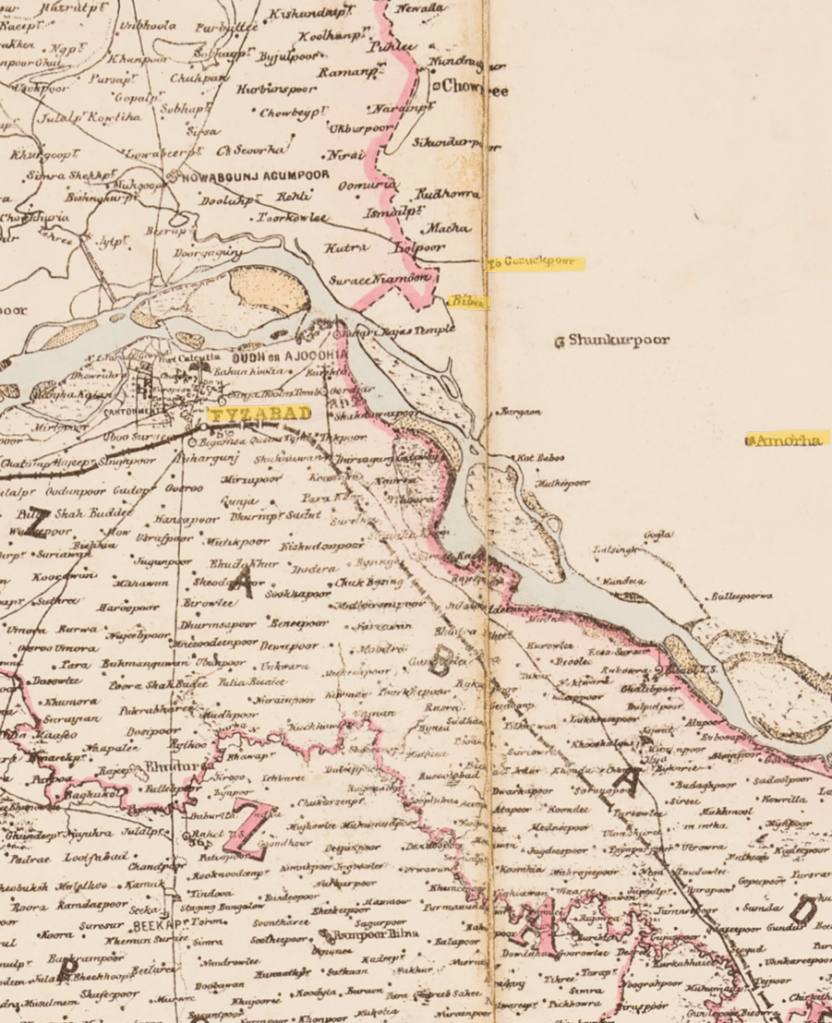
Belwa Fort
“At Amorah, we burst into the full blaze and storm of the rebellion and found ourselves, after many
mouths of unceasing marches, counter-marches, and flying marches, covering an extent of country which in length of mileage would have embraced European kingdoms…” (Nash, The Bengal Yeomanry Cavalry)
The Bengal Yeomanry Cavalry reached Amorha on 23 February, and for a moment, their ride was over. They pitched their tents, stationed guards and finally picketted their horses. However, their work was hardly over.
24th. Duty! duty! everlasting duty continues, and in consequence, some grumbling may be excused until the arrival of the Field Force on its way to succour us.
25th. Last night, without intermission, half the Corps patrolled to and fro in all directions, especially
along the main road leading into Oudh grim work! As rebel horsemen were hovering about, fifty sabres
were kept in the saddle by day and by night, ready for any emergency.
26th, This morning, a strong patrol, while reconnoitring, intercepted a band of rebels, gave chase,
overtook, encountered, and slew some of them, but owing to the difficult ground, the rest escaped, except three who were captured, and on their arrival in the camp, some sensation was caused when their arms and accoutrements proved them genuine Sepoys of the Bengal Army. As no intelligence concerning the rebels at Belwa could be extracted from them, and to all our interrogatories they assumed a sullen silence, they were at once led away to be hanged; and then followed a scene that, thank God! never except in such times as these falls to the lot of Christians to witness. Nobody in the camp who saw that scene has forgotten it, I am sure, or ever will forget it. Within the boundary of the encampment a gibbet having been extemporised in a cluster of trees, the mutineers were ordered to mount the elephant usually employed on such ghastly occasions; this they did with alacrity, and their arms being unpinioned, they helped to adjust the nooses in the cords round their own necks; then the elephant by “command” of its keeper moved off, and left the trio suspended to the branches in dying agony, until death by strangulation relieved their sufferings.”
The rebels were quick to realise that Jung Bahadur and his men were hastening towards Lucknow and had no intention of attacking Fyzabad; they began planning their return to the Gorakhpur District.
While Rowcroft marched, the Bengal Yeomanry Cavalry was indeed now the only force to hold back the tide. Belwa Fort, nine miles from Fyzabad, had been swiftly taken over by the rebels as soon as the Gurkhas had been withdrawn and found the Gurkhas had left them not only a decent supply of grain and stores, but they had taken care to reinforce the fort to which the rebels now added four guns. An advanced force of the Bengal Yeomanry Cavalry had tried to beat the rebels to Belwa, but they arrived too late, and they became the first targets for the fort’s guns, causing them to hastily retreat back to Amorah. The BYC sent a spy to ascertain the situation in the rebel camp – but before he returned, the cavalry would have a desperate fight on their hands. One of their pickets suddenly galloped into camp at speed -and within minutes, the “assembly” was sounded, and the men rushed to their horses.
The picket had been surprised by the approach of some rebels who were certainly looking for a fight. Before the messenger arrived in the camp, the picket had been forced to form up and engage the rebels in hand-to-hand skirmish.
“But not yet had the notes of the trumpets ceased when the camp-picket of fifty sabres were let loose, and away they rushed ” to the rescue,” while the main body to a man stood with bridle in hand if need be in readiness to mount. The picket had, however, attacked with such vigour and effect that, before aid could reach our fellows, the rebels were routed, and thrown out in their calculations; for, armed with muskets and matchlocks, which commanded a longer range than our carbines and revolvers, they probably had calculated on driving in the outposts, with a view no doubt to ascertaining our strength. Thus warned, as it were, we passed the night fully accoutred and on the qui vive.” The BYC suffered their first casualty – Trooper Henry Randolph was killed, his head was cloven in two by tulwar cut that extended over the shoulder, down to his lungs. He was buried the next morning wrapped in a horse cloth – in the distance, the rebel guns boomed, a chilling accompaniment to the prayers his lieutenant read over his melancholy grave. Word finally arrived from Colonel Rowcroft – the Sarun Field Force would be with the Bengal Yeomanry Cavalry on 2 March. However, they would face another day of fighting before Rowcroft arrived.
Their spy returned from Belwa to inform Major Robertson that the rebels were flocking in droves to the fort. Others were planning a foraging raid into the district: how many rebels were actually in the fort, he could not say, but it appeared, in his estimation, no more than 200. In light of his information and the fact that Rowcroft was approaching, Robertson decided to hold the camp ready to move at a moment’s notice and on 1 March, he led another scouting expedition to Belwa Fort.
They rode off at dawn, shrouded by cold, white mist. As the sun rose and the mist dispersed, the men could see the country they were riding through more clearly – every village they passed was deserted; not a soul was in the fields; it was as if the very country was hiding in fear. Halting behind a hillock close to Belwa Fort to better observe the rebels, the men were suddenly surprised by roundshot “ploughed across the fields and ricochetted over the slopes that protected us, while shells rushed and hissed like monsters of the air above our devoted heads….” All they could see was the heads of the gunners at the embrasures and hundreds of rebel sharpshooters who now sallied out, rifle in hand. They advanced some distance in front, but they proved to be such indifferent marksmen that the bullets whizzed harmlessly over the cavalrymen’s heads. After a quick look, the BYC retreated.
They had, however, seen the fort and the English engineer with Jung Bahadur’s force had certainly not wasted time in making those improvements. In the short time the Gurkhas had occupied the fort, he had thrown up earthworks with a deep ditch surrounding it. Loopholed walls and, above all, the four guns nestled in the embrasures certainly gave it a formidable appearance. The fort itself overlooked the Gogra River, and across the plains in front ran the high road to Lucknow. A village of the same name encircled the fort; thick groves of trees and broken ground completed the position. The Nepalese had left in such a hurry that no thought had been given to destroying the very works that the Sarun Field Force would now have to break through.
As the Bengal Yeomanry Cavalry retraced their steps to Amorha, the advanced guard of the Sarun Field Force met them halfway there, bringing with them the BLC’s camp and followers. The next day, as promised, Rowcroft arrived. The Field Force had just completed a tiring march over heavy, wet roads, but at 2 pm, after a short rest, Rowcroft decided to take the fort. Apart from what could be seen without, no one could say for sure how the fort was defended from within, and while the intelligence received that there were no more than 200 rebels in the fort, no one knew these had been augmented during the night of 1 March by reinforcements from Fyzabad. When Rowcroft began his attack, they consisted of at least 14000 men, including 3500 sepoys of the 1st, 10th, 53rd and 56th BNI, 700 men of the Gwalior Contingent and the 2nd Battalion, Oudh Police Force. To meet them, Rowcroft took 168 men of the Naval Brigade with four guns and 24-pounder rockets, 35 Sikhs, 500 men of the Gorukhnath Gurkhas, and 250 men of the BLC. The Ramdhul Gurkhas had been replaced by 500 untried, raw recruits of the Baruk Regiment, and Rowcroft decided, this time, to leave them behind.
Shortly before 5 pm, Rowcroft was in front of Belwa Fort and only then did he discover what he was up against. He brought up the Naval Brigade’s 12-pound howitzers to 900 yard range, which he gradually decreased to 350 yards, while the skirmishers (the Marines and the Sikhs) worked to within 200 yards. They captured the village with relative ease and drove out the rebels in their path at the point of the bayonet, but in front of the walls, Rowcroft was making no impression at all.
“Though the bombardment continued with unabating fury, no serious impression could be made on the stronghold; and long after dusk, in the hellish glare that now and again burst out from the explosions of the infernal missiles hurled at and from the fort, the rebels were visible lining the ramparts in crowds. Secure within strong defences, and outnumbering the Brigade by at least five to one, they could well afford to display a daring tenacity worthy of the old days, when they so courageously fought on behalf of the East India Company.”
After nearly two hours, Rowcroft was making no headway. To storm the place with so few men was suicide; he could not hope for reinforcements, so every man he lost to the failed venture was irreplaceable. As such, he called the retreat. The village was evacuated, and the force marched back to their camp. The rebels did not attempt to follow up on their advantage, but Rowcroft was taking no chances, and the entire force retraced its steps to Amorha. This seemingly retrograde movement was not lost on the rebels, and they at once began planning their next move. Calling on more reinforcements from Fyzabad, they determined now to meet Rowcroft in the open, at Amorha, and wipe the Sarun Field Force from the face of the earth.
 Mutiny Reflections