Moving Camp
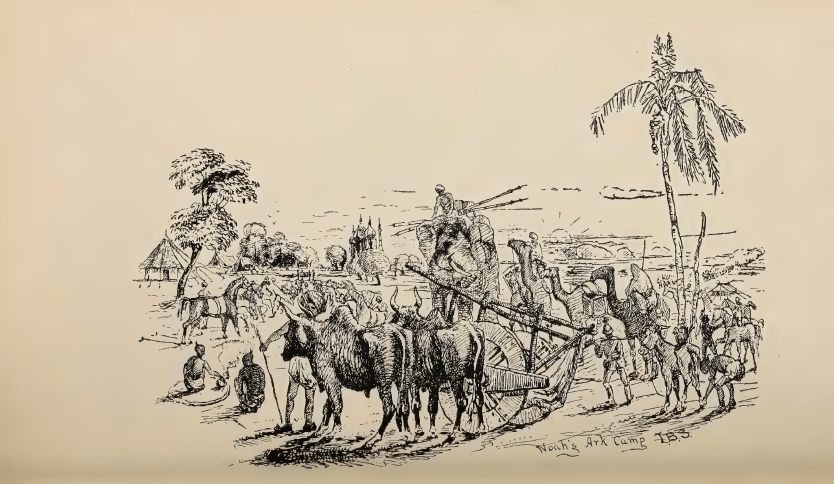
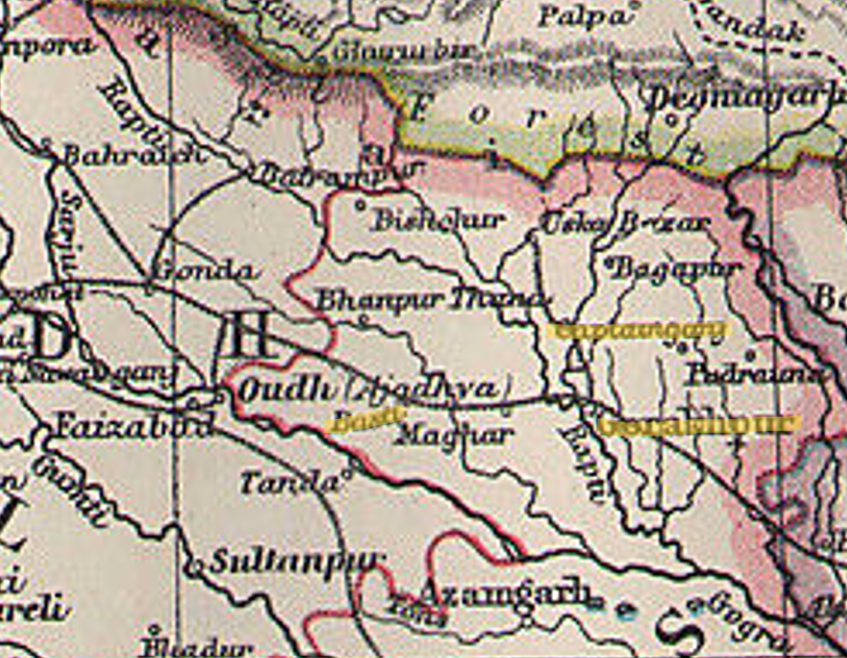
Almost as soon as Rowcroft and his men arrived back in Amorha, spies hurriedly rushed to his tent. The news was anything but reassuring, and there was plenty of it. They stated that Gorakhpur was once again threatened, this time by an invasion from Azamgarh; a horde of plunderers had been chased off by the police near Bustee, the village of Captainganj had been burned to the ground, and the fort at Nuggur had been occupied by insurgents. If they were to be believed, the entire country between the ferry at Gyghat on the Gangra River and the main road was completely overrun by rebels.
At Basti, where Captain Clerk commanded a small detachment of 150 Gurkhas (Burruck Regiment) and 49 men of the 4th Madras Cavalry, the rebels had begun making incursions into areas around Bustee that Clerk felt himself obliged to do something to send them a message. The rebels were led by Sheogholam Singh, a man of some influence and a name among the insurgents, whose reputation had caused Wingfield to put a price on his head of Rs 3000.
Clerk set off on 25 April towards Pyrah, some six miles from Basti, where he found the rebels in a large mango grove. The grove bordered a small village that in turn was covered by a bamboo jungle. The surrounding open country was interspersed with further mango groves, which extended wide and far over the plain. As the rebels were not yet aware of Clerk’s approach, he directed the Gurkhas to form line and advance directly at them while he rode around with the cavalry to intercept the rebels should they make a retreat through the village. The rebels were now fully aware of Clerk. They leapt to their feet and formed a line at the edge of the grove. The Gurkhas continued their advance, with Mr Wilson (assistant magistrate and a volunteer on the expedition) at their head. The rebels fired off a volley, stood to and then began to retreat, the Gurkhas and Wilson continuing forward. The fire of the rebels soon became “ill-directed” and made no impression on the Gurkhas, who drove them towards the bamboo jungle. With the thick bamboo offering some protection, the rebels made a stand, but the Gurkhas were unrelenting, and they continued onwards, pushing the rebels still further, towards Captain Clerk and the Madras Cavalry. Clerk formed up and charged, “cutting down and wounding several.” It was too much for the rebels – with all hope of resistance gone, they fled, rushing headlong into the surrounding groves and disappearing into the countryside. Among the 60 dead was Sheogholam Singh. They had numbered 400 men, but over half of them had retreated before the advance of the Gurkhas and had never taken part in the fight. As for Clerk, intelligence reached him that this was by far not the only rebel force in the area – a further party was merely five miles away, and he called off his men from proceeding too far down the road. His casualty list was two killed, five wounded, six horses wounded and one missing.
Rowcroft now deliberated what was for the best. His position at Amorha, useful as it was, had now the inconvenience of having rebels to the rear of it. If he continued to hold it, the districts and towns around him would be laid open to plunder and destruction. There was no other force in the vicinity to give the rebels a fight, and allowing this kind of ruination, if it was allowed to continue, gave the rebels an upper hand. There was nothing for it – under the urgings of the political officer attached to the force, Mr Charles Wingfield (one-time commissioner of Gorakhpur District), Rowcroft decided he would, at least for a time, abandon Amorah and make off into the district. That this would give the rebels in Belwa a moment of triumph was clear, but if he played his cards right, it might also draw them out into the open, and this ridiculous state of affairs would finally come to an end.
Allowing his men but little rest, Rowcroft ordered the camp struck, the baggage packed and above all, the walls of his little fort levelled. At midnight, the captured guns burst, and the Sarun Field Force moved out. They were headed for Captainganj, only 12 miles distant. As for Clerk, who had requested to be withdrawn from Bustee, Rowcroft told him to stay put; he needed eyes on the road. If all went well, the Sarun Field Force would be at Captainganj the next day.
“Something like a guerrilla warfare having set in, with insurgents threatening our flanks, the baggage, etc., was directed to move between the tail of the Brigade and the head of a strong body of all arms. But this precaution, however necessary, was the means of converting the march into a crawling, melancholy procession, resembling one following a funeral; and so tediously slow was our progress that the camp followers, in their impatience to outstrip an imaginary enemy, from whom no doubt they conjectured we were bolting, could not be restrained within the line allotted to them. “
The roads were bad, and the night uncompromisingly hot. While a stiff wind had been blowing for days over the baked plains around Amorha, it had now ceased, and not even the most trifling of breezes was perceptible. The draft bullocks were out of temper, alternately throwing off their yokes and “scamper facetiously into a neighbouring field or village, giving a run to some unhappy driver.” When they weren’t playing up, they were lying down and falling asleep. It took nine hours to cross the 12 miles, and it was not without added misery. Major Richardson’s horse groom, having missed his way in the dark, overshot the camp altogether and disappeared, taking Richardson’s charger with him. Richardson’s servants, together with his baggage, followed the hapless groom, and he found himself in camp without his clothes, his valuables or his second horse. While Richardson stamped about, cross and put out, his servants suddenly reappeared – they had been set upon by a band of marauding sepoys. The horse was gone, the groom and one other servant had been killed, and they had lost his baggage. It was not the best start, but there was nothing for it, and it was only made worse when other syces came rushing into camp to report the theft of even more BYC chargers. With no replacements to be had, it was a devilish loss.
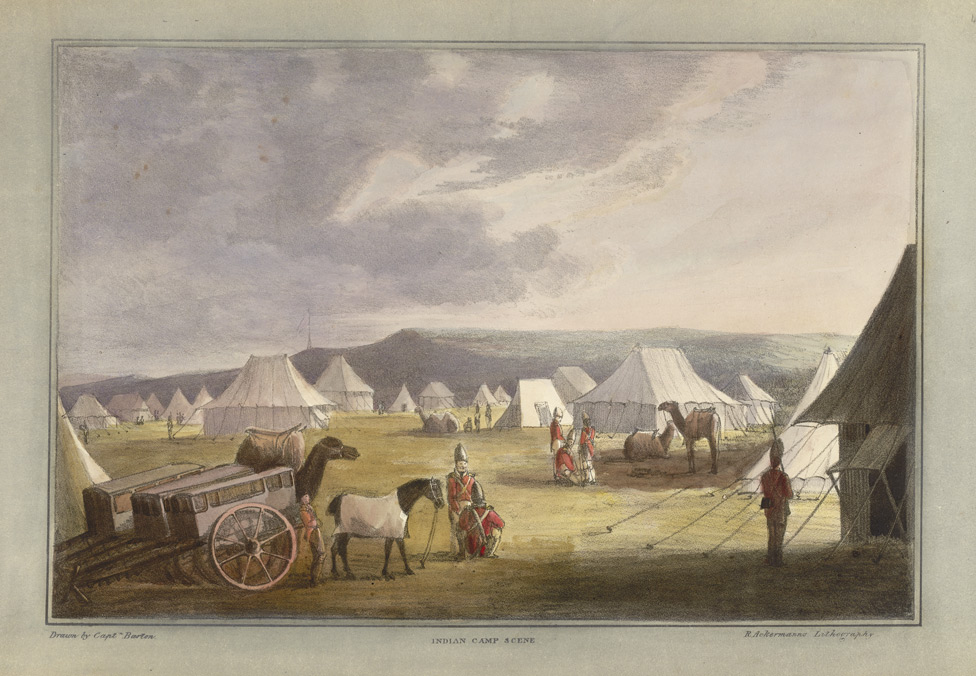
The camp was set up, and the men now waited for their next encounter with the rebels. It came soon enough – on 29 April.
 Mutiny Reflections