Amorha 3- 5 March
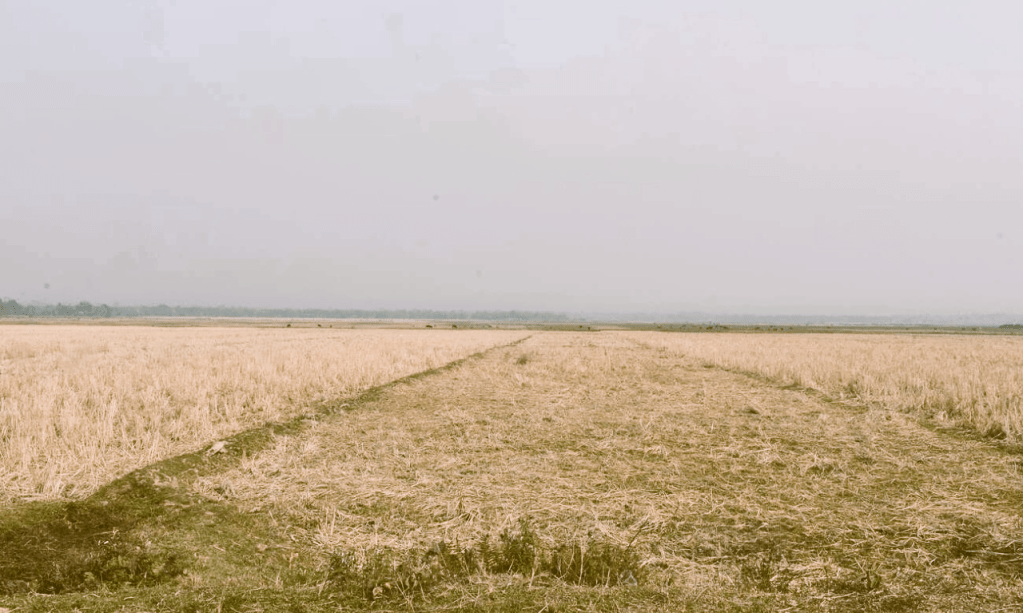
The position at Amorha was by no means a weak one. Although the high road to the southern districts passed through it, the village was surrounded by vast, empty plains which were only sparsely populated. On the right, stretched open country with an unhindered view in that direction, while on the left, the land was so flat, a stealthy approach was impossible. Rowcroft planned to meet the rebels in the open – his force was numerically weak, and there was not a single European regiment within 100 miles of him. All told, Rowcroft was taking a terrible risk.
A rifle pit was dug around the camp, which Rowcroft had pitched in an open field. The only thick jungle to its front was chopped down, and the village was demolished. “The walls of the houses were two or two and a half feet thick and built of strong, tenacious, and compact mud. At the bidding of the mahout, the elephant would push it with his ponderous forehead, throwing the weight of his body into the shove. Sometimes, if this failed, he would open his wide mouth and bite the top of the wall and pull down loosened and detached pieces with his trunk, and then, with the wall thus mutilated and weakened, he would try the pressure of his skull again, levelling a village with marvellous rapidity.” All the tents were packed, and the baggage carts loaded to put all the impedimenta of the field force in as small a space as possible and then taken to a village in the rear, which could be protected by the few guards Rowcroft could spare. He then sent his spies into the field to inform the rebels that his force was in full retreat.
The work was completed by the 4th, and Rowcroft ordered his men to remain under arms for the remainder of the night. Early on the 5th, a messenger arrived that the rebels would not attack that day – they had issues of their own with a raja who had been trying his luck at taking Balwa Fort. As the message came from a loyal Rani, it was considered to be truthful; but within minutes, another messenger arrived, contradicting her report and Rowcroft, not wanting to be caught unawares, sent the cavalry to reconnoitre. They swift returned with the news that the rebels were indeed advancing, so Rowcroft doubled his patrols and sent out a party of cavalry again to report on their progress. His men now stood to arms and waited.
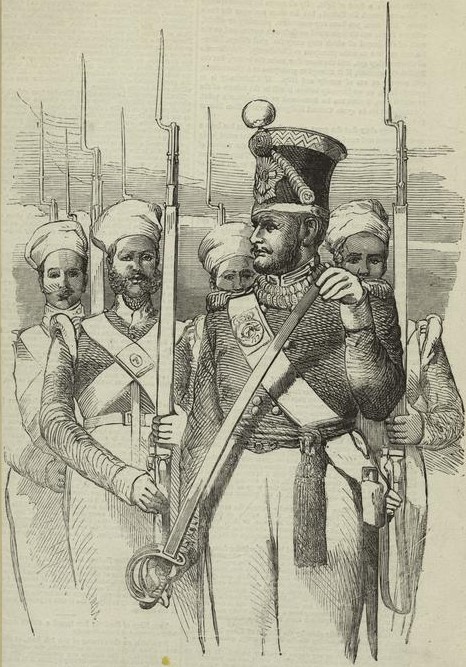
The force moved out at 7 in the morning to take up a position half a mile west of Amorha and formed line. The Naval Brigade and four guns were in the centre across the road, under the command of Captain Sotheby. The two Gurkha Regiments were formed up on either side of the Naval Brigade, under the military charge of Captains Brooks, Berkley and Macgregor. Lieutenant Burlton’s detachment of Sikhs took their position to the left of the Gurkhas, while one squadron of the Bengal Yeomanry Cavalry under Captain Chapman took the right of the line, while another, under Major Richardson, took the left, thus covering both flanks.
Soon, bugle calls were heard in the distance -first sounding the halt and then the advance. The men waited anxiously in line – and slowly, it seemed from the very horizon, the rebel army could be seen. They deployed into line, extending right and left for nearly a mile each way, overlapping Rowcroft’s flanks and opened the day by pushing forward a “cloud of skirmishers”. It was clear they were no rabble – they were skilled and trained sepoys who remembered their training well.
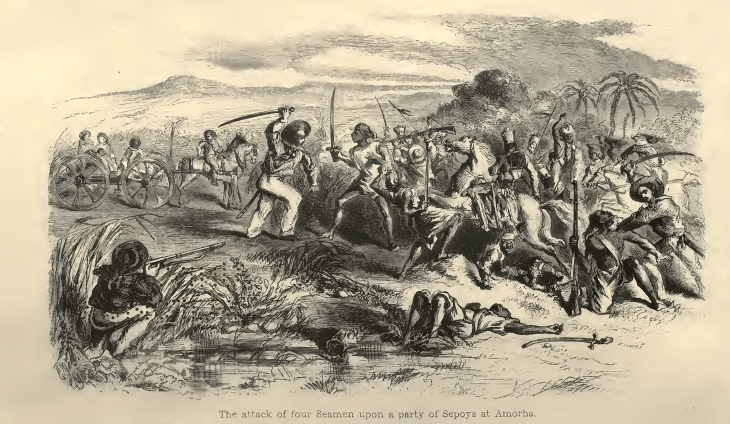
Rowcroft waiting until they were within range of his guns and at 8.30 in the morning, Lieutenant Turnour opened fire from the centre – the rebels replied with ten guns directly at Rowcroft’s line, while his skirmishers were sent forward to contend with those of the rebels. Then, acting on the principle that “attack is the best method of defence, ” Rowcroft ordered the whole line to advance.
“In vain the gallant Jack Tars poured torrents of grape into their thronged ranks, before which they went down like ninepins; in spite of the Marines showering volley after volley into their advancing columns, and the Sikhs and Gurkhas, shoulder to shoulder, bravely holding their ground, the rebels step by step pressed on…There the conflict raged fiercely, the cold steel doing its murderous work unrelentingly, as evidenced by the jags in our sabre-blades retaining pieces of bone, and blood-besmeared hair.”
The rebel line was so extended that when their centre was driven back, their extreme right was not aware of it and they continued marching at a liesurely pace towards Rowcroft’s camp. Realising they could unwittingly outflank him, Rowcroft sent word to the Major Richardson to detach a troop, or if necessary, take the whole left squadron and charge the rebels.
“The cavalry was ordered to pass forward, and charge a surging column of mutineers pushing on to support the centre of their line. Accordingly, the instant the word “charge” was given, the Yeomanry gave the spur to their horses and encountered a deadly hand-to-hand struggle, which they terminated by annihilating the head of the column. So far, so good. But the immediate effect of this charge was electrical on the main body; for, hearing with surprise the din of the desperate men they hesitated in their advance, recoiled, then rallied, and in dense, disorderly masses pressed in towards their centre, while the ” broken column,” disorganised by the charge, likewise collapsed with confusion in the same direction...”
“Many a hand-to-hand light might be described, when a Sepai, despairing of his chance of escape, turned round, stood his ground, and fought fiercely with his mounted antagonist, using either his bayonet or butt-end of his musket, as best suited his taste; and sometimes he would make a cut at the horses’ legs with his tulwar as he passed, which was a favourite trick with those who were unable to make a defence.”
From the first moment the rebels were seen to waver, Colonel Rowcroft immediately ordered a party of Naval Riflemen to reinforce the Royal Marine skirmishers and then ordered Captain Chapman and his squadron to advance, inclining towards the right, to take on the rebel sowars and and infantry; at the same time, the Goraknath Gurkhas advanced at the charge. All the while, the Naval Brigade was advancing on the masses in the front, and never halted except to discharge a volley of grape.
“Then they unlimbered the guns, fired as many rounds as the retreating multitude would wait to receive, then limbering up, would gallop the guns more like horse than foot artillery, and when within range, would again unlimber and discharge as many rounds as the time admitted; limbered up and galloped on, chasing them with a speed, and working their guns with an activity, truly surprising.”
Lieutenant Grant, Engineer Shearman, two seamen and midshipman Lord Charles Scott rushed forward and quickly took charge of a gun the rebels had abandoned in their flight – they turned the gun on the retreating sepoys and loaded it with the contents from its own limber. Realising they had no portfire to hand, a rifle was discharged with the muzzle directly to the vent, giving the rebels the “benefit of grape” from their own gun. Captain Chapman, in the meantime, ordered his squadron to charge, and they flew pell-mell straight into the left wing, slashing as they went, scattering the rebel’s left wing. The centre was driven back, and both their right and left had been severely shaken; their cavalry was no longer up for a fight and began to retreat, with the infantry at their heels. The combined movement of Rowcroft’s troops, the formidable charge of the Bengal Yeomanry Cavalry and the persistent advance of the Naval Brigade had succeeded in shattering the entire rebel line. In their flight, they abandoned eight of their guns, which they had no time to spike. They varied in size from an 18-pounder to a 9-pounder, 6-pounders and some of smaller calibre: the gun-carriages and limbers were complete and stocked with ammunition. The bullocks to draw them were still on the field, and a cart with 25’000 musket balls had been abandoned. Back at the camp, the guard was momentarily threatened by no less than 1500 men, but the cavalry and two companies of the Gurkhas soon put them to flight.
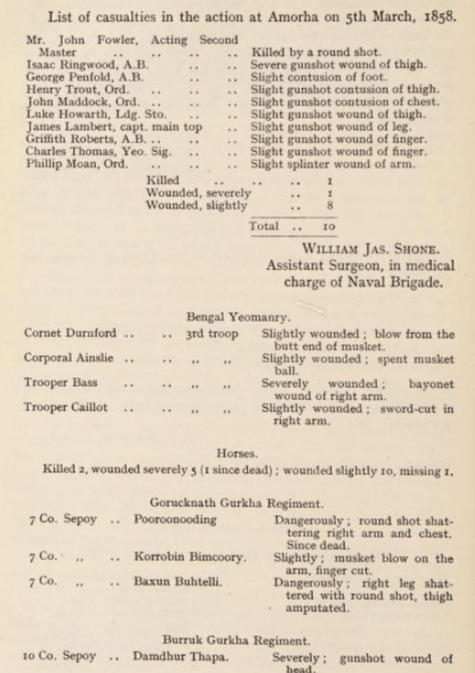
Rowcroft was determined that the lesson had not yet been learned, and he allowed his men to rush in the pursuit. For the next six miles, the rebels were driven from village to village – wherever they contrived to hide, Rowcroft’s men found them and drove them out; it was not a war of mercy or pity and none was expected. As Nash pointed out, it was “war to the knife,” and if we had shown any mercy, they would assuredly have shot us down the next moment….” After eight hours of fighting, the Sarun Field Force and the Bengal Yeomanry Cavalry returned to camp. The BYC, to their surprise, had been given a new name by the rebels – Shaitan-i-Paltan -the Devil’s Regiment, a name their spy assured them had been given with as much respect as they could muster after such fearful slaughter. For the remainder of the mutiny, the name preceded the Bengal Yeomanry Cavalry. The rebels left no less than 800 dead on the field; the Sarun Field Force answered with one killed and 17 wounded.
During the battle, the seamen could not understand why the rebels were bolting and one was heard to exclaim, “What are these rascals bolting away for? If they would only come on with sticks, they must have beaten us!” Their guns had been a target for the rebels and every gun and limber had been struck more than once by grapeshot – the shot fell fast and thick and ricocheted in every direction, while the heavy musketry fire should have been enough to put an end to the Sarun Field Force. Yet, the sepoys persisted in aiming too high, and the balls passed over the heads of the troops in line until their “whiz” was no more than an inconvenience. However, the sepoys, those that had not run from the field, had retreated in an orderly and organised manner. Their uniforms were worse for wear, “Some of them had cross-belts and red jackets, muskets, and bayonets; some had the uniform jacket without the trousers, and some the trousers without the jacket; some wore the jacket with the regulation musket, and some were reduced to the necessity of using native arms and dispense with uniform altogether,” but their regiments still kept together. Unfortunately, their spies had told them Rowcroft mustered only 400 men, was poorly armed, had no cavalry and was in full retreat. The sepoys were, for the most part, leaderless: none of their officers had ever been permitted under their European officers to command in the field, and they were leading from the many years of experience they had gained while fighting at their side. The Nazim Mahomed Hussein and the Rajahs of Gondah and Churdah, among other chiefs, who were present on elephants, left early on in the action and provided no leadership at all. They had once again been betrayed by circumstance.
There would be three actions in all at Amorha, but in this first one, the rebels outnumbered the Sarun Field Force at 15-1. They had brought no less than 15’300 men of all arms to the field and were routed by Rowcroft’s paltry 1420.
Following March 5, the rebels no longer attempted to attack the Sarun Field Force but confined their activities to occasional raids to loot the villages in the district, so it was by no means a time for the field force to sit back. Constant alarms kept them aware of the danger around them, and they would sometimes be left standing to arms for several hours waiting for an enemy that never showed. Rowcroft ordered the camp to be further fortified – it was now encompassed with trenches, and for the protection of the hospital and the magazine, earthworks were built up and mounted with the captured guns. All the remaining huts which stood in the line of fire were levelled. By the middle of the month, the camp was beginning to take on the appearance of a fort, where in case of an attack, the strength of the guard could be reduced without incurring any disproportionate risk.
Although the rebels were only 10 miles away in Belwar Fort, Rowcroft did not attempt to disperse them. For their part, they confined their movements out of Rowcroft’s view. This state of affairs would continue until April – the fall of Lucknow had unleashed a flood of rebels into the surrounding districts. The Sarun Field Force would fight again.
Sources:
Malleson, G. B. History of the Indian Mutiny, 1857-1858, Commencing from the Close of the Second Volume of Sir John Kaye’s History of the Sepoy War. Vol. 2. London: W.H. Allen, 1879.
Malleson, G. B., ed. Kaye’s & Malleson’s History of the Indian Mutiny of 1857-8. Vol. 4. London: W.H. Allen, 1889.
Nash, John Tulloch. Volunteering in India: An Authentic Narrative of the Military Services of the Bengal Yeomanry Cavalry During the Indian Mutiny and Sepoy War. London: George Philip & Son, 1893.
Rowbotham, W. B. The Naval Brigades in the Indian Mutiny 1857-58. London: Printed for the Navy Records Society, 1947.
Williams, E. A. The Cruise of the Pearl Round the World, with an Account of the Operations of the Naval Brigade in India. London: Richard Bentley, 1859.
 Mutiny Reflections