Brigadier Franks
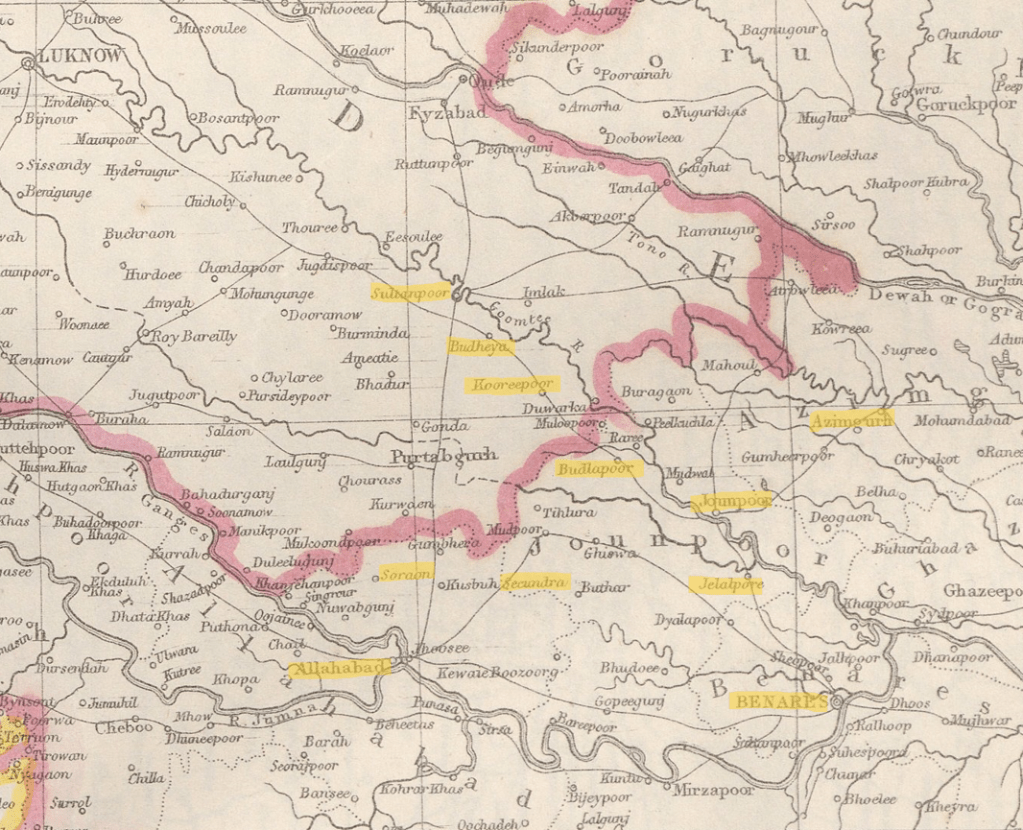
On 29 November 1857, Franks was appointed to command the troops in the Azimgarh and Jaunpore districts. Colonel Wroughton would continue managing the “internal arrangements” of the Gurkhas, but he was placed under the direct orders of Franks. Furthermore, the magistrates of Azimgarh, Jaunpur and Gopiganj were requested to provide all intelligence of rebel movements in their areas directly to the new commander.
The Jaunpore Field Force consisted of:
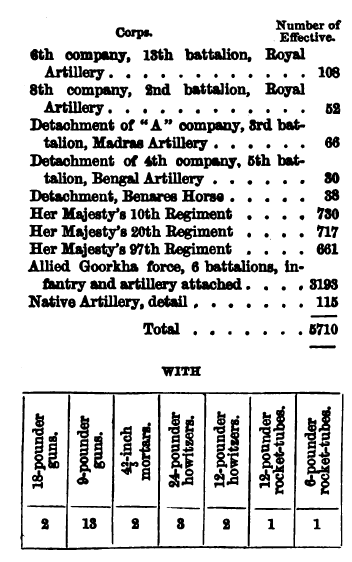
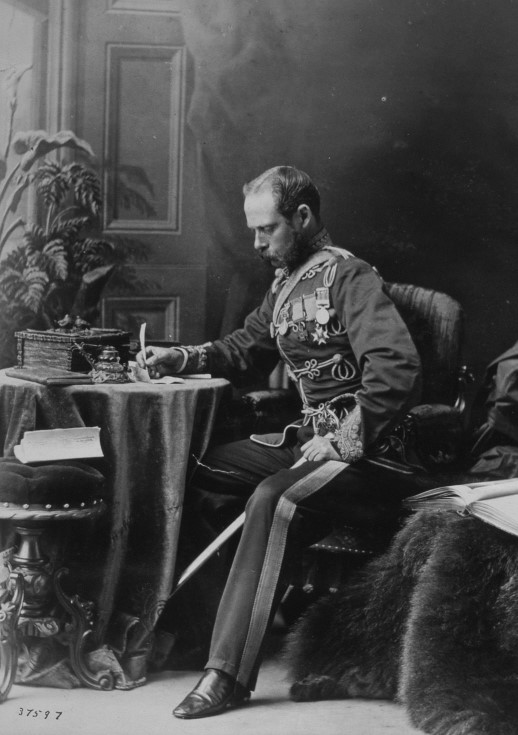
For his Assistant Adjutant General, Franks had the services of Captain Henry “Harry” Havelock, who had served as his adjutant in the 10th Regiment for six years. Although still suffering from his wounds, Havelock, upon hearing Franks was to lead a field force, jumped at the chance to join him, and he wasted no time in rushing up from Cawnpore.
As it was, Franks was told his main duty would be to “protect Benares against attack or insult”; furthermore, he was to prevent them from crossing the Ganges into Bihar and to recover any of the districts they occupied. However, the Lieutenant-Governor of the Central Provinces, Mr J.P. Grant, wisely added a supplement to Canning’s memorandum, in which he described the state of the frontier, its rebel chiefs, the strategies they were likely to pursue and the means at their disposal. In the north, Franks would have to contend with the Nazim Mahomed Hussein, who was conducting raids into the Gorakhpur District. Although he had some isolated sepoys at his disposal, the majority of his force consisted of undisciplined bodies of matchlock men. Together, they numbered 15’000. The concern was the threat he presented to Gorakhpur itself and the Azamgarh District.
The sepoys in the Gorakhpur District had been collecting along the Gogra and Rapti Rivers; nothing was known for sure what their intentions were, and they numbered anywhere between 200 and 600 men; Franks was warned they might try to cross the Gogra. Some had joined forces with a nephew of Kunwar Singh, who was roaming the district with his levies from Bhejpore and Arrah. To add to Franks’ concerns:
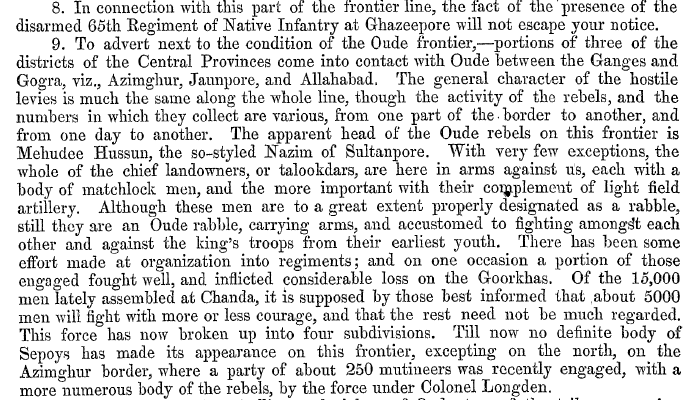
He was further expected to keep the rebellious talukdars of Oudh in check – these had taken to raiding on both sides of the Jaunpore and Azamgarh borders. The supplement concludes:
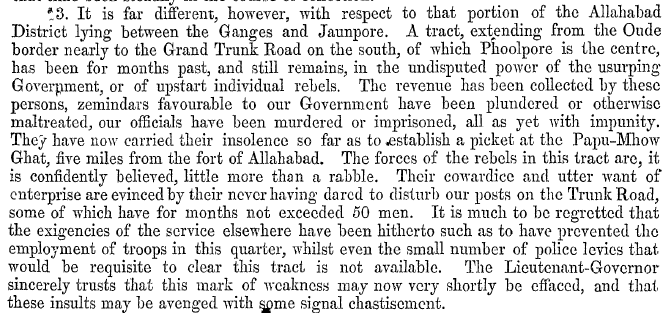
By the end of December 1857, Franks had consolidated his force and had taken up a strong, defensive position, placing his right column near Azamgarh, his centre a few miles from Jaunpore and his left at Badlapur. While this hindered the rebels from launching an all-out assault, Franks was unable to prevent them from continuing their punitive, pillaging raids into the districts 120 miles distant from Jaunpore.
“The leader of the rebels was called Mehndi Husen. He called himself Nazim of Sultanpur. Like many men who rise to the surface in a period of riot and disorder order, he was an adventurer whose main object in life was to secure for himself something tangible out of the general wreck.” (Malleson)
While the Nazim had 15’000 men, intelligence received pointed out that a third of them could not be depended on to fight. However, he was certainly going to try. The Nazim established his headquarters at Chanda, 36 miles from Jaunpur on the Sultanpur road, while his lieutenant, Fazal Azam, occupied the fortified position of Saraun, 14 miles north of Allahabad, with his outposts within four miles of the station. Franks intended to deal with Azam first.
Franks’ problem, however, was that he had no cavalry to speak of. Twenty-five men HM’s 10th Foot were saddled and placed under Lieutenant Tucker of the Bengal Cavalry to augment Captain Matheson (13th Irregular Cavalry) and his 38 volunteers of the hastily raised Benares Horse. These units were hardly formidable, and while there was no questioning their usefulness, with so few numbers, their ability to sustain a pursuit after a battle would be ineffective. Both Calcutta and Sir Colin Campbell were aware of this particular difficulty, but logistically, it was well-nigh impossible to send the cavalry Franks needed on such short notice; the first reinforcement Franks received was a two squadrons of the 2nd Dragoon Gaurds (The Queen’s Bays) and four additional horse artillery guns, despatched from Allahabad, on 20 January 1858. As soon as Franks learned these were on their way, he moved his left column of 1400 men, with six guns to Sikandra, only seven miles from Saraun. Fazal Azam was in no mood to meet Franks yet – as soon as he heard of his advance, he packed up his camp of 8000 men and six guns to a new position at Nasratpur, where he joined forces with his ally, the beligerant talukdar Beni Bahadur Singh.
Franks decided there was little point following Azam without cavalry and spent 22 January gathering as much information as he could about Azam’s position. Like Rowcroft, he ordered a temporary stockade to be erected around his camp in which he would leave, under a minimal guard, his baggage, camp followers and sick when he finally entered the field. Towards evening, his cavalry reinforcements arrived, and the next morning, Franks opened his campaign.
 Mutiny Reflections