Lieutenant Herbert Taylor MacPherson, 78th Highlanders
“In Sir Herbert Macpherson we are glad to recognise a true born Highlander…”
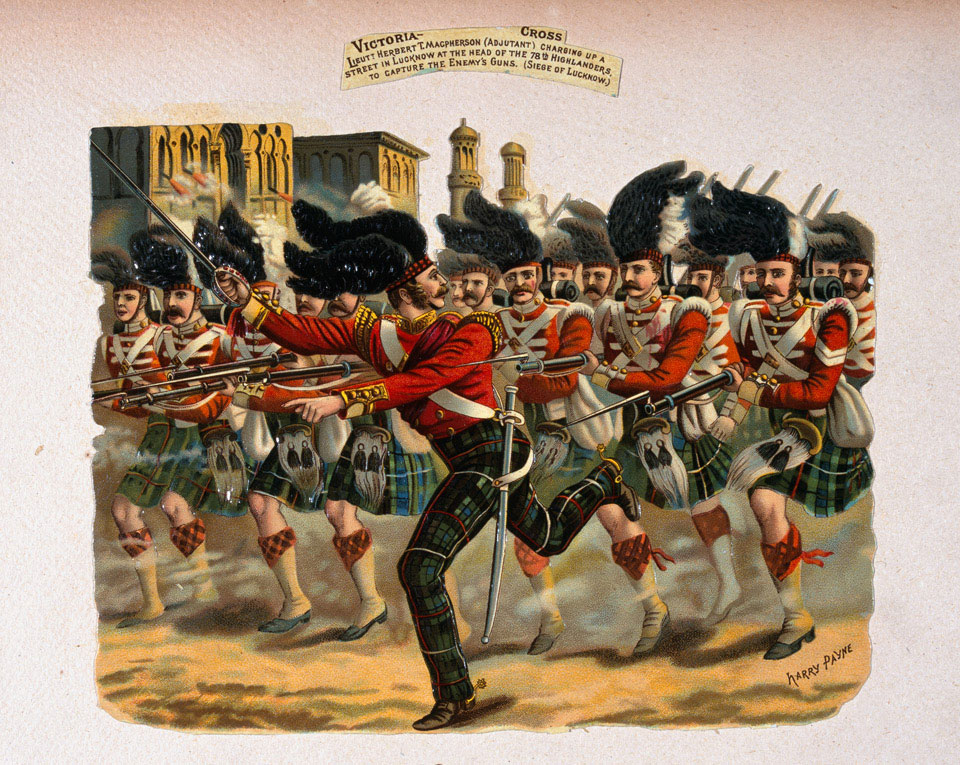
For Herbert Macpherson, there was never a doubt he would join the army. When the 78th was raised at Fort George, his father and uncle entered into the service of the regiment. While his uncle would be killed fighting in Java, his father, Duncan Macpherson served out his career with the 78th and finally retired as lieutenant colonel. The death of his mother prompted him to return home; he took up his residence in Ardersier, married one Miss Campbell and settled down to a life with her and their ten children – Herbert was born in 1827.
Herbert spent his childhood at Aredersier and attended Nairn Academy during which time, he lived with his aunt, the widow of none other than Dr. Smith, assistant surgeon aboard the Trafalgar and one of the attendants of Lord Nelson at the time of his death. Unfortunately for Herbert, with little money and no connections save the names of his father and uncles to fall back on, it seemed unlikely he could obtain a commission to the army. That is, until 1844.
In 1844, the 78th was stationed in Scinde and had fallen prey to such a violent scourge of cholera, that the regiment appeared to be on the verge of extinction. Hearing of this most distressing news, Herbert boldly applied directly to Lord Fitzroy Somerset, then Adjutant-General and pointedly asked for a commission in the 78th. Possibly more surprised than anything else that a young man could be so determined to join a dying regiment, Somerset promised him the grant of his request. In 1845, Herbert was gazetted an ensign in the 78th and soon after joined them. He quickly made a name for himself – in 1848 he obtained his lieutenancy and was proclaimed to be the smartest adjutant in India, besides his reputation as a sterling rider and the keenest of sportsmen. If anything, army life certainly agreed with Herbert Macpherson.
However, there was more than this to Macpherson. Stationed with his regiment in Aden, in 1855, he embarked on a hunting expedition to the interior with two of his comrades. On one fateful night, their hut was attacked by thieves – in the ensuing scuffle, one of his companions was mortally wounded, but Macpherson, having been awoken by the noise, rushed at a man, whom he could barely see in the dim light. To his astonishment, he found the man was perfectly naked and covered in oil, making it impossible for Macpherson to hold him but with grim determination, Macpherson tried and in the resulting fight, was knocked senseless and awoke to find himself wounded in eight places. He recovered in time to join his regiment for the Persian War of 1856.
With the 78th, Macpherson fought through all of Havelock’s battles and finally, in Lucknow:
“When with his regiment he was making his way through the city, fire was opened on them from some guns in a cross street; for an instant, the regiment hesitated, but the gallant Adjutant, collecting one or two men, charged the guns, cut down the gunners, and silenced them, and for this deed of daring he bears the Victoria Cross. He was one of the first to reach the defences of the Residency, and might have been the first man to enter it, but as his regiment was then under a hot fire he preferred to remain with, and encourage, his men.”
Following the relief by Sir Colin Campbell, Macpherson remained behind with Outram at the Alambagh, he was raised to the rank of Captain in 1857 and then rejoined the force as acting Brigade-Major in Campbell’s retaking of Lucknow in March 1858, the same year Macpherson received his brevet majorcy. Shortly after, the 78th was ordered home. Macpherson did not go with them; he exchanged into the Bengal Staff Corps and was appointed by Sir Colin to command a Gurkha regiment with whom he saw service in Hugara during the Looshai Expedition and in Iowaki, where he proved he was not just an excellent soldier but an “able tactician and strategist.” Later, under Sir Samuel Brown, Macpherson took to the field again for the advance to Afghanistan.
“The first duty assigned to him and his brigade was a march by mountain tracks, so as to get in rear of Ali Musjid, and cut off the retreat of the garrison if they should attempt to escape when the fort was attacked by Sir S. Brown. Macpherson remonstrated against the orders, pointing out that the time allowed him to accomplish the march was insufficient, but without effect, and like a good soldier he set himself to do his best. The difficulties of the march were incredible, a great part of it being accomplished by night over tracks where men could only march in single file, and the light mountain guns had to be taken to pieces and lowered over precipices by ropes. He accomplished his task, however, within the time allotted to him, but only to find that a demonstration having been made against the fort a day sooner than had been arranged, it was evacuated fully twelve hours before he was informed the attack would take place, and he arrived in the Valley of the Kyber only in time to catch sight of the rear guard of the retreating garrison as his weary brigade were threading their way down the hills. It is said that in sheer vexation he rode after the enemy himself, and fired his pistols at them as a challenge.“
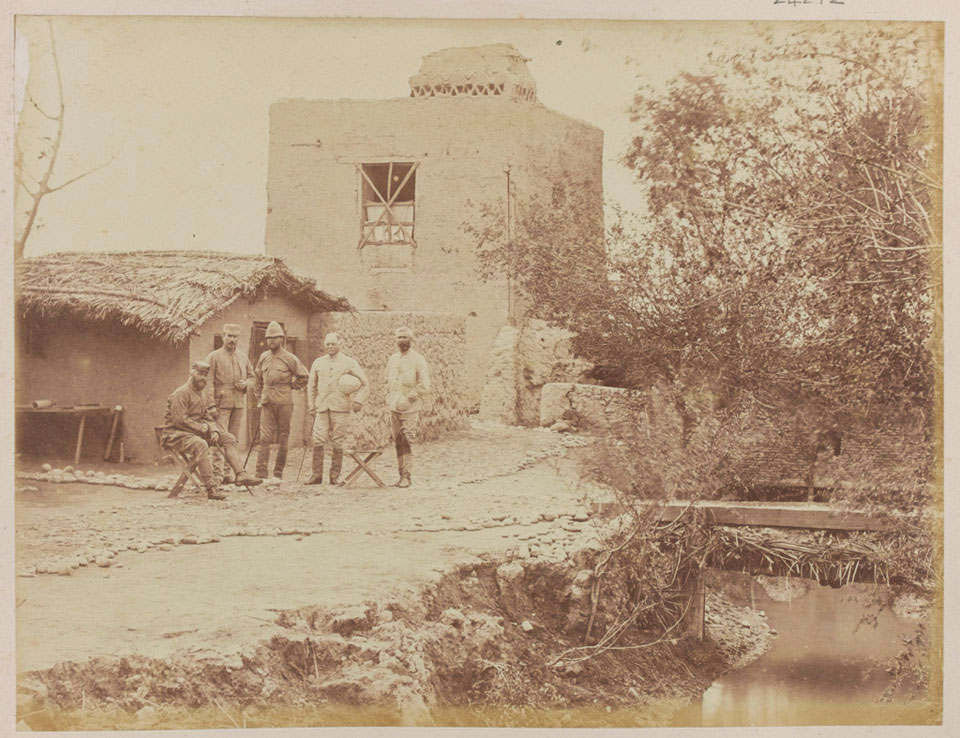
https://collection.nam.ac.uk/detail.php?acc=1969-03-8-18
As we cannot spend our time on the illustrious career of Herbert Taylor Macpherson, as intriguing as it is, he did, after all, accompany Roberts on the march to Kandahar, we shall allow his medals to speak for themselves:
- Victoria Cross
- Knight Grand Cross, Order of the Bath ( GCB )
- Knight Commander, Order of the Star of India ( KCSI )
- India General Service Medal ( 1854-95 )
- 5 clasps:
- “Persia” – “North West Frontier” – “Looshai”
- “Jowaki 1877-78” – “Burma 1885-87”
- Indian Mutiny Medal ( 1857-58 )
- 2 clasps:
- “Defence of Lucknow” – “Lucknow”
- Afghanistan Medal ( 1878-80 )
- 4 clasps:
- “Ali Musjid” – “Charasia”
- “Kabul” – “Kandahar”
- Kabul to Kandahar Star ( 1878-80 )
- Egypt Medal ( 1882-89 )
- 1 clasp:
- “Tel el Kebir”
- Khedive’s Star ( 1882-91 ) ( Egypt )
- Order of Medjidieh ( 2nd Class ) ( Turkey)
At the close of the final hostilities, Macpherson returned to India to take up the command of the first division of the Bengal Army at Allahabad, a post he held until 1885, when Sir Frederick Roberts, on being promoted to Commander-in-Chief to India, left the Madras command to now, General Macpherson. He had barely time to take up his duties when the 3rd Anglo-Burmese War reared its head. With 15’00 troops Madras troops at Rangoon, General Prendergrast ordered the advance and within the space of a few weeks, Burma was taken. Persistent to the last, the Burmese organised themselves as a notable guerilla army and continued their harassment of the conquering army. So distressing was their success, that Macpherson was called to ”summarily deal with them” and, reinforcements in tow, he set out for Upper Burma. At Prome, the now 59-year-old Macpherson contracted a virulent fever which cost him his life. He died aboard the steamer, Irawaddy, bound for Rangoon, on the 20th of October in 1886. His burial place remains unknown but a memorial, according the the VC&GC Association, was erected at the Christian Cemetery, Yeway, Yangon, Myanmar (Burma).
The Celtic Magazine ends its article when Macpherson was still alive and well, with these words:
“Such is a short sketch of the services of the gallant soldier, who, as we go to press, is again among us and about to be honoured by his fellow burgesses, by the presentation to him by the Town Council, in name of the community, of a Highland claymore, with appropriate inscription, and by entertaining him to a public banquet under the patronage of the Provost, Magistrates, and Town Council...He shows once more that
” The path of duty is the way to glory.”
Sources:
Bartlett, D. W. The Heroes of the Indian Rebellion. Columbus, OH: Follett, Foster and Co., 1859.
Best, Brian. The Victoria Crosses That Saved an Empire: The Story of the Mutiny VCs. Barnsley: Frontline Books, 2016.
Cromb, James. The Highland Brigade: Its Battles and Its Heroes. Edited by David L. Cromb. Stirling: Eneas Mackay, 1902.
Keltie, John S., ed. A History of the Scottish Highlands, Highland Clans, and Highland Regiments. Vol. 2. Edinburgh: A. Fullarton & Co., 1875.
Malleson, G. B., ed. Kaye’s and Malleson’s History of the Indian Mutiny of 1857–58. Vol. 3. London: W.H. Allen & Co., 1889.
Maude, Francis Cornwallis. Memories of the Mutiny. 2 vols. London: Remington & Co., 1894.
Napier, H. D. Field Marshal Lord Napier of Magdala: A Memoir. London: Edward Arnold & Co., 1927.
Parry, D. H. Britain’s Roll of Glory; or, The Victoria Cross: Its Heroes and Their Deeds. London: Cassell and Co., 1898.
Raikes, G. A. Roll of the Officers of the York and Lancaster Regiment. Vol. 1, The First Battalion (Formerly 65th Foot). London: Richard Bentley & Son, 1885.
Stewart, Rupert, comp. The Book of the Victoria Cross. London: Hugh Rees, Ltd., 1916.
The Register of the Victoria Cross. Cheltenham: This England Books, 1981.
Wilkins, Philip Aveling. The History of the Victoria Cross: Being an Account of the 520 Acts of Bravery for which the Decoration Has Been Awarded, and Portraits of 392 Recipients. London: Archibald Constable & Co., 1904.
Links:
https://vcgca.org/
https://www.nam.ac.uk/
https://www.memorialstovalour.co.uk/
https://victoriacrossonline.co.uk/
https://www.newulsterbiography.co.uk/index.php/home/printPerson/1959
https://trove.nla.gov.au/newspaper/article/164379598
https://www.con-telegraph.ie/2022/02/05/three-mayo-soldiers-awarded-victoria-cross-for-gallantry-in-indian-rebellion/
https://electricscotland.com/history/scotreg/macpherson_vc.pdf
https://www.dib.ie/biography/olpherts-sir-william-a7115
 Mutiny Reflections
People today have no idea what war is. (Except for a handful).
I am always impressed by your knowledge.
Thank you for sharing
LikeLike