Colour-Sergeant Stewart McPherson, 78th Highlanders
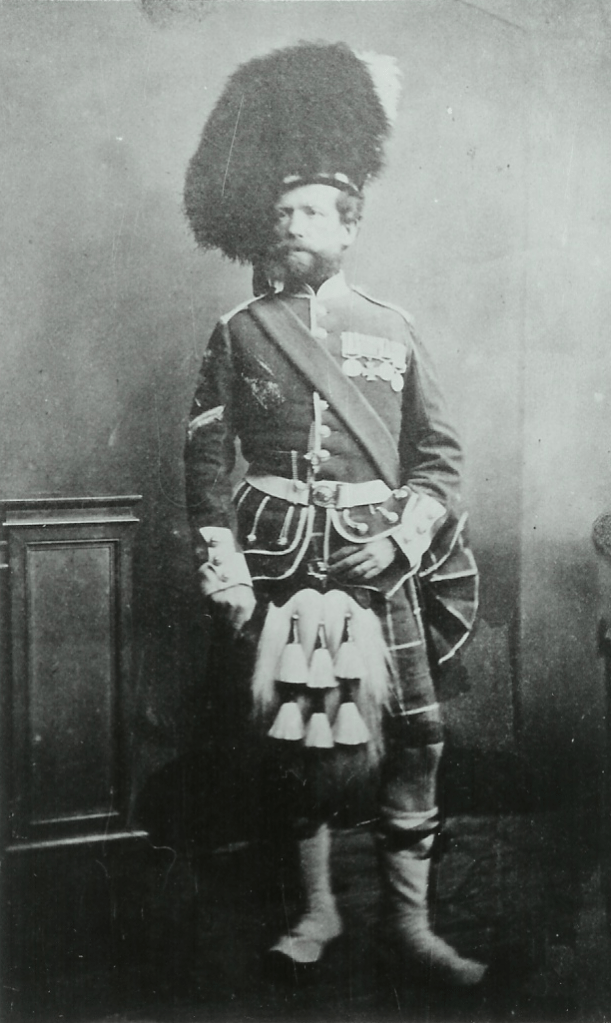
Born in Culross, Fife, Scotland in 1822 (or 1819 – the difference would be, that he was either 17 or 20 when he enlisted) the only son of Mungo McPherson and his wife Mary, Stewart spent his formative years at Geddes Public School, and at the age of 15, was apprenticed to a weaver in Dunfermline. In 1839, with a spirit meant for adventure, he walked to Stirling and joined the 78th Highlanders.
After seeing duty in Great Britain and Ireland, in 1842, the 78th, with McPherson set sail for India. They were sent to replace the forces lost in the First Afghan War, only to find themselves under siege in Sinde – not from marauders or insurgents, but the scourge of the subcontinent, namely cholera. Between 1844 and 1845, the 100 strong regiment lost 535 men of all ranks and 171 women and children to the disease and the regiment itself stood on the brink of extinction.
“The excitement of the march kept the scourge from showing itself, but no sooner had the men settled in their barracks than a most virulent fever broke out, which continued, without cessation, throughout the stay of the regiment. Some lingered for weeks, some for days. It was not unfrequent to hear of the death of a man to whom one had spoken but half an hour previously. The hospital, a large one, was of course filled at once; some of the barrack-rooms were converted into wards, and at one time there were upwards of 800 men under treatment. Some hundreds of the less dangerously affected were marched about, a few paces, morning and evening, in hopes that by their being called ‘ convalescent,’ the mind might act beneficially on the body, but as death called them away the group became less and less.
“Day after day we attended at the hospital for, in fact, funeral parade; for four or five, and then eight or nine, men died daily; you did not ask who had died, but how many. Firing parties were discontinued, not only that the sad volleys might not disturb the dying, but because there were no men for the duty. In the graveyard at Sukhur lie the bodies of hundreds of the regiment — officers, men, women, and children.”
To make up for these terrible losses, recruitment was opened up across the United Kingdom – although the numbers rose with each new recruit, it was to the detriment of some of the Scottish nature of the regiment; before Sinde, it had been 91% Scottish; after the drive, it was less than half. Invaliding committees were set up and most of the survivors of the scourge were sent home; what remained of the 78th in India was sent back to Poona. They received 100 volunteers from the 2nd Queen’s who were on their way home; by December 1845, 700 men had joined the 78th Regiment, who would afterwards always be known as “The 700.”
More postings in India followed until it was decided the left wing would make its way to Aden, of which McPherson was party, while the right would proceed to Bombay. War was declared against Persia in 1856 of which McPherson would have his share; however, it was back in India where he would make his name.
” For daring gallantry in the Lucknow Residency on the 26th September 1857, in having rescued, at great personal risk, a wounded Private of his Company, who was lying in a most exposed situation, under a very heavy fire. Colour-Serjeant McPherson was also distinguished on many occasions by his coolness and gallantry in action.” (“No. 22248” The London Gazette. 12 April 1859. p. 1483).
There is little mention of what the gallant actions were but considering the 78th was placed in the precarious position of holding the newly extended grounds, it is unlikely he would have found opportunity wanting. As it was, when it came to the ballots for the VC, the 78th waited until Havelock sent them a reminder – their answer however was clear, no man in the regiment had done better than the other. After the assistant surgeon had saved the Colours and the Colour-Sergeant saved a man’s life; choosing names for the ballot must have been a most disagreeable task – Havelock did not call the 78th Regiment the Gallant Regiment for nothing.
McPherson received his VC from Queen Victoria in 1860; three weeks after the investiture, he discharged himself from the army and returned home to Culross with his wife and six children, two of whom had been born in India. After working for ten years as the superintendent of Glasgow Industrial School in Ballieston, McPherson returned home. The house in Low Valleyfield where McPherson died in 1892; the name bestowed on the house by McPherson was “Lucknow Villa.”
His medals are held by the Queen’s Own Highlanders Museum Collection at Fort George.
We shall now turn our attention to the final VC won by the 78th Highlanders on this first advance to Lucknow.
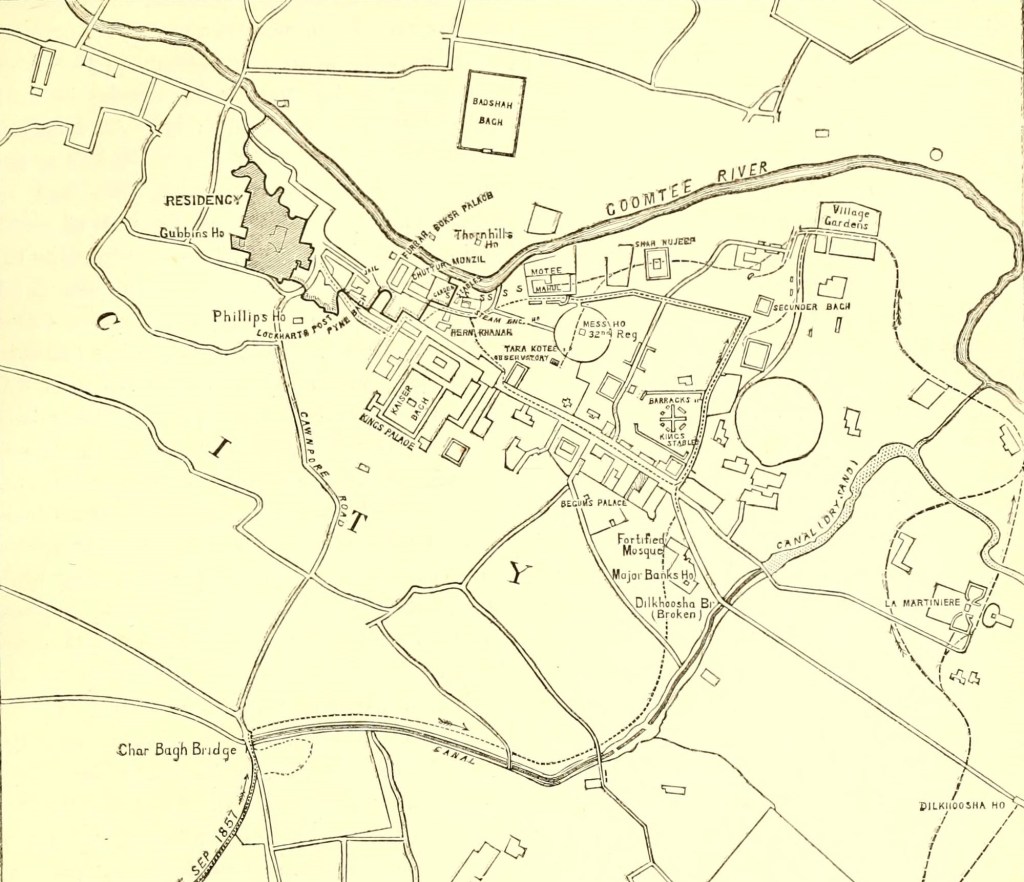
On the 25th of September, the 78th Highlanders were having a terrible time of it. Detailed to hold the bridge and the houses just beyond it until the remaining troops, baggage and wounded could cross. Realising that in reality only a small body of troops was holding the bridge, the rebels made a determined attack and returned in ferocious numbers. Two companies, No.7 and No.8 under captains Hay and Hastings were sent forward to occupy the more advanced positions around the Charbagh, while four companies were sent off, as skirmishers into the surrounding gardens. The remainder, held in reserve, were posted in the buildings close to the bridge. As luck would have it, the road had by this time become as treacherous as the rebels – cut up by the passage of the heavy guns and being very narrow, it was the work of hours to convey the Commissariat carts and cattle through it, by which time, the 78th had become completely separated from the main body. To add to their misery, the insurgents brought down two guns within 500 yards of the 78th and opened a severe fire of shot and shell on the advancing companies, all the while liberally peppering them with musketry fire. Seeing there was nothing for it but to capture the guns at the point of the bayonet, the two advanced companies under Hay and Hastings and Lieutenants Webster and Swanson formed up on the road. They charged and captured the first gun, which was quickly sent to the rear and tossed in the canal.
The skirmishing companies were now called together and they formed up to support No. 7 and No. 8 companies. Thus united, the regiment pushed forward towards the second gun which kept up its firing from its more “retired position.” The second charge resulted in the capture of the gun, but it was found impossible to take it; the Highlanders had to fall back to keep that vital line of communication open; for in the brief moment they had turned their backs, the rebels were again swarming in that direction. The gun, in consequence, was spiked and the 78th, with their wounded, moved back. The regiment then became lost in the streets of Lucknow and found themselves on the other approach to the Residency, Hazratganj.
 Mutiny Reflections
People today have no idea what war is. (Except for a handful).
I am always impressed by your knowledge.
Thank you for sharing
LikeLike