Captain William Olpherts, Bengal Artillery
Very few men saw as much service in his lifetime as William Olpherts, whose sobriquet, “Hellfire Jack” was given as much for his temperament as his near maniacal need to lead wherever the fire was the hottest.
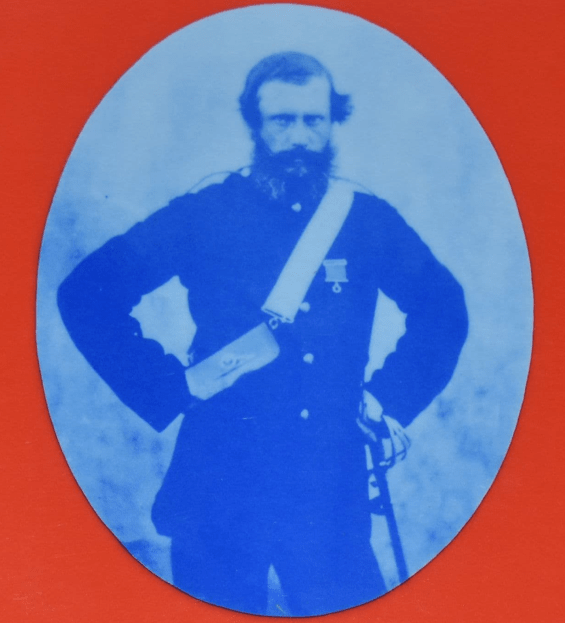
Born in 1822, the third son of William Olpherts, a lawyer and his wife Rosanna, at Darty Lodge Blackwaterstown, near Armagh, in Ireland, Olpherts was educated first at Grace School, and later at Dungannon School. In 1837 he received a nomination to Addiscombe and within two years he entered into the service of the Bengal Artillery in 1839, sailing out to India with his cousin, Henry. William started a life of campaigning, seeing service first in 1840 in Burma, then swiftly moving through Saugor, where he received his first mention in dispatches for his actions at Jhirna Ghat in 1842 and again in 1843, for actions at Punniar, during the Gwalior Campaign, where he was already in command of his own artillery battery. Noted in dispatches again during the 1st Sikh War of 1844-45 for his uncompromising approach to combat, it is with little surprise he would then fight in the frontier wars in 1851. He returned to England in 1852 for a brief stint at Addiscombe but the life of an orderly officer was not one for him. Olpherts had a different destiny.
1854 brought the Crimean War to Olphert’s ears and he immediately sought a posting – accepted, he served in the Caucasus with General Sir Fenwick Willims and the Defence of Kars and Erzeroum and finally in Crimea where he commanded a force of bashi-bazouks in the Turkish Contingent. After the war, Olpherts returned to India and assumed command of a horse artillery battery in Benares. We have already met him once before in “A Most Indifferent Regiment” regarding the mutiny at the station.
Olpherts described himself as “an old smooth bore, muzzle-loader, hopelessly behind the times,” though others were more prone to remember him for his outbursts of colourful language, his rough manners and above all his eccentricity.
“A fiery, sometimes uncontrollable individual, he was often carried away by his powerful emotions. Once, while delivering a toast at a temperance gathering, he became so caught up in his own oratory that he ended the speech with a declaration that he did not trust anyone who would not take a drink.” (https://www.dib.ie/biography/olpherts-sir-william-a7115)
Garnet Wolseley of the 90th recalled seeing Olpherts on the march to Cawnpore,
“His battery was a sort of military curiosity in every way. His gun carriages were old, and always on the verge of absolute dissolution; and as for his harness, it seemed to be tied together with pieces of string. First came dear old Billy himself, clad in garments he had used in the Crimean War, a fez cap and a Turkish grego (a rough jacket), the latter tied round his waist with a piece of rope. About 50 yards behind him came his well-known battery sergeant-major, in a sort of shooting coat made from the green baize of a billiard table; then a gun, every driver flogging as hard as he could; then another, a long distance in the rear…
Some of the spokes had gone; they all rattled.”
Although his citation would ultimately be for actions at Charbagh Bridge, where he was seen, with his usual daring, joining the 90th Regiment of Foot to capture the guns at the end of the street. He then turned his horse and galloped back under a perfect hail of musketry fire to bring up the limbers and horses to carry off the captured guns. Robert Napier noted,
“The promptitude with which Captain Olpherts brought up his spare horses and carried off the guns, actually bringing them into the intrenchment, under all the difficulties of that advance, is worthy of admiration.” This was but one of many actions where Olpherts stood out and was noted again by Napier in the action which won one Private Thomas Duffy his Victoria Cross.
Private Thomas Duffy, 1st Madras Fusiliers
Born in 1823 in Mount Temple, Athlone, Westmeath, Ireland, Duffy attested into the East India Company Army, 1st Madras Fusiliers and embarked for India in 1841, at the age of 18. Interestingly enough, it has been often stated that Duffy was the oldest private in Havelock’s force, however, this writer believes the mistake lies in his birth year – while some sources state Duffy was born in 1806, it is likely there is some confusion with the array of Thomas Duffy’s available at this time and the problem arises from a misidentified gravestone. It was believed the one at Glasnevin Cemetery in Dublin belonged to Thomas Duffy VC, when in fact it belongs rightly to Thomas Duffy, boat owner and corn merchant who happened to be running his thriving business when this Thomas was in India. Sources for this is: http://www.victoriacross.org.uk/bbduffyt.htm and https://vcgca.org/news-and-events/39/Thomas-Duffy-VC-correction-re-grave-location
A picture of Private Duffy exists, albeit he is rather blurred, in “Neill’s Blue Caps.”
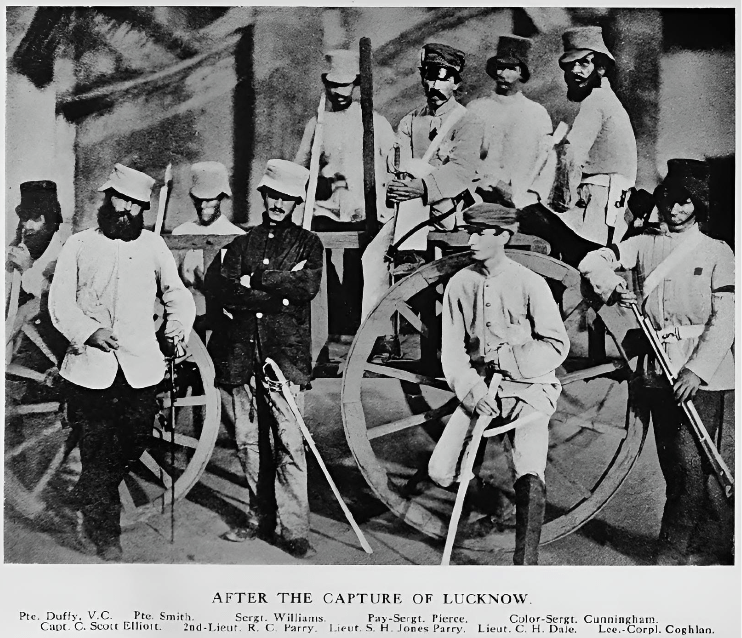
Now to return to Private Thomas Duffy.
On the morning of the 26th of September, a detachment of 250 men under Major Simmons of the 5th Fusiliers was sent out by Sir James Outram to reinforce Colonel Campbell, who was still outside the Residency. Unfortunately, they were unable to make any headway and judiciously took up a position in a house and garden between Campbell and the Farhat Baksh Palace. Napier was thus ordered to take a further 100 men of the 78th Highlanders and 2 guns of Olpherts battery, along with Captain Hardinge’s sowars, to make another attempt.
According to Napier, Olpherts “strongly objected” to his guns being taken on what appeared to be a fool’s mission and Napier contented himself with simply taking Olphert’s bullocks. Olpherts accompanied him as a volunteer. Somewhere in this melée was Private Thomas Duffy and leading the party was none other than Thomas Kavanagh. While Kavanagh does not mention Duffy or Olpherts in this sortie, Napier does.
“I then led the party by one of the side outlets of the Palace along the river bank to Major Simmons’ position under a smart fire from the enemy, by which, however, we received little damage. Under cover of the night all the sick and wounded were quietly and safely transported along the river bank to the intrenchment by a path impracticable for guns. Captain Hardinge made several journeys until every sick and wounded man was removed, he also took away the camels laden with Enfield ammunition. One of our 24-pounders which had been used on the previous day against the enemy, but the working of which had ceased, owing to the musketry fire which was poured upon it, was left in an exposed position. It was extricated in a very daring and dexterous manner by Captain Olpherts, aided by Captain Crump (killed) and Private Duffy of the Madras Fusiliers.”
The dextrous manner consisted of three men going out – Olpherts, Crump and Duffy – under heavy fire with Duffy managing to fasten two drag ropes, under Olphert’s directions, to the trail of the gun. They were fastened to limbers, the bullocks were then yoked and the gun was drawn in. Unfortunately, the action cost Captain Crump his life.
Olpherts recommended Duffy for the VC, which was seconded by Robert Napier, and he was elected through ballot, by his regiment.
“”For his cool intrepidity and daring skill, whereby a 24-pounder gun was saved from falling into the hands of the enemy. ” (Extract from Divisional Orders of Major-General Sir James Outram, G.C.B., dated 16 October 1857.”No. 22154″. The London Gazette. 18 June 1858. p. 2958. )
What happened to Thomas Duffy subsequently is unknown. He died in 1868 and it is presumed he is buried closer to home than Dublin.
As for William Olpherts, Sir James Outram wrote, “My dear heroic Olpherts, bravery is a poor and insufficient epithet to apply to a valour such as yours.” As such, Olpherts was far from finished with war. Acting as brigade major of artillery during the 2 remaining months at the Residency, he shared in the defence of the Alambagh under Sir James Outram after the evacuation of the Residency in November and then in March 1858, Olpherts once again took part in the siege and capture of Lucknow, his name mentioned in despatches for conspicuous bravery. Towards the end of the Oudh Campaign, Olpherts received his brevet majority and brevet lieutenant colonelcy, his VC, the Indian Mutiny Medal with 2 clasps and the Companionship of Bath.
In 1859-1860 Olpherts volunteered to serve under Brigadier Sir Neville Chamberlain in the Waziri Expedition on the North-West Frontier and managed to complete 20 years of active service, practically unscathed. Between 1861 and 1868, he commanded the artillery stations in Peshawar and Rawalpindi, finally returning home on furlough in 1868, now a colonel, to be presented the sword of honour by the city and county of Armagh. He returned to India four years later to a rather tame life of commanding brigades in Gwalior, Ambala and Lucknow. With the rank of Major General, Olpherts left India for the final time in 1875, was promoted to Lieutenant General in 1877, General in 1883 and Colonel Commandant of the Royal Artillery in 1888. A battery of the Royal Artillery existed until 2015 which bore his name, called 56 (Olpherts) Battery. The honorary title – “Olpherts” – was bestowed in 1966.
General Sir William Olpherts died at his home at Norwood on the 30th of April 1902, apparently exclaiming, at the very end, “They can now see how a Christian can die! Turn out the lights!” His body was escorted to the cemetery by a detachment of the Royal Horse Artillery, in such a torrent of rain that it seemed “the very elements were rehearsing the battle scenes of the life that had ceased.”
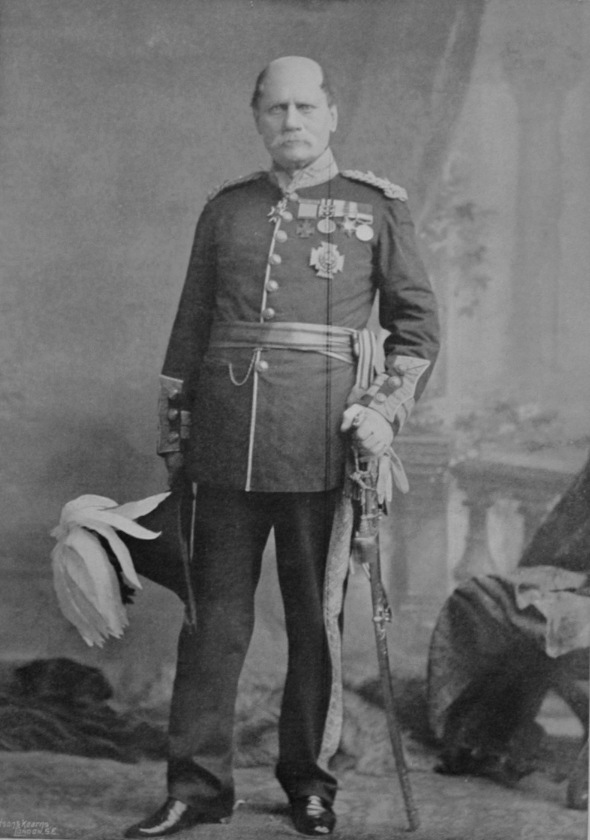
Interestingly two VCs were won at Lucknow by surgeons of the same regiment, the 78th Highlanders – Surgeon Joseph Jee and Assistant Surgeon Valentine Munbee McMaster. While Jee received a rather long and detailed citation, the one for McMaster would be strangely short.
 Mutiny Reflections
People today have no idea what war is. (Except for a handful).
I am always impressed by your knowledge.
Thank you for sharing
LikeLike