Private Patrick McHale, 5th Fusiliers
The first of Havelock’s force to be recommended for a Victoria Cross was Private Patrick McHale of the 1st Battalion, 5th Fusiliers.
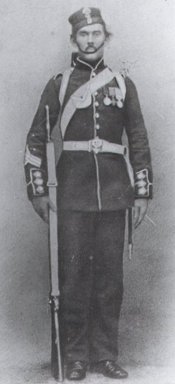
Born in 1826 in Killala, County Mayo, Ireland, McHale enlisted in the 5th Fusiliers in 1847. Standing 6’2”, he was certainly a taller specimen of recruit than the officers were used to.
Six months later, McHale sailed with the regiment to Mauritius where they would remain for the next 9 years, until the outbreak of the mutiny. Their first action in India was not with Havelock, however, but with Major Vincent Eyre and the Relief of Arrah – following the final outcome of that venture, it was off to Cawnpore.
McHale won his Cross for not one, but two deeds – the first, on the 2nd of October, when he was the first man to lead the assault on Phillip’s Garden Battery and capture one of the guns which had been sending a destructive fire of shot and shell into the Residency. Like the impetuous Dawson that Anderson had had the sense to call back the day before, McHale managed to be the first to meet the rebels, “who were so distracted by his courage” there seemed little for anyone else to do. Unfortunately, accounts of the 2nd of October do not mention McHale; Thomas Henry Kavanagh who volunteered for the sortie recalls more fondly the rooster he managed to acquire and the sack full of oranges he purloined from the pillaged shops on the Cawnpore Road.
Following the evacuation of the Residency in November, McHale remained behind in Lucknow with Sir James Outram at the Alambagh, and on the 22nd of December, received his second citation.
“For conspicuous bravery at Lucknow on the 2nd October 1857, when he was the first man at the capture of one of the guns at the Cawnpore Battery,—and again, on the 22 December 1857, when, by a bold rush, he was the first to take possession of one of the enemy’s guns, which had sent several rounds of grape through his company, which was skirmishing up to it.
On every occasion of attack, Private M’Hale has been the first to meet the foe, amongst whom he caused such consternation by the boldness of his rush, as to leave little work for those who followed to his support. By his habitual coolness and daring, and sustained bravery in action, his name has become a household word for gallantry among his comrades.” (No. 22396″ The London Gazette. 19 June 1860, p. 2316).
McHale remained with the Fighting 5th and received his VC in India from Lady Heresey at Fort William in Calcutta, in 1860. Shortly after, he returned to England with his regiment.
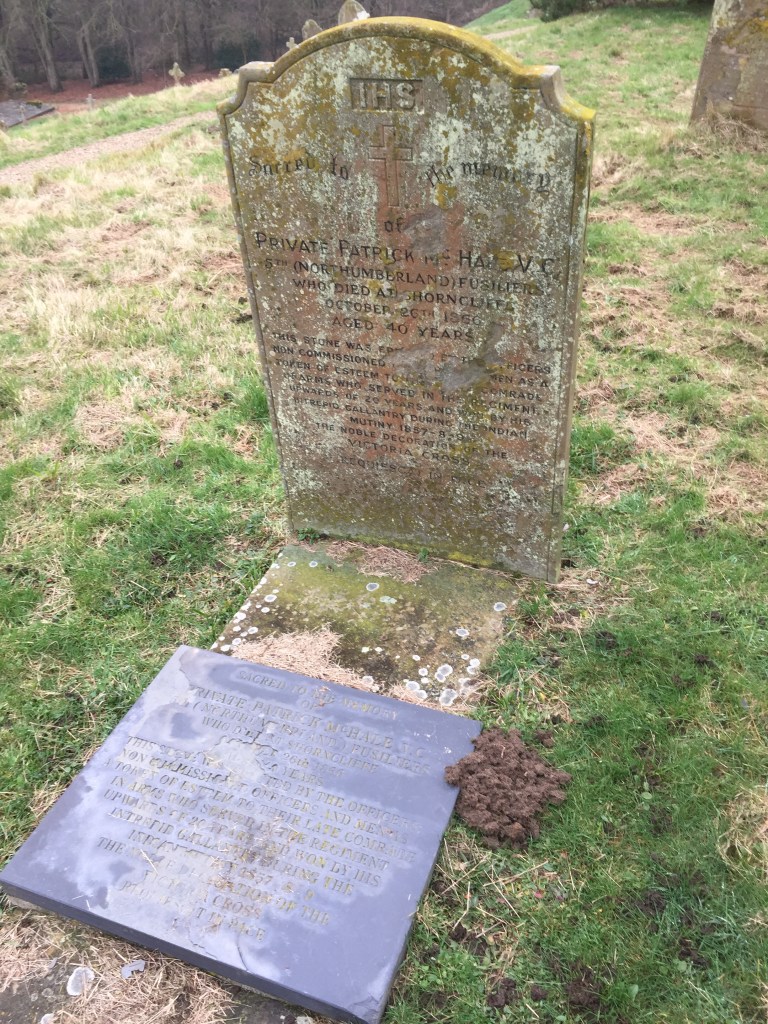
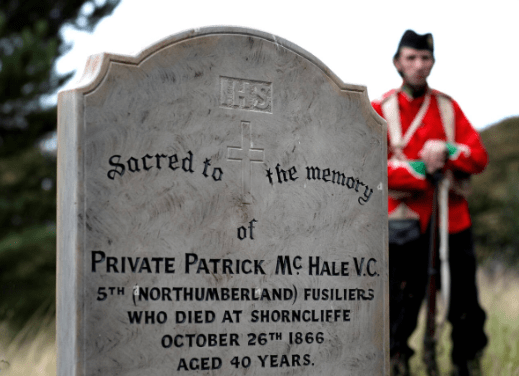
On the 26th of October, 1866, McHale died suddenly of heart failure while on duty at Shorncliffe, Kent. He was buried, aged 40, in Shorncliffe Military Cemetery. In honour of his memory, his regimental comrades erected a fine gravestone.
Time and the unfortunate addition of German bombs in WWII took their toll on McHale’s grave and finally in 2019, a project funded jointly by the Royal Regiment of Fusiliers, the Northumberland & North East Fusilier Association and the Victoria Cross & George Cross Association restored his grave. It was rededicated in October of the same year at a ceremony attended by Veterans and personnel from the Royal Regiment of Fusiliers. A German Military Air Attaché was in attendance and made a contribution to the repairs.
We now come to two VCs which were awarded for similar circumstances – saving the life of another.
Bombardier Jacob Thomas, Bengal Artillery
Born on a farm in 1833 Llanwinio, in Carmarthenshire, Wales, Thomas decided fairly early in life that farming was not his vocation and in 1853 he enlisted in the Bengal Artillery in Cardiff. Shortly after he found himself in India.
The Bengal Artillery already had one imposing VC – William Olpherts, but it would take a certain kind of bravery to be Bombardier Jacob Thomas.
As part of the ill-conceived sortie on the 27th of September to spike guns outside the Residency, which some of the men had managed to drink off the water meant for job at hand (ramming powder down the barrel of the gun and then blocking the muzzle with wet clay, hence the need for water – the most effective way to spike a gun), they were then left to run the gauntlet of the rebels musketry on their retreat back to the Residency. It was fortunate for one of the wounded Madras Fusiliers that Thomas had the presence of mind to run back, heave the man over his shoulder and carry him to safety. It was only luck that neither of them were hit.
“For distinguished gallantry at Lucknow on the 27th September 1857, in having brought off on his back, under a heavy fire, under circumstances of considerable difficulty, a wounded soldier of the Madras Fusiliers, when the party to which he was attached was returning to the Residency from a sortie, whereby he saved him from falling into the hands of the enemy.” ( “No. 22212” The London Gazette, 24 December 1858. p. 5519).
He received his VC from Queen Victoria at Windsor Castle in 1860. Following the mutiny, Thomas transferred to the Royal Artillery but chose to remain in India. He was eventually promoted to Quartermaster-Sergeant but due to a mishap in which a horse fell on him, Thomas was discharged in 1866 on medical grounds. He took up his old profession of fitter, something he pursued before his military career and died in India on the 24th of April, 1896 and was buried at the Bandel Churchyard, Hooghly, near Darjeeling.
His medals are held by the Royal Artillery Museum, Woolwich.
 Mutiny Reflections
People today have no idea what war is. (Except for a handful).
I am always impressed by your knowledge.
Thank you for sharing
LikeLike