90th Regiment of Foot (Perthshire Volunteers) (Light Infantry)
Raised in 1794 as the 90th Regiment of Foot in Scotland as a light infantry corps, by Thomas Graham, in response to the worrisome French Revolution. Graham had requested permission to raise and command a regiment following his return from Toulon where he served as a volunteer with the force under Admiral Lord Hood. Permission was given with some reluctance as the king disliked giving “high commands to individuals who had no previous military training, nor held a commission in the army.” As it was, Graham received his right and set about with boundless energy to raise his regiment. Recruiting parties were sent to scour England and Scotland, while with the regimental headquarters were set up in Perth. and on the 10th of February 1794, Mr. Graham issued a rousing address,
“To the Inhabitants of the County of Perth.
” Being desirous that the regiment I have undertaken to raise, and which I am to have the honour to
command, should bear the name of a county I am so much attached to, I have obtained His Majesty’s leave that it should be called ‘ The Perthshire Volunteers.’
“While I flatter myself that the corps will prove worthy of so distinguished a name, allow me to hope that it will find in the spirit of the young men of the county, and in the zeal of the recruits, that preference and support which may make up for the want of the extensive influence which patronizes the other corps now recruiting. I need not assure all able-bodied volunteers that they will be received by the Commanding-Officer, at the headquarters at Perth, with the greatest attention, and will meet with the most liberal treatment.
I am, with sincere regard,
‘ Your devoted servant,
THOS. GRAHAM.”
His zeal paid off – on the 13th of May, 1794, 7 officers, 746 NCOs and men were paraded for inspection in Perth and gained the pleasure of Lieutenant-General Lord Adam Gordon, Commander-in-Chief in Scotland. The Perthshire Volunteers became the 90th Foot and Lord Moira, equally impressed by Mr. – now Colonel -Grahm as Gordon had been, petitioned the King’s leave to have the 90th enrolled as a Light Infantry Battalion and were subsequently trained and equipped as such. The regiment received their Colours in 1795 in Winchester on the occasion of the King’s birthday (June 4th) and was treated to a fiery speech from Colonel Graham who presented the Colours to the regiment himself.
“Officers and fellow soldiers, I have chosen to deliver the Colours of the Regiment into your custody on this day, because I wish that it should be marked in every man’s remembrance by its being the anniversary of the birth of our gracious Sovereign. The sentiments of loyalty to your King, and attachment to these Standards, blended together with happy enthusiasm on this day of national joy, will forever remain engraven on your hearts. The defence of these colours is a sacred trust that I need not dwell on; the honour of the regiment is in your hands and depends on the exertion of your attention, perseverance, and courage. Courage, however, is the growth of the soil of Britain; cowardice and slavery are alike unknown in these isles, for the bravery of her sons is cherished and confirmed by the fostering hand of freedom. When I look then on this chosen band, can I doubt that the truest spirit of heroism pervades its ranks? Who amongst you would not devote himself to death rather than abandon these banners, and who of you would not be ready to spill the last drop of his blood in defence of that constitution which equally secures the rights of the people and the throne of the King!
I entertain no such doubts; on the contrary, I am sure that if 1 have the honour of leading you into the field against the enemy, I shall have more occasion to temper your ardour than to animate your courage. But I am most anxious that courage should be tempered and directed by the most perfect discipline, and 1 trust that none who think themselves worthy to belong to the 90th Regiment will grudge the pains necessary to attain to that perfection. You must be distinguished not only in appearance but in reality. It is highly gratifying to me to be at the head of a body of men on whose exertions as good soldiers 1 ran rely, as I do with confidence. Accept my thanks for your past conduct; we shall soon be in company with other troops: let it be your constant object to excel. 1 wish not only to be proud of you but to owe you my gratitude and affection.”
Following their inspection by His Royal Highness, the Duke of York on the 9th of July – shortly after they were marched off to Southampton to board vessels bound for France as a part of the Quiberon Expedition. The 90th did not disappoint Graham and a year later they were sent to support the French Royalist, Lieutenant-General François de Charette who was caught up in a struggle against the Republicans. The 90th reduced Minorca for Charette, capturing it in 1798 – they set sail for Malta to wrest it from the French in 1800 before heading off to Egypt in 1801 for the Egyptian Campaign, fighting through both the battle of Abukir and Mandora before returning to Malta.
A second battalion was raised in 1804, but they were destined to never leave home; the 1st Battalion in the meantime, set off for the West Indies to garrison Saint Vincent. They would be called into action for the Invasion of Martinique in 1809 and the subsequent Invasion of Guadeloupe in 1810. It was then a change of scenery for the 90th who, in 1814 would sail for Canada, to garrison Quebec. They were renamed the 90th Regiment of Foot (Perthshire Volunteers)(Light Infantry) in 1815, the same year they were back in Europe to serve as a part of the Army of Occupation of France. In 1817, the 2nd Battalion was amalgamated with the 1st and in 1820, sailed once again for Malta. They would not return home for another 10 years.
In 1835, after a five-year stay, the regiment left for Ceylon where they remained for 10 years. War however was never far off, in their case, it was in Africa. Landing at the Cape of Good Hope in 1846, for service in the Seventh Xhosa War they remained on the continent until 1847, when the regiment was sent back home. The Crimean War would have them setting off, in 1854, for very active service including the Siege of Sevastopol. In 1856, after two years away, the 90th returned home in June. However, with the outbreak of the Indian Mutiny, their stay was cut short. Orders were given for the 90th to proceed to India in February 1857, but these were rescinded and they were not to start until June. However, their rest would be brief. Instead of India, the 90th was ordered to sail for China instead, in March. They got as far as Singapore when orders were relayed to that erstwhile place, the 90th was to abandon the idea of China for the present – they were needed in India. The regiment arrived in Calcutta on the 21st of July taking part not only in the 1st Relief of Lucknow but subsequently under Sir Colin Campbell for the 2nd Relief.
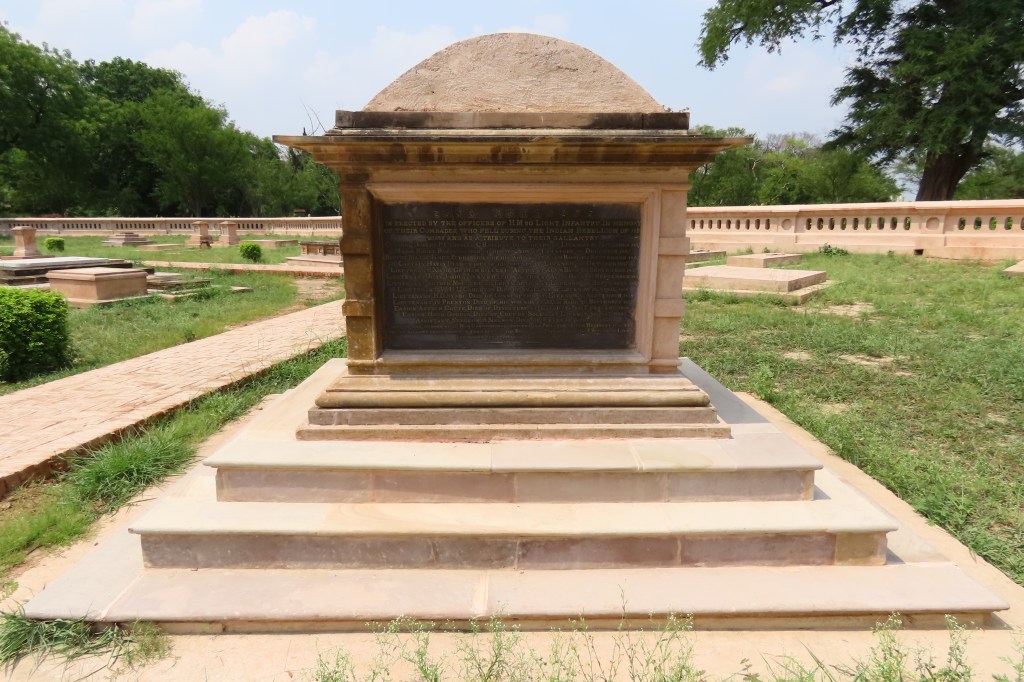
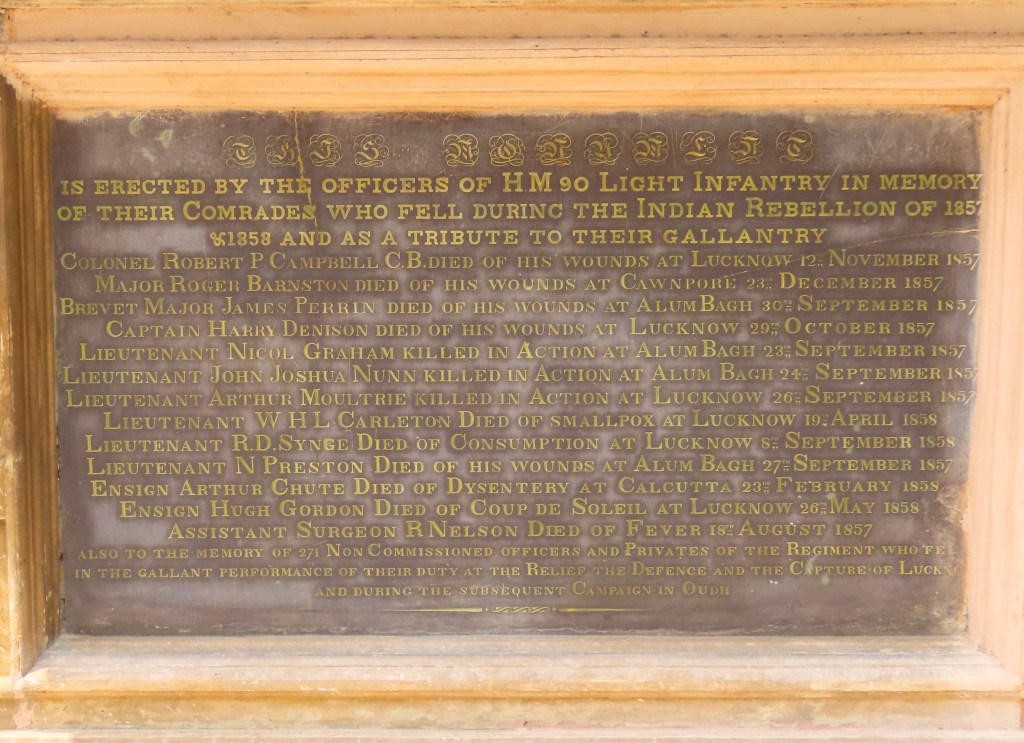
It must be mentioned that only part of the regiment arrived in July. While the Himalaya arrived safely in Singapore, the second ship, the Transit, which left a few days later, was shipwrecked after leaving the Cape, following a cyclone out at sea. Recalled Lieutenant Herford,
“It was an anxious moment, but we had all our work to do. Some of us were sent down to remain with the men, in order to keep them quiet, while others superintended the bringing up of provisions, and securing as much ” fresh water as possible. The boats were hoisted out, and the baggage brought on deck; the water soon filled the mess-room and came over the stern of the poop. Between us and the land, about a mile and a half distant, was a long low reef, and on this it was determined to disembark the troops first, that we might get clear of the ship with all good speed—as, indeed, no one among us could say at what moment she might not go down altogether. The men behaved admirably—as quietly and as orderly as if on parade, and the boats were quickly filled and went to and fro from the reef until all the troops were landed—those under my care being the last party which left for the reef, with the exception of the officers in command.”
The reef, though infinitely better than being at the bottom of the sea, was little more than a “seaweed-covered rock,” and the men found themselves at the mercy of the incoming tide and the blazing tropical sun. After five hours the boats which had been dispatched to the land in the distance – it turned out to be the Island of Banca, a protectorate of the Dutch, who behaved splendidly towards the British, allowing the men from the reef to be conveyed to their colony and treated hospitably. News was sent to Singapore and The H.M.S. Actceon arrived shortly after to convey the men to Singapore.
When they arrived in Singapore on the 23rd of July, their regimental compatriots in India were already fighting with Havelock across the Ganges. On the 29th of July, Captain Peel with the Shannon arrived in Singapore, followed closely by the Pearl under Captain Sotheby, and arrangements were made to proceed to India. Having lost everything in the wreck of the Transit, the detachment would be refitted shortly after its arrival, but would not be ready to leave Chinsurah until the end of August. They would be ready in time to meet up with Sir Colin Campbell for the 2nd Relief of Lucknow.
The 90th remained in India until 1869 and sailed for England on the 1st of October. Their old Colours, which they had carried through Crimea and India were placed over the monument to the regiment in the East Church at Perth upon which an inscription was engraved on two brass plates:
“The colours, emblazoned with the honours gained by the 90th Perthshire Light Infantry, at Mandora, in Egypt, at Martinique, Guadaloupe, Sevastopol, and Lucknow, were presented to the Regiment on the 6th August, 1852, carried through the Crimean and Indian Mutiny campaigns, and their remnants finally here deposited, 27th June, 1872.”
After 5 years, the 90th was called up for duty in Africa for the 9th Xhosa War and then in 1879 at the Battle of Kambula and of Ulundi during the Anglo-Zulu War. Later that year, they found themselves back in India where, in 1881, they were merged with the 26th (Cameronian) Regiment of Foot to for the Cameronians (Scottish Rifles). While their history as the 90th ends here, as the Cameronians they would fight their way through the Boer War, the two World Wars and the Malay Emergency from 1950 to 1953.
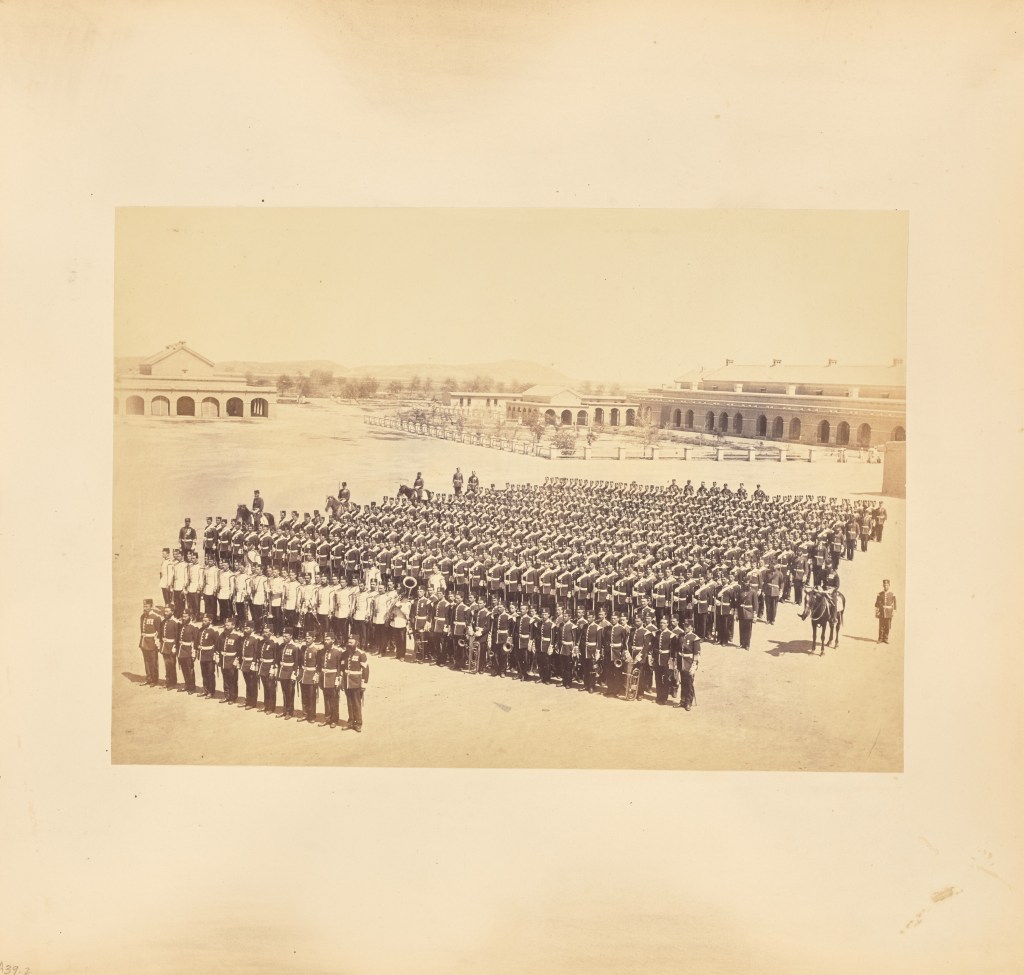
Its final posting in a wayward land would be the Aden Emergency of 1966 – in 1968, the regiment chose to be disbanded instead of amalgamation and remains without a successor in the British Army of today.
Sources:
Cromb, James. The Highland Brigade: Its Battles and Its Heroes. Edited by David L. Cromb. Stirling: Eneas Mackay, 1902.
Delavoye, Alex. M. Records of the 90th Regiment (Perthshire Light Infantry), with Roll of Officers from 1795 to 1880. London: Richardson & Co., 1880.
Donald, Creighton Williamson. The York and Lancaster Regiment: 65th and 84th Regiments of Foot. London: Michael Joseph, 1968.
Norman, C. B. Battle Honours of the British Army: From Tangier, 1662, to the Commencement of the Twentieth Century. London: John Murray, 1911.
Raikes, G. A. Roll of the Officers of the York and Lancaster Regiment. Vol. 1, The First Battalion (Formerly 65th Foot). London: Richard Bentley & Son, 1885.
Raugh, Harold E., Jr. The Victorians at War, 1815–1914: An Encyclopedia of British Military History. Santa Barbara, CA: ABC-CLIO, 2004.
Wylly, H. C. Neill’s “Blue Caps”: Being the Record of the Antecedents and Early History of the Regiment Variously Known as the East India Company’s European Regiment, the 1st Madras European Regiment, the 1st Madras European Fuziliers, the 1st Madras Fusiliers, the 102nd Royal Madras Fusiliers, and the 1st Battalion Royal Dublin Fusiliers. Vol. 2, 1826-1914. London: Gale & Polden, 1923.
Links:
FibisWiki
https://www.britishbattles.com/
https://www.nam.ac.uk/
https://uelac.ca/military-units/young-emigrants/
Photographs of the memorials at the Lucknow Residency, taken by the author, 2011 (84th Regiment) and 2023
 Mutiny Reflections
The Lieut. Herford quoted here is my second great grandfather. He wrote a memoir about his Indian war experience called Stirring Times under Canvas. Although he also served in the Crimean War, it seems remarkable to me that that entire conflict only merited a couple of indifferent paragraphs while the Indian experience was clearly riveting and seared in his memory.
LikeLiked by 1 person
Thank you for the information! I have not heard of the book! I think perhaps, Crimea was a certain set of horrors – I have noticed that in other officers who served in both campaigns. There also seemed to be some kind of a justification needed for India. I will definitely be looking for his book!
LikeLike
Given your record you could up the betting stakes from a cup of tea to thali or at least tiffin.
LikeLiked by 1 person
Great historical events! Well shared with photos 👌
LikeLiked by 1 person
A strangely compelling read.
LikeLike
I wrote it on a bet – a rather interesting person told me I could never write anything in under 48 hours. The brief was to write something about Lucknow that wasn’t only Lucknow. So I sat down and wrote this in one sitting of 18 hours, with research. I chose the history of 4 well-known regiments of which I already possess a wealth of knowledge. I am still waiting for my cup of tea, which was promised.
LikeLiked by 2 people