At the Lucknow Residency, memorials were erected to the regiments that took part in the first and second relief and the final battle for Lucknow in 1858. For the men who died in the battles, those who suffered through their wounds only to breathe their last in the foetid residency hospitals and those who never found a burial place at all, these memorials served to preserve their part in this long, and terrible war, if only for short time. Four of the regiments arrived at the Bailey Guard Gate on the 25th of September 1857 carrying their histories with them – Lucknow was yet another battle to add to their long lists of triumphs and tribulations.
The 1st Madras Fusiliers
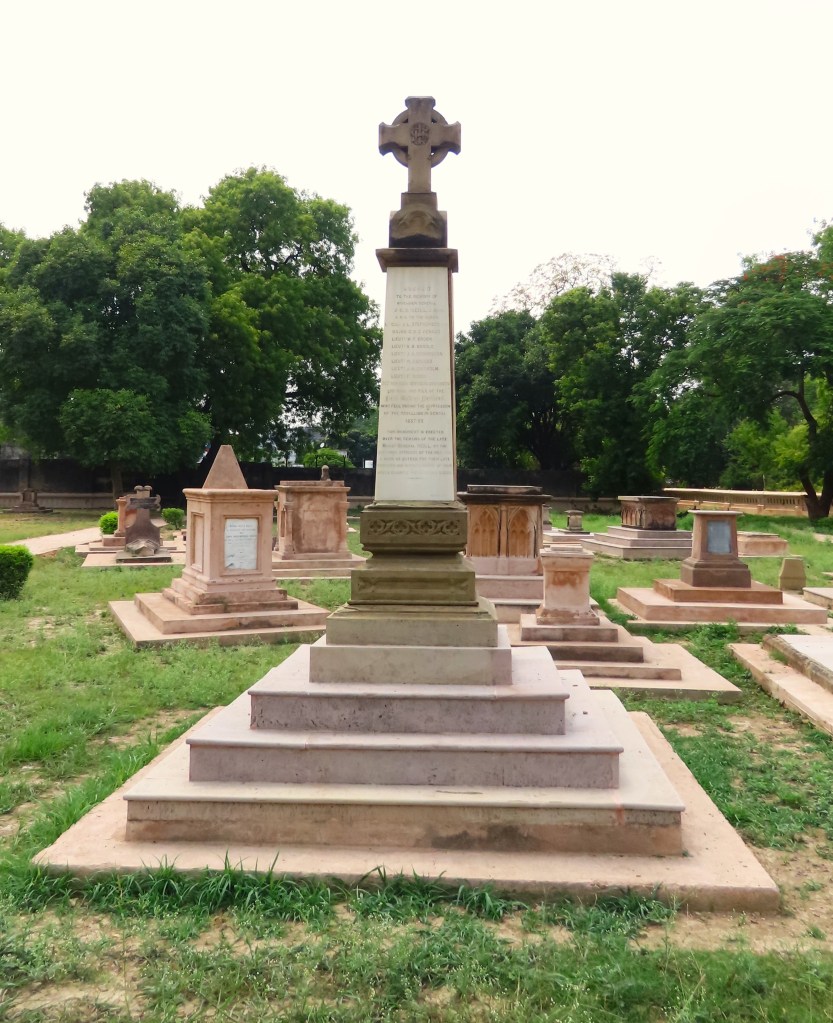
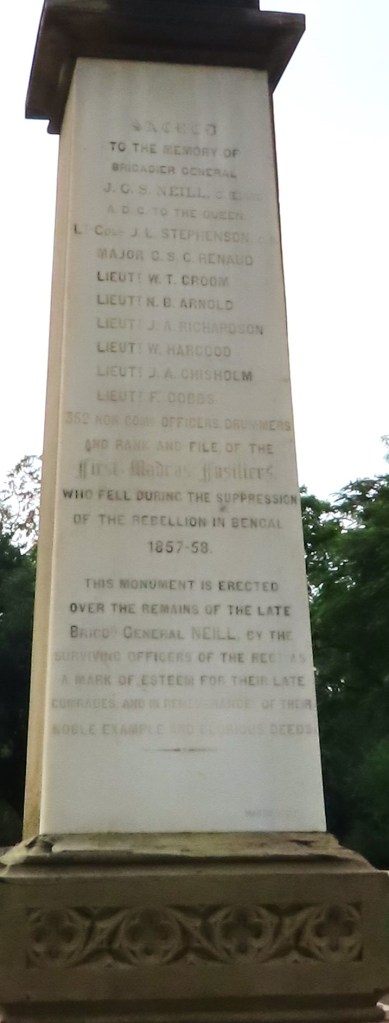
The 1st Madras Fusiliers were raised in 1742 by Major Stringer Lawrence as the first troops for the East India Company, in Madras and were known as the East India Company European Regiment.
Renamed in 1766 as the 1st Madras Europeans they consisted of three regiments.
1744 – became the 1st Madras European Regiment – 1st and 2nd Battalions
1799 – restructured as The Madras European Regiment – single battalion
1824 – became The Madras European Regiment – 1st and 2nd Battalion
In 1830, they were once again reduced to a single battalion.
1839 saw them become the 1st Madras (European) Fusiliers
Following the mutiny, they were incorporated into the British Army as the 1st Madras Fusiliers.
1861 saw another change in title – 1st Royal Madras Fusiliers and a year later, renamed the 102nd Regiment of Foot (Royal Madras Fusiliers)
1881 the regiment was merged with the 103rd Regiment of Foot to become 1st Battalion, Royal Dublin Fusiliers. In 1900, they would see service in the war in South Africa.
They were disbanded in 1922 on the formation of the Irish Free State.
The regiment took part in all three of the Carnatic Wars (1744, 1751 and 1756) for which they received Battle Honours for
Arcot – 1751
Plassey – 1757
Condore – 1758
Wandiwash – 1760
Pondicherry – 1761
In 1781, they were present at the Battle of Sholingur and the honour was awarded in 1889. vide The Gazette. They also received a Battle Honour in 1791 for the Siege of Nundy Droog during the 3rd Mysore War.
As a part of the expeditionary force to the Dutch East Indies, the Madras Fusiliers received Battle Honours for the capture of Amboyna, Ternate and Banda in 1810. However war in India was never far off and in 1817, they became embroiled in the ferocious 3rd Mahrata War adding the Battle Honour Maheidpoor, which led to the final destruction of Mahrata power and the exile of Baji Rao II, the last Peshwa of the Mahrata Confederacy. He surrendered in 1818 and was promptly sent off to Bithur where the British could keep a rather watchful eye on him for the next 33 years, until he died in 1851. His adopted son, Dhandu Pant, would become better known in years to come as Nana Sahib.
In 1824, the regiment was shipped off to Burma for the first war in 1823, for which they received the Battle Honour Ava (1823-26) and then again for the second war, for which Pegu (1852) was added to their list. They received their last Battle Honour in 1858 for Lucknow.
 Mutiny Reflections
The Lieut. Herford quoted here is my second great grandfather. He wrote a memoir about his Indian war experience called Stirring Times under Canvas. Although he also served in the Crimean War, it seems remarkable to me that that entire conflict only merited a couple of indifferent paragraphs while the Indian experience was clearly riveting and seared in his memory.
LikeLiked by 1 person
Thank you for the information! I have not heard of the book! I think perhaps, Crimea was a certain set of horrors – I have noticed that in other officers who served in both campaigns. There also seemed to be some kind of a justification needed for India. I will definitely be looking for his book!
LikeLike
Given your record you could up the betting stakes from a cup of tea to thali or at least tiffin.
LikeLiked by 1 person
Great historical events! Well shared with photos 👌
LikeLiked by 1 person
A strangely compelling read.
LikeLike
I wrote it on a bet – a rather interesting person told me I could never write anything in under 48 hours. The brief was to write something about Lucknow that wasn’t only Lucknow. So I sat down and wrote this in one sitting of 18 hours, with research. I chose the history of 4 well-known regiments of which I already possess a wealth of knowledge. I am still waiting for my cup of tea, which was promised.
LikeLiked by 2 people