78th (Highland) Regiment of Foot, or The Ross-shire Buffs
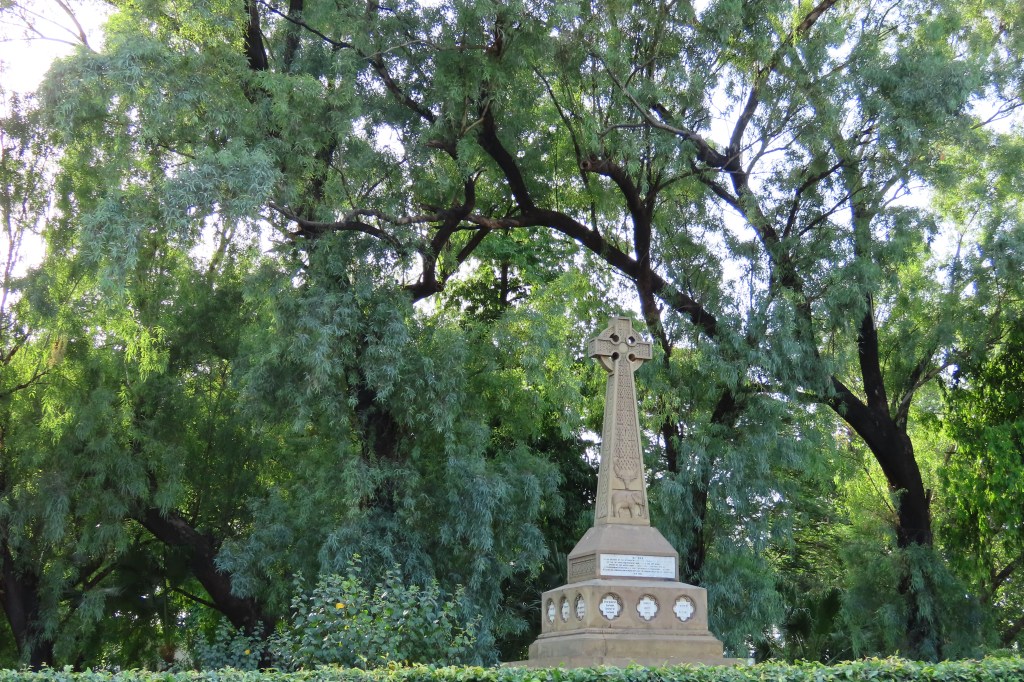
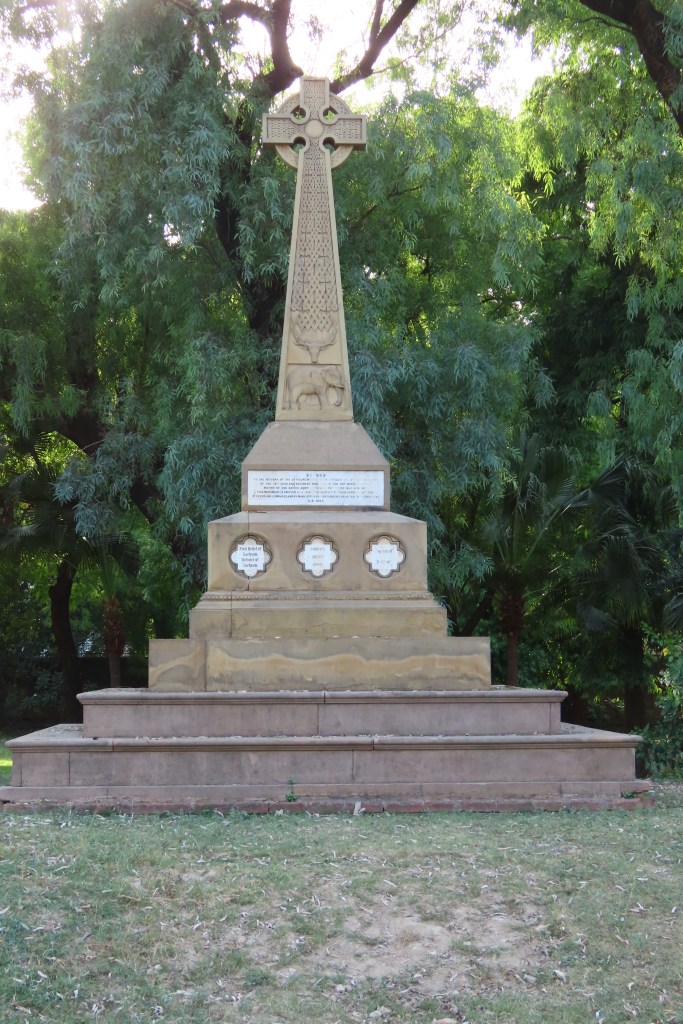
Set away from the main cemetery at the Lucknow Residency is the monument to the men of the 78th.
The regiment was raised in 1783 by Francis Humberston Mackenzie, Chief of Clan Mackenzie and later by Lord Seaforth, as the 78th (Highlanders) Regiment of Foot ( The Ross-shire Buffs), and embarked for Holland in 1794 for service in the French Revolutionary Wars. In 1795, they moved to England but were shortly after off to France for the Battle of Quiberon Bay in the same year.
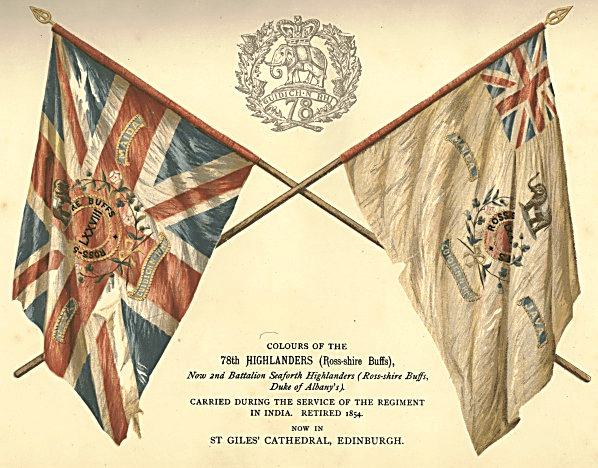
A second battalion was raised in 1794, which was promptly sent to South Africa in 1795, followed closely by the 1st Battalion – the two battalions were amalgamated together and, in short order, sent to India arriving in time for the Battle of Assaye in 1803 in the Second Maratha War. This decisive victory came with a special honour for the 78th – they were presented with a third Colour by the East India Company, embossed with an elephant. The same symbol would then be worn on the regimental badges.
The regiment left India in 1811 for the Invasion of Java during the Napoleonic Wars and remained there until 1816, after a shipwreck it arrived in England in 1817.
In the meantime, a second battalion had been raised again in 1804 and was sent to Gibraltar in 1805 and then onto Italy for the Battle of Maida in 1806. The Alexandria Expedition saw them in even warmer climes in 1807 where three of their companies were captured and taken prisoner at Al Hamed. They returned to England in 1808 but it was a small reprieve – in 1809 a small contingent of the battalion would battle death and disease during the miserable Dutch Walcheren Campaign which left them under strength. However, the remaining fighting fit were sent to Holland in 1814, to skirmish at Merksem in Belgium and end up on garrison duty in Belgium for the next 2 years, remaining as reserves at Nieuwpoort during the Waterloo Campaign.
Home again, in 1817 the 1st and 2nd Battalions, together at last in Scotland, were amalgamated and posted to Ireland, where they remained until 1826. When they left for Ceylon in 1826, they would not return home for 12 years and then it would be a short stay. In 1842, the 78th embarked for India as replacement for the losses suffered by the army in the disastrous 1st Anglo-Afghan War. In turn, the 78th would suffer terrible losses, mainly from cholera, during their stay in Sindh between 1844 and 1845, reducing their ranks so severely a recruitment campaign was started to replace the dead – which changed the proportion of Scots in the regiment to less than half, where previously it had been 91%.
For the very brief Anglo-Persian War, the regiment was called up from its station in Aden; after the Battle of Khushad, it was back to India in 1857.
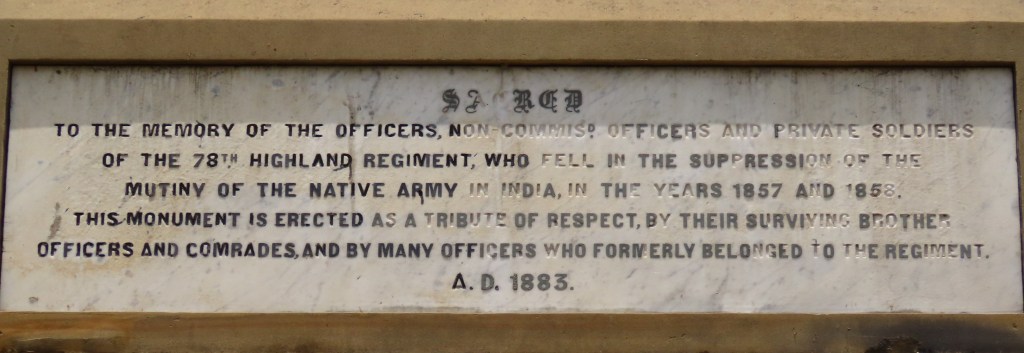
From May until the end of the mutiny, the 78th would win 8 Victoria Crosses and would hailed as “the saviours of British India” giving even Alfred, Lord Tennyson a reason to write a commemorative poem in which the Highlanders received a few stanzas to themselves. It was greeted with much enthusiasm at the time, however, can scarcely be read today without some raised eyebrows. The Defence of Lucknow is a truly Victorian poem, bombastically descriptive and melodramatic.
“Hark cannonade, fusillade! is it true what was told by the scout,
Outram and Havelock breaking their way through the fell mutineers?
Surely the pibroch of Europe is ringing again in our ears!
All on a sudden the garrison utter a jubilant shout,
Havelock’s glorious Highlanders answer with conquering cheers,
Sick from the hospital echo them, women and children come out,
Blessing the wholesome white faces of Havelock’s good fusileers,
Kissing the war-harden’d hand of the Highlander wet with their tears!
Dance to the pibroch!—saved! we are saved!—is it you? is it you?
Saved by the valour of Havelock, saved by the blessing of Heaven!
‘Hold it for fifteen days!’ we have held it for eighty-seven!
And ever aloft on the palace roof the old banner of England blew.
John Greenleaf Whittier had his own take on the Highlanders at Lucknow, in his poem, The Pipes at Lucknow, taking up the story of Jessie Brown, who heard the pipes playing over the din of battle on the 25th of September. This is only a small sample of the work.
Then up spake a Scottish maiden,
With her ear unto the ground:
‘Dinna ye hear it?—dinna ye hear it?
The pipes o’ Havelock sound!’
But to sounds of home and childhood
The Highland ear was true;—
As her mother’s cradle-crooning
The mountain pipes she knew.
Like the march of soundless music
Through the vision of the seer,
More of feeling than of hearing,
Of the heart than of the ear,
She knew the droning pibroch,
She knew the Campbell’s call:
‘Hark! hear ye no MacGregor’s,
The grandest o’ them all!’
Oh, they listened, dumb and breathless,
And they caught the sound at last;
Faint and far beyond the Goomtee
Rose and fell the piper’s blast!
Then a burst of wild thanksgiving
Mingled woman’s voice and man’s;
‘God be praised!—the march of Havelock!
The piping of the clans!’
The story of Jessie Brown, however, the corporal’s wife, must be kept for another time and the Highlanders returned home in 1859. From here, much of their history is of garrison duty in various countries, from Canada to Afghanistan and following 2 reforms – Cardwell in the 1870s and the Childers Reforms in 1881, the regiment would be amalgamated finally with the 72nd Regiment, Duke of Albany’s Own Highlanders to form the Seaforth Highlanders, of which the 78th became the second battalion.
 Mutiny Reflections
The Lieut. Herford quoted here is my second great grandfather. He wrote a memoir about his Indian war experience called Stirring Times under Canvas. Although he also served in the Crimean War, it seems remarkable to me that that entire conflict only merited a couple of indifferent paragraphs while the Indian experience was clearly riveting and seared in his memory.
LikeLiked by 1 person
Thank you for the information! I have not heard of the book! I think perhaps, Crimea was a certain set of horrors – I have noticed that in other officers who served in both campaigns. There also seemed to be some kind of a justification needed for India. I will definitely be looking for his book!
LikeLike
Given your record you could up the betting stakes from a cup of tea to thali or at least tiffin.
LikeLiked by 1 person
Great historical events! Well shared with photos 👌
LikeLiked by 1 person
A strangely compelling read.
LikeLike
I wrote it on a bet – a rather interesting person told me I could never write anything in under 48 hours. The brief was to write something about Lucknow that wasn’t only Lucknow. So I sat down and wrote this in one sitting of 18 hours, with research. I chose the history of 4 well-known regiments of which I already possess a wealth of knowledge. I am still waiting for my cup of tea, which was promised.
LikeLiked by 2 people