“Another tragic sight on that road was the death of a fine young gunner, the only one, I believe, who wore an Artillery jacket that day. A round-shot took his head clean off, and for about a second the body stood straight up, surmounted by the red collar, and then fell flat on the road.” (Francis Cornwallis Maude)
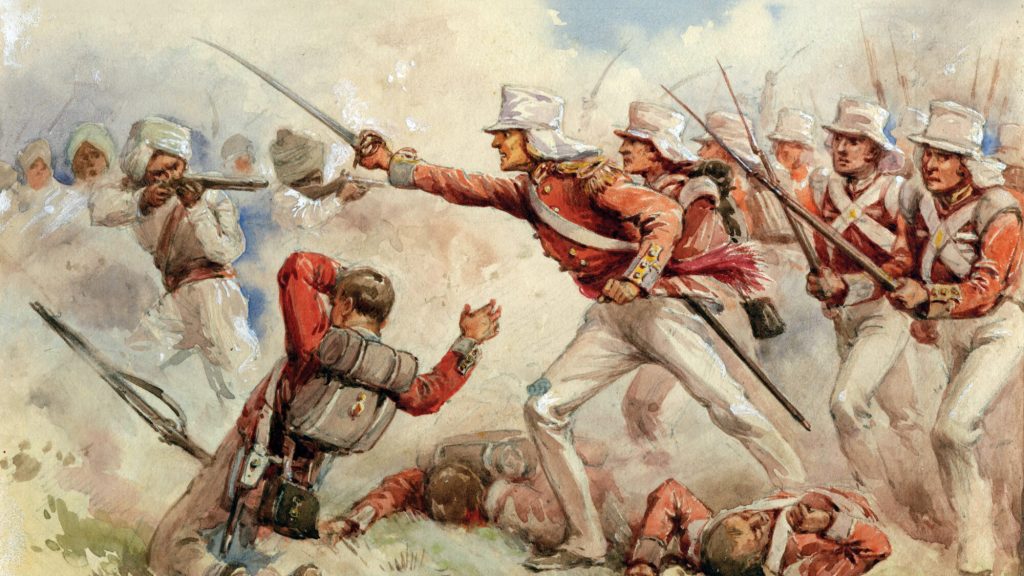
The fine young gunner was one of 21 men of the artillery who lost their lives between the attack on the Alam Bagh and the push to the Lucknow Residency. It would not be the only tragic sight of those few harrowing days.
The Relief of Lucknow under Sir Henry Havelock encompasses the following actions
21st September – Mungalwar
23rd September – the advance to and capture of the Alam Bagh
24th September – attack on the Alam Bagh
25th-27th September the advance through the city on the 25th and the final push to the Residency by the rearguard, carrying in the heavy gun,s ammunition and the remaining wounded.
While 21 men would receive the VC for actions at Alam Bagh or Lucknow, 535 would be killed or wounded on the 25th and 26th of September alone.
28th and 29th September -subsequent operations of securing the palaces which would serve as the extended position of the Residency.
Advancing towards Lucknow, under Sir Henry Havelock were the following:
First Infantry Brigade. — The 5th Fusiliers; 84th Regiment, Detachments, 64th Foot and 1st Madras Fusiliers; Brigadier General Neill commanding
Second Infantry Brigade. — H.M. 78th Highlanders; H.M. 90th Light Infantry, and the Sikh Regiment of Ferozepore; Brigadier Hamilton commanding.
Third (Artillery) Brigade. — Captain Maude’s Battery. Captain Olpherts’s Battery. Brevet-Major Eyre’s Battery. Major Cooper to command.
Cavalry. — Volunteer Cavalry to the left, Irregular Cavalry to the right. Captain Barrow to command.
Engineer Department. — Chief Engineer, Captain Crommelin; Assistant Engineers, Lieutenants Limond and Judge.
In all 3,179 men, six British and one Sikh infantry battalions, three artillery batteries, and 168 volunteer cavalry. Lieutenant William Tate Groom, an officer in the 1st Madras Fusiliers wrote on the 18th of September,
“We shall soon be back from Lucknow, and then I hope that something will be done to relieve us; at the same time I hardly expect it, as I know the 60th Rifles are not to come from Madras to Calcutta, and I see that our 2nd are still sending men from Burmah. However, you may be sure that everything will turn out for our good eventually, so we must look forward with brave hearts till happier days come.”
Little did Groom know that Havelock could not carry the beleaguered garrison to safety and they would be caught behind the Residency walls.
21st of September Action at Mangalwar
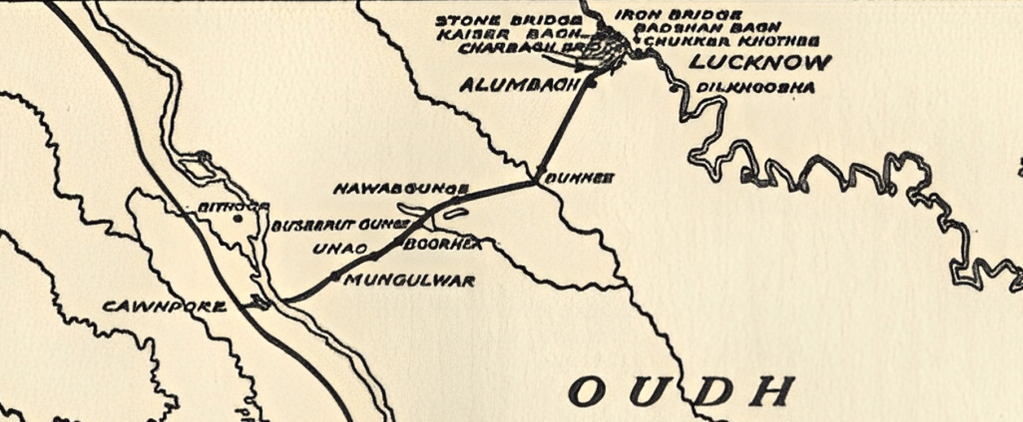
On the 20th, the force having crossed the Ganges, the Volunteer Cavalry, under Colonel Fraser Tytler, was sent out to reconnoitre and came upon the rebel’s advance position at Sainjunnee, 2 miles before Mangalwar, which was now held by the rebels. The next morning, the 21st of September, the men were called to arms at the appointed time but without bugles – these were prohibited during the march – and advanced on Mangulwar.
The position of the rebels rested on the right on a village and walled enclosure with their centre and left covered by a line of breastworks, behind which they had concealed 6 guns. The high road intersected their position. Falling back on his usual tactics, General Havelock determined to turn their flank. Deploying the heavy battery on and across the road supported by the 5th Fusiliers as skirmishers while the rest of the force diverged to the left. The insurgents opened their guns, directing their fire at Eyre’s heavy battery which was drawn by elephants. One of the elephants was wounded, the lower part of its trunk carried clean off by round shot and the poor animal “came charging amongst the battery in a very uncomfortable and dangerous manner.” The rest of the elephants, equally galled by such intolerable fire, quickly turned back and could not be induced to move the guns forward. forcing Eyre to bring forward bullocks, which with some difficulty, were attached to the heavy guns. The injured elephant, Maude noted, survived its ordeal and recovered from the wound, though its trunk had been reduced to the size of a “Gladstone bag.”
However, the resistance of the insurgents was brief – as the 90th Light Infantry swept forward, so retreated the rebels, pursued by the Volunteer Cavalry.
Riding at the front of the Volunteer Cavalry were Major Lousada Barrow, Sir Henry Havelock and Sir James Outram, armed, as was his wont, with his heavy cudgel. At Outram’s side was Colonel Robert Napier.
“We had 100 valuable cavalry – Outram headed them and I with him. We followed the enemy up for seven or eight miles cutting into their line of retreat and taking two guns. They were so wet and miserable that we were cutting them down before they knew an enemy was near them. One Native officer of Cavalry was jogging on in front of us, and if Outram could have got his horse near enough, he would have knocked him off his horse with his stick. One stupid fellow would stay in front of me, and made me break my sword on his head…” (Napier)
Bengal Volunteer Cavalry
Privates
Garretty, Joseph (90th Foot)- severely wounded
Weatherly, James (5th Foot) – severely wounded
1st Madras Fusiliers
Sergeant Patrick Mahoney – wounded severely
Private Joseph Orridge – wounded slightly
The cavalry chased down the fleeing insurgents a full eight miles, killing 107 men before they reached the walls of Bashiratganj. The colours of the 1st BNI were recovered during the pursuit.
A tactic, to which the isurgents often resorted to when thus chased by cavalry, was to fling themselves flat on the ground and then, as a horse jumped over or passed close to them, they would make an upward cut with their swords which “seldom failed to effect on horse or rider,” the blade cutting mercilessly at the animal’s underbelly or slicing clean through the boot of the rider.
The moment the charge was over, Havelock rode up to Maude’s guns, his horse bleeding from eight severe tulwar cuts. As the animal began to stagger, Havelock quickly dismounted.
“That makes the sixth horse I have had killed under me!” he said in a melancholy tone to Maude. Within minutes, his horse was dead.
Havelock bivouacked his men overnight just beyond the town and resumed the march on the 22nd, in a deluge of rain to the river Sye.
Following their defeat at Mangalwar, the rebels had fled towards Lucknow, many of them throwing away their guns – some were recovered from wells on the line of march. They also neglected to destroy the bridge over the river, allowing Havelock to continue his march unhindered. The men spent the night – the last before Lucknow – quartered at Bunee and partly at a village on the other side of the Sye. Havelock ordered a royal salute fired, hoping that the garrison at Lucknow, only 16 miles away, would hear the sound of their approach. Unfortunately, the barrage was lost to the wind and no one in Lucknow heard it.
On the 23rd of September, the march continued, to the Alam Bagh.
23rd of September Action at Alam Bagh
“On the third day, we arrived at the Alum Bagh (the Garden of the World), where we found the enemy drawn up in beautiful order, and during the time we were being deployed into line we suffered a little from their Artillery. But the moment we made a forward movement they ran away–so fast that the difficulty was to get near enough to them; and here Olpherts with his Horse Battery, had decidedly the best of it. Our Battery got a few shells into straggling bodies of the enemy, but they retired, with nearly the whole of their guns, for the bloody day which was soon to follow.” (Maude)
On that day and part of the next, the force found itself within range of the rebel guns, and considering it “necessary to reply” Maude lobbed 300 hundred rounds of shot and shell at 1200-yard range in return, however without doing the rebels any damage whose guns remained well masked. Four men of Maude’s Battery were injured, three gun-bullocks wounded and one howitzer badly damaged. On the night of the 23rd, with the rain falling torrents, Maude was forced to retire his camp four yards in the rear, overlooking the approach to Lucknow. The rebel artillery, now at 2000 yards, continued to throw shot at Maude.
“One of these missiles happened to fall among our cooking utensils and made the most tremendous shindy. As the infernal din changed to shrieks and cries, we got out of our tent to see what was the matter and found that one or two of our camp followers had been wounded. One man was lying dead, apparently without a wound. On examining him, all we could see was a white mark, of four streaks, in the small of his back…” (Maude)
5th Foot
Lieutenant Land Adjutant Edwin Fell Haig – killed in action. Haig was struck by roundshot
Sergeant H. Waller – wounded
Privates
Bishop, J.C. – killed in action
Blogg, J .- dangerously wounded. Died of wounds, 26th September
Gueran, M.,- severely wounded
Lennon, B.- mortally wounded. Died of wounds, 25th September
Lewis, L.- killed in action
McAllister, B.- killed in action
McWade, J.- severely wounded
Smith, Jeremiah.- severely wounded
Turner J.- severely wounded
Whatnall, J.- wounded
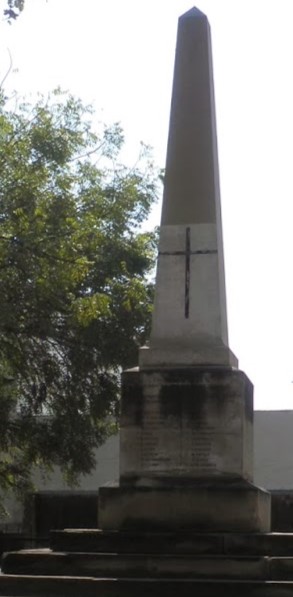
Close to the village of Bargawan, 5 miles from Lucknow a column was erected in memory of the men of the 5th Fusiliers:
“This column is erected by the Officers, Non-commissioned Officers and Privates of HM’s 5th Fusiliers to their undermentioned Comrades who fell during the occupation of the Alam Bagh under Sir J. Outram, K.C:B., 1857-58.
Lieutenant J. Brown; Armourer Sergeant H. Whitworth; Sergeants W. Walthers, Privates W. Anderson, W. Baldley, T. Hill, D. McEvoy, H. Wright, J. Baker, J. Martin, W. Chamberlain, J. Cleary, J. Kelly, T. Mara, J. Marsh, J. Doughty, W. Pottle, W. Moran, H. Messenger.”
78th Highlanders
Privates
Birks, John – killed in action
84th Foot
Sergeant Matthew Richardson – wounded
90th Foot
Lieutenant Nicol Grahame – killed in action.
Son of Major Duncan Grahame (6th Foot) and Mary Love, from Ardrossan, Ayrshire.
1st Madras Fusiliers
Sergeant Maurice Reardon – severely wounded in left leg
Privates
Bass, Isaac – slightly wounded in left shoulder
Gardiner, Charles – slightly wounded in left thigh
Williams, John – left leg shattered by round shot
Royal Artillery
Bombardier Carrigan, John .- killed in action
Bengal Artillery
Corporal James Grace – wounded
Gunner Joseph Cleary – wounded
Bengal Volunteer Cavalry
O’Brien, Edward (64th Foot) wounded
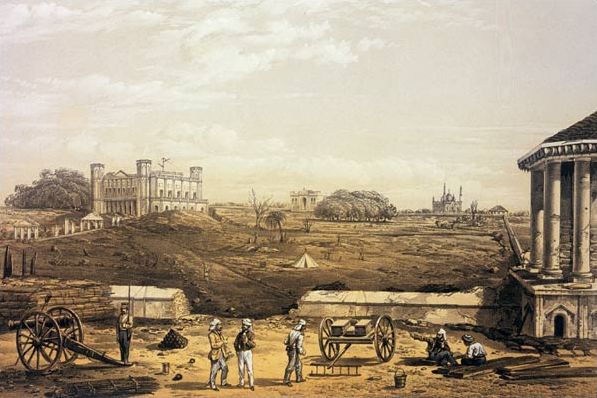
24th of September -Attack on the Baggage Column, outside the Alam bagh
From early in the morning, cavalry was observed hovering in the distance as it made its way towards the baggage of the column, guarded by men of the 90th. The movements were duly reported but not realising there was any danger, the report went unheeded. A request was made for a gun to be moved to strengthen the rear guard but it never appeared. Meanwhile, the guard had scattered unaware of any danger, some wandering away from their post, leaving only a few on the alert. The cavalry started their approach and were observed with more than a little alarm by Captain James Joshua Nunn of the 90th Regiment who realised they were men of the 12th Irregular Cavalry. Nunn quickly gave the order for his men to prepare for attack, when a voice called out in English, “It’s all right; we are friends!” That a portion of the 12th had remained loyal was well known to Nunn and served as a momentary reassurance – quite momentary in fact, for as soon as the horsemen had closed up, they swiftly commenced cutting down the escort. They killed Nunn and many others, before galloping off. Nunn’s body was found hacked to pieces, with numerous wounds but the one cut that decided his death, went through the crown down towards the left side and cleft his skull.
A section of the 78th had succeeded in pouring a “death-dealing volley” into the cavalry leaving a few empty saddles, while the horse battery swept the plain and the volunteer cavalry rushed in the pursuit but it was all in vain. The sowars had vanished.
78th Highlanders
Drummer George Carr – killed in action
Privates
Dewar, Joseph – killed in action
Grant, Donald – killed in action
Tweedie, Thomas – killed in action
84th Foot
Privates
Rawlins, Jesse – killed in action
Ward, Thomas – killed in action
90th Foot
Captain John Joshua Nunn – killed in action
Privates
Albison, Joseph – wounded “…by sabre cut on the posterior part of the right forearm, about three inches above the wrist, which nearly severed both bones. There is now loss of power of the extensor muscles; there is considerable deposition of new osseous matter around the cut bone. The hand is slightly bent inwards, powerless, and he cannot use his fingers, which are in a straight position. June 15th, 1858.-Invalided.”
Alexander, John – killed in action – gazetted for a VC for Crimea. Alexander was killed before he could receive his medal.
Byrne, S.- wounded
Connor, J. – wounded
Walsh, W. – killed in action
Wild T. – killed in action
1st Madras Fusiliers
Private William Dwyer – flesh wound over right eye
Jenkins, Henry – right foot nearly severed. Right leg amputated
Moore, George, slightly wounded
 Mutiny Reflections
This is some history you are compiling here. And what stories. And – for me – listing to the names adds emotional reality to this. All those names. I can only imagine who thy were and why they enlisted and what their other options in life were. When mindless idiots bang on about imperialism and colonisation I know they have no idea. The truth, the facts, the history are always way more complicated than the ideology would ever allow for.
LikeLiked by 1 person
Richard Holmes wrote an incredible book called Redcoat that left quite an impression on me as it went into the lives of the men and boys who enlisted. Many did so from desperation, fleeing poverty and starvation. For the most part, they were not educated, many would not have known where they were going. Their lives in many cases were short, rough and brutal. But they were soldiers, and belonged to one of the most disciplined armies in the world. Terrible things were asked of them and they did their duty and died for it. We honor the men of WWI and WWII but we forget the men in unfashionable wars. But every one of those names was someones son too. Writing these returns is quite emotionally draining. I also want people to see the battles that is why I put the details of animals, of wounds and destruction. No one marched in and simply took over. The history, as you say is far more complicated and in all the blabbering about imperialism people no longer see the forest for the trees. Thank you for reading!!
LikeLiked by 1 person