29th September
On the 29th of September, sorties were made, according to Lieutenant John Edmonstone of the 32nd, “in all directions.” All of them were led by men of the 32nd.
In all, there were 3 sorties. One was to clear the area in front of Gubbins’ House. The second, under Captain McCabe, were directed to destroy any guns they found while the third, under Lieutenant Graydon of the 41st BNI consisted of 150 officers and men of the 84th, 64th and 5th Regiments. Lieutenant Edmonstone commanded the 32nd on this occasion.
“They issued from our outpost at early dawn, and proceeded towards the iron bridge, stormed the house known as Mr. Hill’s shop, close to our garrison, where Lieutenant Tulloch, who accompanied them, after our men had succeeded in driving the enemy out and killing a great number, blew up their favourite gun called Luchminya, which had been captured by the insurgents at Chinhut, and which had played with such fatal effect upon our garrison and the Residency. Lieutenant Graydon’s order to occupy the houses near the iron bridge, and near the lane commanded by our outpost, was unfortunately not executed. The consequence was, that the insurgent guards there, who in their first surprise had fled across the river on recovering from their panic, reoccupied them, and fired at our men murderous volleys. We lost no fewer than thirty-five men, killed and wounded, exactly the third part of the strength of the detachment which had gone out, and our men were obliged to retreat without being able to maintain the positions they had taken temporary possession of. A large part of the enemy attacking our party from the lane opposite our garrison were fired on by us, and I had the good fortune to shoot two more natives on that day. Lieutenant Graydon was slightly wounded in the ear, and Lieutenant Edmonstone received his third wound in the arm…” (Rees)
1st Battalion, 5th Foot
Major James Egbert Simmons – killed in action. Aged 41
Lieutenant W.C. Carter – dangerously wounded. Died of wounds, 18th October
Privates
Shea, D.- severely wounded
Purcell, P.- slightly wounded
32nd Foot
“A very sad day. Very early in the morning a party of men assembled in our yard for a sortie to destroy guns. They were taken from the different regiments, the 32nd furnishing a good number. Mr. McCabe was told off to lead. John (Brigadier Inglis) protested against the selection, saying he had already led three sorties, and it was not fair to take him again; but General Outram said he must have him. The affair was far from being successful; only seven guns were spiked, and our loss was most severe. Poor Mr. McCabe was carried past our door shot through the lungs.” (Julia Inglis)
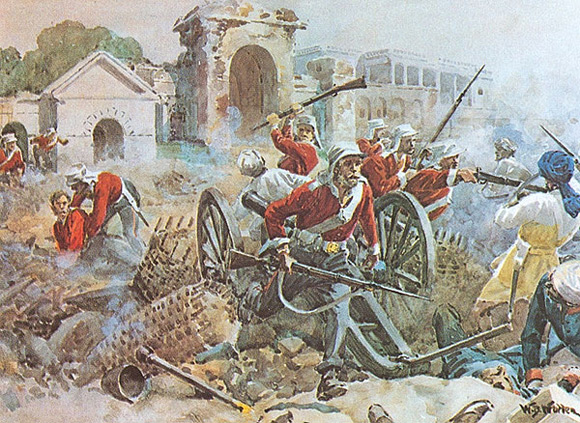
Captain Bernard McCabe – shot through the lungs. Died of wounds, 1st October.
A most indefatigable man, Captain Bernard McCabe had won the admiration of everyone during the Siege of Lucknow. An officer promoted from the ranks, he had started his career in the 31st Regiment in 1839 and shortly after, arrived in India. He would see service in Afghanistan in 1842 under General Pollock, then the 1845-46 Sutlej Campaign, including the battles of Moodkee, Ferozeshah, Buddiwal, Aliwal and Sobraon. It was the last battle – Sobroan, on the 10th of February, 1846, that paved his way to rise through the ranks.
With both of the officers carrying the Colours, dead, Sergeant McCabe took up the Colours and carried them to the top of the Sikh Army ramparts, inspiring the men of his regiment to go over and through the defences. For his gallantry, McCabe A was awarded a commission in the 18th Royal Irish Regiment, and with them went to Hong Kong taking part in an action to protect British interests in Canton. He returned to India, in April 1849 and transferred on promotion to Lieutenant to the 32nd Regiment. 1857 found McCabe with the 32nd in Lucknow.
During the siege, McCabe was noted as being “continually bobbing about…” encouraging men, holding them steadfast in battle and volunteering for arduous sorties outside the entrenchments. He was a man of tireless energy and imagination. During an attack on the Residency, McCabe was ordered to send men to a post more hard-pressed than his, as reinforcements. He had none to send but went himself.
“The gallant McCabe was equal to the occasion. He had recourse to a ruse which succeded admirably. We made such a hubbub in running to the help of our comrades, the officer shouted, “No. 1 will advance, No. 2 support and No. 3 reserve. Charge!” as loud as he could, which had the desired effect.” (Metcalfe)
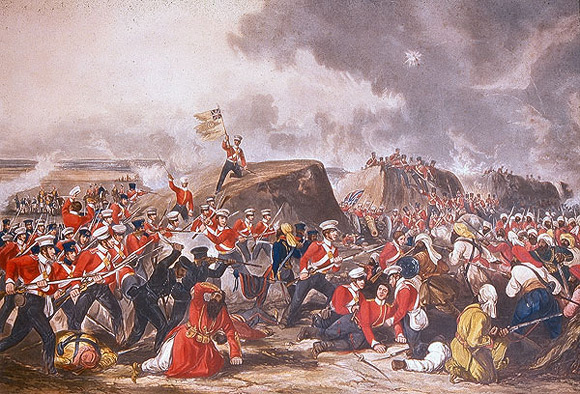
McCabe had been involved in the sorties on the 26th and the 27th of September – the 29th, despite Inglis’ protests, he took with this usual calm, little realising that in two days he would be one of the illustrious dead of the 32nd Regiment at Lucknow.
Lieutenant John Edmonstone – wounded. It was his third wound since the beginning of the siege. Colour Sergeant Thomas Purtill – wounded
Drummer James Grimes – killed in action
64th Foot
Private Thomas McGrath – killed in action
Private Sutherland, Robert- dangerously wounded in left thigh. Leg amputated. Died of wounds.
78th Highlanders
Sergeant James Young – severely wounded at Brigade Mess
Private David Rewitt – dangerously wounded. Died of wounds, 9th October
84th Foot
Private George Axson – killed in action
Calagee, John – missing in action
Cronin, Cornelius – wounded
O’Neal, Richard – killed in action
Shackleton, Thomas – missing in action
Woodhead, Henry – missing in action
Madras Fusiliers (“Neill’s Blue Caps” Vol II)
Sergeant Drury – killed in action
Privates Peard and Snowden – killed in action
Private McGill – wounded
Privates Parker and Young died of their wounds
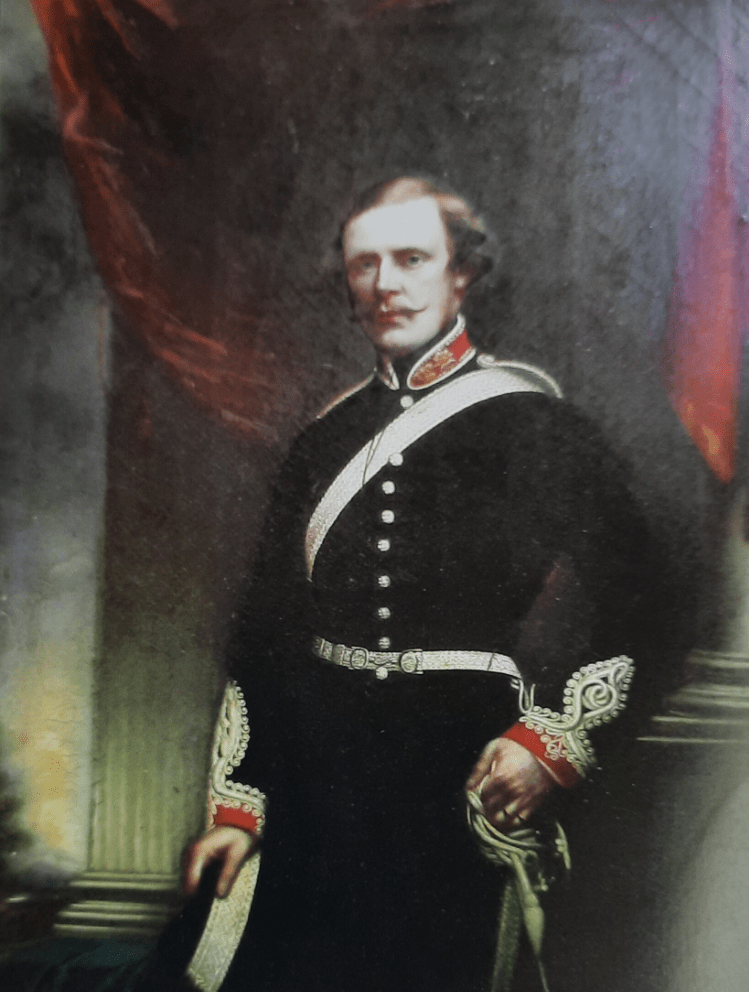
Killed – Gentleman Volunteer, Mr. Fitzherbert Dacre Lucas – a traveller and speculator and a gentleman of fortune. Lucas had come to India more for pleasure than on business and when the mutiny broke out he found himself in Lucknow. Having formerly been a captain of the SouthTipperary Militia, he volunteered his services to Sir Henry Lawrence and subsequently found himself in constant employ at Gubbins’ House with 6 other officers. Of these, three were killed and three severely wounded, leaving Lucas the last of the original defenders at the post. His gallantry and coolness under fire soon became very conspicuous – wherever danger reared its head, Lucas could be found at the head of the volunteers, always ready to face it. On the 29th of September, he had returned safely to the Residency but left again to assist in the bringing in of one of the guns. Lucas was shot just outside the Bailey Guard Gate and died a day later of his wounds. He was the third son of the Right Honourable E. Lucas, of Castle Shane, Monaghan, Ireland. Lucas was 34 at the time of his death. He left behind a widow in Ireland, Laura Adelaide (née Scudamore) and a young son, Edward (aged 4) who would become, in later life a colonel in the 4th Battalion, King’s Shropshire Light Infantry.
His brother, Charles Pierpoint Lucas, born in 1825 served in the 47th Bengal Native Infantry.
https://www.castleshanehistory.ie/lucas-becomes-lucas-scudamore
However not all the events of the 29th ended sadly – one took a surprising turn.
On this day one of the Madras Fusiliers was saved from the most dangerous position imaginable, and the most horrible of all deaths. On the afternoon of the 26th, he had been suddenly cut off from the sortie party which he had accompanied. To return to the Residency was impossible — a considerable force of the enemy having taken up a position between him and his comrades, and he, therefore, thought the best plan was to escape into a house and endeavour to return at light. But the house, too, was occupied, and unwilling to fall alive into the hands of the insurgents, he threw himself in a well. Fortunately, it was a dry one. Near him lay the dead body of a native that had been thrown into it. For nearly three days and two nights, the poor fellow remained concealed there. The pestilential atmosphere of the cistern was horrible to bear, and he could only at night venture out to breathe a little fresh air. He had nothing to eat or to drink, and hope almost began to desert him when the shouts of our men gave him notice of their approach. He emerged from his hiding place to the great astonishment of ‘our men, who were about to shoot him for an insurgent, so filthy and black had he become when he was recognised and saved.” (Rees)
On the 30th of September, Captains Lousda Barrow and Hardinge, commanding a small number of volunteers and the Sikh Cavalry, slipped out of the Residency at night on Outram’s orders. Concerned by the lack of fodder for their horses within the Residency grounds, it was considered prudent to send the cavalry back to the Alam Bagh. Unfortunately, they were stopped on the road by the heavy firing of the rebels and were forced to retrace their steps. According to Gubbins, it was later ascertained the firing had not been from the insurgents after all, but from one of the lately gained outposts. Another attempt was not made and the cavalry was forced to watch their horses slowly starving over the next 2 months as they tried to feed them on the smallest possible grain ration – grass was only procurable at great personal risk to the cutters as they were a favourite target of the insurgents. As for the horses, they would survive the siege but would resort to chewing each other’s tails off from hunger.
Thus ended the month of September. Havelock and Outram would remain besieged in the Residency, the position greatly advanced by the capture of the Tehri Koti, Farhat Baksh Palace and the Chattar Manzil. However, the Alam Bagh and the small detachment left there would be cut off from the Residency and it would be another 2 months before Lucknow was finally relieved.
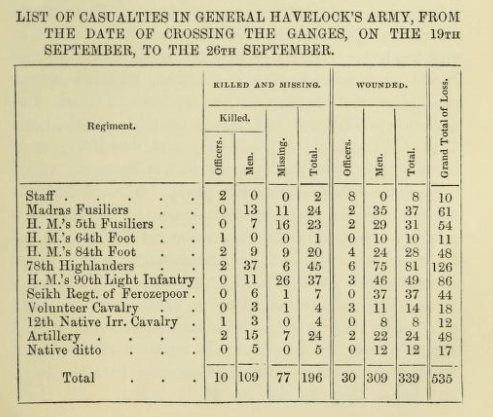
As for the Lucknow Garrison, they had started the siege 1’692 strong. By the 25th of September, the number was reduced to 979 – 577 Europeans and 402 Indians. The number included the sick and the wounded.
It was also the end of Havelock’s Campaign. He had surrendered his command to Outram at the gates of the Residency.
By all accounts, a bittersweet victory.
Sources
Accounts and Papers: East India. 1861. Vol. 43, Command No. 2878. London: House of Commons Parliamentary Papers.
Cromb, James. The Highland Brigade: Its Battles and Its Heroes. Edited by David L. Cromb. Stirling: Eneas Mackay, 1902.
Delavoye, Alex. M. Records of the 90th Regiment (Perthshire Light Infantry), with Roll of Officers from 1795 to 1880. London: Richardson & Co., 1880.
Forrest, G. W., ed. Selections from the Letters, Despatches and Other State Papers Preserved in the Military Department of the Government of India, 1857-58. Vol. 2, Lucknow, Cawnpore. Calcutta: Military Department Press, 1902.
Gubbins, Martin Richard. An Account of the Mutinies in Oudh, and of the Siege of the Lucknow Residency. London: Richard Bentley, 1858.
Hervey, Charles. Lieutenant General Crommelin, C.B., Royal (Bengal) Engineers: A Memoir and a Retrospect. Exeter: Printed by W. Pollard, 1887.
Home, Anthony Dickson. Service Memories. Edited by Charles H. Melville. London: Edward Arnold, 1912.
Inglis, Julia Selina. The Siege of Lucknow: A Diary. London: James R. Osgood, McIlvaine & Co., 1892.
Johnson, W. T. Twelve Years of a Soldier’s Life: From the Letters of Major W. T. Johnson. Edited by his Widow. London: A. D. Innes & Company, 1897.
Marshman, John Clark. Memoirs of Major-General Sir Henry Havelock, K.C.B. London: Longmans, Green, and Co., 1909.
Maude, Francis Cornwallis. Memories of the Mutiny. 2 vols. London: Remington & Co., 1894.
Metcalfe, Henry. The Chronicle of Private Henry Metcalfe, H.M. 32nd Regiment of Foot. Edited by Francis Tucker. London: Cassell & Co., 1953.
My Journal, or What I Did and Saw Between the 9th June and 25th November, 1857: With an Account of General Havelock’s March from Allahabad to Lucknow. By a Volunteer [Volunteer Cavalry under Captain Lousada Barrow]. Calcutta: Baptist Mission Press, 1858.
Napier, H. D. Field Marshal Lord Napier of Magdala: A Memoir. London: Edward Arnold & Co., 1927.
North, Charles Napier. Journal of an English Officer in India. London: Hurst and Blackett, 1858.
Outram’s Campaign in India, 1857-1858: Comprising General Orders and Despatches Relating to the Defence and Relief of the Lucknow Residency. London: Printed for Private Circulation, 1860.
Rees, L. E. Ruutz. A Personal Narrative of the Siege of Lucknow, from Its Commencement to Its Relief by Sir Colin Campbell. London: Longman, Brown, Green, Longmans, & Roberts, 1858.
Tavender, I. T., comp. Casualty Roll for the Indian Mutiny, 1857-59. Polstead, Suffolk: J. B. Hayward & Son, 1983.
Williamson, George. Military Surgery. London: John Churchill, 1863.
Wylly, H. C. Neill’s “Blue Caps.” Vol. 2, 1826-1914. London: Gale & Polden, 1923.
Links
https://glosters.tripod.com/
https://www.memorialsinportsmouth.co.uk/churches/royal_garrison/rugbeians2.htm
https://www.ramcassociation.org.uk/all-tagger/78th-highlanders-regiment-of-foot#gazette-entry
https://fibis.ourarchives.online/bin/aps_browse_sources.php?mode=browse_dataset&id=1992&s_id=1070&sort=0&st=1020&np=48&tn=1437
https://www.jstor.org/stable/26876125
 Mutiny Reflections
This is some history you are compiling here. And what stories. And – for me – listing to the names adds emotional reality to this. All those names. I can only imagine who thy were and why they enlisted and what their other options in life were. When mindless idiots bang on about imperialism and colonisation I know they have no idea. The truth, the facts, the history are always way more complicated than the ideology would ever allow for.
LikeLiked by 1 person
Richard Holmes wrote an incredible book called Redcoat that left quite an impression on me as it went into the lives of the men and boys who enlisted. Many did so from desperation, fleeing poverty and starvation. For the most part, they were not educated, many would not have known where they were going. Their lives in many cases were short, rough and brutal. But they were soldiers, and belonged to one of the most disciplined armies in the world. Terrible things were asked of them and they did their duty and died for it. We honor the men of WWI and WWII but we forget the men in unfashionable wars. But every one of those names was someones son too. Writing these returns is quite emotionally draining. I also want people to see the battles that is why I put the details of animals, of wounds and destruction. No one marched in and simply took over. The history, as you say is far more complicated and in all the blabbering about imperialism people no longer see the forest for the trees. Thank you for reading!!
LikeLiked by 1 person