26th September
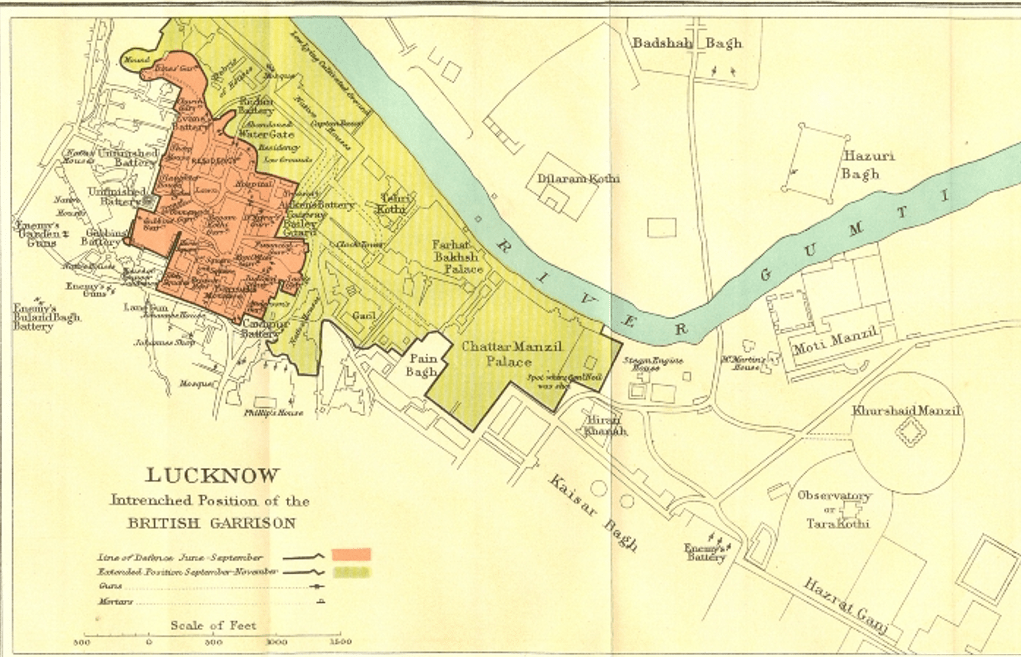
The rear guard had been left under Colonel Campbell of the 90th with two heavy guns at the Moti Manzil, to aid the advance of the 78th Highlanders. The Highlanders, however, took a different route and managed to rejoin the main column, unbeknownst to Campbell. Campbell was completely invested and besieged at the palace but fortunately, he was not forgotten. It fell to Napier, with 100 men and some spare bullocks to provide the much-needed guard. Napier volunteered for the task and managed to reach the Moti Manzil – instead of taking the road taken to reach the Residency on the 25th, he opted for another carriage road, which led through a series of palaces, each of which would subsequently occupied.
As soon as it was dark, Napier left a party at the Moti Manzil to keep communication open by holding a post in the grounds and then sent all the wounded via the river route across the Goomti, along with the camels and Enfield ammunition. He then replaced all the wounded gun bullocks with those he had brought with him. In all, there were thirty guns and waggons in all which soon became entangled in the narrow lane out of the palace. Napier ordered the rear-guard to keep up a steady fire – a deception for the rebels – “and in the quiet, comparative, of the night, when my force divided into advance and rear-guard of 200 and 150 and flankers of 100 each, we emerged from our prison.”
The column had to make its way first through a jungly garden before crossing over a bridge, which during daylight hours, would have been impossible to cross for the rebels keeping a close watch on it. The rear guard continued to exchange shots with the rebels as Napier tried to coax the column to move. The 24-pounder stuck “and there was a check, and visions of the approaching daylight finding us all drawn out on that line of danger and death flashed up on me.” Napier scrambled back to the rear to see what he could do to get the gun moving again – but it was caught up in a prickly hedge by its gun wheels. Napier left his horse behind and got through the waggons, only to find, when he reached the gun, it had started moving again. He quickly hopped onto one of the waggons until he reached his horse.
“No sooner had I done so than the heaps on which I trod began to cry out, “Sahib, zakhma, zakhma.” (Sahib, wounded, wounded). It made my flesh creep. I tried to be as soft as I could until we cleared the jungle, when I got down, crept through the waggons to the front and led the way into the palaces between the enemy’s post from which, if they had been prepared, we should have suffered terribly.”
It would take another four days for Napier to get the guns through the palaces and into the Lucknow Residency.
Staff
Captain Andrew Becher – A. A. G. dangerously wounded. Died of wounds, 9th October. Attached to HM 90th Foot.
Orr, Alexander -Intelligence Department, slightly wounded
1st Battalion 5th Foot
Captain Ferdinand William L’Estrange – Dangerously wounded. Died of wounds, 30th October.
The son of Torriano Francis L’Estrange, Esq., of Lynn, County Westmeath and grandson of Lieutenant General L’Estrange of Larkfield and Lieutenant Colonel Darby of Bath, Somerset, England. Baptised on 7 Jun 1826 at Walcot, Somerset, England. Cadet at the Royal Military College, Sandhurst and commissioned into the 5th Foot on 27 Dec 1842. He was promoted to Lieutenant on the 9th of January 1846, to Captain on the 7th of March 1851. He landed at Calcutta in 1857 from the China expedition. He commanded a small detachment of his Regiment which effected the relief of Arrah on the 3rd of August 1857. He was then involved in the relief of Lucknow but he was wounded on 26 Sep 1857. He died of his wounds on the 30th of October 1857.
Sergeant W. Kett – slightly wounded
Corporal B, McManus, B. – wounded
Drummer W, Morgan – wounded
Privates
Banham, S, – wounded
Clements W.- slightly wounded
Curran, P,. missing in action
Hill, D.- severely wounded
Johnson, J,. killed in action
Keenahan, P . killed in action
McManus, Peter – wounded
Wakefield, J.- killed in action
Wilson, J.- severely wounded
Hospital Apprentice J.Harris – wounded
32nd Foot
Although the 32nd was not in the march to Lucknow under Havelock and Outram, they were in the Residency (along with men of the 84th) and were put to duty by Outram who had taken over all operations at the Residency, with Brigadier Inglis remaining in command of the garrison itself in lieu of General Neill. They were thus employed in sorties outside the Residency compound.
Captain Edmond Lotbiniere de le Jol(l)y – dangerously wounded (attached 90th Foot). Died of wounds 29th September. He had been on leave when the mutiny broke out and joined Havelock’s force in order to rejoin his regiment at Lucknow. For a small insight into the character of Jolly we have the account of Private Robert Waterfield who had served with the 32nd until the beginning of 1857 :
“We had a young officer named Jolly (sic) of French Armenian descent and as conceited a little fop as ever carried Her Majesty’s Swords. This young Subaltern must needs act the tyrant…” However, not everyone despised Joly quite as much as Waterfield. By others, he was described as a brave, young officer, who, while on leave, had volunteered for service in Crimea with the Buffs and Connaught Rangers, was at the attack on the Quarries and at the assault on the Redan. He met his end at Lucknow, like so many men of his regiment.
Lieutenant Pelham C. Webb – killed in action
Corporal Thomas Vernon – killed in action
Privates
Burlow – killed in action
John Burton – killed in action
Anthony Carroll – killed in action
Reilly, Patrick – wounded
78th Highlanders
Captain Robert Bogle – wounded. Died of wounds, 19th October – brother of Lieut.A.C.Bogle, VC.
Corporal John Borthwick – dangerously wounded. Died of wounds
Privates
Cole, Joseph – killed in action
Somerville, James – killed in action
90th Foot
Colonel Robert Parker Campbell – severely wounded. He won his C.B. at Crimea, and was “a very intelligent and capable, as well as a brave officer.” (Maude). He died of his wound at the Residency.
On the 25th of September, Campbell had his horse shot under him and a bullet which would have been his death, was stopped by a small book called “Pietas and Altar” which belonged to his wife and Campbell was in the habit of carrying it in his front pocket. The book took the brunt of the shot.
The next day, while superintending the passage of a 24-pounder through a narrow gateway out of the Moti Mahal, where he and 100 men of the 90th had been forced to spend the night, he was wounded by a ball below the knee. Campbell lingered on in pain and suffering until his death at the Residency on the 11th of November. He was 37 years old.
He had entered the service in 1837 as an ensign in the 73rd Regiment. He saw action in the Kaffir War 1850-1853 (also called the Xhosa Wars or Cape Front Wars – a series of 9 wars which raged from 1779 to 1879 in what is now the Eastern Cape, South Africa ) under Sir Henry Smith and earned himself a brevet majority. In June 1854, he exchanged from the 73ed to the 90th and accompanied the regiment to Crimea. He was present in all the operations before Sebastopol and was present at the assault of the Redan. Numerously mentioned in dispatches, Campbell was nominated for CB and promoted to the rank of Colonel for distinguished services in the field. At the end of the Crimean War, he returned to England with the 90th.
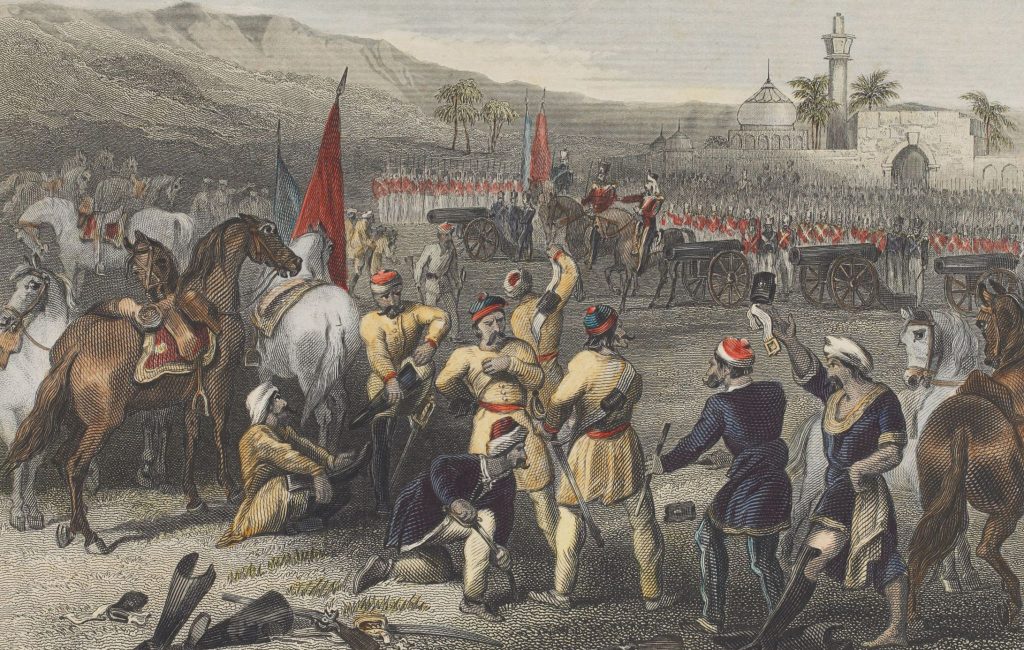
No sooner had the 90th managed to recruit for their diminished ranks, than the regiment was ordered for service in China. At Singapore, the news of the Sepoy Mutiny and change of orders thus, saw the 90th proceed to Bengal. The regiment arrived in Calcutta and proceeded by the steamers Mirzapore and the Calcutta to Berhampore to disarm the 11th Irregular Cavalry and the 63rd BNI. Colonel Campbell landed his men at four in the afternoon and immediately proceeded to the lines of the 63rd. Dividing his men into three columns to surround any of the 63rd who might have considered fleeing, he ordered the native regiment to pile arms. They reluctantly obeyed. Then, he marched to the lines of the 11th Irregular Cavalry. Upon being called to pile arms, the cavalry attempted to push their way through the 90th – but realising they would have a bad time of it, they consented to “obey the order with a very bad grace, many of them flinging their arms up into the air, and evincing the utmost dissatisfaction.” For good measure, Campbell deprived them of their horses as well, before turning command of the station back to the resident.
Back on the steamers, the regiment proceeded to Allahabad where he joined Sir James Outram, and set off on his last fight at Lucknow.
Assistant Sergeant William Bradshaw – slightly wounded
While Surgeon Holmes remained entrapped in the Moti Mahal and subsequently had to fight his way through the next 2 days, William Bradshaw fortuitously managed to reach the Residency with 20 doolie bearers, using not the main road but a side one which led through the river.
Private T. Kilcannon – killed in action
1st Madras Fusiliers
Sergeant John Finlayson -severely wounded in left eye. Attached to the Bengal Artillery
Corporal John English – severely wounded in right leg. Leg amputated. Died of wounds on the 6th of October. Attached to the Bengal Artillery.
Lance-Corporal John Moore – attached to the Bengal Artillery, killed in action
Privates
Chaplin, William – slightly wounded. Attached to the Bengal Artillery.
Glassford, William – severely wounded in left hand
Healy, Patrick – contusion to left side of head.
Hillary, Joseph – killed in action
Matthew, Frederick – slightly wounded. Wounded again on the 16th of October. Died of wounds on the 27th of October.
Sadlier, William – dangerously wounded in left leg. Leg amputated
Simpson, Robert – severely wounded in right hand
White, John – flesh wound in right arm. Attached to the Bengal Artillery
30th BNI
Captain David Scott Dodgson (attached 90th Foot) – wounded.
Royal Artillery
Sergeant Thomas Lowe, wounded
Bengal Field Artillery
Lieutenant J. McK. Fraser – slightly wounded
Asst. Surg. R.H. Bartrum – killed in action
Bengal Horse Artillery
Gunner James Williams – dangerously wounded. Died of wounds, 27th September.
Bengal Engineers
Captain W Crommelin – Chief Engineer Bengal Field Force – slightly wounded
Oudh Irregular Cavalry
Captain W.H. Hawes – severely wounded
Madras Artillery
Lieutenant C.W. Crump -killed in action
On the 26th of September, Outram had telegraphed to Sir Colin Campbell the following message
“The insurgents are too strong to admit withdrawing the garrison. The sick, wounded, women and children amount to upwards of 1000. The force will retire, therefore, after making arrangements for the safety of the garrison, by strengthening it with all but four of our guns, and leaving the 90th Regiment; destroying the enemy’s works; exploding all six mines which we have found since our access to the interior, and disturbing the ground in front of each work as to render further mining a difficulty, and demolishing the houses in the neighbourhood which command the entrenchments. The remainder of our force will make its way back to Cawnpore, and will leave in two or three days hence…”
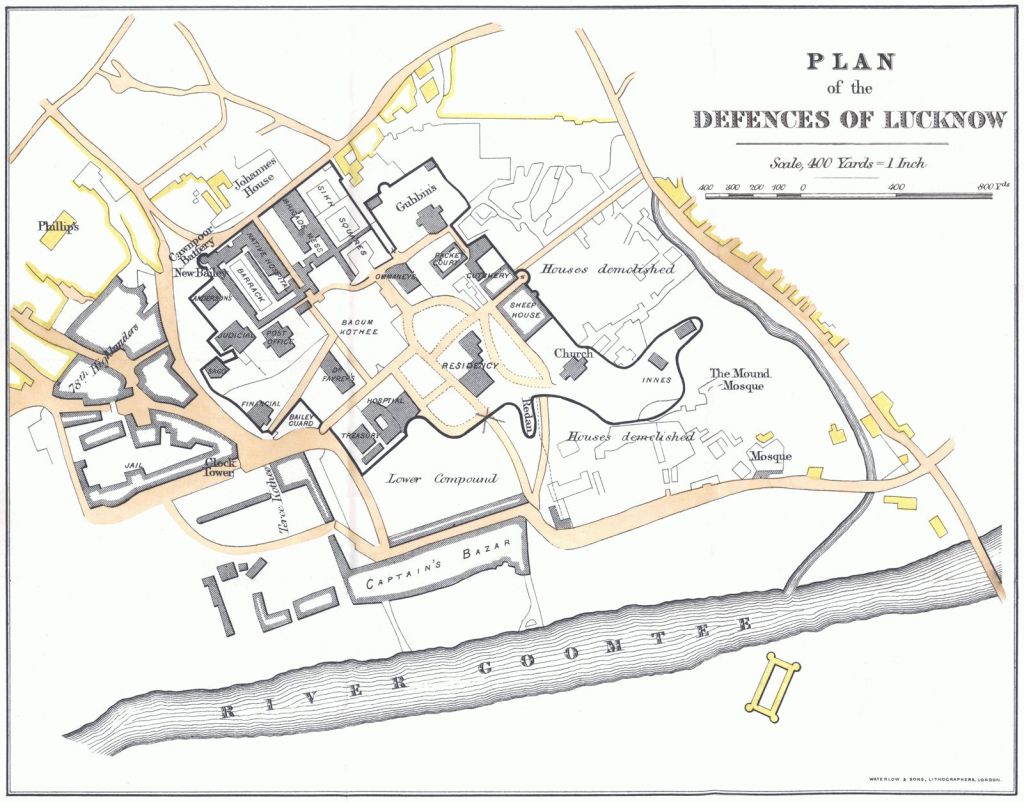
Early that day, 150 men of the 32nd under the command of Major Edward Lowe sallied out of the Residency towards Captain’s Bazar to clear not only it but the adjoining posts, all occupied by the rebels. The force was split into three groups with the other parties under Captain Bassano and Lieutenant Samuel Hill Lawrence. They managed to capture several guns, spiking those they could not remove, and destroying what powder they found, thus capturing another position for the Residency. Lowe had his own version of events.
” I was sent out with a good party of the 32nd, to take some enemy’s guns and clear neighbouring streets, we stalked through some high Castor Oil bushes and came down on the enemy, who ran off double quick to the rive, most of them either shot or drowned crossing. We got 2 large guns and 3 or 4 smaller things, and after seeing a few more fellows killed in another place, came in. I soon after received an order that I was to go out with as many men as I could collect with the Sikhs and 50 of the 78th to bring in the heavy guns and baggage. We had an uncommonly unpleasant day of it, they go jammed up in a road between two walls and were exposed to fire whenever anyone showed himself and round sot were being sent into the house men were put into for the day. What rendered it more mortifying was that the brutes fired at us out of our old mess house and my quarters.”
Gentleman Volunteer, Mr. Sinclair of the original Lucknow Garrison accompanied Lowe on his sortie. He had scarcely recovered from his previous wound when he received another in the arm.
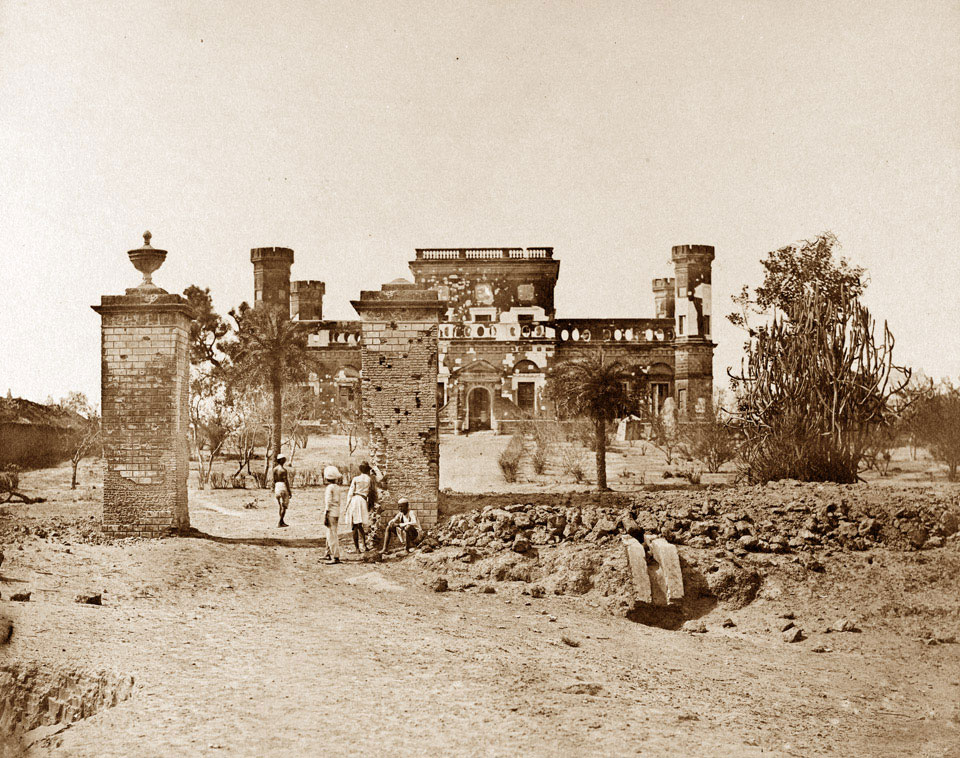
By the end of the 26th of September, the Residency position had been extended to include the Farheed Baksh Palace and the Teri Koti – both were subsequently formed into new entrenchments.
 Mutiny Reflections
This is some history you are compiling here. And what stories. And – for me – listing to the names adds emotional reality to this. All those names. I can only imagine who thy were and why they enlisted and what their other options in life were. When mindless idiots bang on about imperialism and colonisation I know they have no idea. The truth, the facts, the history are always way more complicated than the ideology would ever allow for.
LikeLiked by 1 person
Richard Holmes wrote an incredible book called Redcoat that left quite an impression on me as it went into the lives of the men and boys who enlisted. Many did so from desperation, fleeing poverty and starvation. For the most part, they were not educated, many would not have known where they were going. Their lives in many cases were short, rough and brutal. But they were soldiers, and belonged to one of the most disciplined armies in the world. Terrible things were asked of them and they did their duty and died for it. We honor the men of WWI and WWII but we forget the men in unfashionable wars. But every one of those names was someones son too. Writing these returns is quite emotionally draining. I also want people to see the battles that is why I put the details of animals, of wounds and destruction. No one marched in and simply took over. The history, as you say is far more complicated and in all the blabbering about imperialism people no longer see the forest for the trees. Thank you for reading!!
LikeLiked by 1 person